
Functional English Grammar: What It Is, How to Learn It, and How to Ace Your English Grammar Test
Master functional english grammar with real examples, study tips, and practice quizzes. Prep for any english grammar test today! 📚

If you have ever struggled to understand why a sentence sounds wrong even though you can't pinpoint the rule, you have already encountered the core challenge of functional english grammar. Unlike memorizing a list of definitions, functional grammar focuses on how language actually works in real communication — how words, phrases, and clauses combine to convey meaning, establish relationships, and express intent. Preparing for an what is grammar in english language assessment means going beyond surface rules and understanding the purpose behind every structural choice you make.
Functional English grammar is a framework developed largely by linguist M.A.K. Halliday. It asks not just "what is this word's part of speech?" but "what job is this word doing right now in this sentence?" A noun can be a subject, an object, a complement, or an appositive — and each role changes how the reader or listener interprets its meaning. Understanding these roles gives you the analytical depth needed to excel on any formal english grammar assessment test, from high school placement exams to professional certification evaluations.
Many learners ask "what is english grammar" as if it were a single, monolithic set of rules. In reality, English grammar operates on multiple levels simultaneously: phonological patterns shape how words sound, morphological rules govern how words are built from smaller units, syntactic principles determine word order, and semantic conventions control meaning. Functional grammar integrates all of these layers by grounding them in communicative purpose, making it one of the most holistic approaches to language study available today.
One reason functional grammar is so valuable for test preparation is that english grammar test questions rarely test isolated rules. Instead, they present you with complete sentences and ask you to identify errors, choose better alternatives, or explain why one option is more effective. That kind of analytical reading requires exactly the skills that functional grammar builds: recognizing how every element of a sentence contributes to its overall meaning, tone, and clarity. Students who study grammar functionally tend to outperform those who only memorize rules.
Another dimension of functional english grammar involves understanding register — the level of formality appropriate to a given context. The same idea can be expressed formally ("The committee has reached a decision") or informally ("The group made up their minds"), and choosing correctly requires awareness of audience, purpose, and situation. Register sensitivity is frequently tested on both academic and professional english language grammar test formats, making it a high-value skill to develop during your preparation period.
This guide will walk you through the core concepts of functional english grammar, explain how they appear on standardized assessments, and give you practical strategies for building fluency and accuracy. Whether you are a native English speaker brushing up on formal conventions or an ESL learner working toward proficiency, the functional approach will help you see grammar not as a set of arbitrary restrictions but as a powerful toolkit for clear, effective communication.
By the end of this article, you will have a clear mental model of what functional grammar covers, how to study it efficiently, and how to apply it on test day. You will also find targeted practice quizzes, a checklist of essential skills, and answers to the most common questions learners ask about english grammar. Let's build that foundation right now.
Functional English Grammar by the Numbers

Core Concepts of Functional English Grammar
Functional grammar categorizes clauses by the process they describe: material (doing), mental (thinking/feeling), relational (being), verbal (saying), behavioral (behaving), and existential (existing). Identifying the process type tells you which roles participants play and why certain verb-subject combinations feel natural or awkward.
Every English clause divides into a Theme (what the sentence is about — typically the first element) and a Rheme (the new information being conveyed). Skilled writers manipulate theme-rheme structure to build cohesion and guide readers. Test questions on sentence order and paragraph coherence directly assess this skill.
Mood determines whether a clause is declarative, interrogative, or imperative. Modality expresses degrees of certainty, obligation, and possibility through modal verbs like might, should, must, and can. Both systems are heavily tested in grammar assessments and are essential for formal academic and professional writing contexts.
Cohesion refers to the grammatical and lexical links between sentences — pronouns, conjunctions, repeated key words, and substitution. Coherence is the logical unity of ideas across a passage. Together they determine whether a text reads as a unified whole. Many editing and revision questions on grammar tests specifically target cohesion errors.
English typically moves from given (already known) information to new information within a sentence. Violating this pattern creates jarring, hard-to-follow prose. Functional grammar trains you to spot these violations and restructure sentences so that each new idea builds naturally on what came before, improving both clarity and test scores.
Understanding how the english grammar assessment test is structured is just as important as knowing grammar rules. Most formal assessments — from the ACT and SAT to TOEFL, IELTS, and workplace placement exams — do not simply ask you to recite definitions. They present you with authentic-style sentences, paragraphs, or essays and require you to identify errors, choose correct alternatives, or improve style and clarity. To succeed, you need both declarative knowledge (knowing the rule) and procedural knowledge (applying it quickly under time pressure).
The functional approach is especially useful here because it trains you to read holistically. When you see a sentence like "The committee, along with several advisors, have reached a decision," a rule-based learner might struggle because the word "advisors" is close to the verb and triggers a plural response.
A functional grammar learner recognizes that "committee" is the head noun (the participant in the relational process) and therefore controls subject-verb agreement, making "has" the correct form. That kind of clause-level analysis is what separates high scorers from average ones. You can test grammar english skills through structured practice that mimics the exact format of real assessments.
Many grammar tests also include questions about punctuation, which is deeply tied to syntactic function. Commas, semicolons, colons, and dashes each signal specific grammatical relationships between clauses and phrases. A functional grammar framework helps you see punctuation not as a set of arbitrary rules but as a system for marking boundaries between units of meaning. Once you understand that a semicolon joins two independent clauses of equal weight, for example, you will never misuse it as a fancy comma again.
Parallel structure is another major test category that functional grammar explains beautifully. When you list items in a series or create comparative constructions, each item must perform the same grammatical function. "She enjoys reading, hiking, and to swim" fails because "to swim" is an infinitive while the others are gerunds — all three should be either gerunds or infinitives. Functionally, the issue is that three elements holding the same slot in a clause structure must belong to the same grammatical category to signal equivalence clearly.
Pronoun reference and agreement questions appear on virtually every english language grammar test. Functional grammar helps here by reminding you to trace each pronoun back to its antecedent and verify that it agrees in number, gender, and case. Problems arise most often with indefinite pronouns ("everyone," "neither," "each"), collective nouns ("team," "jury"), and compound antecedents joined by "or" or "nor." A functional lens keeps your attention on the relationship between the pronoun and its referent rather than just the pronoun in isolation.
Modifier placement — another frequent test topic — is fundamentally a question of functional proximity. Modifiers must be placed as close as possible to the element they modify, and they must modify something that actually appears in the sentence. Dangling modifiers occur when the word a participial phrase is meant to modify is absent. Misplaced modifiers occur when ambiguity arises because the modifier is too far from its head. Both errors disrupt the functional relationship between sentence elements and produce unintended or confusing meanings.
Verb tense consistency is the final major category worth highlighting before we move to study strategies. Narratives, explanations, and arguments must maintain a consistent temporal framework so readers can track the sequence of events or ideas. Unnecessary tense shifts create confusion about what happened when. Functional grammar teaches you to see verb tense as part of a broader system of time reference that includes adverbials, aspect markers, and modal auxiliary verbs — not just a single isolated choice about past, present, or future.
How to Learn English Grammar: Three Proven Approaches
The functional method asks you to analyze every sentence in terms of what job each element is doing. Start by identifying the main verb (the process), then ask who is doing it (the participant), and finally note the circumstances (time, place, manner). Practice this with newspaper articles, academic paragraphs, and dialogue samples. Within two to three weeks of daily 20-minute sessions, most learners report a measurable improvement in their ability to spot errors and restructure awkward sentences on practice tests.
One concrete functional exercise is "clause mapping": take any complex sentence and draw a box around each clause, label its function (main, relative, adverbial, nominal), and identify how it connects to adjacent clauses. This visual habit forces you to see grammar as architecture rather than a list of isolated rules. Students who combine clause mapping with timed practice quizzes consistently outperform those who rely solely on rule memorization, because they can apply their knowledge flexibly under the time constraints of real tests.

Is English Grammar Hard to Learn? Honest Pros and Cons
- +English has no grammatical gender for nouns, eliminating a major source of confusion for speakers of Romance and Slavic languages
- +Word order in English is relatively fixed (SVO), which gives learners a reliable template for building sentences
- +Verb conjugation in English is simpler than in most European languages — only the third-person singular present adds an -s ending
- +Vast resources exist for every level: free apps, structured textbooks, online courses, and thousands of practice tests
- +Functional grammar frameworks make it possible to analyze any sentence systematically, even when memorized rules fall short
- +English grammar skills transfer directly to better writing, higher test scores, and stronger professional communication in every field
- −English spelling and pronunciation are notoriously inconsistent, making phonics-based grammar learning unreliable for many learners
- −Irregular verbs (go/went, be/was/were, buy/bought) must be memorized individually — there are over 200 common irregular forms
- −Articles (a, an, the) follow complex rules that depend on countability, definiteness, and context — a persistent challenge for speakers whose languages lack articles
- −Phrasal verbs (give up, turn down, look into) often cannot be decoded from their components and must be learned as vocabulary items
- −Formal written English differs substantially from spoken English, requiring learners to master two overlapping but distinct registers
- −Punctuation rules are subtle and context-dependent, and different style guides (APA, MLA, Chicago) sometimes contradict each other on specifics
Essential English Grammar Skills Checklist
- ✓Identify the subject and main verb of any clause, including those with inverted word order or intervening phrases
- ✓Apply subject-verb agreement rules correctly for collective nouns, indefinite pronouns, and compound subjects
- ✓Choose the correct pronoun case (nominative, objective, possessive) in every position in a sentence
- ✓Recognize and correct dangling and misplaced modifiers by repositioning phrases or rewriting the main clause
- ✓Maintain consistent verb tense within paragraphs and identify unjustified tense shifts in editing tasks
- ✓Use commas, semicolons, colons, and dashes correctly to signal grammatical relationships between clauses
- ✓Construct parallel series and comparisons in which all listed elements perform the same grammatical function
- ✓Distinguish between restrictive and non-restrictive relative clauses and punctuate them accordingly
- ✓Select correct prepositions in idiomatic expressions and distinguish commonly confused word pairs (affect/effect, lie/lay, who/whom)
- ✓Analyze a paragraph for cohesion, checking that pronouns have clear antecedents and transitions signal logical relationships
Functional Analysis Beats Rule Memorization on Timed Tests
Research on high-scoring test takers consistently shows that students who can identify a word's grammatical function in context — not just its part of speech in isolation — answer grammar questions 40% faster and with greater accuracy. When you train yourself to ask "what job is this word doing?" rather than "what category does it belong to?", you develop the flexible, rapid analysis that timed english grammar assessment tests reward most.
Reading and writing are the two most powerful laboratories for developing functional grammar competence. Reading exposes you to an enormous variety of sentence structures, clause combinations, and stylistic choices made by skilled writers. Writing forces you to make your own grammatical decisions actively and to discover the gaps in your knowledge when a sentence doesn't quite say what you intended. Together, these practices build the intuitive grammatical sense that separates proficient users from those who are still consciously applying rules one at a time.
When reading for grammar development, adopt an active stance. Don't just absorb meaning — notice structure. When a paragraph flows particularly smoothly, stop and ask what the writer did to create that effect. Look for how long and short sentences alternate, how transitional phrases signal relationships, how pronouns create chains of reference across multiple sentences. This kind of structural noticing is sometimes called "consciousness-raising," and it has strong empirical support as a method for accelerating grammar acquisition in both first and second language contexts.
One of the most effective reading-based exercises is sentence imitation. Choose a complex sentence from a quality source — a New York Times editorial, a published essay, a college-level textbook — and write your own sentence using exactly the same grammatical structure but different content. For example, if the model sentence is "Although the evidence remains preliminary, the findings suggest that regular grammar practice produces measurable gains in writing quality," your imitation might be "Although the deadline seems distant, the schedule shows that consistent daily review prevents last-minute cramming." Over time, complex structures become natural tools in your writing repertoire.
When it comes to writing practice, the most productive approach is to write first and edit second. Trying to apply grammar rules as you compose slows you down and disrupts your thinking. Instead, write a full draft focused on meaning and argument, then return with a functional grammar lens for revision. Ask yourself: Does every subject agree with its verb?
Does every pronoun have a clear, nearby antecedent? Are all modifying phrases attached to the right head words? Is punctuation marking the genuine boundaries between grammatical units? This two-pass approach mirrors the process of skilled writers and is directly applicable to test editing tasks.
Understanding what is of in english grammar — including prepositions and the relationships they signal — is another crucial area that reading and writing practice reinforce simultaneously. Prepositions like "of," "by," "in," "on," and "for" carry precise grammatical meanings that shift depending on context. "A change of policy" (possessive/partitive), "a woman of courage" (characterization), "a matter of time" (quantification) — the word "of" performs different functional roles in each phrase. Only extensive exposure to real text can internalize these distinctions deeply enough for reliable test performance.
Grammar journals are another underused tool for combining reading and writing practice. Keep a dedicated notebook where you record interesting or challenging sentences from your reading, along with your own analysis of their structure. Note the clause types, the relationships between elements, and any features that surprised you. Over a semester or a few months of preparation, this journal becomes a personalized grammar reference that reflects your specific strengths and weaknesses — far more useful than a generic textbook for targeted study.
Finally, peer review and revision are invaluable for grammar development in ways that solo study cannot replicate. When you explain a grammatical error to someone else — or when someone explains one to you — the social accountability and the need to articulate the rule out loud cement understanding at a much deeper level. Study groups, writing centers, and online grammar forums all provide this kind of collaborative feedback. Even reviewing AI-generated explanations with a critical eye can be productive, as long as you verify the reasoning against authoritative sources.
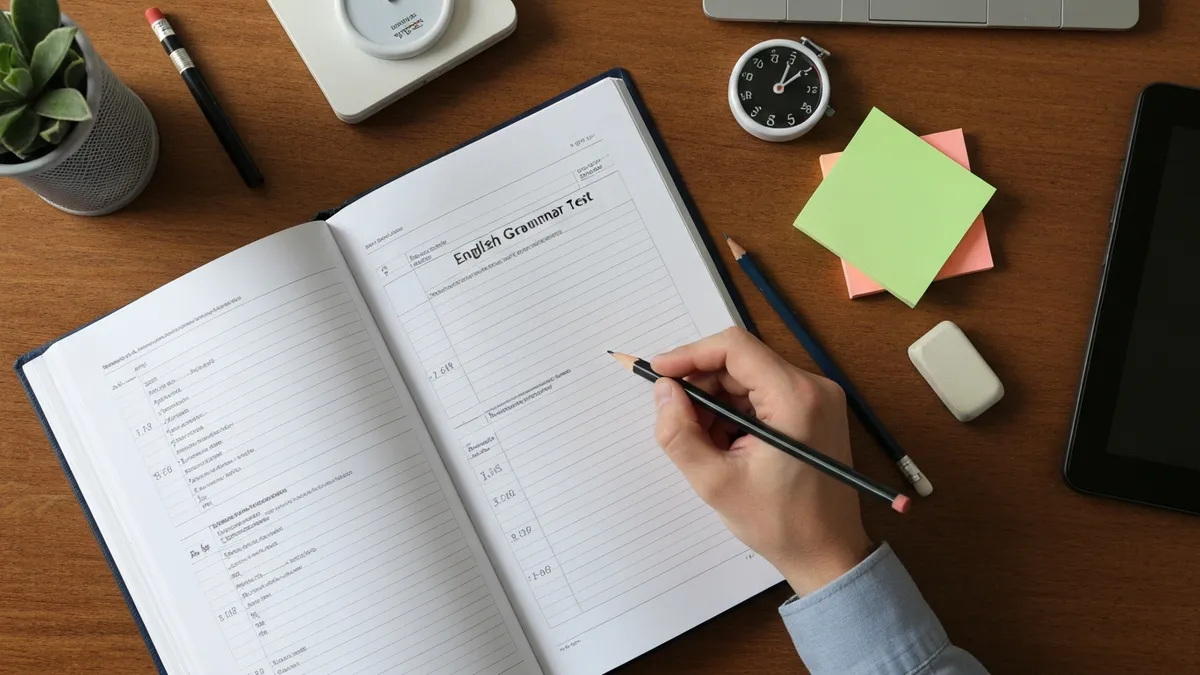
Many test-takers lose points not because they don't know the rules, but because they fall for deliberate distractors. Watch out for sentences where a plural noun appears between the subject and verb ("The list of requirements are posted" — the verb should be "is" because "list" is the subject). Also beware of sentences that sound awkward but are grammatically correct, especially formal constructions like subject-verb inversion or the subjunctive mood. Always identify the grammatical function of each element before choosing your answer.
Test-day success in any english grammar assessment test depends on both knowledge and strategy. You can know every rule in the book and still underperform if you mismanage your time, second-guess correct answers, or panic at unfamiliar sentence types. The strategies in this section are specifically designed for grammar test formats and are grounded in what high-scoring students actually do differently from average scorers. Apply them consistently in your practice sessions so they become automatic by test day.
The first strategy is process of elimination applied functionally. When you see a grammar question with four answer choices, your goal is not to find the one that "sounds right" but to identify the grammatical function each choice would perform and determine which function the sentence actually requires. Often two or three choices are clearly wrong for structural reasons, and the final decision between the remaining options becomes much more manageable. This approach is especially powerful for questions about pronoun case, verb form, and modifier placement.
The second strategy is reading the entire sentence — and often the surrounding sentences — before answering. Grammar questions frequently test coherence and consistency across sentence boundaries, not just correctness within a single sentence. A pronoun reference error, for example, requires you to identify the antecedent, which may appear in the previous sentence. A tense consistency error may not be visible without comparing the sentence in question to the temporal frame established earlier in the paragraph. Train yourself to never answer a grammar question in isolation without checking context.
Pacing is the third critical strategy. Most grammar tests allot approximately 30 to 45 seconds per question. If you find yourself spending more than a minute on a single question, mark it for review and move on. Spending three minutes on a difficult question while leaving three easy questions unanswered is a guaranteed net loss. In practice sessions, time yourself strictly and build the habit of making a decision — even an uncertain one — within the allotted time. You can always revisit flagged questions if time permits at the end of the section.
Understanding what is by in english grammar — including passive voice constructions, agent phrases, and the difference between active and passive clauses — will help you on tests that ask about clarity and directness in writing. Many test editing sections include passive-voice sentences where the active construction is clearly superior, and you need to recognize when the passive is unnecessarily wordy versus when it is the most appropriate choice for the context. Active voice is generally preferred in formal academic and professional writing unless the agent is unknown, unimportant, or intentionally withheld.
Elimination of "always" and "never" thinking is another hallmark of sophisticated test performance. Beginning grammar students often look for the rule that always applies, but english grammar test questions are designed to test your understanding of context, not your ability to apply blanket rules. "Don't use passive voice" is terrible advice on a test because sometimes passive voice is the right answer. "Never start a sentence with 'because'" is a myth — subordinate clauses can begin sentences perfectly correctly. Learn to evaluate each sentence on its own terms rather than running through a checklist of absolute prohibitions.
Finally, review your wrong answers thoroughly in every practice session. Most learners circle their score and move on, missing the most valuable part of practice: understanding exactly why each wrong answer was wrong and why each right answer was right. For every error, ask three questions: What was the grammatical issue? What rule or functional principle applies? How would I recognize this pattern faster next time? This deliberate error analysis, applied consistently over your preparation period, produces the most targeted and durable improvement in grammar test performance.
A well-rounded preparation plan combines functional grammar study, extensive reading, timed practice tests, and systematic error review. There is no single shortcut to grammar mastery, but the functional approach ensures that every hour of study builds transferable analytical skills — not just isolated facts that may or may not appear on your specific test. Consistency over six to twelve weeks of structured practice is what separates test-day confidence from test-day anxiety.
Practical tips for daily grammar improvement begin with the smallest sustainable habit: fifteen minutes of focused grammar reading every morning before you check your phone. Choose a high-quality source — a feature article from a respected publication, a chapter from a well-written nonfiction book, or a transcript from an academic lecture. As you read, keep a pencil in hand and underline any sentence whose structure you find interesting, challenging, or particularly clear. Over a week, you will accumulate a personal anthology of model sentences to analyze and imitate.
Flashcard systems work well for grammar items that truly must be memorized: irregular verb forms, idiomatic preposition pairings, commonly confused word pairs, and pronoun case rules. Digital spaced-repetition systems like Anki automatically schedule each card for review at the optimal moment before you forget it, making your memorization sessions dramatically more efficient than rereading lists. Spend no more than ten minutes per day on flashcards; the remainder of your study time should be spent applying grammar in context, not memorizing in isolation.
Grammar podcasts and instructional videos are excellent supplements for auditory learners who absorb explanations better through listening than reading. The key is to follow up each listening session with at least five minutes of writing that uses the concept you just heard explained. Passive consumption of grammar instruction — watching videos without practicing — produces minimal lasting improvement. The writing step forces you to retrieve the new knowledge and apply it, which is what actually builds long-term retention according to cognitive science research on the testing effect.
For learners asking "is english grammar hard to learn," the honest answer is: it depends heavily on your native language and your learning approach. Spanish and French speakers often find English grammar relatively accessible because of shared Latin-derived vocabulary and similar clause structures. Speakers of Mandarin, Arabic, or Japanese face steeper initial challenges because of fundamental typological differences. However, regardless of your starting point, consistent functional analysis practice levels the field considerably — because functional grammar gives every learner the same analytical tools to decode sentence structure systematically.
Vocabulary and grammar are more intertwined than most learners realize. Knowing that a word is a transitive verb tells you it requires a direct object; knowing that a word is an attributive-only adjective ("utter," "mere," "sheer") tells you it cannot follow a linking verb. Building a grammatically annotated vocabulary — where you learn not just what a word means but how it behaves syntactically — accelerates both grammar and vocabulary development simultaneously. When you encounter a new word, always note its part of speech, its typical collocations, and any structural restrictions on its use.
Mock tests under real conditions are the single most important component of test preparation in the final two weeks before your assessment. Set a timer for the exact length of the real test, sit in a quiet space without distractions, and work through a full practice test from start to finish without pausing. This trains the mental endurance needed to sustain focus throughout the test and reveals any time-management problems while there is still time to correct them. After the mock test, score it immediately and begin your error analysis session.
Remember that grammar improvement is cumulative — every practice session builds on the last, and progress that seems invisible in week two becomes unmistakable by week eight. Trust the process, prioritize consistency over intensity, and keep your focus on functional understanding rather than surface memorization.
The students who improve the most are not those who study the hardest in a single marathon session, but those who show up for focused, reflective practice day after day. That consistent discipline, combined with the functional grammar framework outlined in this guide, is your most reliable path to a strong performance on any english grammar test.
English Grammar Questions and Answers

English Grammar Practice Test PDF (Free Printable 2026)

ESL English Grammar Lessons: Complete Guide to Parts of Speech, Tenses, and Punctuation

English Grammar Answer Key: A Complete Guide to Understanding Grammar Tests and Assessments

ACT English Grammar Rules: Complete Guide to Mastering the English Grammar Test

English Grammar Sentences: A Complete Guide to Structure, Rules, and Practice
About the Author

Writing Expert & Communications Certification Educator
Columbia UniversityDr. Rebecca Foster holds a PhD in English Literature and an MFA in Creative Writing from Columbia University. She has 14 years of experience teaching academic writing, professional communications, and editorial skills at the university level. Rebecca coaches candidates through AP English, writing placement assessments, editing certifications, and communication skills examinations.