
English Grammar Online Test: What It Is, How to Prepare, and Why It Matters
Take a free english grammar online test and sharpen your skills. Practice tenses, articles, conditionals & more. 🎯 Start now!

An english grammar online test is one of the most effective tools available for anyone looking to assess, sharpen, or formally demonstrate their command of the English language.
Whether you are a student preparing for an academic entrance exam, a professional seeking to pass an english grammar assessment test for employment screening, or simply someone who wants to confirm that your writing is solid and accurate, a structured online test delivers immediate, objective feedback that self-study alone rarely provides. The format allows you to identify your weak spots, measure your progress, and focus your preparation time on the areas that matter most.
Understanding what is a particle in english grammar — along with dozens of other foundational concepts — is exactly the kind of knowledge these tests probe. Grammar tests are not merely about memorizing rules; they assess whether you can apply those rules instinctively and correctly in context. That distinction is crucial. You might know that subject and verb must agree in number, but can you spot the error in a complex sentence with an intervening prepositional phrase? Timed, question-based tests train your brain to make those judgments quickly and confidently.
English grammar is the backbone of clear, professional communication. Employers, universities, and licensing boards routinely include an english language grammar test as a gateway evaluation. Scores on these assessments influence hiring decisions, placement in academic programs, and eligibility for certifications. A high score signals not just technical skill but also the attention to detail and precision that are valued across virtually every career field, from nursing and law enforcement to business administration and education.
Many learners wonder: is english grammar hard to learn? The honest answer is that English grammar has layers. The foundational concepts — basic sentence structure, common verb tenses, standard punctuation — can be grasped relatively quickly with consistent practice. The advanced layers, however, including conditional moods, participial phrases, dangling modifiers, and the fine distinctions between articles, require deeper engagement and repeated exposure. A good online test system introduces questions at the right difficulty level to stretch your understanding without overwhelming you.
This article gives you a complete roadmap. We will explain what is english grammar in practical terms, break down the major topic areas covered on tests, share strategies for improving your score, and point you toward practice resources you can use right now. The goal is not just to help you pass an exam — it is to help you become a genuinely stronger communicator. Grammar is not a set of arbitrary rules; it is the shared system that makes precise, unambiguous communication possible between people, and mastering it is an investment that pays dividends for life.
We will also address common misconceptions. Many test-takers assume that grammar tests only ask about arcane technical rules that nobody actually uses in real writing. In reality, most english grammar test content focuses on practical correctness: subject-verb agreement, proper pronoun reference, effective use of punctuation, and consistent verb tense — precisely the skills that differentiate polished, professional writing from writing that undermines the author's credibility. By the end of this guide, you will know exactly what to study, how to practice, and how to approach test day with genuine confidence.
Finally, remember that grammar knowledge is cumulative. Each concept you master makes the next one easier to absorb. An online testing platform accelerates this process by giving you instant explanations, not just right-or-wrong verdicts. When you understand why an answer is correct, the underlying rule embeds itself far more durably than simple repetition ever could. Let's dive in and start building the grammar fluency you need.
English Grammar Testing by the Numbers
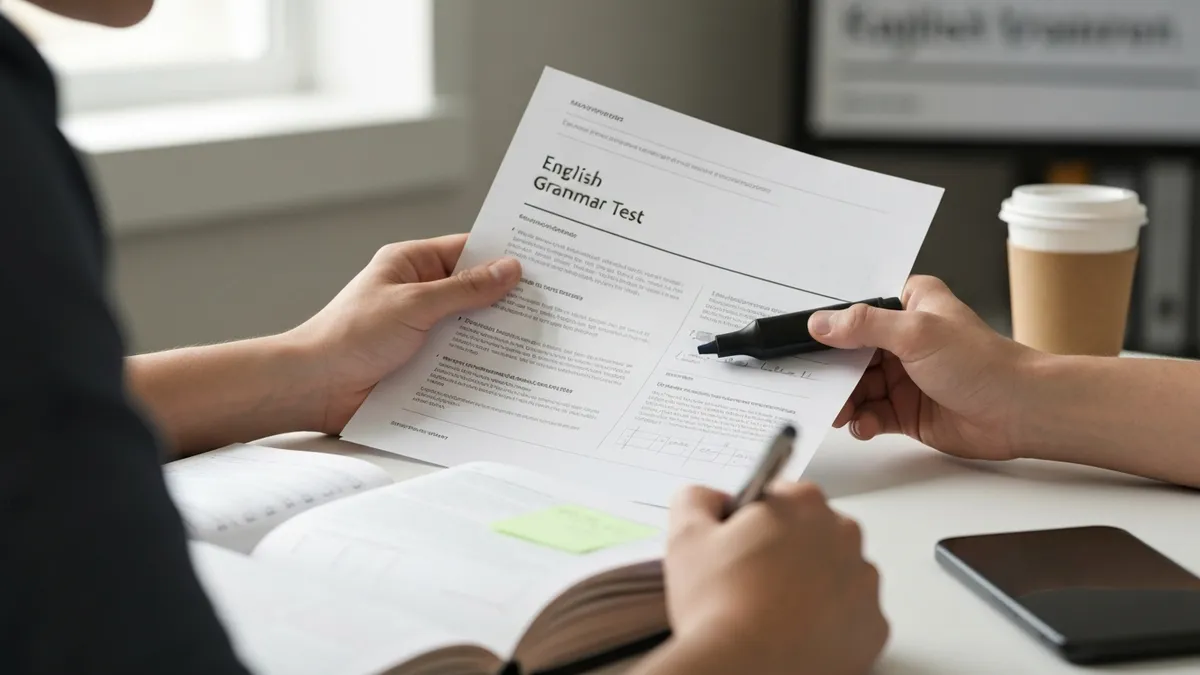
Major Grammar Topics Covered on English Grammar Tests
Tests evaluate your ability to construct grammatically complete sentences, identify fragments and run-ons, and correctly use subordinate clauses, compound structures, and parallel construction across a variety of sentence types.
Subject-verb agreement and proper tense sequencing are among the most frequently tested areas. Questions cover present, past, and perfect tenses, irregular verbs, and tricky agreement scenarios with collective nouns and indefinite pronouns.
Nouns, pronouns, verbs, adjectives, adverbs, prepositions, conjunctions, and articles each have distinct grammatical rules. Tests probe whether you can identify and correctly use each part of speech, including nuanced cases like particles and determiners.
Commas, semicolons, colons, apostrophes, and quotation marks are tested in context. Correct punctuation is essential for clarity, and errors here are among the most commonly flagged issues in professional writing assessments.
First, second, third, and mixed conditionals test your grasp of hypothetical and real situations. Subjunctive mood, often neglected in casual use, frequently appears on advanced grammar assessment tests and academic writing evaluations.
Once you have completed an english grammar assessment test, interpreting your results correctly is just as important as taking the test itself. Most modern online platforms break your score down by topic area, showing you exactly how many questions you answered correctly in each category — verb tenses, punctuation, sentence structure, and so on. This granular feedback is infinitely more useful than a single overall percentage, because it tells you precisely where to direct your study energy in the coming days and weeks.
Start by identifying your lowest-scoring categories. If you scored well on noun-pronoun agreement but struggled with conditional sentences, that imbalance tells you something specific: your foundational grammar is strong, but your understanding of hypothetical and complex tense structures needs reinforcement. Pull up a targeted lesson or practice set on that topic rather than reviewing everything from scratch. Focused, efficient remediation is the fastest path to measurable improvement on your next attempt.
Pay attention to the types of errors you made, not just the number of errors. Pattern recognition is key here. If you consistently chose the wrong answer when a sentence contained an intervening clause between the subject and verb, that is a clue about a specific cognitive gap — your brain may be defaulting to the nearest noun rather than identifying the true grammatical subject. Being aware of that specific tendency allows you to train against it consciously, which accelerates correction far more reliably than random review.
Review every wrong answer, not just your overall score. Most quality platforms provide detailed explanations for each question, spelling out the rule that applies and why the correct answer works while the distractors do not. Read these explanations carefully, even for questions you got right by guessing. Understanding the reasoning behind correct answers is what converts a lucky guess into a reliable skill that you can replicate consistently under real test conditions.
Consider timing as part of your analysis too. Did you run out of time on the final section? Did you feel rushed throughout? Timing data, where available, can reveal whether your pacing strategy needs adjustment. Most grammar tests are designed so that a well-prepared candidate can complete all questions within the allotted time, but that depends on answering routine questions quickly enough to preserve time for harder ones. Building automaticity through practice is the solution to timing pressure.
If you want to explore whether is english grammar hard to learn through structured worksheet practice, supplementing your online test with printable grammar drills can reinforce the same rules in a different modality, which helps cement learning more deeply. Writing answers by hand activates different cognitive pathways than clicking an online interface, and many learners find that switching between formats accelerates retention significantly.
Finally, set a target score before you begin a practice session and track your progress systematically over multiple test attempts. A simple log — date, test name, overall score, weakest category — gives you visible evidence of improvement that is deeply motivating. Grammar mastery is not an overnight achievement; it is a cumulative process. Tracking your trajectory helps you recognize genuine progress, even when individual sessions feel frustrating, and keeps your long-term preparation on a consistent forward path.
What Is English Grammar and Why Does It Matter on Tests?
At its core, what is english grammar can be answered simply: grammar is the system of rules that governs how words are combined to form meaningful sentences in the English language. It encompasses everything from the order in which words appear — syntax — to the way individual words change form to reflect tense, number, or function — morphology. Grammar is not a set of arbitrary prohibitions invented to make writing difficult; it is the shared code that allows speakers and writers to communicate with precision and predictability. When grammar is correct, meaning flows clearly. When it breaks down, misunderstanding follows almost immediately.
On an english grammar online test, questions are designed to measure how well you have internalized this system. A strong test includes items across multiple grammatical dimensions, from identifying parts of speech to correcting faulty parallelism in a compound sentence. Understanding what is the grammar in english — including the distinction between descriptive grammar, which describes how people actually speak, and prescriptive grammar, which defines formal written standards — helps test-takers understand why certain answers are marked correct even when an alternative might sound natural in casual conversation. Tests target prescriptive, formal-register grammar.

Pros and Cons of Taking an English Grammar Online Test
- +Instant feedback shows you exactly which grammar rules you have mastered and which need more work
- +Available 24/7 so you can practice at any time that fits your schedule, without scheduling or cost barriers
- +Adaptive question banks expose you to a wide variety of sentence types and error patterns
- +Timed test simulations build the speed and accuracy needed for real assessment conditions
- +Detailed answer explanations teach the underlying rule, not just the correct answer choice
- +Progress tracking across multiple sessions lets you visualize your improvement over time
- −Multiple-choice format does not replicate open-ended writing tasks required in some academic assessments
- −Internet dependency means practice is interrupted by connectivity issues or platform downtime
- −Some free platforms include low-quality or factually incorrect questions that can reinforce wrong rules
- −Screen fatigue becomes a real issue during long practice sessions, reducing concentration and accuracy
- −Automated scoring cannot evaluate nuanced stylistic choices the way a human instructor can
- −Over-reliance on testing without also reading and writing actively can create a narrow skill set
Pros and Cons at a Glance
| Pros | Cons |
|---|---|
| Instant feedback shows you exactly which grammar rules you have mastered and which need more work | Multiple-choice format does not replicate open-ended writing tasks required in some academic assessments |
| Adaptive question banks expose you to a wide variety of sentence types and error patterns | Internet dependency means practice is interrupted by connectivity issues or platform downtime |
| Timed test simulations build the speed and accuracy needed for real assessment conditions | Some free platforms include low-quality or factually incorrect questions that can reinforce wrong rules |
| Detailed answer explanations teach the underlying rule, not just the correct answer choice | Screen fatigue becomes a real issue during long practice sessions, reducing concentration and accuracy |
| Progress tracking across multiple sessions lets you visualize your improvement over time | Automated scoring cannot evaluate nuanced stylistic choices the way a human instructor can |
English Grammar Test Prep Checklist: 10 Steps to a Higher Score
- ✓Review all twelve English verb tenses and practice identifying them in context sentences
- ✓Study subject-verb agreement rules, including tricky cases with compound subjects and collective nouns
- ✓Learn the rules for comma usage, including comma splices and the Oxford comma in formal writing
- ✓Practice identifying and correcting dangling and misplaced modifiers in sample sentences
- ✓Understand the four types of conditionals and when each one is grammatically appropriate
- ✓Memorize the correct use of commonly confused words: affect/effect, who/whom, lay/lie, fewer/less
- ✓Take at least three full-length timed practice tests before your actual exam or assessment date
- ✓Review every incorrect answer with its explanation and retest yourself on those specific question types
- ✓Read one well-edited article or essay per day to internalize correct grammar patterns naturally
- ✓Focus the final week of preparation on your two weakest topic areas based on practice test data
The 80/20 Rule of Grammar Testing
Research on grammar assessment content shows that roughly 80% of all test questions focus on just five areas: subject-verb agreement, verb tense consistency, pronoun reference and case, comma usage, and parallel structure. Mastering these five domains before your test date gives you the highest possible return on your study time and positions you to score in the top tier of test-takers with focused, efficient preparation.
Advanced grammar concepts are the section where even otherwise strong writers begin to lose points on a formal english grammar online test. These are the areas where casual usage diverges most sharply from prescriptive written standards, and where test designers deliberately place the most challenging questions. Understanding these concepts thoroughly separates students who score in the 70th percentile from those who consistently hit the 90th percentile and above. The good news is that each of these concepts follows clear, learnable rules — they just require more deliberate attention than the basics.
Conditional sentences are a prime example. The three core conditionals — zero, first, second, and third — each describe a different relationship between condition and outcome.
The zero conditional describes universal truths: "Water boils if you heat it to 100 degrees Celsius." The first conditional covers real future possibilities: "If she studies, she will pass." The second conditional addresses unreal or hypothetical present situations: "If he were a doctor, he would understand the diagnosis." The third conditional describes unreal past scenarios: "If they had arrived earlier, they would have seen the opening act." Mixed conditionals combine elements of the second and third, and these are precisely the forms that trip up test-takers who have not studied them explicitly.
Particles represent another advanced area. What are particles in english grammar? A particle is a word that functions grammatically as a preposition or adverb but is so closely tied to a verb that it forms an inseparable unit, creating what linguists call a phrasal verb. In the sentence "She gave up the project," the word "up" is a particle — it cannot be moved the way a true preposition can.
Particles are tested because many test-takers confuse them with standalone prepositions, leading to errors in sentence rewriting and transformation questions. Recognizing phrasal verbs and understanding how particles behave is an important competency for advanced grammar assessments.
Subjunctive mood is another high-frequency advanced topic. The subjunctive is used to express wishes, hypotheticals, demands, and suggestions. "I wish he were here" uses the subjunctive; the indicative form "was" would be grammatically incorrect in formal writing. Similarly, "The committee requires that each member submit a report" uses the subjunctive form "submit" rather than "submits." Many native English speakers rarely use the subjunctive consciously in conversation, which means it requires explicit study to perform well on test questions that target it. Grammar tests love the subjunctive precisely because it is easy to overlook.
Pronoun case is another nuanced area. Many test-takers know that "I" is a subject pronoun and "me" is an object pronoun, but they struggle with compound constructions: "Between you and I" is grammatically incorrect — the correct form is "Between you and me" because the pronoun follows a preposition and must therefore be in object case. Similarly, "Who" versus "whom" trips up many test-takers because it requires identifying whether the pronoun functions as a subject or object within its clause. Working through numerous example sentences is the most effective way to build intuition for these distinctions.
Parallelism is the final advanced concept worth highlighting here. Parallel structure requires that items in a series or comparison use the same grammatical form. "She enjoys running, to swim, and hiking" violates parallelism because the middle item uses an infinitive while the others use gerunds.
The correct form is "She enjoys running, swimming, and hiking." Parallelism errors are subtle enough that many readers skip past them, which is exactly why test designers include them — they measure careful, trained attention rather than intuitive recognition. Practicing parallel structure through rewriting exercises is one of the most reliable ways to eliminate these errors from your writing and test performance.
Understanding what is the grammar of english at this advanced level — including conditionals, particles, subjunctive mood, pronoun case, and parallelism — is what the top-scoring test-takers have in common. They have moved beyond knowing that a sentence sounds wrong; they can identify the specific rule that the sentence violates and explain the correct construction. That level of explicit grammatical knowledge is built through deliberate, targeted study, not through casual reading alone. To learn more about building this foundation systematically, explore what is the grammar of english through structured grammar textbooks and reading resources.
Many readers pair this guide with the english grammar book pdf to check their readiness before exam day.

Many test-takers spend hours reading grammar textbooks but never take timed practice tests before their actual exam. Reading rules passively is not the same as applying them under time pressure. Research on test performance consistently shows that students who take at least five full-length practice tests before their exam outperform those who only review notes, even when both groups spend the same total number of hours preparing. Active practice is non-negotiable for achieving a high score on any formal english grammar assessment test.
Improving your grammar score quickly requires a strategic approach rather than a generalized commitment to "studying more." The most effective improvement happens when you combine diagnostic testing, targeted practice, and active reading into a consistent daily routine. Even thirty minutes of focused, deliberate practice each day produces measurable gains within two to three weeks — far outperforming a single five-hour cramming session the night before a test. Consistency and intentionality are the two variables that matter most.
Begin each study session with a short diagnostic mini-test of ten to fifteen questions. This activates your existing knowledge, warms up your grammatical attention, and — crucially — gives you fresh data on your current weak spots before you invest time in review. If you scored poorly on pronoun case questions this morning, devote the bulk of today's session to pronoun case rules and practice items. This dynamic, data-driven approach to daily study ensures that you are always working on the skills that will produce the greatest score improvement per unit of study time.
Active reading is a powerful supplement to formal test practice. Select well-edited sources — national newspapers, peer-reviewed journals, professionally published books — and read with your grammatical attention switched on. When you notice an unusual sentence construction, pause and identify why it is grammatically correct. When you see a semicolon, verify that both clauses are independent. This kind of conscious, analytical reading trains your eye to recognize grammatical patterns automatically, which is exactly the skill that timed grammar tests measure. Passive reading for pleasure is valuable too, but it does not build the same explicit analytical skill.
Writing practice is equally important, even when the test format is multiple choice. Taking what you have learned about grammar rules and applying them in your own sentences activates a different and deeper kind of learning than recognition alone. Try rewriting incorrect sample sentences in correct form, or write original sentences that deliberately incorporate the rule you are practicing — a subjunctive construction, a parallel series, a properly punctuated compound sentence. This production-based practice reveals gaps in your understanding that recognition-based testing can obscure, because writing forces you to generate the correct form rather than simply identify it among options.
For those who want to know how to learn english grammar through structured sentence practice, working through carefully graded sentence exercises provides an excellent bridge between rule memorization and authentic writing application. Sentence-level exercises give you enough context to understand how grammar functions in real communication while still keeping each practice item concise and focused enough to provide rapid, specific feedback on your accuracy.
Vocabulary and grammar are more connected than most test-takers realize. A broader vocabulary gives you more context clues when reading ambiguous sentences, and it also reduces the cognitive load of working through each question — if you understand every word in a sentence, you can dedicate your full attention to its grammatical structure rather than simultaneously decoding meaning. Make it a habit to look up any unfamiliar word you encounter during practice sessions, and note its part of speech as well as its definition. This dual attention to meaning and function reinforces grammatical category awareness simultaneously.
Finally, manage your mindset going into test day. Grammar anxiety is real, and it can meaningfully suppress performance in test-takers who are otherwise well-prepared. The single most effective antidote to grammar anxiety is thorough preparation — specifically, the confidence that comes from having completed enough practice tests that the format feels completely familiar.
If you know what kinds of questions will appear, roughly how much time each question should take, and what your personal weak spots are and how you handle them, test day holds no surprises. Walk in knowing your preparation is solid, and let your training carry you through.
Building a practical, sustainable grammar study plan is the final piece of the puzzle for anyone serious about excelling on an english grammar test. The structure of your plan matters almost as much as the content. A well-designed study schedule prevents the two most common pitfalls of self-directed grammar study: topic avoidance (spending all your time on material you already know because it feels good) and random coverage (jumping from topic to topic without building systematic depth in any area). A clear plan keeps you accountable and ensures comprehensive preparation.
In the first week of preparation, prioritize a comprehensive diagnostic. Take a full-length grammar practice test without any preparation and record your score in each topic area. This baseline data is your most valuable planning tool. It tells you where you are starting from, and it will allow you to measure your progress objectively as your preparation continues. Resist the urge to guess about your weak spots based on instinct — let the diagnostic data drive your prioritization rather than your assumptions about what you should already know.
In weeks two and three, work through the topic areas where you scored below 70% on your diagnostic, spending two to three days on each area. Use a combination of focused rule review, worked examples, and targeted practice questions. At the end of each topic block, take a short quiz specifically on that topic to measure your mastery before moving on. Only advance to the next topic when your accuracy on practice questions in the current area is consistently above 80%. This mastery-based progression is more effective than calendar-based pacing that moves you forward regardless of your performance.
In weeks four and five, shift toward full-length mixed-topic practice tests taken under timed conditions. Your goal in this phase is integration — taking the isolated skills you have practiced in topic-specific sessions and applying them fluidly together in the kind of comprehensive, multi-topic assessment you will face on the real test. After each practice test, review every wrong answer with its explanation, then add any topic areas where you are still struggling to a targeted review list for the following day.
The final week before your test should focus on light, reinforcing practice rather than intensive new learning. Trying to absorb large amounts of new material in the final days before a test often backfires, as cognitive overload can actually impair performance on concepts you already know well. Instead, revisit your personal review list of past mistakes, take one or two moderate-length practice tests to stay sharp, and spend time reviewing the core rules in your five or six highest-priority areas. Confidence in familiar material is more valuable in the final stretch than exposure to new content.
Rest and physical preparation matter too, even for a grammar test. Adequate sleep in the nights leading up to the test has been shown in multiple studies to significantly improve cognitive performance on assessments that require sustained attention and working memory — both of which are heavily engaged during grammar testing. Arriving at the test well-rested, having eaten a nutritious meal, and with all required materials ready in advance eliminates the logistical stress that can compound test anxiety and distract from performance. Treat your test date like an important professional appointment and prepare accordingly.
When the test is underway, manage your time deliberately. Do not spend more than the average per-question time on any single item — if a question stumps you, make your best selection, flag it for review if the platform allows, and move on.
Returning to difficult questions after completing the easier ones is an effective strategy, because the mental reset of working through other questions often brings fresh clarity to items that initially seemed impenetrable. And when you have truly no clear answer, eliminate obviously wrong options and make an educated choice — unanswered questions always score zero, while an educated guess has a positive expected value.
With consistent preparation, a clear study plan, and effective test-day strategies, achieving a strong score on any formal english grammar assessment test is an entirely realistic goal. The candidates who succeed are not necessarily those with the most natural linguistic talent — they are the ones who prepared most systematically, practiced most actively, and showed up on test day with their skills fully tuned and their confidence fully grounded in genuine preparation.
Sample English Grammar Test Practice Questions
Try these questions from our free English Grammar Test practice tests. The correct answer and an explanation follow each question.
Why do you prepare lunch?
- A. Gab asked Jem why was she cooking lunch.
- B. Gab asked Jem why she was cooking lunch.
- C. Gab asked Jem why she was cooking for lunch?
Answer: B. Gab asked Jem why she was cooking lunch.
When reporting a WH-question, the question word ('why') is retained, but the word order changes from a question (auxiliary verb before subject) to a statement (subject before verb). Additionally, the tense typically shifts back. The direct question 'Why do you prepare lunch?' transforms into 'why she was cooking lunch,' correctly changing 'you' to 'she' and shifting the tense while maintaining statement word order.
Which sentence correctly uses an ellipsis to show omitted text in a quotation?
- A. He said, "We must … all do our part … in this effort."
- B. He said, "We must...all do our part in this effort."
- C. He said, "We must … all do our part in this effort."
- D. He said, "We must all … do our part in this effort."
Answer: C. He said, "We must … all do our part in this effort."
An ellipsis uses three spaced periods with spaces before and after when indicating omitted text.
Select the correctly written sentence.
- A. Five dollars are a lot for a pencil.
- B. Five dollars is a lot for a pencil.
- C. Five dollars were a lot for a pencil.
- D. Five dollar is a lot for a pencil.
Answer: B. Five dollars is a lot for a pencil.
When an amount of money is treated as a single unit, it takes a singular verb.
Which sentence uses brackets correctly?
- A. She said [that] she was tired.
- B. The report noted, 'He [the CEO] resigned.'
- C. He answered [correctly] the question.
- D. They [went] to the store.
Answer: B. The report noted, 'He [the CEO] resigned.'
Brackets are used within a quotation to insert editorial clarification that was not in the original text.
English Grammar Questions and Answers

English Grammar Books: The Complete Guide to Learning Grammar Through Reading, Practice, and Assessment

English Grammar Worksheets: Your Complete Guide to Practice, Assessment, and Mastery

English Grammar: What It Is, How It Works, and How to Master It

English Grammar Sentences: A Complete Guide to Structure, Rules, and Practice

English Grammar Practice Test PDF (Free Printable 2026)
About the Author

Writing Expert & Communications Certification Educator
Columbia UniversityDr. Rebecca Foster holds a PhD in English Literature and an MFA in Creative Writing from Columbia University. She has 14 years of experience teaching academic writing, professional communications, and editorial skills at the university level. Rebecca coaches candidates through AP English, writing placement assessments, editing certifications, and communication skills examinations.