
What Is ELDT Training? Entry-Level Driver Training Requirements 2026 September
Get ready for your What Is ELDT Training? Entry certification. Practice questions with step-by-step answer explanations and instant scoring. 🏆

What Is ELDT Training? Entry-Level Driver Training Explained
ELDT — Entry-Level Driver Training — is federally mandated training that anyone seeking their first commercial driver's license must complete before taking CDL skills tests. The FMCSA (Federal Motor Carrier Safety Administration) implemented the ELDT rule effective February 7, 2022, closing a gap in CDL qualification that had existed for decades: previously, states could issue CDLs without requiring any standardized training. Now, training from an FMCSA-registered provider is a non-negotiable prerequisite for first-time CDL applicants in every state. The rule applies to Class A CDL applicants, Class B CDL applicants, Class B license holders upgrading to Class A, and anyone adding a school bus, passenger vehicle, or hazardous materials endorsement to an existing CDL.
The scope of ELDT is more specific than it might sound. The rule doesn't apply to CDL holders who already have their full license and are simply renewing, nor does it apply to drivers seeking the tank vehicle or double/triple trailer endorsements. Military veterans who used comparable training through military service may be exempt. CDL holders who completed their training and licensing before February 7, 2022 aren't retroactively required to complete ELDT. The rule targets new entrants — drivers coming into commercial trucking, bus operation, or hazmat transport for the first time. If you're in any of those categories and you haven't yet passed your CDL skills test, ELDT is part of your path to licensure. Building a solid knowledge foundation before starting ELDT makes the theory training more efficient — candidates who work through eldt practice questions and answers before beginning formal training retain the material faster and spend less time on content that's already familiar.
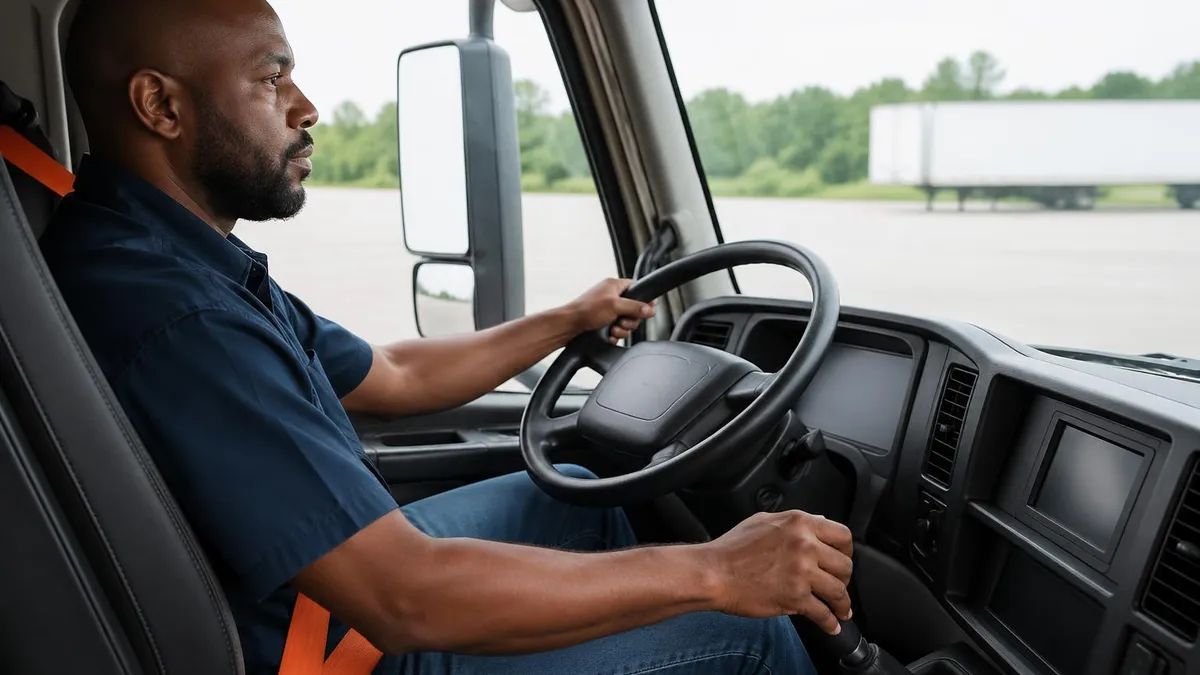
ELDT training has two required components: Theory training and Behind-the-Wheel (BTW) training. Theory covers the conceptual and regulatory knowledge a commercial driver needs — vehicle systems, federal regulations, safety procedures, hazard recognition, and operational practices. It can be delivered in a classroom, online, or through a blended format. Behind-the-Wheel training takes place in an actual commercial vehicle on a closed range (for basic vehicle control skills) and on public roads (for integrated operations in traffic). Both components must be completed with a registered provider. The provider doesn't have to be a trucking school — some employers are registered as ELDT providers and deliver training to new-hire drivers as part of onboarding. Some state licensing agencies also operate registered programs. The only requirement is that the provider appears on FMCSA's Training Provider Registry before your training begins — training with an unregistered provider doesn't count, regardless of quality. Understanding the specific skills tested during range and road sessions, including pre-trip inspection procedures, helps candidates prepare for what BTW training will demand. Practicing with eldt pre trip questions and answers builds the systematic inspection knowledge that BTW instructors evaluate during range sessions.
The ELDT rule is competency-based rather than hour-based — there are no federally mandated minimum hours for theory or BTW training. Providers must certify that a student has demonstrated proficiency in all required training areas before reporting completion to FMCSA. In practice, this means training duration varies by provider and by student. Candidates with prior commercial driving experience through military service or unlicensed operation might complete training faster. First-time drivers with no heavy vehicle experience need more time to develop the spatial awareness and vehicle control skills BTW training requires. Most CDL programs run 3–7 weeks for full Class A preparation including theory, range, and road training, though programs can be shorter or longer. When a provider reports that you've completed training, that report goes directly into FMCSA's database. You can't schedule your CDL skills test until your ELDT completion appears in the system — there's no workaround and no manual override. Federal hours of service regulations are a required theory topic because commercial drivers must understand their legal driving limits before operating commercially. Practicing with eldt hours of service practice test gives candidates the regulatory grounding that both the knowledge test and actual commercial driving require.
ELDT Overview
- First-time Class A CDL applicants: Anyone who doesn't currently hold a CDL and wants a Class A license for tractor-trailers, combination vehicles
- First-time Class B CDL applicants: Anyone seeking a Class B license for straight trucks, city buses, large delivery vehicles
- Class B → Class A upgrade: CDL holders with a Class B upgrading to Class A must complete Class A-specific ELDT
- School Bus (S) endorsement: Required for drivers adding school bus endorsement to an existing CDL
- Passenger (P) endorsement: Required for adding passenger vehicle endorsement
- Hazardous Materials (H) endorsement: Required for adding hazmat endorsement
- ✓Confirm your exam appointment and location
- ✓Bring required identification documents
- ✓Arrive 30 minutes early to check in
- ✓Read each question carefully before answering
- ✓Flag difficult questions and return to them later
- ✓Manage your time — don't spend too long on one question
- ✓Review flagged questions before submitting

Completing ELDT and Moving to the CDL Skills Test
The ELDT process has a specific sequence, and understanding it prevents delays between training completion and CDL licensing. First, you obtain a commercial learner's permit (CLP) from your state DMV — you must hold a CLP for at least 14 days before taking your CDL skills test. Then you begin ELDT with a registered provider. Theory training can begin as soon as you have your CLP; BTW training requires a CLP and must be conducted with a qualified CDL instructor in the vehicle. When training is complete, your provider reports your completion to FMCSA's ELDT database. Only after that report is in the system can you schedule your CDL skills test. The skills test itself — administered by your state DMV or a state-approved third-party tester — has three parts: pre-trip inspection, basic vehicle control, and road test. Passing all three earns your CDL.
Speed and space management is one of the most directly practical ELDT theory topics because the consequences of poor space management in a commercial vehicle are immediately serious. A fully loaded Class A combination vehicle can weigh 80,000 pounds and needs significantly more stopping distance than a car — a driver who doesn't instinctively understand following distance and speed management relative to stopping distance creates real danger on the road. ELDT theory makes this explicit: candidates learn the physics of heavy vehicle braking, the factors that extend stopping distance (speed, load, grade, tire condition, brake adjustment), and the space management techniques that compensate for those factors. Reinforcing this knowledge before and during training with eldt speed management questions and answers builds the conceptual framework that makes BTW instruction land more effectively — understanding why space management matters makes instructors' corrections easier to internalize.
Hazard perception is the cognitive skill that separates experienced commercial drivers from novices. It's not about reacting to hazards — it's about identifying developing hazards early enough that reaction time isn't a factor. An experienced trucker sees the car two vehicles ahead braking, notes the wet road surface, and begins increasing following distance while there's still 400 feet of margin. A novice reacts when the car immediately ahead brakes hard, with 150 feet of margin. ELDT theory covers hazard perception systematically: clues to developing hazards, where hazards typically appear (intersections, merge points, highway on-ramps, blind curves), and the scanning habits that surface hazards early. This is highly learnable content. Practicing with eldt hazard perception questions and answers before BTW training gives candidates mental models for hazard categories before they encounter them on real roads, where reaction rather than recognition becomes the only option.
After passing your CDL skills test, your state DMV issues your commercial driver's license. From that point, ELDT requirements don't apply to you again unless you're adding one of the specific endorsements that trigger the requirement. Your ELDT completion record stays in FMCSA's database permanently — if you're ever in a carrier audit or compliance review, your ELDT record provides documentation that your initial training met federal standards. The commercial trucking industry has fully adapted to the ELDT requirement since its 2022 implementation. Registered providers are widely available in every state, employer-sponsored training programs are well-established, and the process from CLP to licensed CDL holder is predictable for candidates who understand the sequence and find a reputable registered provider.

ELDT Pros and Cons
- +Standardized federal training requirement ensures all new CDL holders receive training on the same essential safety competencies
- +Competency-based standard means faster candidates can progress quickly rather than waiting for arbitrary hour minimums to expire
- +FMCSA's Training Provider Registry makes finding a legitimate registered provider straightforward
- +Employer-sponsored training options allow qualified candidates to enter commercial driving at no upfront cost
- +Online theory training options accommodate candidates whose schedules don't fit traditional classroom formats
- −ELDT completion must appear in FMCSA's system before skills testing — delays in provider reporting can delay licensing
- −Private CDL school costs of $3,000–$8,000 are significant for candidates without employer sponsorship
- −Competency-based standard means training duration and cost can be unpredictable for candidates who struggle with BTW skills
- −Employer-sponsored programs come with employment commitments — candidates who leave early often owe training reimbursement
- −Unregistered training providers still exist — candidates must verify TPR registration before starting to avoid wasted time and money



ELDT Questions and Answers
About the Author

Educational Psychologist & Academic Test Preparation Expert
Columbia University Teachers CollegeDr. Lisa Patel holds a Doctorate in Education from Columbia University Teachers College and has spent 17 years researching standardized test design and academic assessment. She has developed preparation programs for SAT, ACT, GRE, LSAT, UCAT, and numerous professional licensing exams, helping students of all backgrounds achieve their target scores.