
EKG Certification Practice Test: Study Guide & Tips 2026 September
Prepare for the EKG Certification. Practice questions with answer explanations covering all exam domains. 📗
EKG Certification Practice Test: What You Need to Know
If you're preparing for an EKG technician certification—whether the Certified EKG Technician (CET) from the National Healthcareer Association (NHA) or the Certified Rhythm Analysis Technician (CRAT) from Cardiovascular Credentialing International (CCI)—practice testing is the single most efficient study strategy you can use.
EKG certification exams are not the kind of test you can pass by reading a textbook once. They require you to recognize rhythm patterns, apply cardiac anatomy knowledge, and make clinical connections quickly. That pattern recognition develops through repetition, and practice tests create that repetition in a format that mirrors the actual exam.
What EKG Certification Exams Test
While the CET and CRAT differ slightly in emphasis, both exams cover a consistent set of core topics. Understanding these domains helps you allocate study time where it counts most.
Cardiac Anatomy and Physiology: The structure of the heart (chambers, valves, great vessels), the conduction system (SA node, AV node, Bundle of His, Purkinje fibers), and how electrical signals translate to mechanical cardiac function. You need to understand the electrical pathway from depolarization to contraction to interpret what you see on an EKG strip.
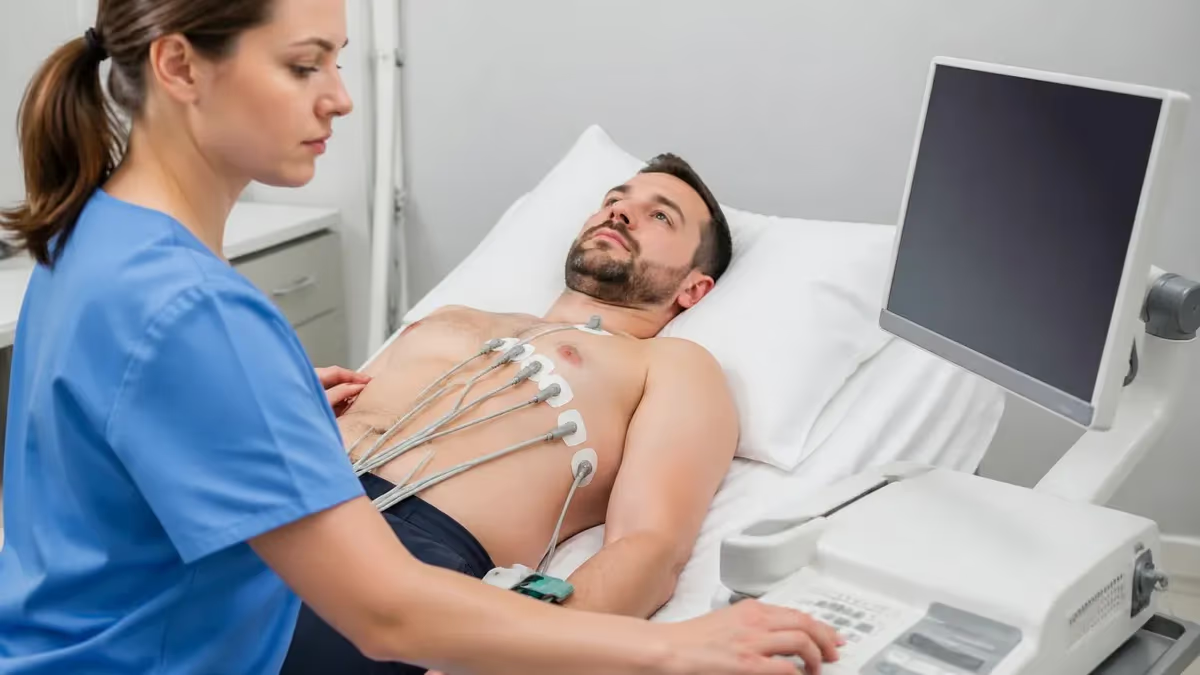
EKG Lead Placement and Equipment: Standard 12-lead EKG placement (limb leads I, II, III; augmented leads aVR, aVL, aVF; precordial leads V1–V6), troubleshooting common artifacts (patient movement, poor electrode contact, AC interference), and equipment operation. Questions test both the technical knowledge and the clinical reasoning behind why each lead placement matters.
Basic EKG Waveforms: P wave, QRS complex, T wave—what each represents, normal values for duration and amplitude, and how to measure intervals (PR interval, QRS duration, QT interval). These measurements are the foundation for identifying abnormal rhythms.
Rhythm Recognition: This is the core of EKG certification. You need to identify normal sinus rhythm and common arrhythmias including:
- Sinus bradycardia and sinus tachycardia
- Atrial fibrillation and atrial flutter
- Supraventricular tachycardia (SVT)
- Premature atrial contractions (PACs) and premature ventricular contractions (PVCs)
- Ventricular tachycardia and ventricular fibrillation
- First-, second-, and third-degree AV blocks
- Bundle branch blocks (LBBB and RBBB)
Patient Preparation and Professional Practice: Explaining the procedure to patients, obtaining consent, positioning for different test types, maintaining patient privacy and dignity, and documentation requirements.
Holter Monitoring and Stress Testing: How ambulatory (Holter) monitoring works and how to prepare patients for it; the basics of exercise stress testing protocols and the EKG changes to watch for during and after exercise.
Important: The EKG certification Certification exam covers multiple domains. Allocate more study time to unfamiliar topics while maintaining review of strong areas.
CET vs. CRAT: Which Certification Is Right for You?
Both credentials are widely recognized, but they come from different organizations and have slightly different emphases:
CET (Certified EKG Technician) — NHA: The NHA's CET is one of the most commonly required certifications for entry-level EKG technician positions in the U.S. It covers all the core topics above—cardiac anatomy, rhythm recognition, lead placement, and patient care. The exam has 100 scored questions plus 20 pilot questions, with a 2-hour time limit. Passing score is around 390 out of 500. Eligibility requires completing an accredited EKG training program or demonstrating equivalent experience.
CRAT (Certified Rhythm Analysis Technician) — CCI: The CRAT has more focus on rhythm interpretation and is often pursued by candidates with some clinical experience who want to demonstrate specialized rhythm analysis competency. It's also recognized for Holter monitoring technician roles. The CRAT exam has 90 questions with a 2-hour limit.
For most people entering the field, the CET is the starting point. Employers at hospitals, clinics, and cardiology practices recognize both credentials, but the CET has broader market penetration in entry-level hiring.
How to Prepare Effectively for the EKG Certification Exam
The candidates who pass the EKG certification exam on the first attempt are almost universally those who practiced rhythm strips extensively before the test. It sounds obvious, but it's the most commonly skipped step—people study the textbook and feel ready, then sit down in front of actual rhythm strips and hesitate.
Master the Basics Before Moving to Arrhythmias
Don't try to recognize atrial fibrillation before you've internalized what a normal P wave looks like, what a normal PR interval is, and what the normal QRS width should be. Every arrhythmia is defined by how it deviates from normal. Build that normal baseline first, so deviations are obvious rather than confusing.
Practice Rhythm Strips Daily
There's no substitute for volume here. Aim to work through 20–40 rhythm strips every day in the weeks leading up to your exam. Use a systematic approach for every strip: rate → rhythm → P waves → PR interval → QRS width → interpretation. Don't shortcut the systematic approach—training your brain to always follow the same steps prevents the most common recognition errors.
Learn the High-Frequency Arrhythmias Cold
Certain rhythms appear disproportionately often on EKG certification exams: atrial fibrillation (the most common arrhythmia overall), PVCs (appear in multiple contexts), and the AV blocks (confuse many candidates). Spend concentrated time on these until recognition is automatic, then move to less frequent rhythms.
Know Your Measurements
Multiple exam questions will ask you to measure a specific interval on a strip or identify an abnormality based on measurement criteria. Know the normal ranges cold:
- PR interval: 0.12–0.20 seconds (3–5 small boxes)
- QRS duration: ≤0.12 seconds (≤3 small boxes; >0.12 = bundle branch block)
- QT interval: ≤0.44 seconds (varies with heart rate; use corrected QTc)
- Paper speed: 25 mm/second (standard); each small box = 0.04 seconds, each large box = 0.20 seconds
Timeline: How Long to Prepare
Most candidates preparing for the CET or CRAT report needing 4–8 weeks of focused preparation if they've completed a training program. Those who come to the exam without formal training need significantly more time—often 3–6 months—to build both the foundational knowledge and the rhythm recognition skills from scratch.
A realistic 6-week plan for candidates coming from a completed training program:
Weeks 1–2: Review cardiac anatomy and the conduction system. Make sure your foundational knowledge is solid. Practice normal sinus rhythm identification until you can recognize it instantly.
Weeks 3–4: Systematic arrhythmia study—one category per day. Atrial arrhythmias, junctional arrhythmias, ventricular arrhythmias, and heart blocks. End each day with a mixed practice session.
Weeks 5–6: Full-length practice exams under timed conditions. Review every wrong answer. Focus remaining time on whatever rhythm types your practice scores show as weak.
The EKG certification exam is genuinely learnable for anyone willing to put in the practice hours. Rhythm recognition is a skill, and like any skill, consistent deliberate practice builds it reliably.
Many readers pair this guide with the free ekg practice test to check their readiness before exam day.

- +Validates your knowledge and skills objectively
- +Increases job market competitiveness
- +Provides structured learning goals
- +Networking opportunities with other certified professionals
- −Study materials can be expensive
- −Exam anxiety can affect performance
- −Requires dedicated preparation time
- −Retake fees apply if you don't pass



Start Practicing for EKG Certification Now
The difference between candidates who pass and those who need a second attempt usually comes down to practice volume. Conceptual knowledge from a textbook is the starting point—but recognizing a third-degree heart block or atrial flutter instantly, under timed conditions, requires deliberate practice with actual question formats. Work through the practice sets available here, focus on your most frequently missed rhythms, and build the pattern recognition you need before exam day.
About the Author

Educational Psychologist & Academic Test Preparation Expert
Columbia University Teachers CollegeDr. Lisa Patel holds a Doctorate in Education from Columbia University Teachers College and has spent 17 years researching standardized test design and academic assessment. She has developed preparation programs for SAT, ACT, GRE, LSAT, UCAT, and numerous professional licensing exams, helping students of all backgrounds achieve their target scores.