
DAT Dental: Complete Dental Admissions Test Guide 2026 October
DAT Dental guide: ✍🏼 4 sections, 280 questions, 4h 15min. Scoring 1-30, average 19-20, 25+ for top dental schools. Prep timeline + top courses.

The DAT Dental exam is your gateway to dental school. Officially called the Dental Admission Test, this standardized exam is run by the American Dental Association (ADA) through its Department of Testing Services. If you want to become a dentist in the United States or Canada, you'll almost certainly need to sit for it. And here's the thing - it's not the kind of test you can cram for over a long weekend.
Most successful candidates spend 3 to 6 months preparing. Some take longer. The DAT covers a wide swath of undergraduate science, throws in a unique spatial reasoning section that nothing in your coursework really prepares you for, and demands sharp reading and math skills under tight time pressure. You'll face 280 questions across four sections, with a total seated time of about 4 hours and 15 minutes.
Score well, and you open doors. The national average sits around 19 to 20, but competitive dental schools - think Harvard, Penn, Michigan, UCLA - typically admit students with composite scores of 22 or higher. The most selective programs? They're looking at 25+. So yes, the bar is high. But it's also reachable with the right plan.
This guide covers what you actually need to know to walk into your DAT prepared. We'll cover the four content sections in detail, scoring breakdown and what counts as competitive at different school tiers, prep timelines from three months to six, the top paid courses (Bootcamp, Destroyer, Crack the DAT, Kaplan) and what each is actually best at, retake policies, and what test day at a Prometric center actually feels like. By the end you'll have a plan, not just information.
DAT Dental by the Numbers
Key Facts at a Glance
| Item | Value | Details |
|---|---|---|
| Total Questions | 280 | |
| Total Seated Time | 4h 15m | |
| Typical Prep Time | 3-6mo |
What Is the DAT and Who Administers It?
The Dental Admission Test was developed by the ADA in 1950 and has been refined many times since. It's a computer-based exam delivered exclusively at Prometric testing centers across the U.S., Canada, and a handful of international locations. Every accredited U.S. and Canadian dental school accepts DAT scores as part of admissions - and almost all of them require it.
You can schedule the DAT year-round. There's no fixed test date. Once you apply through the ADA's online portal and pay the fee (currently around $525, though check the ADA website for current pricing), you receive an eligibility letter and can book a seat at any Prometric center with availability. Spots fill up fast in spring and summer, so book early if you're targeting a specific window.
The test is intentionally broad. It samples content from two years of college-level science coursework - biology, general chemistry, organic chemistry - plus reasoning skills you've built across your education. It's not designed to trick you. It's designed to confirm you have the academic foundation to survive the first two years of dental school, which are notoriously content-heavy.
Want a deeper look at eligibility requirements and registration logistics? Our Dental Admission Test eligibility guide walks through every step, including transcripts, photo ID requirements, and what happens if you miss your scheduled appointment.
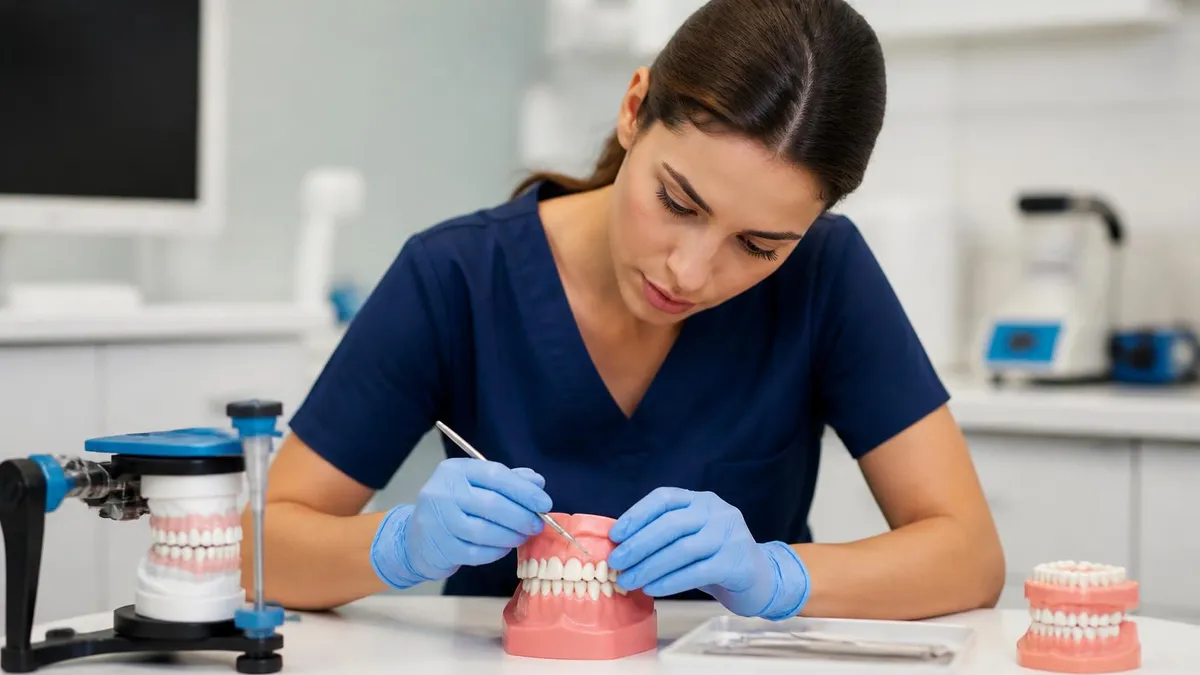
The DAT is for U.S. dental school applicants and is accepted by most Canadian schools too. The Canadian DAT (CDAT), run separately by the Canadian Dental Association, is an alternative accepted by Canadian programs - it swaps the Perceptual Ability Test for a manual dexterity (soap carving) section. The OAT is for optometry school, not dental. If your goal is a DDS or DMD in the United States, the ADA's DAT is the one you need. Don't confuse them with similar-sounding admissions exams. The DAT is also distinct from the NBDE/INBDE, which is taken after you're in dental school, not before admission.
DAT Content Breakdown: Four Sections, 280 Questions
The DAT splits into four scored sections plus an optional 15-minute tutorial at the start and a 15-minute optional break in the middle. The structure cards below summarize the question counts and timing, but a few things deserve special attention before you plan your prep.
The Survey of Natural Sciences bundles biology, general chemistry, and organic chemistry into one 90-minute block. You don't get separate timing for each subject - you manage the budget yourself. Most students aim for roughly 30-35 minutes on biology, 25-30 on gen chem, and 25-30 on organic. If you finish biology in 25 minutes you've banked time for the tougher organic questions later.
The Perceptual Ability Test is where most first-time test-takers panic. You can't really study for it the way you study biology. You drill it. Specialized PAT generators give you thousands of practice items so your brain literally rewires for these visualizations. Plan on PAT eating a big chunk of your study calendar.
Reading Comprehension throws three dense scientific passages at you - usually 1,500 words each - with 16-17 questions per passage. Time management is brutal. Strategies vary by reader. Some skim then search. Others read once carefully then plow through questions. Test both approaches on timed practice passages to see which feels faster for you.
Quantitative Reasoning is the math section. Algebra, fractions, decimals, percentages, ratios, basic probability and statistics, geometry, and trigonometry. No calculus. Recent updates include an on-screen basic calculator - check current ADA guidelines for what's allowed on your test date.
The Four DAT Sections Explained
100 questions in 90 minutes. Biology (40 questions) covers cell biology, genetics, evolution, ecology, vertebrate anatomy, and human physiology. General Chemistry (30 questions) hits stoichiometry, acid-base, kinetics, thermodynamics, equilibria, redox, and gas laws. Organic Chemistry (30 questions) covers functional groups, mechanisms, stereochemistry, spectroscopy, and synthesis. All three subjects share one timed block so you self-manage pacing.
90 questions in 60 minutes. Six question types of 15 questions each: keyhole (aperture matching), top-front-end view reconstruction, angle ranking, hole punching, cube counting, and pattern folding. Tests three-dimensional spatial reasoning, the same skill you'll lean on every day in dental school placing crowns, reading radiographs, and performing implants. Drill with dedicated PAT generators - this skill rewires through repetition, not lectures.
50 questions in 60 minutes. Three scientific passages of roughly 1,500 words each, with 16-17 questions per passage. Most questions are detail-based: According to the passage style. A smaller portion test inference or application. You have about 20 minutes per passage including all questions. Time management decides this section more than reading skill.
40 questions in 45 minutes. Algebra, fractions, decimals, percentages, ratios, basic probability and statistics, geometry (especially area, volume, angle calculations), and trigonometry. No calculus. Includes word problems and quantitative comparison questions. Recent versions provide an on-screen basic calculator with arithmetic and square root functions only.
How DAT Scoring Actually Works
This trips up applicants every cycle. The DAT does not give you a percentage. It gives you scaled scores from 1 to 30 for each section, plus an Academic Average (AA) that combines Biology, General Chemistry, Organic Chemistry, Reading Comprehension, and Quantitative Reasoning. The PAT score is reported separately and does not factor into the AA.
Each scaled score corresponds roughly to a percentile rank. A scaled 17 puts you near the 50th percentile - middle of the pack. A 20 is around the 75th. A 23 hits the 95th. A 25 is roughly the 99th. Schools care about percentile because it controls for variation in test difficulty across forms. Two students who answered slightly different numbers correct can land on the same scaled score because of how the ADA equates forms.
So what's actually competitive? A 17-18 is below average and you'll need an exceptional GPA and extracurriculars to compensate. A 19-20 is the national average - acceptable at less competitive schools, still tough at flagship state programs. A 21-22 is above average and puts most state schools within reach. A 23-24 is strong, making you competitive at almost any U.S. dental school including top-tier programs. A 25+ is elite territory - this is the range that opens up Harvard, Penn, Michigan, Columbia, and UCLA.
Your PAT score is judged similarly. Most schools want to see a 19+ on PAT. The most competitive programs prefer 20-21+. Some schools weight PAT heavily because spatial reasoning is so central to clinical dentistry. One more important note: scores are valid for three years. If you take the DAT junior year and don't apply until two years later, you're fine. After three years, you have to retake from scratch.
DAT Score Categories Explained
The AA is the average of your Biology, General Chemistry, Organic Chemistry, Reading Comp, and Quantitative Reasoning scaled scores. It's the single most-cited number in dental admissions and shows up first on every score report. Aim for 20+ for state programs, 22+ for competitive programs, and 24+ for the most selective schools like Harvard, Penn, Michigan, Columbia, and UCLA. The AA does NOT include your PAT score - that's reported separately. Schools occasionally weight individual sub-scores too, but the AA is your headline number.
Building Your DAT Prep Timeline
The single biggest predictor of DAT success isn't intelligence. It isn't even your undergrad GPA. It's how seriously you plan your study schedule. Three to six months is the sweet spot for most candidates, but the right number depends on three things: how recently you took the prerequisite science courses, how many hours per week you can realistically commit, and what score you're targeting.
The 3-Month Sprint
Works if you're a recent science grad with strong coursework still fresh, or you've already taken a diagnostic and scored within striking distance of your target. You'll need 25-35 hours per week. Month one is content review with daily PAT practice. Month two shifts to problem-solving, timed sections, and full-length practice tests every weekend. Month three is full-lengths twice a week, weakness drilling, and final review.
The 4-5 Month Standard
What most successful candidates follow. About 15-25 hours per week. First six weeks are pure content review. Weeks 7-12 introduce timed mini-sections and daily PAT. Final weeks are full-lengths and targeted weakness work. This pace lets you actually learn material rather than just expose yourself to it.
Whatever timeline you pick, take a diagnostic full-length test on day one. This baseline shows you where you actually stand. Then take another full-length every two to three weeks to track progress. If you're not improving, something in your study method needs adjusting. For week-by-week milestones, see our detailed Dental Admission Test preparation guide.
A common mistake: candidates book their DAT 8-10 weeks out thinking it'll force them to study harder. It usually doesn't. It just means they sit for a test they're not ready for, score low, and face the 90-day retake waiting period. Don't book until your last 2-3 full-length practice tests are within your target range. Then schedule. You can always reschedule (with fee) if needed, but you can't un-score a poor first attempt - all scores get reported to every school you apply to.
Top DAT Prep Courses Compared
The prep market has consolidated around a handful of names. They're not equal, and the right pick depends on your learning style, budget, and weak areas.
DAT Bootcamp
Currently the most popular paid prep platform. Around $500 for a 90-day subscription. Includes video lessons across all sciences, a high-quality question bank, full-length practice tests, and what many consider the best PAT generator available. The bio and organic chem coverage are particularly strong. If you only buy one tool, this is the safest pick.
DAT Destroyer
A PDF book of brutally hard practice questions across bio, gen chem, organic chem, and quant. Around $200. Does not teach you content - it tests whether you actually know content at depth. Many 25+ scorers swear by working through Destroyer in the final 4-6 weeks before their test. It's harder than the real DAT. That's intentional.
Crack the DAT and Kaplan
Crack the DAT (around $400-500) has a strong PAT generator and bigger question bank historically. Worth considering after you've worked through Bootcamp's PAT. Kaplan DAT starts around $1,300 - hard to justify when Bootcamp covers similar ground at a fraction of the cost, unless you need a live instructor or extra structure to stay accountable.

DAT Prep Action Items
- ✓Take a diagnostic full-length practice test before doing any focused study so you have a baseline score
- ✓Block out a realistic 3-6 month study calendar with 15-25 hours per week of focused work
- ✓Subscribe to one comprehensive prep platform such as DAT Bootcamp or Crack the DAT
- ✓Start daily PAT practice from week one - this section requires the most spatial rewiring
- ✓Complete content review across biology, general chemistry, and organic chemistry
- ✓Drill quantitative reasoning weekly to keep math fluency sharp throughout prep
- ✓Take a timed full-length practice exam every 2-3 weeks to track progress against target
- ✓Buy DAT Destroyer for the final 4-6 weeks to drill the hardest possible question style
- ✓Only schedule your real test date once your practice scores hit target range consistently
- ✓Register with the ADA, get your eligibility letter, then book your seat at Prometric
What Test Day Actually Looks Like
You'll show up at a Prometric center 30 minutes before your scheduled appointment. Bring two forms of valid ID, including one government-issued photo ID with your signature. The name must match your ADA registration exactly. Even small mismatches can void your appointment. Don't take the risk - check three times.
The check-in process is methodical. You'll empty your pockets, store everything in a locker, get fingerprinted or palm-scanned (depending on the center), and may be wanded with a metal detector. You can't bring anything into the testing room - no water bottle, no notes, no calculator, no phone, no hat. They provide note boards and markers at your station.
You see your unofficial scores immediately when you finish. They pop up on screen. Official scores are released to you and to the dental schools you've designated within 3-4 weeks. There's no way to cancel a score after you've seen it - if you started the test, that attempt counts.
One often-overlooked test day variable: the testing center itself. Prometric quality varies wildly. Some centers are quiet, well-lit, with comfortable chairs and reliable monitors. Others have flickering screens, loud HVAC, or a check-in proctor running 30 minutes behind schedule. Read recent reviews on Reddit's r/predental for the centers in your area. If a nearby center has consistent complaints, drive farther to a better one - your score is worth the extra commute and you'll thank yourself when you sit down to a working machine in a quiet room.
The Retake Policy
You can retake the DAT, but with restrictions. You must wait 90 days between attempts. You can sit for a maximum of three total attempts in your lifetime; further retakes require special permission from the ADA, which is rarely granted. Every attempt shows on your score report sent to schools, so don't take it casually. Schools want to see growth between attempts - typically at least 2-3 points. Stagnant or declining scores are a red flag.
DAT Pros and Cons
- +Computer-based test you can schedule year-round at any Prometric center
- +Optional 15-minute break gives you time to recover mid-exam
- +Scores valid for three years so you can plan around application cycles
- +Unofficial score appears immediately so you know where you stand on test day
- +Excellent prep ecosystem with Bootcamp, Destroyer, and free ADA materials
- +Standardized format means dental schools have predictable comparison metrics
- −Significant total cost: $525 registration plus $500+ for prep materials
- −Perceptual Ability Test requires drilling thousands of items to build skill
- −Survey of Natural Sciences crams three subjects into one 90-minute block
- −90-day waiting period between attempts limits retake strategy
- −All scores from all attempts are reported to every dental school you apply to
- −Three-attempt lifetime limit means careless test-taking can hurt long-term
Final Strategy: Putting It All Together
Here's how successful applicants approach the DAT. They don't treat it as an obstacle. They treat it as an investment - one that returns interview invitations and acceptance letters when done right.
Start by being honest about your starting point. A diagnostic test on day one reveals everything. If you're scoring 14-15 on biology, you have content gaps and need foundational review. If you're at 18-19, you probably need timing work and harder question drills. Match the prep intensity to the actual gap.
Commit to consistency over intensity. Three hours a day for five months beats ten hours a day for one month. Your brain consolidates information over time. PAT especially needs spaced repetition - skip a week and your spatial reasoning will degrade noticeably.
Use practice tests as more than score markers. After each full-length, spend 4-6 hours reviewing every wrong answer, every guess, and every question that took you too long. Build a personal error log. Pattern recognition in your errors is where score improvements actually live.
Manage the mental side too. The DAT is partly a stamina test. Four hours of intense focus is real fatigue, especially after the heavy biology and PAT sections back-to-back. Take practice tests in the morning when possible, in conditions similar to your actual test slot. Eat the same breakfast on test day that you ate on your best practice day. Don't experiment with caffeine doses on the morning of the real exam - whatever worked in practice is what you do on test day.
And remember: the DAT is one piece of your application. A 22 with strong GPA, meaningful shadowing hours, research, and authentic dental experience often beats a 25 with a thin application. Don't let DAT prep crowd out the other pieces dental schools care about. Balance is the strategy. Burnout is the enemy.
You Can Do This
The DAT looks intimidating because dental school is intimidating. The exam is designed to confirm you can handle the workload of clinical training, and that's a high bar by necessity. Future patients depend on it. But thousands of applicants clear that bar every year, and they're not all geniuses - they're disciplined, organized, and willing to commit four to six months of focused work.
You have the same opportunity. Pick a prep platform. Build a realistic calendar. Take your diagnostic. Drill PAT daily. Review your errors honestly. Schedule your test only when your practice scores match your target. And don't let one section's weakness derail your prep - work it methodically until it's no longer your weakness.
The Dental Admission Test is a checkpoint, not a verdict. Treat it that way, give it the time it deserves, and you'll find yourself with the score you need to walk into dental school interviews confident in your preparation.
Sample DAT Practice Questions
Try these questions from our free DAT practice tests. The correct answer and an explanation follow each question.
A and B can complete a job in ten and twelve days, respectively. A begins working alone, and B joins him five days later to complete the task together. B has been on the job for how many days?
- A. 30/11
- B. 24/11
- C. 2
- D. 32/5
- E. 24/5
Answer: A. 30/11
First, determine the individual work rates: A completes 1/10 of the job per day, and B completes 1/12 of the job per day. A works alone for 5 days, completing 5 * (1/10) = 1/2 of the job. The remaining half of the job needs to be completed by A and B working together. Their combined work rate is 1/10 + 1/12 = 6/60 + 5/60 = 11/60 of the job per day. To find the time it takes them to complete the remaining 1/2 of the job, divide the remaining work by their combined rate: (1/2) / (11/60) = 30/11 days. Since B joins A for this duration, B works for 30/11 days.
A survey of 100 dental patients reveals that 60 floss daily and 35 have at least one cavity. Of the patients who floss daily, 15 have a cavity. What is the probability that a randomly selected patient has at least one cavity, given that they do not floss daily?
- A. 3/8
- B. 7/20
- C. 1/4
- D. 1/2
Answer: D. 1/2
This is a conditional probability problem. Let C be the event of having a cavity and F' be the event of not flossing daily. We want to find P(C|F'). First, find the number of patients in each category: Total patients = 100. Floss daily = 60, so Do not floss daily = 100 - 60 = 40. Total with a cavity = 35. Floss daily AND have a cavity = 15. This means the number of patients who do not floss daily AND have a cavity is: (Total with cavity) - (Flossers with cavity) = 35 - 15 = 20. The conditional probability P(C|F') is the number of patients who don't floss and have a cavity, divided by the total number of patients who don't floss. P(Cavity | Do not floss) = 20 / 40 = 1/2.
The DAT Reading Comprehension section requires test-takers to demonstrate which core ability?
- A. Comprehending scientific passages without prior subject knowledge
- B. Recalling memorized biology facts
- C. Performing chemical calculations
- D. Translating Latin terms
Answer: A. Comprehending scientific passages without prior subject knowledge
The section tests reading skill on unfamiliar scientific material, not prior content knowledge.
Which inheritance pattern produces an intermediate phenotype in heterozygotes rather than complete dominance?
- A. Codominance
- B. Incomplete dominance
- C. Epistasis
- D. Pleiotropy
Answer: B. Incomplete dominance
Incomplete dominance produces an intermediate phenotype in heterozygotes because neither allele is fully dominant over the other.
DAT Questions and Answers
About the Author

Educational Psychologist & Academic Test Preparation Expert
Columbia University Teachers CollegeDr. Lisa Patel holds a Doctorate in Education from Columbia University Teachers College and has spent 17 years researching standardized test design and academic assessment. She has developed preparation programs for SAT, ACT, GRE, LSAT, UCAT, and numerous professional licensing exams, helping students of all backgrounds achieve their target scores.