
CSCS Exam Prep: Complete Study Guide for the NSCA Certification 2026 October
Pass your CSCS exam on the first attempt. 💡 Practice questions with detailed answer explanations, hints, and instant scoring.
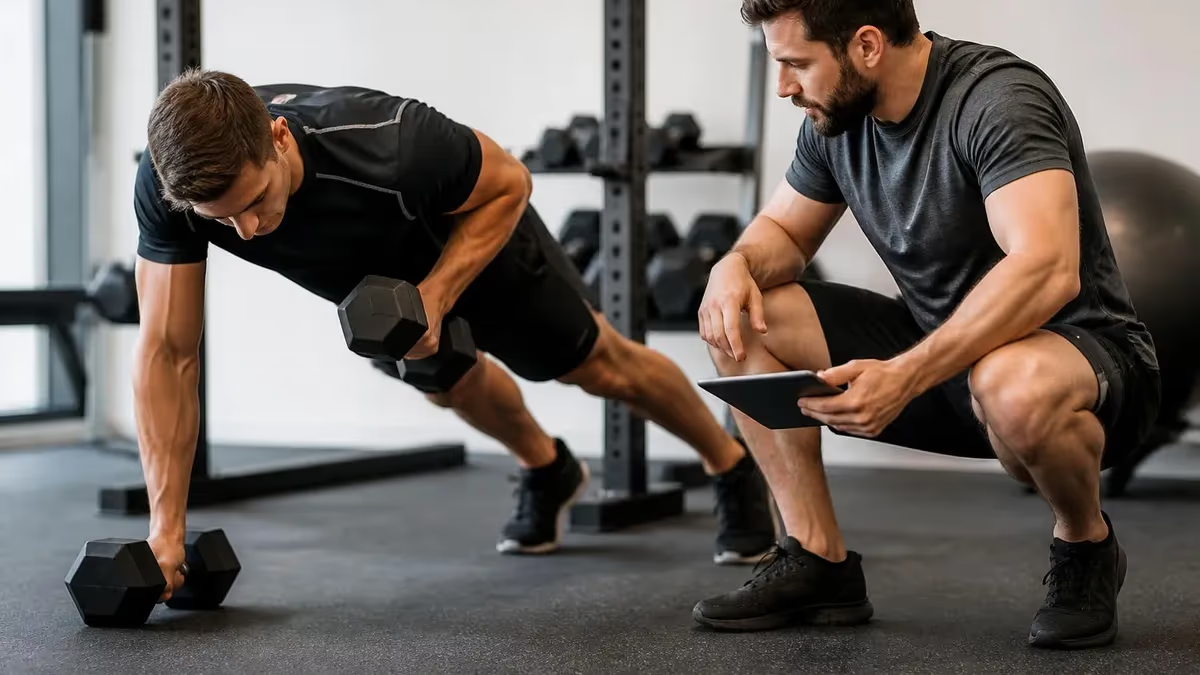
The CSCS exam — administered by the National Strength and Conditioning Association (NSCA) — is the gold standard certification for professionals who design and implement training programs for athletes. Passing it demonstrates that you understand both the science behind human performance and the practical application of that science in a real coaching environment. It's a demanding exam: roughly half of first-time candidates don't pass, which means preparation quality is the most important variable in your outcome.
The exam is divided into two parts: Scientific Foundations and Practical/Applied. Scientific Foundations covers the theoretical knowledge that underpins strength and conditioning — exercise physiology, anatomy, biomechanics, nutrition, and sport psychology. Practical/Applied covers what you do with that knowledge — exercise technique, program design, testing and evaluation, and facility organization. Both portions are required, and you must pass each one to earn the certification. Candidates who fail one section but pass the other may retake only the failed section within one year before needing to start over.
Computer-based testing is the standard format. The exam is delivered through Pearson VUE testing centers, which have locations nationwide. You schedule your exam appointment after NSCA approves your application, and you choose from available dates and testing locations through the Pearson VUE portal. Unlike some certifications that only test a few times per year, the CSCS exam is available year-round, giving you flexibility to schedule when you feel truly prepared.
The NSCA is transparent about the exam blueprint, publishing the exact percentage weighting for each content area. This is valuable for prioritizing your study time — it tells you that program design (35% of Practical/Applied) deserves significantly more attention than organization and administration (15%). Candidates who ignore the blueprint and study all topics equally often run short on time before they've mastered the high-weight sections. Understanding the blueprint before you open a textbook is one of the smartest preparation moves you can make.
One of the most important preparation decisions is timing. The CSCS requires a bachelor's degree or enrollment in the final semester of a degree program, plus CPR/AED certification. Candidates who rush their exam preparation without completing the underlying coursework in exercise science struggle significantly. The content on the exam is deep — it tests understanding of muscle physiology, biomechanics principles, and sport-specific programming at a level that requires genuine conceptual knowledge, not just memorization of facts. Plan your preparation accordingly, and don't underestimate how long it takes to truly understand the scientific foundations material.
Score reporting after the CSCS exam is scaled — raw correct answers are converted to a scaled score ranging from 1 to 100, with a passing score of 70 in each section. This scaling accounts for variation in question difficulty across different exam versions. The good news is that you don't need to answer every question correctly to pass.
Approximately 70% of questions correct is the general benchmark, but because of scaling, the actual pass threshold in raw terms varies slightly by exam version. Don't aim for 70% in practice; aim for 80%+ so you have a comfortable buffer on the actual exam.
Effective CSCS preparation starts with the NSCA's official resources. The Essentials of Strength Training and Conditioning (4th edition) is the primary reference text for the exam and should be the foundation of your study. NSCA also publishes a CSCS study guide that maps textbook chapters directly to exam domains — using these two resources together creates a structured framework for covering every content area without wasting time on irrelevant material.
Beyond the textbook, CSCS practice tests are the single most effective preparation tool. Practice questions force active recall, which builds knowledge retention far more effectively than rereading. When you miss a question, that miss tells you exactly which concept to review — making practice tests a self-correcting study system. Aim to complete at least 300–400 practice questions before your exam date, prioritizing questions in program design and exercise science since those domains carry the most weight.
Creating a structured weekly study schedule prevents the common failure mode of studying intensely for a few days, then burning out and falling behind. Most candidates need 12–16 weeks of consistent preparation. During the first 8 weeks, work through the textbook chapter by chapter, taking notes and creating summary sheets for key concepts. During weeks 9–12, shift primarily to practice questions and review your weak areas. During the final 2–4 weeks, simulate test conditions with timed full-length practice exams and focus only on high-yield topics you haven't yet mastered.
For the Scientific Foundations section, pay special attention to exercise physiology — specifically the energy systems (ATP-PC, glycolytic, oxidative), how the body adapts to training stimulus, and the hormonal responses to exercise. These concepts appear repeatedly across multiple question formats. Muscle fiber types, the neuromuscular junction, and EPOC (excess post-exercise oxygen consumption) are also high-frequency exam topics that many candidates underestimate. Build a strong mental model of how the body produces and uses energy before moving to the applied sections.
The Practical/Applied section rewards candidates who understand the why behind programming decisions, not just the formulas. For periodization, don't just memorize linear versus undulating models — understand the physiological rationale for each approach and when you would apply them to different athletes in different training phases. For exercise technique, study proper movement patterns with enough depth to identify technique faults in description-based questions. The NSCA tests applied judgment, not rote recall, so connecting concepts to real coaching decisions is essential for high scores in this section.

The Scientific Foundations section tests your theoretical knowledge across exercise science and nutrition — the academic underpinning of everything a strength coach does. Exercise science makes up 68% of this section (roughly 54 questions), while nutrition covers the remaining 32% (about 26 questions). Together these 80 questions set the stage for the Practical/Applied section by establishing whether you understand why training produces adaptation, not just how to write a program.
Within exercise science, anatomy and physiology form the core. You need to know the major muscles — their origins, insertions, and actions — as well as the structure of muscle fibers, the sliding filament theory of muscle contraction, and how motor units are recruited during exercise. Type I (slow-twitch) versus Type II (fast-twitch, IIa, and IIx) fiber characteristics are tested repeatedly, including which fiber type is dominant in different sports and how training affects fiber type distribution. Neuromuscular adaptations — the strength gains that occur before hypertrophy — are a particularly common exam topic.
Biomechanics questions focus on force, torque, velocity, and the mechanical principles that govern human movement. Understanding lever systems (first, second, and third class levers in the human body), the force-velocity relationship, and how joint angle affects strength output prepares you for questions that describe movement scenarios and ask you to apply mechanical principles. These questions often trip up candidates who studied physiology thoroughly but neglected the biomechanics chapters.
Nutrition content covers macronutrient functions (carbohydrates as primary fuel during high-intensity exercise, fat oxidation during low-intensity sustained effort, protein for muscle repair and synthesis), micronutrient roles in performance, hydration protocols, and ergogenic aids. Creatine monohydrate, caffeine, beta-alanine, and sodium bicarbonate are the ergogenic aids most frequently tested — know their mechanisms, evidence quality, and recommended dosing. Sports supplement questions require you to separate well-supported supplements from those with weak or no evidence, which tests your ability to apply critical thinking to applied nutrition scenarios.
Sport psychology is the smallest sub-area of Exercise Science but still appears on the exam. Key topics include arousal regulation (the inverted-U hypothesis and the zone of optimal functioning), goal-setting theory, imagery techniques, and the psychological responses to injury. Many candidates skip sport psychology in their preparation because it feels less technical than physiology — this is a mistake, as these questions are often straightforward if you've studied them and unnecessarily costly if you haven't.

The Practical/Applied section is where many candidates struggle — not because the content is harder, but because it requires judgment rather than memorization. Questions in this section describe a scenario (an athlete's training history, current phase, performance goals) and ask you to select the best programming decision. Candidates who've worked with real athletes and understand the coaching rationale behind programming choices have a natural advantage; candidates who've only studied from textbooks need to work harder to develop that applied intuition through practice questions.
Program design dominates the Practical/Applied section at 35% of its content. Periodization models — linear (classic), undulating (daily/weekly), and block periodization — are heavily tested. Know the definitions and be able to match each model to an appropriate athlete or situation. Linear periodization systematically increases intensity while decreasing volume over a training cycle and suits beginner to intermediate athletes during off-season training. Undulating models vary intensity and volume within weekly or daily microcycles, providing more frequent variation and suiting advanced athletes who adapt quickly to sustained loading patterns.
Training variables — volume, intensity, frequency, rest intervals, and exercise selection — and how to manipulate them for specific goals (strength, power, hypertrophy, muscular endurance) are foundational program design content. The NSCA publishes specific loading guidelines in the textbook: 1–5 reps at ≥85% 1RM for maximum strength, 3–5 reps at 75–85% for power, 6–12 reps at 67–85% for hypertrophy, and 15+ reps at ≤67% for muscular endurance. These ranges appear directly in exam questions.
Exercise technique questions test your ability to identify correct biomechanics and spot errors. For CSCS training programs, the technique section covers the back squat, deadlift, Olympic lifts (clean, snatch, jerk), bench press, and plyometric exercises. Know the spotting positions for major exercises and the common technique faults (forward lean in the squat, bar drift in the clean, hyperextension in the deadlift). Video-based technique questions are common on the exam — the computer-based format allows the NSCA to include short clips where you identify errors, making this a uniquely visual test component.
Testing and evaluation questions ask you to interpret fitness assessment results and make programming decisions based on the data. Body composition (DEXA, hydrostatic weighing, skinfold), strength testing (1RM protocols, safety considerations), aerobic capacity (VO2max testing methods), and power assessment (vertical jump, Wingate test) are all testable. Understanding the validity and reliability of different assessment methods — and their practical limitations in athletic settings — prepares you for scenario-based questions that ask what test to use given specific constraints of time, equipment, and athlete population.
CSCS Practice Test Questions
Prepare for the CSCS - Certified Strength & Conditioning Specialist exam with our free practice test modules. Each quiz covers key topics to help you pass on your first try.
CSCS Client Assessment & Goal Setting
CSCS Exam Questions covering Client Assessment & Goal Setting. Master CSCS Test concepts for certification prep.
CSCS Coaching Techniques & Communication
Free CSCS Practice Test featuring Coaching Techniques & Communication. Improve your CSCS Exam score with mock test prep.
CSCS Periodization & Performance Planning
CSCS Mock Exam on CSCS Periodization & Performance Planning. CSCS Study Guide questions to pass on your first try.
CSCS Resistance Training Techniques
CSCS Test Prep for CSCS Resistance Training Techniques. Practice CSCS Quiz questions and boost your score.
CSCS Exercise Science & Anatomy
CSCS Questions and Answers on Exercise Science & Anatomy. Free CSCS practice for exam readiness.
CSCS Nutrition Fundamentals
CSCS Mock Test covering Nutrition Fundamentals. Online CSCS Test practice with instant feedback.
CSCS Nutrition & Performance Enhancement
Free CSCS Quiz on Nutrition & Performance Enhancement. CSCS Exam prep questions with detailed explanations.
CSCS Periodization & Energy Systems
CSCS Practice Questions for Periodization & Energy Systems. Build confidence for your CSCS certification exam.
CSCS Program Design & Implementation
CSCS Test Online for Program Design & Implementation. Free practice with instant results and feedback.
CSCS Resistance Training Biomechanics
CSCS Study Material on Resistance Training Biomechanics. Prepare effectively with real exam-style questions.
CSCS Safety & Injury Prevention
Free CSCS Test covering Safety & Injury Prevention. Practice and track your CSCS exam readiness.
CSCS Special Populations & Injury Prevention
CSCS Exam Questions covering Special Populations & Injury Prevention. Master CSCS Test concepts for certification prep.
CSCS Study Resources: Pros and Cons
- +NSCA Essentials textbook is comprehensive and exam-aligned — the gold standard reference
- +NSCA study guide maps content to exam blueprint so you know what to prioritize
- +Practice question banks build active recall and identify weak areas efficiently
- +Online courses from NSCA and third-party providers offer structured pacing for self-directed learners
- +NSCA publishes sample questions on its website — free preview of actual question style
- −The Essentials textbook is dense and can take 100+ hours to read thoroughly — many candidates underestimate the time investment
- −Third-party study materials vary widely in quality — some contain outdated or inaccurate information
- −No NSCA-produced full-length practice exam publicly available — you must assemble mock exams from multiple question sources
- −Nutrition and sport psychology chapters are often under-studied because they feel secondary to physiology
- −The 4-hour test duration is physically fatiguing — mental stamina is a preparation factor most candidates ignore
Pros and Cons at a Glance
| Pros | Cons |
|---|---|
| NSCA Essentials textbook is comprehensive and exam-aligned — the gold standard reference | Third-party study materials vary widely in quality — some contain outdated or inaccurate information |
| NSCA study guide maps content to exam blueprint so you know what to prioritize | No NSCA-produced full-length practice exam publicly available — you must assemble mock exams from multiple question sources |
| Practice question banks build active recall and identify weak areas efficiently | Nutrition and sport psychology chapters are often under-studied because they feel secondary to physiology |

Registering for the CSCS exam begins with verifying your eligibility through the NSCA. You must hold a bachelor's degree (or be enrolled in your final semester) in any field, and you must have a current CPR/AED certification from a recognized provider. Once eligibility is confirmed, you submit your application through the NSCA website and pay the exam fee. First-time exam fees run approximately $300–$350 for NSCA members and $400–$475 for non-members — NSCA membership typically pays for itself given the fee difference, especially if you plan to retake the exam or pursue additional NSCA credentials.
After your application is approved, NSCA provides a testing window during which you must schedule and sit for the exam through Pearson VUE. You choose your specific date and testing center location through the Pearson VUE website. Testing centers are available in most metropolitan areas; if you're in a rural area, you may need to travel to the nearest Pearson VUE location. Arrive early — testing centers require check-in procedures including ID verification and a security scan — and you don't want to start your exam stressed about being late.
On exam day, you're permitted to bring only approved items into the testing area. No personal notes, phones, or study materials are allowed. The testing center provides scratch paper and a pencil for calculations. The exam is presented on a computer screen with a built-in timer and the ability to flag questions for review.
A smart strategy is to answer every question on the first pass (flagging anything you're unsure about), then return to flagged questions with remaining time. Don't leave any questions unanswered — there's no penalty for wrong answers on the CSCS exam, so educated guesses on unknown questions are always better than blank responses.
Managing time across a 4-hour exam requires pacing discipline. With roughly 220 questions in 4 hours (240 minutes), you have just over a minute per question on average. Most questions will take 30–60 seconds; the few that require deeper analysis might take 2–3 minutes. Practice building this awareness by timing yourself during mock exam sessions.
Candidates who run out of time on the final 20–30 questions — after spending too long on difficult questions earlier — lose points that a pacing strategy would have recovered. The ability to confidently skip and return is a skill, and it's worth practicing before exam day.
After the exam, your score report is available immediately on the computer screen at the testing center. You see a pass/fail result and section-level feedback showing your performance in each content area. If you pass, your CSCS credential becomes active and you'll receive your official certificate within a few weeks. The CSCS requires 30 continuing education units (CEUs) every three years for recertification, keeping your knowledge current with evolving research in strength and conditioning.
Professionals who invest in their initial preparation tend to find recertification straightforward — the hard part is earning the certification the first time, and that's where excellent exam prep makes all the difference. Understanding the CSCS certification guide fully before you test gives you a clear picture of what you're working toward and what comes after.
CSCS Exam Prep Strategies by Learning Style
Visual learners retain CSCS content best through diagrams, flowcharts, and concept maps. Draw the energy system pathways (ATP-PC → glycolytic → oxidative) and label each with duration, substrate, and ATP yield. Create a periodization timeline showing how volume and intensity shift across training phases. Use muscle anatomy diagrams to learn origins and insertions. Color-code your notes by content domain so you can see at a glance which sections you've covered and which still need work.
For exercise technique, watch video demonstrations of the major lifts and annotate the key technique checkpoints. The NSCA YouTube channel and university strength programs often post instructional content that aligns with exam standards. Creating your own visual summary of spotting positions for each lift — with stick figures or downloaded images — reinforces the technique content far better than rereading text descriptions.
CSCS Exam Prep Checklist
- ✓Verify NSCA eligibility requirements (bachelor's degree + CPR/AED certification) before registering
- ✓Download the CSCS exam content outline from NSCA to understand domain weightings before studying
- ✓Obtain the Essentials of Strength Training and Conditioning (4th edition) — the primary exam reference
- ✓Create a 12–16 week study schedule with dedicated blocks for each content domain
- ✓Complete at least 300 practice questions before exam day, reviewing every missed question
- ✓Prioritize Program Design (35% of Practical/Applied) and Exercise Science (68% of Scientific Foundations)
- ✓Study periodization models in depth: linear, undulating, and block — know when to use each
- ✓Review NSCA loading guidelines for strength, power, hypertrophy, and muscular endurance
- ✓Practice timed full-length mock exams in weeks 11–12 to build 4-hour mental stamina
- ✓Confirm Pearson VUE testing center location and check-in requirements the week before your exam
Sample Certified Strength & Conditioning Specialist Practice Questions
Try these questions from our free Certified Strength & Conditioning Specialist practice tests. The correct answer and an explanation follow each question.
What is the MOST important factor when selecting assessment tools for CSCS certification work?
- A. The cost of the assessment tool
- B. Validity, reliability, and appropriateness for the specific context
- C. How quickly the tool can be administered
- D. Personal familiarity with the tool
Answer: B. Validity, reliability, and appropriateness for the specific context
Assessment tools must be valid, reliable, and appropriate for the specific context.
What is the recommended sequence for exercise order within a resistance training session according to NSCA guidelines?
- A. Core/isolation exercises first, then power exercises, then structural/multi-joint exercises
- B. Power exercises first, then structural/multi-joint exercises, then core/isolation exercises
- C. Aerobic warm-up, isolation exercises, then power exercises
- D. Any order is acceptable because sequencing does not affect performance
Answer: B. Power exercises first, then structural/multi-joint exercises, then core/isolation exercises
NSCA guidelines recommend power exercises first (highest neural demand), followed by structural/multi-joint, then core and isolation exercises.
The NSCA recommends flexibility training should occur with a minimum frequency of:
- A. Once per week for sedentary individuals only
- B. At least 2–3 days per week for general ROM improvement
- C. Every day without exception for all populations
- D. Only during defined deload weeks in a periodized plan
Answer: B. At least 2–3 days per week for general ROM improvement
NSCA guidelines recommend stretching at least 2–3 days per week to achieve meaningful and lasting improvements in range of motion across most populations.
When conducting a risk assessment for CSCS operations, which factor should receive the HIGHEST priority?
- A. Cost of implementing safety measures
- B. Probability and severity of potential harm
- C. Convenience for daily operations
- D. Time required for safety training
Answer: B. Probability and severity of potential harm
The probability and severity of potential harm are the primary factors in risk assessment.
Take the full Certified Strength & Conditioning Specialist practice test
CSCS Questions and Answers




About the Author

Registered Dietitian & Fitness Certification Coach
University of FloridaAmanda Foster holds a Master of Science in Kinesiology from the University of Florida and is a Registered Dietitian and NASM Certified Personal Trainer. She has helped over 1,000 fitness professionals prepare for their ACE, NASM, ACSM, and specialty nutrition certifications, specializing in evidence-based exercise science and macro nutrition coaching methodology.
Join the Discussion
Connect with other students preparing for this exam. Share tips, ask questions, and get advice from people who have been there.
View discussion (8 replies)