
CQE Certification Guide: How to Become a Certified Quality Engineer 2026 October
Free CQE Certification Guide: How to Become practice test with questions and answer explanations. Prepare for the 2026 October exam with instant scoring. 🟢
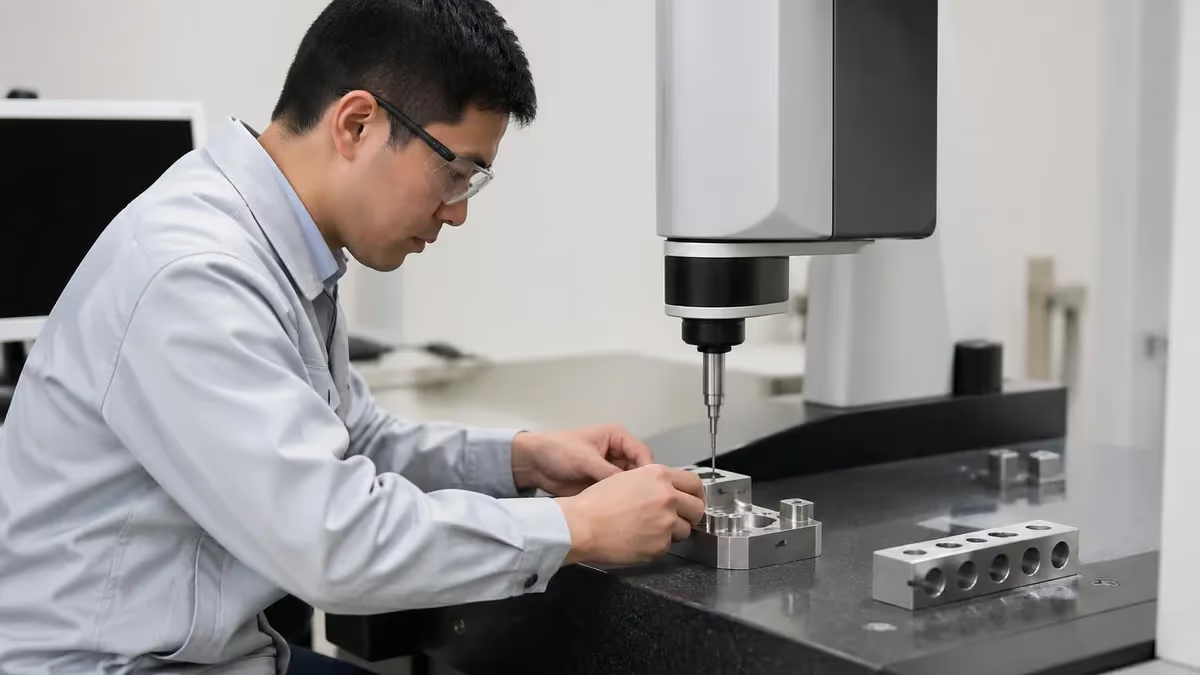
The CQE — Certified Quality Engineer — is one of the most recognized and valuable certifications offered by ASQ, the American Society for Quality. It validates a quality professional's ability to understand and apply quality principles across the full product and process lifecycle: from quality system design through statistical analysis, inspection methodology, auditing, continuous improvement, and management.
For quality engineers, quality managers, and technical professionals who work in quality roles across manufacturing, healthcare, aerospace, automotive, and defense, CQE certification is the credential that formally documents the depth of knowledge and practical experience that separates capable quality professionals from truly expert ones.
The CQE is not an entry-level credential. ASQ requires candidates to document at least 8 years of work experience in quality — with at least 3 of those years in a decision-making position — before they're eligible to sit for the exam. Candidates with relevant degrees may substitute some education for experience, reducing the required experience in some cases, but the intent of the eligibility requirements is clear: this is a credential for experienced quality professionals, not recent graduates.
The depth and breadth of the exam content reflects this: a candidate who hasn't spent years working through actual quality problems in real organizational contexts will find the CQE exam extremely challenging regardless of how much time they put into studying.
What makes CQE preparation challenging is the exam's broad coverage. ASQ's CQE Body of Knowledge spans six major sections: Quality Management and Leadership, the Quality System, Product and Process Design, Product and Process Control, Continuous Improvement, and Quantitative Methods and Tools. Each section contains multiple sub-topics, and the exam covers all of them. Candidates without experience in one or more sections — say, a manufacturing quality engineer who hasn't done much auditing work, or a quality manager who hasn't used statistical methods extensively — need to invest disproportionate preparation time in those weaker areas.
This guide covers everything you need to know about the CQE certification: eligibility requirements, exam format, what the body of knowledge covers, how to prepare effectively, what the exam experience is like, and what career benefits follow from earning the credential. It also covers the recertification requirements that CQE holders need to plan for after earning the credential, since maintaining the certification requires ongoing professional development over the 3-year recertification cycle.
The CQE is an open-book exam, which is one of its distinctive features. Candidates can bring reference materials — the ASQ-published CQE Handbook is the most common choice — into the testing room. This doesn't make the exam easy. The volume of content covered and the time pressure of 140 scored questions in 5 hours mean that candidates who need to look up basic concepts repeatedly will run out of time.
Open-book access is most valuable for confirming specific formulas, statistical tables, and procedural details on questions where the candidate already understands the concept but needs to verify a specific value or reference.

The CQE exam consists of 160 questions, but only 140 are scored — 20 questions are unscored pretest items that ASQ uses to evaluate future exam content. You won't know which questions are unscored, so answer every question as if it counts. The 5-hour time limit for 160 questions works out to roughly 1 minute 52 seconds per question — adequate for straightforward concept recall questions, tight for complex statistical calculations, and very tight if you need to frequently reference your open-book materials to answer basic questions.
The exam is offered computer-based at Prometric testing centers and also in paper-and-pencil format at select ASQ exam events. Computer-based testing allows candidates to flag questions and return to them, which is a useful strategy for the CQE given its breadth. Moving through questions you're confident on first, flagging uncertain ones, and returning for a second pass — particularly on quantitative problems where calculation time is the main constraint — is more efficient than trying to complete every question in strict order.
Open-book access means candidates can bring one or more printed references into the testing room. The ASQ CQE Handbook is the most commonly used reference because it's organized to align with the exam's body of knowledge. Candidates who bring their handbook with tabbed and highlighted sections can locate specific formulas, sampling plan tables, and reference material quickly.
However, practicing with the handbook open during preparation — rather than treating open-book access as a substitute for preparation — is what makes it actually useful on exam day. The CQE Quality Auditing practice test covers one of the exam's high-weight sections; working through it under timed conditions builds the question-answering pace the exam requires.
Scoring on the CQE uses a scaled score — typically around 550 out of 750 for passing — rather than a simple percentage of correct answers. The scaling adjusts for variations in exam difficulty across different exam forms. This means the passing threshold in terms of raw correct answers varies slightly by form, but approximately 75-80% correct answers generally represents a passing score. ASQ publishes passing scores for each exam window after results are released.
The CQE Inspection and Testing Methods practice test addresses one of the technically demanding sections of the CQE exam: measurement system analysis, sampling methodology, inspection planning, and the practical application of statistical sampling to inspection decisions. Candidates with quality assurance backgrounds often find this section conceptually familiar but technically challenging on the exam — particularly questions involving attribute sampling plans (AQL tables), measurement uncertainty, and gage capability calculations.
Targeted practice on inspection and testing methods builds both the conceptual understanding and the calculation familiarity needed to answer these questions efficiently under time pressure. Candidates who time themselves on practice exam sections — particularly Section IV and Section VI where calculation questions concentrate — build the pacing intuition that prevents time overruns on exam day far better than untimed practice alone. The five-pass review — content study, practice, timed practice, open-book drill, final full exam — is the most reliable preparation structure.

CQE Certification: Exam, Prep, and Career
How to Approach the CQE Exam
Time management is the primary tactical challenge on the CQE. With 160 questions in 5 hours, candidates who spend too long on complex quantitative problems early in the exam often find themselves rushing through later sections. The recommended approach: answer every question you can resolve quickly first, flag quantitative calculations and complex scenario questions, then return for a second pass where you apply your references and calculation time to the harder items. This approach ensures that every straightforward question gets answered before time pressure builds.
For open-book questions, identify what specifically you need to look up before opening your reference — "I need the table for single-sampling AQL plan" is a more efficient search than flipping through pages hoping to encounter the right content. Tabbing your CQE Handbook by BOK section and flagging key tables (OC curves, AQL tables, control chart constants, hypothesis test decision rules) reduces lookup time dramatically. Candidates who've practiced locating specific references quickly — through deliberate pre-exam familiarization with their handbook's layout — consistently use their open-book access more effectively than those relying on general familiarity.
Pursuing CQE Certification: Honest Assessment
- +Globally recognized ASQ credential with high employer recognition in quality-intensive industries
- +Validates deep technical quality knowledge across the full product and process lifecycle
- +Open-book format rewards deep understanding rather than purely memory-based preparation
- +Meaningful salary premium in manufacturing, aerospace, automotive, and medical device industries
- +ASQ membership and certification network provides ongoing professional development resources
- +BOK breadth forces candidates to address knowledge gaps that may not be apparent in day-to-day work
- −8-year work experience requirement makes this inaccessible to early-career professionals
- −Exam's breadth (six major sections) requires extensive preparation time — typically 100-200 hours
- −Quantitative sections are genuinely challenging for quality professionals without strong statistical backgrounds
- −Annual ASQ membership fee required to maintain certification at member rates
- −3-year recertification cycle requires 18 RUs of continuing education — ongoing time and cost commitment
- −Exam fee is significant; retake costs apply if the first attempt is unsuccessful

CQE Certification Preparation Checklist
- ✓Verify you meet ASQ's 8-year experience requirement (3 years in decision-making role)
- ✓Download the official ASQ CQE Body of Knowledge from ASQ's website
- ✓Assess your knowledge gaps across all 6 BOK sections with a diagnostic practice test
- ✓Obtain the CQE Primer (ASQ publication) or equivalent comprehensive study guide
- ✓Build a study plan that allocates more time to your weakest BOK sections
- ✓Tab and annotate your CQE Handbook before beginning exam-style practice sessions
- ✓Practice calculating control chart limits, process capability indices, and AQL sampling
- ✓Work through complete timed practice exams starting 4-6 weeks before your exam date
- ✓Register for the exam through ASQ's website after completing your application and experience documentation
- ✓Review recertification unit (RU) tracking requirements before your exam — plan your 3-year cycle from the start
Section VI — Quantitative Methods and Tools — is consistently where CQE candidates invest the most preparation time and where first-time exam failures most commonly occur. The section covers statistics, probability distributions, hypothesis testing, regression analysis, and design of experiments at a level that requires genuine mathematical competency, not just conceptual familiarity.
Quality engineers who've spent years in quality roles but haven't actively used statistical methods since their engineering education often find this section requires significant catch-up study. The good news is that systematic preparation produces real improvement in this section — working through statistical problems regularly, verifying your calculations against correct solutions, and building familiarity with the specific calculation methods the exam tests produces measurable progress over a 3-4 month preparation period.
The CQE Inspection and Testing Methods 3 practice test covers the more advanced inspection and measurement content that differentiates high scorers from borderline passers. Measurement system analysis — Gage R&R studies, calibration systems, uncertainty analysis — is tested at a level of detail that requires both conceptual understanding and the ability to interpret specific calculation results.
Candidates who can read a Gage R&R output and correctly identify whether the measurement system is adequate for the application will answer these questions correctly; those who have only a general sense of what measurement system analysis involves will struggle with the specific numerical questions.
Section IV — Product and Process Control — is the other high-weight section that requires targeted statistical preparation. Control chart selection (which chart for which data type), control chart interpretation (special cause patterns, run rules, chart limits), and process capability calculations (Cp, Cpk, Pp, Ppk) appear throughout the exam.
The calculation questions in this section are among the most time-consuming — computing control chart limits or process capability indices from given data requires multiple calculation steps with specific formulas. Practicing these calculations before the exam, not just understanding the concepts, is what allows candidates to complete them efficiently within the time limit.
The CQE Quality Auditing 3 practice questions address the audit content that spans Section II of the BOK. Quality audits — first-party, second-party, and third-party — require specific knowledge of audit planning, audit execution protocols, audit reporting, and corrective action follow-up. The exam also tests understanding of quality management standards, particularly ISO 9001 and its application to audit criteria. Candidates with direct auditing experience often find this section conceptually accessible; those whose quality engineering work hasn't included audit responsibilities benefit from focused study of the audit process and ISO 9001 requirements.
Continuous improvement methodology — Section V — tests knowledge of Lean and Six Sigma tools, root cause analysis methods, corrective action processes, and improvement facilitation tools. Many experienced quality engineers have strong intuitive understanding of continuous improvement from direct experience but struggle with exam questions that require precise knowledge of specific tool definitions, DMAIC phase assignments, and statistical decision thresholds in Six Sigma methodology.
The distinction between which tools belong to which DMAIC phase, the specific criteria for moving between phases, and the statistical rigor required at each step are details the exam tests that candidates without formal Six Sigma training may need to study explicitly rather than relying on experiential knowledge alone.
Career advancement for CQE-certified engineers is most pronounced in quality-intensive industries where the credential is specifically valued. In aerospace and defense, CQE certification is often listed as a preferred or required qualification for quality engineer roles supporting AS9100-certified organizations. In medical device manufacturing, CQE certification combined with quality management system experience positions engineers for senior quality roles and management tracks. In automotive, CQE holders who also hold IATF 16949 familiarity and APQP/PPAP experience are among the most sought-after quality professionals in production and supplier quality roles.
The recertification process for CQE holders requires accumulating 18 recertification units (RUs) over the 3-year recertification cycle. RUs are earned through professional development activities: ASQ-sponsored education, qualifying technical publications, presentations at professional conferences, teaching quality-related courses, and other documented professional development. Tracking RU activities from the moment you earn the CQE credential — rather than scrambling to document activities retroactively as your recertification deadline approaches — makes the recertification process significantly more manageable. ASQ's online recertification portal allows ongoing RU tracking, and many quality professionals log activities quarterly as a routine professional development habit.
For quality professionals currently working toward CQE eligibility — those with 4-6 years of quality experience who are building toward the 8-year requirement — the preparation period is an opportunity to intentionally develop the specific knowledge areas the CQE tests. Volunteering for quality audit assignments, taking statistical process control courses, and engaging with continuous improvement projects in areas where you have less direct experience builds both the documented experience for your application and the actual knowledge that will make the exam more manageable when you're eligible to sit for it.
ASQ membership, while not technically required for CQE certification, provides significant exam-related benefits: reduced exam fees, access to ASQ's CQE practice exam and study materials, and the technical publications and continuing education resources that support both exam preparation and ongoing recertification. For candidates who plan to sit for the CQE, the exam fee savings alone typically exceed the annual membership cost — making ASQ membership a straightforward decision for anyone who is serious about earning and maintaining the credential.
Quality engineers who've invested in CQE certification and continued their professional development through ASQ's technical publications and certification network consistently report that the credential opened doors to senior roles that would have been harder to access without the formal quality engineering credential backing their experience. The ASQ Certified Quality Engineer certification stands as the most comprehensive quality engineering credential available, and its difficulty is part of what makes it genuinely valuable.
CQE Practice Test Questions
Prepare for the CQE - Certified Quality Engineer exam with our free practice test modules. Each quiz covers key topics to help you pass on your first try.
CQE Inspection and Testing Methods
CQE Exam Questions covering Inspection and Testing Methods. Master CQE Test concepts for certification prep.
CQE Quality Auditing
Free CQE Practice Test featuring Quality Auditing. Improve your CQE Exam score with mock test prep.
CQE Quality Management Systems
CQE Mock Exam on Quality Management Systems. CQE Study Guide questions to pass on your first try.
CQE Reliability and Risk Management
CQE Test Prep for Reliability and Risk Management. Practice CQE Quiz questions and boost your score.
CQE Statistical Process Control
CQE Questions and Answers on Statistical Process Control. Free CQE practice for exam readiness.
CQE Certified Quality Engineer (CQE) Course
CQE Mock Test covering Certified Quality Engineer (CQE) Course. Online CQE Test practice with instant feedback.
Preparing for the CQE exam while working full-time in a quality role is the typical candidate experience, and it requires deliberate schedule management. Most successful candidates invest 10-15 hours per week for 12-16 weeks — roughly 120-200 total preparation hours. Candidates who try to compress preparation into a shorter, more intensive window often find the quantitative content doesn't have time to consolidate into reliably retrievable knowledge, particularly for statistical calculations and DOE methodology where distributed practice produces better retention than intensive cramming.
Study groups are particularly valuable for the CQE because the exam's breadth means different candidates have different knowledge gaps. A group where one member has strong statistical background, another has extensive auditing experience, and a third comes from a design quality role can mutually compensate for individual gaps in ways that solo study doesn't support. ASQ's local sections and online communities are good starting points for finding other CQE candidates in your geographic area or industry sector who might form a productive study group.
The relationship between the CQE and other ASQ certifications — particularly the Certified Quality Auditor (CQA) and the Certified Six Sigma Black Belt (CSSBB) — is worth understanding. The CQE's auditing content overlaps with CQA but is less audit-specialized; the CQE's quantitative content overlaps with CSSBB but is less statistically intensive.
Quality professionals who hold the CQE alongside the CQA or CSSBB have a particularly strong credential portfolio for senior quality leadership roles, and the knowledge overlap between these certifications means that earning one makes subsequent certifications more accessible from a preparation standpoint. CQE holders who continue their professional development consistently report that the habits formed during exam preparation — systematic problem-solving, reference discipline, structured analysis — improve their quality engineering effectiveness in ways that extend far beyond the certification process itself.
CQE Questions and Answers
About the Author

Manufacturing Engineer & Quality Certification Expert
Purdue University School of Industrial EngineeringDr. James Park is a licensed Professional Engineer and Six Sigma Black Belt with a Master of Science in Industrial Engineering from Purdue University. He has 17 years of manufacturing operations and quality management experience across automotive and aerospace industries. Dr. Park coaches manufacturing professionals through Six Sigma, Lean Manufacturing, CPIM, and quality engineering certification exams.