
Firefighter Drug Testing: What to Expect and How to Prepare 2026 October
Pass the Firefighter Drug exam with confidence. ✅ Practice questions with detailed explanations and instant feedback on every answer.
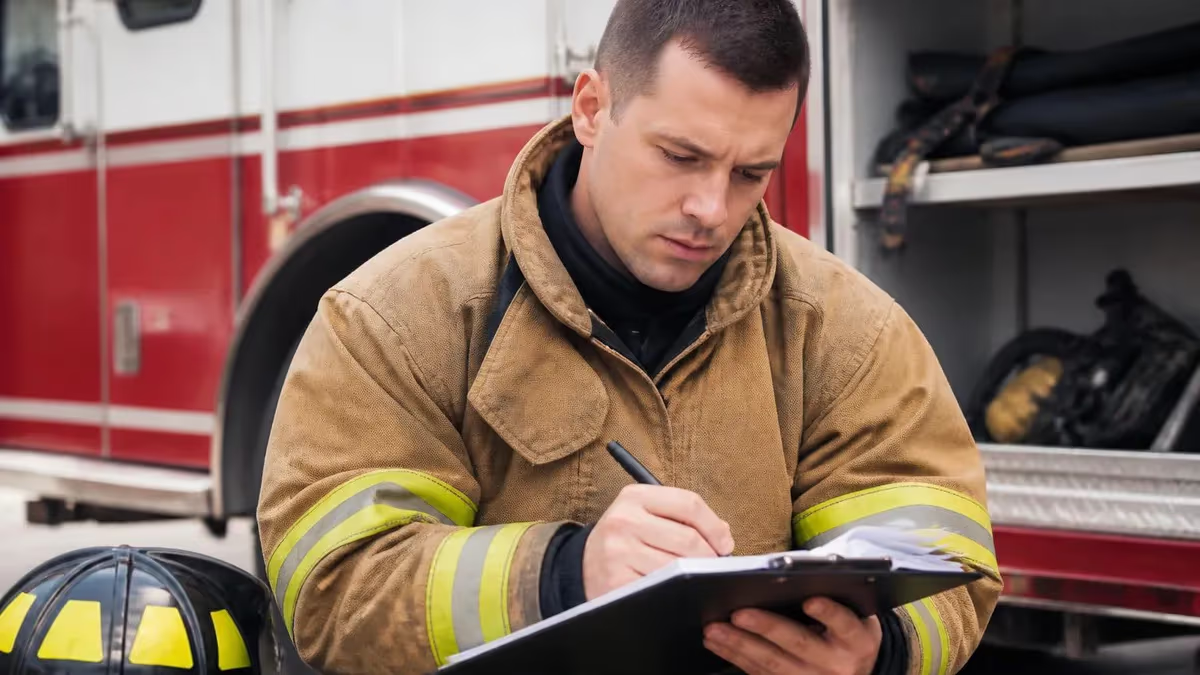
What Is Firefighter Drug Testing?
Firefighter drug testing is a mandatory screening process that fire departments use to ensure candidates and active personnel are free from substances that would impair their ability to perform safely. The work of firefighting requires acute physical coordination, rapid decision-making under pressure, and the ability to operate dangerous equipment in life-threatening conditions. Impairment from any substance — legal or illegal — creates risk not just for the affected firefighter but for the entire crew, civilian victims, and the public. Drug testing is how departments maintain the fitness standards that public safety requires.
Pre-employment drug testing is universal among fire departments. Before any conditional job offer becomes final, you'll be required to submit to drug screening as part of the background investigation and medical evaluation process. This is non-negotiable and non-waivable — there's no appeal pathway for a failed pre-employment drug test. If you test positive, the offer is withdrawn. Some departments impose a waiting period before you can reapply; others permanently disqualify candidates who fail pre-employment screens. Knowing the department's specific policy before you begin the application process is important if there's any uncertainty about your test results.
Beyond pre-employment, firefighters are subject to ongoing drug testing throughout their careers. Random testing is standard — departments select personnel for testing through randomized processes on unannounced schedules, typically several times per year across the force. Post-incident testing occurs after any accident, injury, or critical incident involving department personnel or equipment, regardless of apparent fault. Reasonable-suspicion testing is initiated when supervisors observe behavior consistent with impairment — slurred speech, unsteady movement, erratic behavior, or other documented indicators. Each testing trigger has different protocols, but all carry serious consequences if results are positive.
Drug testing in fire departments is federally regulated for departments that receive certain federal funding, and many are also subject to state-level testing requirements. Departments that operate under collective bargaining agreements may have negotiated specific testing procedures, chain-of-custody requirements, and dispute processes for contested results. Career departments in large urban areas typically have more formalized testing programs with written policies, medical review officer (MRO) oversight, and clear procedural protections. Smaller volunteer or combination departments may have less formalized programs, but the underlying requirement to maintain drug-free standards remains consistent.
The testing process itself begins with collection — typically a urine sample collected at a certified laboratory or collection site under direct or observed conditions to prevent tampering. Collected samples are tested first using an immunoassay screening test, which is fast and sensitive but can produce false positives.
Any positive result from the initial screen is confirmed using gas chromatography-mass spectrometry (GC-MS), which is highly accurate and definitive. A Medical Review Officer (MRO) — a licensed physician — reviews all positive confirmed results to determine whether a legitimate medical explanation exists (such as a prescription medication) before reporting the result to the department.
Candidates often ask how far in advance they need to stop using substances before a drug test. The answer depends on the substance, the test type, and individual metabolism. Urine tests detect most substances for 3–7 days for single use and longer for heavy or chronic use. Hair follicle tests detect use over the previous 90 days, making them significantly more difficult to clear with short-term abstinence.
Departments that use hair testing — increasingly common in some regions — effectively require a multi-month clean period rather than days. If you're planning to apply to a fire department, abstaining from all substance use well in advance is the only reliable approach.
What Substances Does Firefighter Drug Testing Screen For?
Standard firefighter pre-employment testing typically uses a 10-panel urine drug screen, though 5-panel and 12-panel screens are also used depending on the department. The 5-panel screens for marijuana (THC metabolites), cocaine, opioids, amphetamines, and phencyclidine (PCP). The 10-panel adds barbiturates, benzodiazepines, methadone, propoxyphene, and methaqualone. Some departments include additional substances — MDMA, synthetic cannabinoids, designer drugs, or prescription drug monitoring — particularly in jurisdictions where opioid abuse has been a significant problem.
Alcohol is tested separately from the standard panel and is typically not included in urine drug screens used for pre-employment. Breathalyzer or blood alcohol tests for alcohol are used in post-incident and reasonable-suspicion contexts. Some departments do prohibit alcohol use within a specific period before reporting for duty (commonly 8–12 hours) and test for it under appropriate circumstances, but it's generally handled under separate policies from the drug testing program.
Prescription medications are a source of confusion for many applicants. Taking a legitimately prescribed controlled substance — an opioid pain medication, a benzodiazepine for anxiety, or stimulants for ADHD — can produce positive results on initial screening panels. This is why the Medical Review Officer step exists. If you have a legitimate prescription for a substance that appears on a drug test, disclose it to the MRO during the review process.
The MRO will verify your prescription and determine whether the use is consistent with the test result. A confirmed prescription does not automatically clear you — departments may still evaluate whether the medication itself impairs job performance, and some medical conditions underlying the prescription may be independently disqualifying under medical standards.
Knowing what the specific department you're applying to uses for their screening panel is helpful but not always easy to determine in advance. For a comprehensive overview of what the full firefighter drug test process entails — from collection through MRO review — reviewing published department policies and union contracts where available is the most reliable approach. The broader cps firefighter test study guide for the Civil Service exam covers the full range of background, medical, and physical requirements that go alongside drug screening in the candidate evaluation process.
Synthetic cannabinoids (K2, Spice, and similar products) are designed to mimic THC effects but have different chemical structures that don't always appear on standard marijuana panels. Some departments have added synthetic cannabinoid testing to their panels in response to their use among applicants who believed standard panels couldn't detect them.
Additionally, delta-8 THC products — legal at the federal level and in many states — do produce metabolites that appear on standard marijuana tests. Candidates using delta-8 products under the assumption that they're 'legal marijuana' and therefore safe from testing are frequently surprised to test positive for THC metabolites on standard panels.
Over-the-counter medications can cause unexpected complications. Some cold medications containing pseudoephedrine or ephedrine can trigger positive results for amphetamines on initial screens. Ibuprofen at high doses has historically triggered false positives for marijuana on some panel types. These are exactly the situations the MRO review process is designed to catch — providing a documented explanation typically resolves a false positive without consequence. The key is not attempting to hide use; the MRO process exists to protect candidates and employees from false positives, not to catch additional substance use.

Marijuana and Firefighter Drug Testing
The complicated legal status of marijuana — legal for recreational use in a growing number of states, still federally prohibited under Schedule I — creates significant confusion for firefighter applicants and active firefighters alike. The simplest and most important fact: the majority of fire departments continue to test for and disqualify based on marijuana use, regardless of state law. Legal marijuana use at the state level does not override departmental or federal standards for firefighter fitness. This is especially true for departments that receive federal funding and are subject to federal drug-free workplace requirements.
Why do departments maintain marijuana testing and disqualification policies even in legal states? The core reason is the safety-sensitive nature of firefighting. Federal drug-free workplace regulations that apply to safety-sensitive transportation positions (airlines, railroads, trucking) also influence fire department policies in many jurisdictions. Courts have generally upheld fire department marijuana policies even against challenges from employees in legal states, reasoning that the safety demands of the job justify stricter standards than employment law requires in most commercial contexts.
Some departments — particularly in jurisdictions where marijuana legalization has been law for several years — have modified their policies. A few have eliminated marijuana from their pre-employment screens entirely. Others have adopted lookback policies that disqualify candidates only if they've used marijuana within a specific recent period (commonly 1 year or 6 months prior to application, rather than treating any lifetime use as disqualifying). Still others are in the process of evaluating or updating their policies as labor markets tighten and the pool of candidates with zero marijuana history shrinks.
For active firefighters, discipline for positive marijuana tests varies by department and labor agreement. Some departments maintain zero-tolerance termination for any positive result. Others have tiered response systems — first positive offense triggers mandatory treatment referral and probation; subsequent positives lead to termination. The specifics are heavily influenced by the terms of collective bargaining agreements in unionized departments.
If you're a current firefighter with questions about your department's marijuana policy or your rights in the event of a positive test, consulting your union representative before the situation arises is better than doing so after. The cps firefighter exam preparation process covers standards and background requirements in detail, but department-specific drug policies require direct inquiry to your employer or union. For candidates evaluating whether to pursue a cps firefighter career, understanding the full scope of character and fitness standards — including drug policies — before making the commitment is part of informed career planning.
CBD products derived from hemp are legal under federal law and in all states, but they're not necessarily safe from a testing standpoint. Many CBD products contain trace amounts of THC that can accumulate to testable levels with regular use. The FDA does not certify CBD product labels for accuracy, and independent testing has repeatedly found that products labeled as THC-free contain measurable THC.
If you're using CBD regularly as part of a wellness routine and plan to apply to a fire department, stopping use well in advance of testing is the only reliable approach — relying on product labels for testing safety has proven to be insufficient protection for numerous candidates.
The trend among fire departments nationally is toward less strict marijuana policies as legalization spreads, labor markets tighten, and the cultural conversation shifts. But change is slow and uneven — departments in conservative jurisdictions may maintain strict policies indefinitely. Candidates who've used marijuana in the past should verify the specific policy of each department they're considering applying to before beginning the application process, rather than assuming that state legalization implies departmental acceptance.
Firefighter Drug Testing: By Situation
Timing: Required before any conditional offer becomes final. Usually scheduled during the background/medical evaluation phase, after passing written and physical tests.
Process: Candidate reports to a certified collection site, provides a urine sample (and possibly hair if the department uses it) under controlled conditions. Sample sent to certified laboratory for immunoassay screening, with confirmed positives reviewed by an MRO.
What to do: Abstain from all substance use for the appropriate detection window. Disclose any legitimate prescription medications to the MRO during review. Do not attempt to adulterate or dilute your sample — these are detected and treated as failures.

Firefighter Drug Testing: Pre-Employment Checklist
- ✓Research the specific drug testing policy of each department you're applying to — marijuana policies especially vary by jurisdiction
- ✓Abstain from all substance use well in advance of applying — urine tests require days to weeks; hair tests require 90+ days
- ✓Stop using all CBD products at least 30–60 days before testing — trace THC in CBD products can accumulate to detectable levels
- ✓Compile documentation for any prescription medications that could affect test results before your test date
- ✓Disclose prescription medications to the Medical Review Officer during MRO review if you receive a positive result
- ✓Do not attempt to tamper with, adulterate, or substitute your sample — these actions are detected and permanently disqualifying
- ✓Follow all collection site instructions exactly — a refused or invalid collection is treated as a failed test
- ✓Verify whether the department uses urine, hair, or both — preparation requirements differ significantly by test type
Firefighter Drug Testing: What Candidates Should Know
- +Clear, predictable process — knowing what to expect removes uncertainty from the testing phase
- +MRO review protects candidates from false positives caused by prescription medications or OTC drugs
- +Most substances clear urine testing within a week — adequate preparation time exists for most candidates
- +Departments are increasingly transparent about their testing policies in job postings
- +Confirmed positive results include MRO review — legitimate prescriptions can be documented and verified
- +Random testing applies equally to all personnel — no singling out of individuals without reasonable suspicion
- −Marijuana disqualification persists in most departments regardless of state legal status
- −Hair follicle testing is increasingly used — 90-day detection window requires very long abstinence period
- −Reapplication windows after a failed test can be long — often 1–2 years, sometimes permanent disqualification
- −CBD products are not reliably safe from THC detection — product labels are not certified for accuracy
- −Random testing continues throughout career — ongoing compliance required indefinitely
- −Delta-8 and synthetic cannabinoids are increasingly detected on panels, creating risks for users of 'legal' products
Pros and Cons at a Glance
| Pros | Cons |
|---|---|
| Clear, predictable process — knowing what to expect removes uncertainty from the testing phase | Marijuana disqualification persists in most departments regardless of state legal status |
| MRO review protects candidates from false positives caused by prescription medications or OTC drugs | CBD products are not reliably safe from THC detection — product labels are not certified for accuracy |
| Most substances clear urine testing within a week — adequate preparation time exists for most candidates | Random testing continues throughout career — ongoing compliance required indefinitely |
What Happens If You Fail a Firefighter Drug Test?
Failing a pre-employment firefighter drug test results in immediate withdrawal of the conditional job offer. There's no retesting, no second chance on the same application, and no partial credit for being close to passing. The hiring process ends at that point. The department's decision is final for that application cycle. Whether you can reapply depends entirely on the department's policy — some allow reapplication after a defined waiting period (typically 1–3 years), others permanently disqualify any applicant who fails a pre-employment screen.
For active firefighters who fail a random or for-cause drug test, the consequences range from mandatory treatment referral and probation on a first offense to immediate termination for subsequent offenses or particularly serious violations. Departments with unionized workforces typically have negotiated procedures that provide due process before termination — a grievance process, access to union representation, and potentially arbitration. Even with union protections, a confirmed positive test for most substances makes continued employment extremely difficult to preserve. Departments view drug test failures as serious fitness-for-duty violations, and arbitrators typically uphold terminations for positive tests on second offenses.
The record of a failed drug test follows a candidate longer than most other disqualifications. Background investigation reports are shared among some law enforcement and public safety agencies, meaning a failed pre-employment drug test at one department may surface when you apply to another. This varies by jurisdiction and department, but the risk of cross-department information sharing is real in interconnected regional public safety hiring networks. It's not universal — many departments conduct independent background investigations — but it's a factor worth considering.
Some candidates who fail pre-employment tests pursue appeals or challenge the results through the MRO process or legal channels. The appeal window is typically short — 72 hours to request split sample testing from the original collection in most standard protocols. If you believe your test result was a laboratory error or affected by a legitimate prescription you didn't disclose in time, pursuing the MRO review and split sample request process is the appropriate path. Administrative challenges to drug test results that went through proper collection, laboratory, and MRO review procedures rarely succeed without substantive evidence of procedural error.
For candidates who want to build the most competitive possible application — including a clean background and strong exam scores — the cps practice test preparation materials provide the foundational academic preparation. The written exam is the first major hurdle in most firefighter hiring processes, and strong exam performance keeps your candidacy moving forward to the medical, background, and drug testing phases.
Every element of the hiring process — from the written exam through drug screening — requires preparation, honesty, and alignment with the standards the profession demands. Candidates who approach the process transparently and with adequate preparation give themselves the best chance of success at every stage.
The firefighting profession's drug testing standards exist for genuine safety reasons, not arbitrary gate-keeping. The job demands 100% cognitive and physical capacity in moments when human lives depend on it. The standards reflect that reality. Candidates who can meet those standards — and maintain them throughout a career — are positioned to serve effectively in one of the most respected professions in public service. Understanding the drug testing process clearly and preparing accordingly is simply part of taking the career seriously.
Sample CPS Firefighter Test Practice Questions
Try these questions from our free CPS Firefighter Test practice tests. The correct answer and an explanation follow each question.
A firefighter must carry two 50-foot sections of 1.75-inch hose up three flights of stairs. If each 50-foot section weighs 28 pounds when empty, what is the total weight of the hose the firefighter is carrying?
- A. 28 pounds
- B. 84 pounds
- C. 56 pounds
- D. 112 pounds
Answer: C. 56 pounds
The question asks for the total weight of the two sections of hose being carried. Multiply the weight of one section by the number of sections: 28 pounds/section * 2 sections = 56 pounds. The number of stairs is extra information not needed for the calculation.
A firefighter needs to carry a 28-foot extension ladder alone. To maintain balance and stability with the least amount of effort, the firefighter should position their shoulder at what point on the ladder?
- A. At the ladder's marked center point or balance point.
- B. Approximately one-third of the way from the base.
- C. Exactly at the halfway mark of the first section.
- D. As close to the tip of the ladder as possible.
Answer: A. At the ladder's marked center point or balance point.
To balance an object for a single-person carry, it must be supported at its center of gravity. This is the point where the object's weight is evenly distributed on all sides. Carrying the ladder at this balance point prevents it from tipping forward or backward, allowing for a more stable and less strenuous carry.
During station cleanup, you observe a senior firefighter using a wooden stepladder that you know has been flagged for removal due to a crack. When you point it out, the firefighter dismisses your concern, saying, 'It's fine, I'm only going up a few steps.' What is the most appropriate initial action?
- A. Immediately report the unsafe act to your company officer.
- B. Respectfully state that for their safety you are taking the ladder out of service, and offer to get them the proper equipment.
- C. Walk away so you are not involved if the ladder fails.
- D. Allow the senior firefighter to continue, as their experience means they can judge the risk appropriately.
Answer: B. Respectfully state that for their safety you are taking the ladder out of service, and offer to get them the proper equipment.
This is a direct and immediate safety concern for a fellow firefighter. The most appropriate initial action is a direct, respectful, peer-to-peer intervention that corrects the unsafe condition. It addresses the hazard, reinforces a positive safety culture, and offers a solution without immediately escalating to disciplinary action or ignoring the problem.
Read the following passage: 'Wildland firefighters use a tool called a Pulaski to construct fire lines. One end of the Pulaski is an axe blade used for chopping through vegetation, while the other end is an adze blade used for grubbing and scraping. Together these functions allow a single firefighter to both cut and dig efficiently.' What can be inferred about the Pulaski's design?
- A. It was designed primarily for use on structural fires
- B. Its dual-purpose design increases a single firefighter's efficiency
- C. It requires two firefighters to operate safely
- D. It is only effective in dense forest environments
Answer: B. Its dual-purpose design increases a single firefighter's efficiency
The passage explains that both blades together allow one firefighter to cut and dig, directly inferring the dual-purpose design improves efficiency.
CPS Firefighter Questions and Answers
About the Author

Educational Psychologist & Academic Test Preparation Expert
Columbia University Teachers CollegeDr. Lisa Patel holds a Doctorate in Education from Columbia University Teachers College and has spent 17 years researching standardized test design and academic assessment. She has developed preparation programs for SAT, ACT, GRE, LSAT, UCAT, and numerous professional licensing exams, helping students of all backgrounds achieve their target scores.
Join the Discussion
Connect with other students preparing for this exam. Share tips, ask questions, and get advice from people who have been there.
View discussion (7 replies)