
CPL Pilot: What It Means, What It Takes, and How to Get There 2026 October
Pass the CPL Pilot: 🔎 What It Means, What It exam with confidence. Practice questions with detailed explanations and instant feedback on every answer.
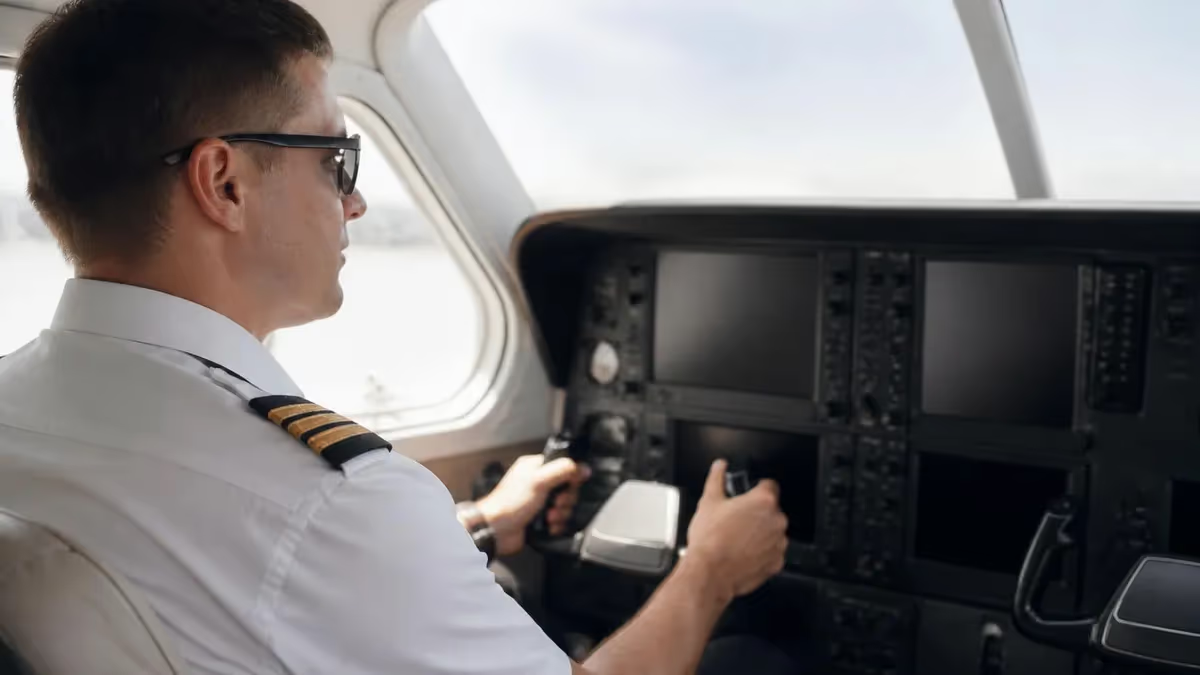
The term "CPL pilot" refers to someone who holds a Commercial Pilot Licence — the credential that allows you to fly aircraft for compensation or hire. It's the professional entry point into aviation, sitting above a Private Pilot Licence (PPL) and below the Airline Transport Pilot Licence (ATPL) that major airlines require.
If you're serious about a flying career, the CPL is where it actually begins. This guide covers what the licence authorizes you to do, the requirements to get it, how training works, and what comes after.
What a CPL Pilot Is Authorized to Do
A Commercial Pilot Licence unlocks categories of work that a private pilot simply can't do legally. With a CPL, you can:
- Fly as Pilot in Command (PIC) of aircraft for hire — charter flights, aerial survey, aerial photography
- Work as a flight instructor (with an additional Flight Instructor Rating)
- Fly air ambulance or medevac operations
- Work for cargo operators (small to mid-size freight)
- Act as co-pilot (First Officer) on commercial multi-crew aircraft with a Multi-Crew Cooperation (MCC) certificate
What a CPL doesn't automatically give you: the right to serve as captain of a multi-crew commercial airliner. For that, you need an ATPL (frozen or full). Most airline first officers hold a "frozen ATPL" — meaning they've passed all the ATPL theory exams but haven't yet accumulated the flight hours to convert to a full ATPL.
CPL vs. ATPL: What's the Difference?
This is probably the most common confusion in commercial aviation training. Here's how they relate:
A CPL lets you fly commercially as a single pilot or in specific co-pilot roles. A frozen ATPL means you've completed all the ATPL theoretical knowledge exams and hold a CPL/IR — but you haven't yet hit the 1,500 flight hours needed to unlock the full ATPL. Nearly every cadet airline program produces frozen ATPL holders, not full ATPLs. You "unfreeze" the ATPL after accumulating hours in airline service.
Think of it this way: CPL training and ATPL theory exams are intertwined in most integrated programs. You study and sit the ATPL exams during your CPL training, which positions you as a frozen ATPL holder when you finish — making you eligible to apply as a First Officer at commercial airlines.
- ✓Review the official CPL exam content outline
- ✓Take a diagnostic practice test to identify weak areas
- ✓Create a study schedule (4-8 weeks recommended)
- ✓Focus on your weakest domains first
- ✓Complete at least 3 full-length practice exams
- ✓Review all incorrect answers with detailed explanations
- ✓Take a final practice test 1 week before exam day
Two Routes to a CPL
There are two primary training pathways. Which one fits depends on your timeline, budget, and how much flying experience you already have.
Integrated Pathway (Modular Accelerated)
Integrated training programs take you from zero hours to frozen ATPL in roughly 18–24 months through a single flight school. You progress through PPL, instrument rating, multi-engine rating, and CPL in one continuous program designed to flow without gaps. These are full-time, expensive (typically £70,000–£100,000+), and preferred by airlines because the training is standardized and continuous.
The advantage: you're employable faster and have a recognizable training history that airline recruiters know how to evaluate. The disadvantage: the cost is substantial and usually requires financing or a training loan.
Modular Pathway
The modular route lets you build ratings one at a time, often while working. You get your PPL first, then add an Instrument Rating (IR), then your CPL, then your Multi-Engine Rating (MEP) and MCC. It's significantly cheaper if you spread it over time, but it takes longer (3–5+ years) and requires more self-management to stay on track.
EASA regulations allow CPL issuance with as few as 150 flight hours on the modular route (provided certain conditions are met). For CPL training specifics including structure, approved flight schools, and what's covered in each phase, see the full training guide.
| Section | Questions | Time |
|---|---|---|
| Air Law | 44 | — |
| Aircraft General Knowledge | 80 | — |
| Flight Performance & Planning | 43 | — |
| Navigation | 60 | — |
| Meteorology | 84 | — |
| Human Performance | 48 | — |
| Communications | 34 | — |
ATPL Theory Exams: The Academic Foundation
Whether you take the integrated or modular route, you'll need to pass 14 ATPL theoretical knowledge exams (under EASA rules). The exam subjects above represent the core categories, though EASA further splits some into subcategories.
Pass marks are typically 75% per subject. You have a limited number of attempts per subject and a window of time to complete all exams. Failing to pass within the window means starting over in some subjects. This is why most trainees take ground school seriously — these exams aren't trivial.
Ground school can be taken as part of an integrated program or as a standalone distance-learning or classroom course before beginning flight training. Several online providers cover all 14 subjects. The key is consistent study across several months — you can't cram 14 subjects in a few weeks.
Flight Hour Requirements
EASA CPL requirements (used across EU and many other countries including the UK post-Brexit via UK CAA, which mirrors EASA closely) set the following minimums:
- Integrated route: 195 total hours minimum, including 100 hours as PIC, 50 hours cross-country, 5 hours cross-country by night, 10 hours instrument flight
- Modular route: 200 total hours (or 150 in some cases), with 100 hours as PIC, similar cross-country requirements
In the United States, the FAA requires 250 total hours for a CPL. The UK CAA and EASA standards differ slightly from FAA — if you're training internationally, clarify which authority's requirements you'll be meeting before enrolling.
Medical Requirements for CPL Pilots
You'll need a Class 1 Medical Certificate to exercise CPL privileges commercially. This is more stringent than the Class 2 Medical a PPL requires.
The Class 1 Medical assesses cardiovascular health, vision, hearing, neurological function, and mental health. Some conditions that are acceptable for private flying disqualify applicants from commercial flight. Common issues that generate extra scrutiny: corrected vision beyond certain thresholds, color vision deficiencies (though this affects specific roles more than others), history of certain cardiac conditions, and some psychiatric diagnoses.
Get your Class 1 Medical assessment before committing significant money to flight training. It's the first thing you should do. Discovering a disqualifying condition after spending £30,000 on ground school and early flight training is a scenario to avoid entirely. Most aviation medical examiners (AMEs) can give you a realistic picture of your status at a first appointment.
Cost of CPL Training
Here's an honest breakdown. Costs vary significantly by country and flight school, but these ranges reflect current UK/EU pricing.
- Integrated program (UK/EU): £70,000–£100,000 all-in, including ground school, flight hours, exams, and ratings
- Modular route (UK/EU): £40,000–£65,000 total, but spread over 3–5 years and self-managed
- US FAA CPL (modular): $30,000–$60,000 depending on aircraft and location
Financing is common. UK pilot loans, bank loans, and some airline cadet bonds (where the airline funds training in exchange for a work commitment) are all used. Research bond schemes carefully — repayment penalties if you leave the airline early can be steep.
Career Entry Points for CPL Pilots
What does an newly qualified CPL pilot actually do first? Airlines don't typically hire zero-hour commercial pilots as First Officers — most want 500–1,500 hours minimum and a frozen ATPL plus Instrument Rating.
Common first jobs after CPL qualification:
- Flight Instructor (FI): The most common route. Instruct student pilots while building hours. Takes an additional FI rating, but you're accumulating hours quickly in a structured environment.
- Skydive pilot or banner tow pilot: Unconventional but real. These roles build hours faster than instructing in some markets.
- Charter and air taxi: Smaller operators sometimes hire lower-hours CPL holders for light twin or turbo-prop operations with specific type ratings.
- Airline cadet program: Some airlines (Ryanair, easyJet, TUI) run cadet schemes where they place newly qualified CPL/frozen ATPL holders directly into First Officer training. Competitive but a direct route.
The typical path to an airline seat: CPL/IR + frozen ATPL → flight instructing or charter work to 500–1,000 hours → regional airline First Officer → major carrier after building further.
Preparing for CPL Theory Exams
The ATPL/CPL theory exams are where many trainees struggle most. Flight training is intuitive in many ways; the theoretical exams are dense, technical, and require memorizing substantial volumes of regulatory and technical content.
A few things that consistently help: working through question banks (not just reading notes) from early in your ground school, using timed practice tests to simulate exam conditions, and grouping your weaker subjects for concentrated review rather than spreading revision evenly. Subjects like Navigation, Meteorology, and AGK (Aircraft General Knowledge) are consistently the heaviest in terms of content volume.
Don't overlook the Human Performance paper. It's shorter than the technical subjects but covers CRM, fatigue science, and cognitive factors that show up in practical scenarios too — not just exam questions.
CPL: Pros and Cons
- +cpl — cPL credential is recognized by employers and industry professionals
- +Higher earning potential compared to non-credentialed peers
- +Expanded career opportunities and professional advancement
- +Structured learning path builds comprehensive knowledge
- +Professional development that stays current with industry standards
- −Preparation requires significant time and study commitment
- −Associated costs for exams, materials, and renewal fees
- −Continuing education needed to maintain credentials
- −Competition for advanced positions can be challenging
- −Requirements and standards may vary by state or region
Pros and Cons at a Glance
| Pros | Cons |
|---|---|
| cpl — cPL credential is recognized by employers and industry professionals | Preparation requires significant time and study commitment |
| Higher earning potential compared to non-credentialed peers | Associated costs for exams, materials, and renewal fees |
| Expanded career opportunities and professional advancement | Continuing education needed to maintain credentials |
| Structured learning path builds comprehensive knowledge | Competition for advanced positions can be challenging |
| Professional development that stays current with industry standards | Requirements and standards may vary by state or region |
Sample Commercial Pilot Licence Practice Questions
Try these questions from our free Commercial Pilot Licence practice tests. The correct answer and an explanation follow each question.
During a sterile cockpit phase of flight, the pilot monitoring notices the pilot flying has missed a critical radio call from ATC. What is the most appropriate CRM action for the pilot monitoring to take?
- A. Wait until the sterile cockpit period is over to mention the missed call.
- B. Take over the radio and respond to the call without notifying the pilot flying.
- C. Assertively and clearly state, "ATC called with a heading change," and verify the pilot flying heard.
- D. Assume ATC will repeat the call if it was important.
Answer: C. Assertively and clearly state, "ATC called with a heading change," and verify the pilot flying heard.
Effective CRM requires assertive communication, especially for safety-critical information. During a sterile cockpit, communication should be limited to items essential for the safe operation of the flight. A missed ATC instruction is critical. The pilot monitoring has a duty to promptly and clearly bring this to the other pilot's attention to maintain situational awareness and ensure a safe outcome.
A Part 135 pilot deviates from operations specifications during an in-flight emergency. Under 14 CFR 135.19, what is the pilot's obligation after the flight?
- A. File a NASA ASRS report within 10 days to retain immunity
- B. Submit a written report to the FAA within 10 days of the deviation
- C. Notify the certificate holder's director of operations only
- D. No reporting is required if no damage or injury occurred
Answer: B. Submit a written report to the FAA within 10 days of the deviation
14 CFR 135.19 requires a pilot who deviates from any rule during an emergency to submit a written report to the FAA Administrator within 10 days.
A pilot is operating an aircraft over a congested area of a city. According to regulations, what is the minimum altitude the pilot must maintain above the highest obstacle within a horizontal radius of 2,000 feet?
- A. 500 feet
- B. 1,500 feet
- C. 1,000 feet
- D. 2,000 feet
Answer: C. 1,000 feet
According to 14 CFR § 91.119, when operating over any congested area of a city, town, or settlement, or over any open-air assembly of persons, an aircraft must be flown at an altitude of 1,000 feet above the highest obstacle within a horizontal radius of 2,000 feet of the aircraft.
A commercial pilot hears another aircraft transmit 'PAN-PAN, PAN-PAN, PAN-PAN.' What should the pilot do?
- A. Immediately switch to 121.5 MHz and assist
- B. Keep the frequency clear and listen for ATC instructions
- C. Continue normal communications; only ATC responds to urgency calls
- D. Transmit position to assist the aircraft in distress
Answer: B. Keep the frequency clear and listen for ATC instructions
Upon hearing a PAN-PAN urgency call, other aircraft should maintain radio silence on that frequency unless they can provide assistance, and follow ATC direction for handling.
About the Author

Attorney & Bar Exam Preparation Specialist
Yale Law SchoolJames R. Hargrove is a practicing attorney and legal educator with a Juris Doctor from Yale Law School and an LLM in Constitutional Law. With over a decade of experience coaching bar exam candidates across multiple jurisdictions, he specializes in MBE strategy, state-specific essay preparation, and multistate performance test techniques.
Join the Discussion
Connect with other students preparing for this exam. Share tips, ask questions, and get advice from people who have been there.
View discussion (9 replies)