
CPC Practice Tests 2026 September — Free Certified Professional Coder Exam Questions
Pass your CPC exam on the first attempt. 💡 Practice questions with detailed answer explanations, hints, and instant scoring.

The CPC (Certified Professional Coder) is the most widely recognized medical coding credential in the United States, and it's harder than most candidates expect. You've got 150 questions and 5 hours 40 minutes — that sounds generous until you're staring at a 10-line operative note and need to assign three correct codes from a 1,400-page CPT manual. Speed and accuracy under pressure are skills you can only build through practice, not through reading alone.
What makes CPC practice tests genuinely valuable isn't just the questions — it's the repetition of the lookup process. The CPC is open-book, meaning you can bring your ICD-10-CM, CPT, and HCPCS code books into the exam room. That doesn't make it easy; it means the test is designed around your ability to navigate those books quickly and select the most specific, accurate code.
Candidates who practice coding scenarios under timed conditions develop the index familiarity and tabular navigation speed that separates passing scores from failing ones. If you've never timed yourself flipping to E/M guidelines and back to the Tabular List in under two minutes, you're not exam-ready yet — regardless of how much content you've studied.
Practice tests also surface the question types that catch most first-time CPC candidates off guard. Operative note questions require you to read a surgical description, identify the procedure performed, and select the correct CPT code with the right modifiers — often while distinguishing between two codes that differ by a single anatomical detail. Evaluation and management (E/M) questions require you to apply the 2021 E/M guidelines to a clinical vignette.
Anatomy and medical terminology questions appear throughout. There is also a psychological dimension to CPC practice testing that rarely gets discussed. Most candidates feel overwhelmed the first time they sit a full-length timed test — flipping between three code books under pressure while reading dense clinical language feels nothing like studying from a textbook. That overwhelm is normal, and it fades with repetition.
The candidates who struggle on exam day are the ones who never exposed themselves to that pressure in practice. Consistent timed practice normalizes the experience enough that exam-day nerves do not derail your performance. Understanding what is cpc and how the exam is structured helps you allocate practice time across all tested domains rather than over-preparing for one section at the expense of others.
Reviewing cpc exam preparation strategies covers the content knowledge and test-taking approach that combine to produce passing scores on the AAPC certification.
CPC Exam Content: What's Tested
- Code selection specificity — ICD-10-CM questions test your ability to select the most specific code for a diagnosis, including laterality, episode of care, and combination codes that capture etiology and manifestation together
- Coding guidelines — Official ICD-10-CM guidelines (the long Tabular List introduction) govern sequencing, principal vs. secondary diagnosis selection, and code application rules — these guidelines are frequently tested
- Signs, symptoms, and uncertain diagnoses — When to code a definitive diagnosis vs. a sign/symptom; when to use "probable" or "suspected" codes in different care settings
- Injury and external cause codes — Fracture coding with episode of care (initial, subsequent, sequela), poisoning vs. adverse effect vs. underdosing, and external cause coding for injury circumstances
- Chronic vs. acute conditions — Multiple coding guidelines apply when both chronic and acute forms of a condition coexist; the CPC tests these sequencing rules consistently

Most CPC candidates make the same mistake: they take practice tests to check their score rather than to identify gaps. A score is a data point. What matters is understanding why you missed what you missed — and whether the error was a knowledge gap (you didn't know the coding guideline), a lookup gap (you knew but couldn't find the answer fast enough), or a reading comprehension gap (you misread the clinical scenario). Each type requires a different fix.
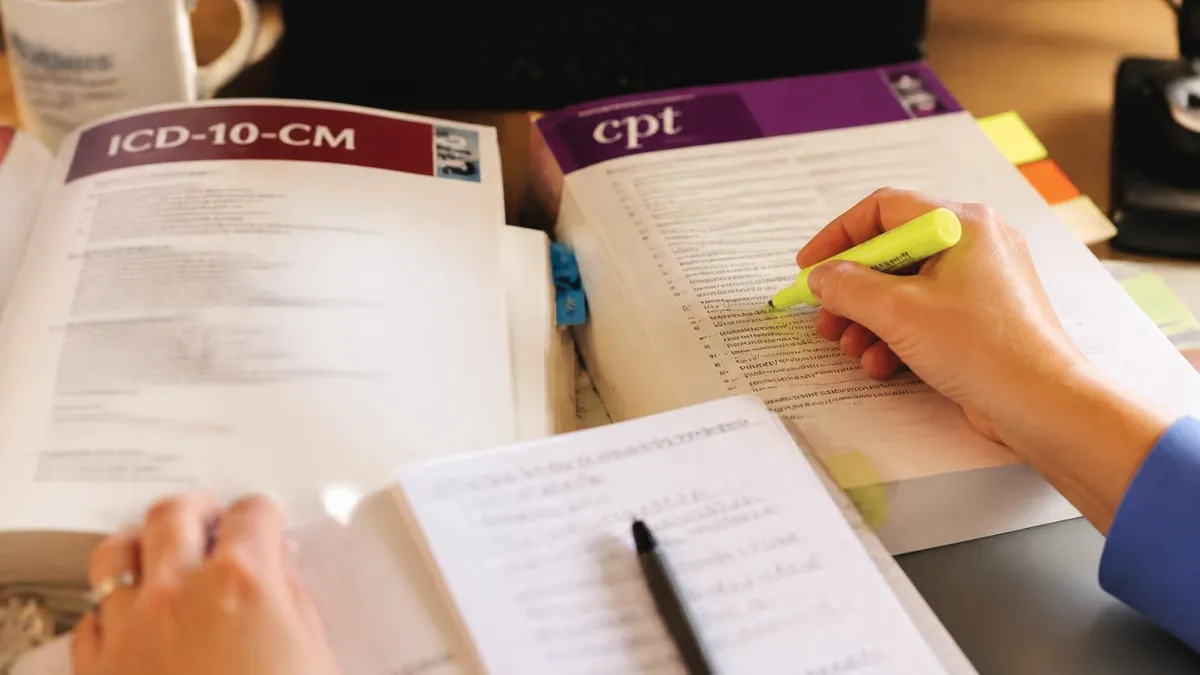
For knowledge gaps, go back to the AAPC study guide or the official coding guidelines and read the rule you violated. For lookup gaps, practice that specific section of your code books — tabbed, flagged, and annotated. The CPC allows you to write in your books, and experienced coders' exam copies are filled with highlights, sticky tabs at chapter breaks, and penciled notes next to confusing guidelines.
Your books should look used by exam day. For reading comprehension gaps, slow down and annotate the scenario before you look anything up — identify the diagnosis, the procedure, the setting, and the provider, then begin coding.
Domain scoring is also worth understanding before you take your first full-length practice test. The CPC does not report sub-scores by category on official score reports — you get a total score only. But your practice test performance absolutely should be tracked by domain so you know whether your weak point is E/M coding, surgery, medical specialties, or compliance.
Keeping a simple tally of wrong answers by section across multiple practice tests gives you better diagnostic data than any single score report. Aim for at least 4–5 full-length practice tests under timed conditions before your exam date. The 5-hour-40-minute time limit means roughly 2.5 minutes per question — that's plenty for straightforward questions and barely enough for complex operative notes.
If you're not taking timed practice tests, you won't know how your pacing feels under real conditions until it's too late to fix it. Understanding cpc certification requirements and what AAPC expects from passing candidates helps you calibrate your preparation to the right depth. Working through certified professional coder study strategies gives you a systematic approach to covering all tested sections in the weeks before your exam date.
Reviewing certified professional coder certification requirements confirms you meet eligibility before you register — the AAPC requires one year of coding experience or formal training for full CPC status (apprentice status available without experience).
CPC Certification Pros and Cons
- +CPC is the most widely recognized medical coding credential — AAPC reports over 200,000 active CPCs, giving it stronger employer recognition than any competing credential in physician office coding
- +Open-book format rewards skill over memorization — candidates who know how to navigate code books efficiently aren't disadvantaged by the volume of codes they'd otherwise need to memorize
- +Strong salary impact — median CPC salary is approximately $52,000–$65,000 depending on setting and specialization, with certified coders consistently earning more than uncertified counterparts
- +AAPC membership provides study resources, local chapters, networking, and continuing education — the ecosystem around the credential provides ongoing career value beyond the exam itself
- +Specialization credentials (CPC-H for hospitals, CPC-I for instructors, specialty-specific certs) allow experienced CPCs to build additional credentials on top of the base certification
- −Exam difficulty is consistently underestimated — the 70% passing requirement sounds low but first-attempt pass rates hover around 60–70% even among candidates who complete formal training programs
- −Code book navigation takes months to develop — candidates who try to pass without substantial hands-on coding practice consistently struggle with lookup speed under timed exam conditions
- −Ongoing CEU requirements (36 CEUs per 2-year renewal cycle) create a recurring time and cost obligation, with AAPC membership required for most CEU sources
- −The open-book format requires physical exam code books — candidates must purchase and annotate current-edition books, adding $200–$400 to preparation costs
- −Remote coding job market has grown competitive — the CPC credential alone is increasingly table-stakes; specialized experience in high-demand areas (oncology, surgery, cardiology) provides additional differentiation
Most AAPC training programs recommend 3–6 months of preparation for the CPC, and that estimate is realistic if you're coming in with healthcare background knowledge. Candidates without clinical exposure typically need closer to 6 months — anatomy and medical terminology alone require weeks of dedicated study before coding scenarios make intuitive sense. If your prerequisites feel shaky, don't rush the timeline. First-attempt failures cost a retake fee of $199 (member) or $249 (non-member) on top of your original exam investment.
AAPC's official CPC Study Guide is the primary recommended resource — it's aligned directly to the exam content outline and includes practice questions. Blitz Medical Coding is a widely praised third-party resource with video explanations for every code section. The AAPC's online question bank provides additional practice questions. For free resources, AAPC's website publishes the exam content outline, sample questions, and the official 2021 E/M guidelines.
Medical coding forums (including AAPC's own community) are active with current candidates sharing question types and study strategies.
The week before your exam should be spent almost entirely on practice tests and targeted review of your weakest sections — not new content learning. Run through at least one full-length timed practice test in the final five days.
Check your code books are the correct year (ICD-10-CM and CPT update annually on October 1; HCPCS updates on January 1) — bringing outdated code books to the exam is a real and avoidable mistake. If you do not pass on your first attempt, it is not the end. AAPC allows candidates to retake the exam up to two additional times within a 12-month period at a reduced fee.
Many candidates who retake have a focused advantage — they know exactly which sections cost them points and can target those specifically rather than re-reviewing everything. The retake pass rate is meaningfully higher than the first-attempt rate for candidates who do targeted review between attempts rather than simply registering again and hoping for a different outcome.
Confirming you understand cpc exam day logistics — what ID you need, whether your testing site is in-person or remote, and how to request accommodations if needed — removes uncertainty from an already high-stakes day.
- ✓Review the official CPC exam content outline
- ✓Take a diagnostic practice test to identify weak areas
- ✓Create a study schedule (4-8 weeks recommended)
- ✓Focus on your weakest domains first
- ✓Complete at least 3 full-length practice exams
- ✓Review all incorrect answers with detailed explanations
- ✓Take a final practice test 1 week before exam day

CPC Practice Test Questions and Answers
About the Author

Certified Internal Auditor & Compliance Certification Expert
University of Illinois Gies College of BusinessBrian Henderson is a Certified Internal Auditor, Certified Information Systems Auditor, and Certified Fraud Examiner with an MBA from the University of Illinois. He has 19 years of internal audit and regulatory compliance experience across financial services and healthcare industries, and coaches professionals through CIA, CISA, CFE, and SOX compliance certification programs.
Join the Discussion
Connect with other students preparing for this exam. Share tips, ask questions, and get advice from people who have been there.
View discussion (8 replies)