
CPC Certification Requirements: AAPC Eligibility Guide 2026 September
🎓 Prepare for the CPC Certification Requirements: AAPC certification. Practice questions with answer explanations covering all exam domains.

CPC Certification Requirements: What AAPC Requires
The Certified Professional Coder (CPC) credential is issued by AAPC — the American Academy of Professional Coders. It's the most widely recognized medical coding certification in the U.S., and it opens doors to jobs in physician offices, hospitals, billing companies, and insurance payers.
To earn your CPC, you need to meet two things: pass the CPC exam and fulfill the experience/education requirement. The exam is the harder part — it's long, it's technical, and it requires solid coding knowledge. But you also can't just walk in off the street and sit for it without any background.
Here's what AAPC requires and how the eligibility process actually works.
The Education or Experience Requirement
AAPC requires that CPC candidates demonstrate either formal education in medical coding or practical work experience. Specifically:
Work Experience: Two years of on-the-job professional coding experience. This means billing and coding in a medical setting — physician offices, outpatient facilities, billing companies. Hospital inpatient coding doesn't count for CPC (that's the domain of the CCS credential). The experience must involve actually assigning CPT, ICD-10-CM, and HCPCS Level II codes.
Education Equivalent: If you don't have two years of experience, AAPC accepts completion of an AAPC-recognized training program as an equivalent. These are formal coding courses offered through community colleges, vocational schools, and online programs that use the AAPC curriculum.
Here's the catch — and it trips up a lot of first-time candidates: you can actually sit for the CPC exam before you have the experience or education requirement met. You'll pass as a CPC-A (CPC Apprentice) instead of a full CPC. The "A" designation is removed from your credential once you fulfill the two-year experience or education requirement and submit documentation to AAPC.
What the CPC Exam Covers
The CPC exam is 150 questions answered over a 5-hour and 40-minute window. That's roughly 2.2 minutes per question — tight, especially for the coding questions where you're actually looking up codes in your codebooks.
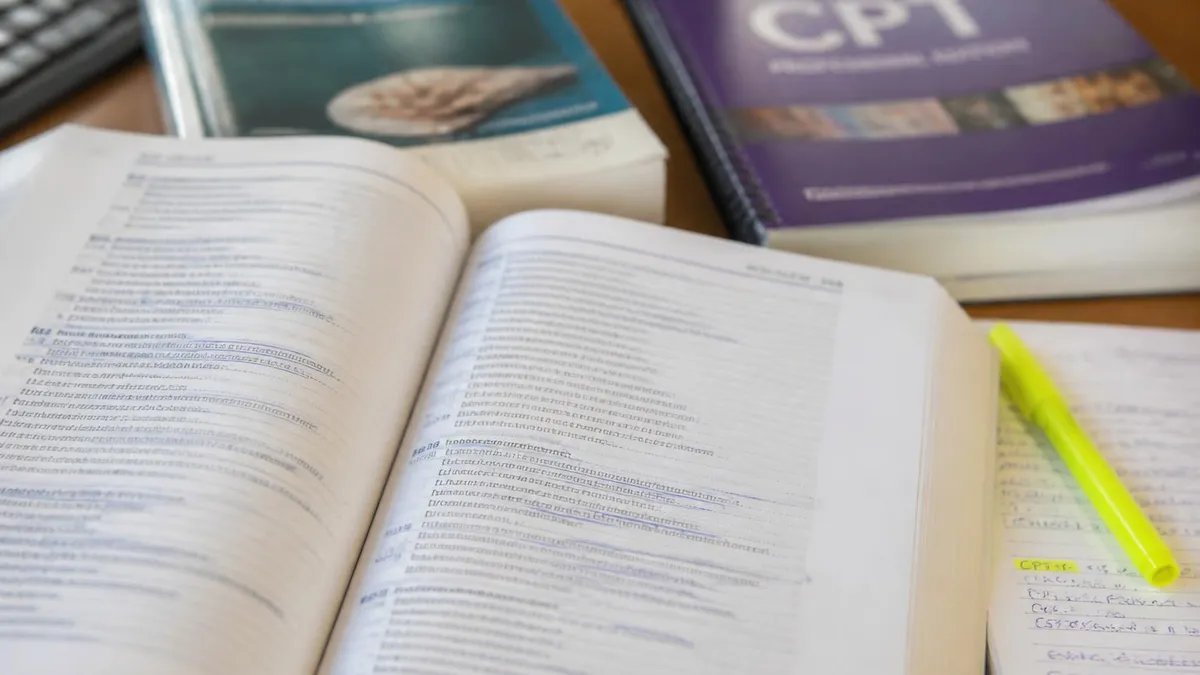
You're allowed to bring physical codebooks: the current CPT, ICD-10-CM, and HCPCS Level II manuals. Tabbed and highlighted — those are legal and expected. The exam is open-book in that sense, but it's not easy open-book. The questions aren't answered by just flipping to a page; they require understanding guidelines, modifier usage, bundling rules, and sequencing conventions.
The content domains covered on the exam include:
- Medical terminology and anatomy
- ICD-10-CM diagnosis coding
- CPT surgery coding (the largest section)
- Evaluation and management (E/M) coding
- Radiology, pathology, and laboratory coding
- Medicine coding
- HCPCS Level II coding
- Modifiers
- Compliance and regulatory topics
Surgery coding dominates the exam — roughly 30% of questions come from CPT surgery sections. That's where most candidates lose the most points and where preparation time should be concentrated.
Did You Know? Passing the CPC exam on your first attempt saves both time and money. Start with diagnostic practice tests to identify weak areas.
Who Should Pursue CPC Certification?
The CPC is specifically designed for outpatient and physician-office coding. If you're working in — or want to work in — coding for medical practices, ambulatory surgery centers, urgent care, or outpatient clinics, the CPC is the right credential. It's the most employer-recognized credential for those settings.
If you're interested in hospital inpatient coding, the CCS (Certified Coding Specialist, from AHIMA) or CCS-P (outpatient version) might be a better fit. The CPC and CCS credentials target different coding environments.
That said, the CPC's breadth makes it useful across many settings. Billing companies often prefer CPC-credentialed coders because the credential covers the full range of CPT codes, modifiers, and compliance knowledge that billing work demands.
How to Apply for the CPC Exam
The application process is through AAPC's website. You'll need to:
1. Create an AAPC account (or log in if you already have one)
2. Register for the CPC exam under "Certifications"
3. Pay the exam fee — currently $399 for AAPC members and $459 for non-members
4. Choose your testing format: in-person proctored or remote proctored online
5. Select your exam date and location (or schedule your remote proctored session)
AAPC membership isn't required to take the exam, but it's worth the annual fee if you're going to use AAPC resources for study and join a local chapter. Student memberships and first-year professional memberships are cheaper than the standard annual rate.
CPC Exam Passing Score
You need a 70% or higher to pass — 105 correct out of 150. AAPC allows you to retake the exam if you don't pass, but each retake costs an additional fee. Passing on the first attempt saves time and money, which is why preparation quality matters.
AAPC also reports domain-level performance on your score report, so even if you don't pass, you can see exactly which areas dragged your score down. Most candidates who fail do so in surgery coding or E/M — the two most complex and most heavily weighted domains.
Maintaining Your CPC Certification
Once you earn the CPC, you'll need to renew it every two years. Renewal requires 36 continuing education units (CEUs) every two years, plus payment of a renewal fee. CEUs can be earned through AAPC-approved webinars, workshops, online courses, and local chapter meetings.
If you let your credential lapse, you can typically reinstate it within a certain window without retesting. Beyond that window, reinstatement may require retaking the exam.
You can see what job opportunities come available with CPC credentials at the CPC job market overview — it covers salary ranges, employer types, and how the credential compares in the current hiring environment.
Preparing for the CPC Exam
The CPC is a legitimate challenge. Most candidates spend 3–6 months preparing. The most effective preparation combines:
- Reading and understanding the coding guidelines in your CPT and ICD-10-CM manuals
- Practicing with timed, full-length mock exams
- Drilling the surgery sections — particularly musculoskeletal, integumentary, and cardiovascular CPT codes
- Reviewing E/M guidelines thoroughly (the 2021 changes are testable)
- Practicing with individual coding scenarios by category
Practicing with surgical coding principles practice tests and radiology and pathology coding questions mirrors the actual exam structure and helps you build both speed and accuracy before test day.

CPC: Pros and Cons
- +cpc — cPC certification validates expertise recognized by employers nationwide
- +Certified professionals typically earn 15-20% higher salaries
- +Opens doors to advanced positions and leadership roles
- +Demonstrates commitment to professional standards and ethics
- +Builds a strong professional network through certification communities
- −Exam preparation typically requires 2-4 months of dedicated study
- −Certification and exam fees can range from $150-$500+
- −Must complete continuing education to maintain active certification
- −Pass rates vary — thorough preparation is essential for success
- −Some certifications require prerequisite experience or education




CPC Exam Eligibility: The Bottom Line
The CPC certification requirements aren't designed to be gatekeeping — they're designed to make sure the credential means something. AAPC allows candidates without experience to sit for the exam and earn the CPC-A designation, which gives you a realistic path into the field even without years of prior work.
What you do need is genuine exam preparation. The CPC is a 150-question exam with specific CPT and ICD-10-CM coding knowledge tested under time pressure. That's not something you pass by cramming the night before — it requires months of systematic study and a lot of practice coding.
Start by getting your codebooks and learning the structure. Then practice with topic-specific question sets — HCPCS Level II coding practice and surgical coding principles are areas where consistent drilling pays off most. Track your performance by domain, identify your weakest areas, and drill those specifically in the final weeks before your exam date.
The CPC is achievable with the right preparation. Thousands of coders earn it every year — including first-time test-takers with no prior work experience who came in prepared.
About the Author

Educational Psychologist & Academic Test Preparation Expert
Columbia University Teachers CollegeDr. Lisa Patel holds a Doctorate in Education from Columbia University Teachers College and has spent 17 years researching standardized test design and academic assessment. She has developed preparation programs for SAT, ACT, GRE, LSAT, UCAT, and numerous professional licensing exams, helping students of all backgrounds achieve their target scores.
Join the Discussion
Connect with other students preparing for this exam. Share tips, ask questions, and get advice from people who have been there.
View discussion (8 replies)