
Online CPC Training: Your Complete Guide to Becoming a Certified Professional Controller
Master online CPC training with our complete guide. Requirements, top programs, study tips & practice tests to pass your controller certification. 🎯
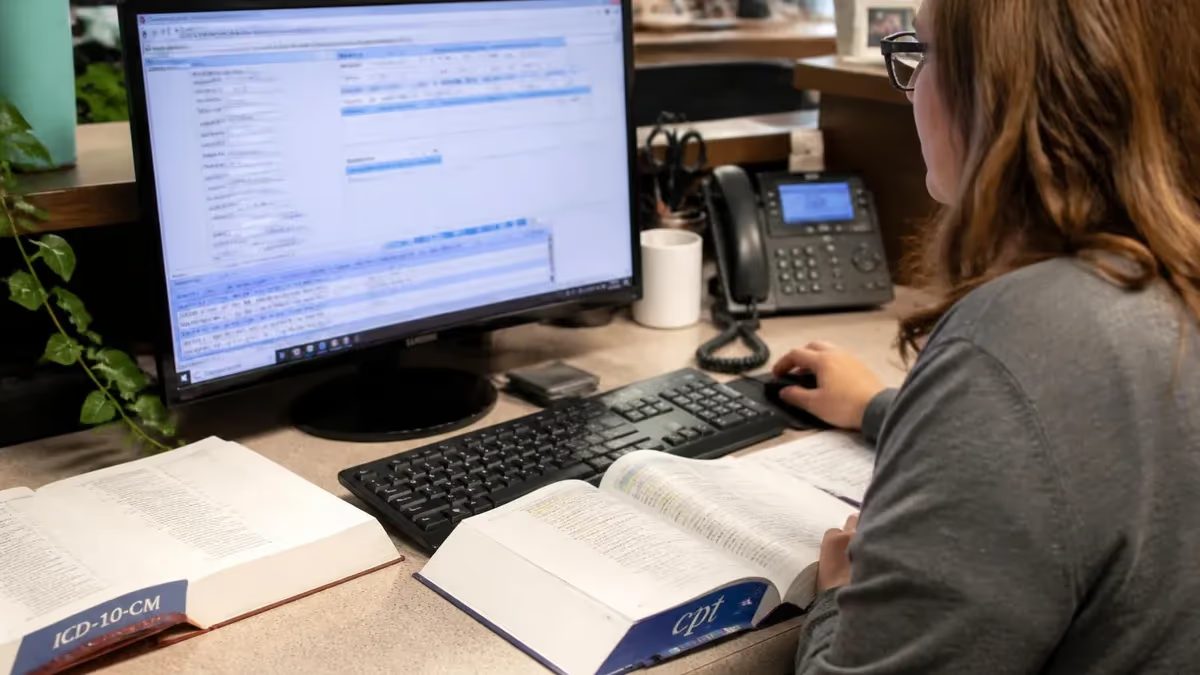
Online CPC training has become the most accessible and efficient pathway for aspiring air traffic controllers to earn their Certified Professional Controller designation. Whether you are transitioning from military aviation, completing a college AT-CTI program, or starting from scratch, today's digital learning platforms give you the flexibility to build critical knowledge around your existing schedule. Before you can step into a facility and manage live traffic, FAA regulations require a solid academic foundation — and structured cpc online training delivers exactly that in a format designed for modern learners.
The Federal Aviation Administration reports that the U.S. will need to hire more than 10,000 new air traffic controllers over the next decade to replace a rapidly retiring workforce. That demand creates real urgency for qualified candidates who can demonstrate both theoretical mastery and practical competency. Online training programs help bridge the gap between initial eligibility and facility readiness by letting students cover radar fundamentals, airspace classifications, weather interpretation, and phraseology at their own pace before they ever touch a simulator.
Understanding what online CPC training actually covers is essential before you enroll in any course. The curriculum typically spans six core knowledge domains: aircraft performance and systems, airspace classification and structure, meteorology and weather avoidance, ATC procedures and phraseology, flight planning and coordination, and emergency procedures. Each domain maps directly to competencies the FAA evaluates during your Academy training in Oklahoma City and later at your assigned facility during On-the-Job Training (OJT).
Cost is another factor that makes online training especially appealing. Traditional in-person prep courses can run $2,000 to $5,000 when you factor in travel, lodging, and materials. Reputable online programs typically range from $300 to $800 for a self-paced course bundle, and free resources — including practice tests, flashcard decks, and YouTube tutorials from retired controllers — supplement paid instruction effectively. That cost advantage is particularly significant for candidates who are already managing student debt from an aviation-focused degree program.
Scheduling flexibility is perhaps the single greatest advantage online CPC training offers. Facility training schedules are notoriously rigid once you are hired, but the months before your Academy date are yours to structure. Many successful trainees recommend dedicating eight to twelve weeks of intentional online study before reporting to the FAA Academy. Spreading your study across ninety-minute daily sessions, five days per week, gives you consistent review without mental burnout — a strategy that mirrors the spaced repetition principles supported by cognitive science research on long-term retention.
Technology has also dramatically improved the quality of online CPC content. Simulation tools, interactive radar scopes, and voice-guided phraseology drills now exist that were inconceivable just ten years ago. Modern platforms incorporate adaptive testing algorithms that identify weak areas in real time and serve additional practice material exactly where you need it. When paired with timed practice exams that mirror actual Academy assessments, these tools create a preparation experience that meaningfully predicts facility-level performance.
This guide covers everything you need to know to make the most of online CPC training: from structuring a realistic study plan, to choosing the right platform, to knowing exactly which topic areas demand the most attention during each phase of your preparation. Read every section carefully — the decisions you make in these early stages will shape your trajectory all the way to facility certification.
Online CPC Training by the Numbers

How Online CPC Training Programs Are Structured
Covers aviation basics including airspace classifications, aircraft performance limits, weather theory, and FAA regulations. This phase is entirely self-paced and typically takes two to four weeks of daily one-hour study sessions to complete thoroughly.
Introduces standard phraseology, separation standards, and coordination procedures aligned with FAA Order 7110.65. Voice-guided drills and scripted scenario playback are the most effective formats for internalizing these communication patterns.
Builds proficiency with radar interpretation, conflict detection, traffic flow management, and altitude assignment logic. Interactive radar simulation tools let you practice vectoring aircraft and identifying conflicts before reaching a real scope.
Tests your ability to handle pilot-declared emergencies, equipment failures, lost communications, and weather deviation requests. Scenario-based question banks are the best way to drill these low-frequency but high-stakes procedures.
Simulates the Academy testing environment with full-length exams covering all domains under time pressure. Reviewing wrong answers in detail — not just the score — is the highest-return activity in this final phase of online preparation.
The core curriculum of any credible online CPC training course is built around the knowledge domains that the FAA directly evaluates during the Academy and subsequent OJT phases at your assigned facility. Understanding these domains in depth — not just well enough to guess — is what separates candidates who wash out from those who certify in record time. The six domains work together as an integrated system, and weakness in any single area creates compounding errors when you face complex traffic scenarios in real time.
Aircraft performance and systems knowledge is the first domain and perhaps the most technically demanding for candidates without a flying background. You need to understand how jet engine thrust curves affect climb rates, how aircraft weight limits change handling characteristics, and why wake turbulence separation standards vary between heavy, large, and small aircraft categories. A Boeing 777 departing ahead of a Cessna 172 creates a vortex wake that persists for minutes — knowing the standard separation minima and when to apply increased spacing is non-negotiable controller knowledge tested repeatedly on Academy assessments.
Airspace classification and structure is the second major domain, and it receives heavy emphasis in online training because the rules governing Class A through G airspace are nuanced and easy to confuse under pressure. Class A airspace from 18,000 feet MSL to FL600 operates exclusively under IFR with mandatory ATC contact. Class B surrounds the nation's busiest airports and requires explicit clearance.
Class C airspace at major regional airports requires two-way radio contact. Class D covers towered airports with operating control towers. Classes E and G govern the remaining uncontrolled and transitional airspace. Controllers must be able to identify relevant airspace instantly when a pilot reports a position or requests a clearance.
Meteorology and weather interpretation make up the third domain and are especially critical because weather is the leading cause of ATC workload spikes. Online courses cover METAR decoding, TAF reading, SIGMET and AIRMET interpretation, and the use of Pilot Reports (PIREPs) to update real-time weather pictures. You will need to understand how convective activity affects traffic flow, why wind shear creates go-around situations, and how icing conditions change an aircraft's performance envelope — all of which directly influence the separation standards and routing decisions you will make as a working controller.
ATC procedures and phraseology form the fourth and perhaps most operationally critical domain. FAA Order 7110.65, the Air Traffic Control handbook, is the authoritative reference document, and online training programs that align their content directly to this order give you the strongest possible foundation. Phraseology drills should cover clearance delivery, ground control, local control, approach, and en route scenarios. The language must become automatic — in a high-traffic situation you cannot pause to think about how to phrase a clearance; the words need to flow instinctively and accurately.
Flight planning and coordination represent the fifth domain, covering how controllers interact with Traffic Flow Management Units (TFMUs), how ground delay programs work during weather events, and how coordination between facilities keeps traffic seamlessly handoff from sector to sector. Online training that includes coordination scenario simulations — where you practice handing off a target at the appropriate time with the correct verbal coordination — prepares you for a dimension of the job that purely written exams cannot capture as effectively.
Emergency and abnormal procedures complete the six-domain framework and are the area where well-prepared candidates most decisively distinguish themselves. Emergency procedures cover 7700 transponder squawks, declared emergencies, fuel emergencies, hijack situations (squawk 7500), and lost communications (squawk 7600). The ability to remain calm, gather essential information, coordinate with supervisors, and continue managing surrounding traffic simultaneously is a skill that benefits enormously from scenario-based online practice before you are ever in a real position.
Taken together, these six domains form the intellectual architecture of effective controller performance. The best online CPC training programs do not treat them as isolated modules but instead integrate them through multi-domain scenario questions that require you to draw on airspace knowledge, phraseology, and performance data simultaneously — exactly as you will in an operational facility.
Choosing the Right Online CPC Training Platform
Self-paced online CPC training courses are the most popular format because they let you control the speed of progression through each knowledge domain. Platforms like ATCTRAIN, ControllerPrep, and several university-affiliated AT-CTI programs offer structured modules with video lectures, reading assignments, and embedded quizzes that automatically track your progress. Look for courses that provide at least 40 hours of content spread across all six core domains, include a question bank of 500 or more practice items, and offer a money-back guarantee if their content does not match Academy test material.
The main limitation of purely self-paced courses is accountability. Without scheduled sessions or an instructor to answer questions, some candidates drift through modules without truly testing their retention. To counteract this, set weekly completion milestones in a calendar, use a physical notebook to summarize each module in your own words, and take a timed practice quiz at the end of every week rather than waiting until you feel fully ready. This habit transforms passive video watching into active recall practice — the cognitive mechanism that actually drives long-term memory consolidation.

Online CPC Training: Benefits and Limitations
- +Study anytime, anywhere — no commute or relocation required before your Academy date
- +Significantly lower cost than in-person prep courses, with savings of $1,200 to $4,000 on average
- +Self-paced formats let you spend extra time on weak domains without rushing through strong ones
- +Access to large question banks and adaptive testing tools that identify knowledge gaps in real time
- +Ability to replay lectures and simulation scenarios as many times as needed for full comprehension
- +Online communities of fellow CPC candidates provide peer support, shared resources, and motivation
- −No hands-on simulator access for realistic radar scope or tower cab experience
- −Self-discipline required — completion rates for self-paced online courses are historically lower than structured classes
- −Quality varies dramatically between platforms; some courses are outdated or misaligned with current FAA Order 7110.65
- −Limited direct instructor feedback on phraseology pronunciation and communication clarity
- −No immersive facility environment to build the situational awareness that comes from watching live traffic
- −Screen fatigue and isolation can reduce study effectiveness for candidates who thrive in group learning settings
Online CPC Training Readiness Checklist
- ✓Confirm your eligibility pathway — AT-CTI graduate, veteran preference, or competitive hire — before enrolling in any course.
- ✓Choose a course that aligns content directly to FAA Order 7110.65 and documents that alignment explicitly.
- ✓Set a daily study goal of 60 to 90 minutes and block it on your calendar for the full eight-to-twelve-week prep period.
- ✓Complete at least one full-length timed practice exam per week during the final four weeks of preparation.
- ✓Record yourself reading phraseology scripts aloud and play them back to identify hesitations or pronunciation errors.
- ✓Study all six core knowledge domains, not just the ones that feel comfortable — weak areas compound under pressure.
- ✓Join an online CPC study community or Discord server to access shared resources and peer accountability.
- ✓Review wrong answers in detail after every practice quiz — understanding why an answer is wrong matters more than the score.
- ✓Practice reading METARs and TAFs daily so weather decoding becomes automatic before your Academy date.
- ✓Download a copy of FAA Order 7110.65 and cross-reference your course content against the official source regularly.
Practice Tests Predict Academy Success Better Than Any Single Study Method
Research on professional certification outcomes consistently shows that candidates who complete five or more full-length timed practice exams before their assessment date outperform those who only study content materials. For online CPC training, this means scheduling weekly mock exams from week four onward — not just accumulating lecture hours. The act of retrieving information under time pressure is itself a form of learning that no passive study method replicates.
Maximizing the effectiveness of your online CPC training requires more than simply logging hours — it demands a systematic approach to learning that aligns with how the FAA actually tests and evaluates candidates. The most successful trainees treat their preparation period like a structured academic semester, with defined weekly objectives, scheduled assessments, and deliberate review sessions that target their documented weaknesses rather than reinforcing what they already know well.
Spaced repetition is the single most evidence-backed learning strategy for dense technical material like ATC procedures. Rather than studying a topic once in depth and moving on, spaced repetition schedules increasing intervals of review — returning to material after one day, then three days, then one week, then two weeks.
Anki, a free flashcard app used widely by medical students and pilots alike, allows you to build custom decks for CPC content including phraseology, airspace rules, and equipment minimums. Ten minutes of Anki review per day adds up to more durable retention than two-hour cramming sessions the week before your Academy date.
Active recall is the companion strategy to spaced repetition. Every time you finish a content module, close the course interface and write out what you just learned from memory on a blank sheet of paper. This retrieval practice forces your brain to consolidate new information more effectively than re-reading notes or re-watching lectures. For procedural content like emergency protocols, active recall also reveals gaps you did not know existed — you may believe you know the seven-step NORDO procedure until you try to write it from memory and realize you cannot sequence steps four and five correctly.
Interleaving is a third cognitive strategy that is underused in most online CPC training programs. Instead of studying aircraft performance for a full week and then switching to airspace classification, interleaving mixes topics within each study session. You might spend twenty minutes on airspace rules, twenty minutes on weather interpretation, and twenty minutes on phraseology drills in a single sitting. Research shows that interleaved practice produces lower confidence during study but significantly higher retention and transfer to novel scenarios — which is exactly what Academy testing and OJT require.
Error analysis deserves a dedicated weekly ritual. After every practice quiz or mock exam, do not simply note your score and move on. For every wrong answer, write out in your own words why the correct answer is right, why you chose the wrong one, and what specific knowledge gap or reasoning error led to the mistake.
Maintaining an error log over the full preparation period reveals patterns — perhaps you consistently misidentify the cloud ceiling requirements for different airspace classes, or you confuse the terminology for LAHSO operations. These patterns are your highest-priority review targets in the weeks before your Academy date.
Time management during practice exams is a skill that requires explicit training. The FAA Academy assessments are timed, and many candidates who know the material thoroughly still struggle to complete exams within the allotted window. Practice navigating questions strategically: answer every question you know immediately, flag uncertain items for review, and ensure you never spend more than ninety seconds on any single question during the first pass. This pacing discipline ensures you accumulate easy points efficiently while leaving adequate time to reason through complex scenario questions without the clock forcing impulsive answers.
Sleep and recovery are non-negotiable components of effective online CPC training, even though they appear nowhere on most course syllabi. Cognitive neuroscience research demonstrates that the hippocampus consolidates new information during slow-wave sleep — meaning the knowledge you study today is only fully encoded in long-term memory after you sleep.
Pulling all-night study sessions before practice exams consistently produces worse outcomes than stopping at a reasonable hour and getting seven to eight hours of rest. Build recovery into your schedule with the same intentionality you bring to study blocks, and you will find that your retention and test performance improve without adding a single extra hour of active study.

The FAA revises Order 7110.65 periodically, and online CPC training courses that are not updated accordingly may teach outdated procedures, obsolete phraseology, or deprecated separation standards. Before purchasing any course, confirm with the provider that their content reflects the most current version of 7110.65. Studying from outdated materials can introduce procedural errors that are difficult to unlearn once they become habitual — and incorrect procedures on Academy assessments result in immediate failures.
The transition from online CPC training to full facility certification is a multi-stage process that unfolds over twelve to thirty-six months depending on your facility assignment, the complexity of your airspace, and your individual learning pace during OJT. Understanding this full pathway before you begin online preparation helps you calibrate your expectations and identify exactly which skills your pre-Academy study should prioritize to compress the total time between application and certification.
After completing your online preparation, candidates who are hired through the competitive process report to the FAA Academy in Oklahoma City for the Collegiate Training Initiative or Off-the-Street candidate course. This Academy training typically runs five to six months and covers all six knowledge domains in a structured, instructor-led environment with simulation lab time built into the schedule. Candidates who arrive at the Academy with strong online preparation consistently advance through the initial phases faster and achieve higher scores on proficiency checks — evidence that pre-Academy online study directly accelerates certification timelines.
From the Academy, trainees are assigned to their Enroute, TRACON, or Terminal facility based on a combination of class rank, facility needs, and sometimes geographic preferences. OJT at the facility is where online knowledge is applied in real traffic conditions for the first time, and this phase is where the procedural internalization you built during online training pays the most significant dividends.
Controllers who arrive at a facility unable to recall phraseology automatically, or who need to consciously think through airspace class rules while simultaneously managing traffic, face a much steeper OJT curve than those who arrive with those basics fully automatized.
Each position within your facility requires a separate check-out, and the total number of positions you must certify on determines how long your OJT phase lasts. A smaller terminal facility might have three to five positions, while a major TRACON or en route center could have dozens of specialty sectors.
For each position, you will work under the direct supervision of a certified controller who evaluates your performance through Developmental Controller Progress Reports. Online training that includes scenario-based simulation for specific position types — ground control, clearance delivery, local control — accelerates progress on those specific checkouts more than general knowledge study alone.
Salary progression during the certification journey is worth understanding because it provides important motivation benchmarks. Entry-level developmental controllers typically start at $44,000 to $60,000 annually depending on location and facility classification. Upon achieving CPC status — meaning full certification at your facility — compensation increases substantially, with mid-career controllers at busy facilities earning $100,000 to $130,000 or more when premium pay and locality adjustments are included. The financial incentive to certify quickly is real, and every week of accelerated OJT progression translates to meaningful cumulative earnings over a career.
Maintaining your CPC certification requires ongoing proficiency and periodic medical evaluations. Controllers must pass a second-class medical examination annually before age forty and more frequently after forty. Proficiency is maintained through continuous facility training, currency requirements, and periodic evaluations. Some controllers pursue additional endorsements or transfer to busier facilities over their careers, which may require additional OJT and checkout processes. Online training resources remain valuable throughout a controller's career for reviewing procedural changes, studying for facility transfers, and preparing for supervisor evaluations.
One often-overlooked aspect of the transition from online training to facility certification is the importance of professional networking during the preparation phase. Connecting with working controllers through online communities, social media groups, and aviation events gives you access to firsthand accounts of specific facility cultures, common check-out challenges, and tips for navigating the OJT process effectively. These informal mentorship relationships — which frequently begin in the same online study communities where candidates share practice test results — can provide guidance that no formal course covers and may ultimately be as valuable as the technical content itself.
Practical preparation strategies separate candidates who pass their Academy assessments on the first attempt from those who need remediation. The most effective approach combines disciplined online study with deliberate physical and mental preparation that mirrors the operational demands of a working controller. Start with honest self-assessment: take a diagnostic practice test before enrolling in any course so you know your baseline across all six domains and can allocate study time proportionally to actual need rather than perceived comfort level.
Building a dedicated study space with minimal distractions significantly improves both the depth and duration of effective study sessions. Air traffic control training material is cognitively demanding — every session requires active engagement rather than passive exposure. Controllers who train in noisy, interruption-prone environments consistently report that their retention suffers compared to the same hours spent in a quiet, distraction-free setting. If your home environment is not conducive to deep focus, consider studying at a library or coffee shop during off-peak hours when ambient noise is low and social interruptions are rare.
Phraseology practice benefits enormously from audio recording tools. Use your smartphone to record yourself delivering clearances and read-backs, then play them back critically. Common issues include hesitation between call sign and instruction, unclear altitude pronunciation (especially distinguishing flight levels from altitudes below 18,000 feet), and inconsistent use of the phonetic alphabet. Share recordings with a study partner or post them in online CPC communities for peer feedback — external perspectives identify errors that self-review routinely misses because familiarity with your own voice creates blind spots.
Weather interpretation practice should include daily real-world METAR reading. Choose an airport near you and decode its METAR every morning using the FAA format — sky condition, visibility, wind, temperature, dewpoint, altimeter, and remarks. After a few weeks this becomes automatic, and you will notice your ability to mentally build a weather picture from raw data improves dramatically. When you encounter weather-related scenario questions during practice exams, this habit gives you the ability to reason through the weather component instantly rather than burning cognitive resources on decoding syntax.
Coordination practice is often the weakest element of pre-Academy online preparation because it requires interaction with another person or a sophisticated simulation platform. If your online course does not include coordination scenario drills, supplement with a study partner: one person plays the controller, the other plays the adjacent sector or approach control, and you practice the verbal coordination phrases for traffic handoffs, point-outs, and altitude restrictions. This roleplay feels awkward at first but builds the muscle memory for coordination language that written flashcards cannot develop effectively.
In the final two weeks before your Academy reporting date, shift your focus from learning new material to consolidating what you have already studied. Reduce content exposure by fifty percent and increase timed practice testing to daily frequency.
Use these final exams as confidence calibration tools — pay close attention to whether your score variance is decreasing, which indicates consistent mastery, or remaining high, which signals that certain topics need one more targeted review pass. Entering the Academy with stable, high scores across all domains is far more valuable than arriving with very high scores on some domains and uncertain performance on others.
Finally, approach the Academy itself with the mindset that online training was preparation, not replacement. The Academy instructors are professionals who have seen thousands of trainees succeed and fail, and they will identify knowledge gaps quickly regardless of how thoroughly you studied online.
Accept correction graciously, ask questions proactively, and resist the temptation to rely exclusively on what you learned during your online phase when instructors present methods that differ from your study materials. The FAA is the authoritative source, and your online preparation was designed to help you absorb Academy content faster — not to pre-certify you on your own.
CPC Questions and Answers


About the Author

Certified Internal Auditor & Compliance Certification Expert
University of Illinois Gies College of BusinessBrian Henderson is a Certified Internal Auditor, Certified Information Systems Auditor, and Certified Fraud Examiner with an MBA from the University of Illinois. He has 19 years of internal audit and regulatory compliance experience across financial services and healthcare industries, and coaches professionals through CIA, CISA, CFE, and SOX compliance certification programs.
Join the Discussion
Connect with other students preparing for this exam. Share tips, ask questions, and get advice from people who have been there.
View discussion (8 replies)