
CPC Eligibility Requirements: Complete Guide to Becoming a Certified Professional Coder
Meet every CPC education requirement & eligibility rule. Full breakdown of AAPC's CPC certification path — exams, experience & fees. 🎯
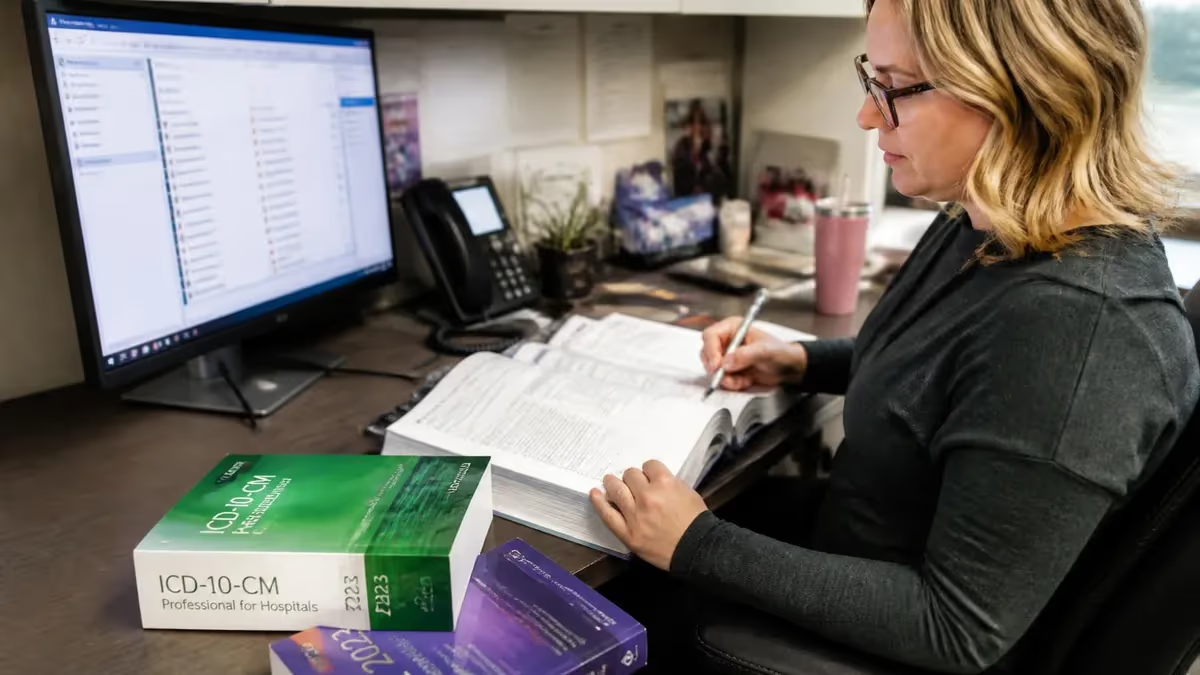
Becoming a certified professional coder is one of the most direct routes into a stable, well-paying healthcare career. The CPC credential — awarded by the American Academy of Professional Coders (AAPC) — is the gold standard in outpatient medical coding, and understanding the CPC education requirements before you invest your time and money is the smartest first step you can take. Whether you are a recent high school graduate, a career changer, or an experienced healthcare worker, the path to certification is clearly defined and achievable.
The AAPC established the Certified Professional Coder (CPC) credential in 1988, and it has since become the most widely recognized coding certification in the United States. Hospitals, physician practices, billing companies, and insurance carriers all list CPC as a preferred or required qualification on job postings. Earning the credential signals to employers that you have mastered CPT, ICD-10-CM, and HCPCS Level II coding systems to a professional standard, and that you can apply those skills accurately in a real-world setting.
Understanding the eligibility landscape matters because the AAPC has separate tracks for candidates with different backgrounds. The core exam is the same for everyone — 150 multiple-choice questions administered over five hours and 40 minutes — but your education and work-experience profile determines whether you will test as a standard candidate, a medical-coding student, or an apprentice coder. Each track leads to the same CPC credential, but the time it takes to get there can vary significantly depending on your starting point.
Many candidates wonder whether they need a formal college degree to sit for the CPC exam. The short answer is no: the AAPC does not require an associate's or bachelor's degree. What the organization does require is some combination of training and practical experience. Specifically, you need either two years of on-the-job coding experience or completion of an AAPC-approved medical coding training program — or both. This flexible structure makes the certified professional coder certification accessible to a wide range of applicants.
It is also worth noting that the AAPC offers an apprentice designation for exam passers who have not yet accumulated two years of experience. An apprentice CPC-A can still list the credential on a resume and apply for entry-level certified professional medical coder jobs remote and in-person, giving newcomers a competitive edge while they build their work history. Once two years of experience are documented, the AAPC removes the apprentice designation and the credential becomes a full CPC.
Throughout this guide you will find a detailed breakdown of every eligibility rule, the education options that satisfy the training requirement, the exam format, associated costs, and a realistic study timeline. By the time you finish reading, you will know exactly where you stand today and what steps to take next. Be sure to review the cpc eligibility requirements page for the latest exam scheduling windows so you can plan your preparation calendar accordingly.
The demand for skilled coders is not slowing down. The U.S. Bureau of Labor Statistics projects steady growth in health information technician roles, and certified coders consistently command higher salaries than their uncredentialed counterparts. The certified professional coder salary averages around $58,000 to $70,000 annually depending on specialty, setting, and geographic location — with experienced remote coders often earning more. Investing a few months in preparation for the CPC exam is one of the highest-return career moves available in the healthcare industry today.
CPC Certification by the Numbers
Key Facts at a Glance
| Item | Value | Details |
|---|---|---|
| Exam Time Limit | 5h 40m | 150 questions total |
| Passing Score | 70% | Approximately 105 correct answers |
| Required Every 2 Years | 36 CEUs | To maintain active status |

Core CPC Eligibility Requirements at a Glance
No formal college degree is required. Candidates must hold a high school diploma or GED equivalent. Completion of an AAPC-approved or accredited medical coding training program satisfies the education portion of the eligibility standard.
AAPC requires two years of on-the-job professional coding experience. Candidates who pass the exam without this experience receive a CPC-A (apprentice) designation, which converts to full CPC status once experience is documented.
While not strictly mandatory to sit for the exam, AAPC membership significantly reduces exam fees. Members pay $300 versus $399 for non-members. Student membership is available at a reduced annual rate for those enrolled in training programs.
Candidates who do not pass on the first attempt may retake the exam. AAPC allows multiple retakes with a $199 member retake fee per attempt. There is no cap on the total number of attempts, giving persistent candidates every opportunity to succeed.
One of the most common questions prospective coders ask is whether they need to enroll in a formal certified professional coder online course before sitting for the exam. The AAPC does not mandate it — you can self-study and still sit for the exam — but the organization's own data consistently shows that candidates who complete a structured training program pass at significantly higher rates than those who attempt to self-prepare without guidance. Understanding your options helps you choose the path that fits your schedule, budget, and learning style.
The AAPC offers its own Professional Medical Coding Curriculum (PMCC), which is a comprehensive instructor-led program designed specifically to prepare students for the CPC exam. The PMCC covers all major code sets used in outpatient coding, including CPT procedural codes, ICD-10-CM diagnosis codes, and HCPCS Level II supply and drug codes. The curriculum also walks through medical terminology, anatomy, and the compliance frameworks — including HIPAA and the False Claims Act — that govern coding practice in the United States.
Community colleges and vocational schools across the country offer accredited medical billing and coding programs that align with AAPC exam content. Many of these programs run for one to two years and award a certificate or associate degree upon completion. While a degree is not required to sit for the CPC exam, completing a community college program gives candidates an educational credential that strengthens their resume and satisfies the training requirement simultaneously. Some employers specifically seek candidates who have completed accredited programs because it signals broader foundational knowledge.
Online learning has transformed access to the certified professional coder program. Platforms such as AAPC's own online courses, CareerStep, Penn Build, and various university extension programs allow candidates to study at their own pace from anywhere in the country. This flexibility is especially important for candidates who are working full-time or raising families while preparing for the credential. Asynchronous coursework means you can study during evenings, weekends, or any window of time that fits your life without sacrificing the quality of instruction.
When evaluating any training program, look for these key indicators of quality: AAPC approval or AHIMA accreditation, a curriculum that includes hands-on coding practice with real-world case studies, instructor access for questions, and a strong student pass rate on the CPC exam. Avoid programs that focus only on test-taking tricks without building genuine coding competency — those shortcuts rarely result in a passing score, and they leave you underprepared for the actual demands of a coding position.
For candidates who already work in a medical office or clinical setting, on-the-job experience can substitute for or supplement formal training. If you have been abstracting information from medical records, assigning diagnosis or procedure codes, or working alongside a certified coder in a supervisory relationship, that experience counts toward the two-year work requirement. Document your experience carefully using AAPC's experience verification form, which asks for employer name, dates of service, a description of your coding duties, and a supervisor signature.
Regardless of which training route you choose, building a solid study library is essential. At minimum you will need the current-year CPT manual, the ICD-10-CM code book, the HCPCS Level II manual, and a medical dictionary or anatomy reference. AAPC allows candidates to bring tabbed and annotated code books into the exam, so the time you spend color-coding, adding tabs, and writing personal notes in your manuals is directly transferable to test performance. Many successful candidates describe their annotated code books as their single most valuable exam resource.
Certified Professional Coder Certification: Pathway Options
The standard CPC candidate path is designed for individuals who already have two or more years of professional coding experience in an outpatient setting. These candidates register for the full exam, pay the standard fee, and — upon passing — receive the full CPC credential immediately with no apprentice designation. Employers strongly prefer hiring candidates on this track because the credential signals both tested knowledge and verified real-world application of coding principles.
Standard candidates should still invest in structured review before exam day. Even experienced coders encounter content areas on the CPC exam that differ from their day-to-day specialty. For example, a coder who works exclusively in orthopedics may be less fluent in E/M coding guidelines or radiology coding conventions. A thorough review course that covers all 17 content domains on the exam helps experienced coders shore up gaps and maximize their first-attempt pass probability.

Is Pursuing the Certified Professional Coder (CPC) Credential Worth It?
- +No college degree required — accessible to candidates with a high school diploma or GED
- +Apprentice (CPC-A) designation lets you start applying for jobs before accumulating two years of experience
- +Nationally recognized by hospitals, physician groups, billing companies, and insurance carriers
- +Certified professional coder salary averages $58K–$70K, significantly above uncredentialed coder pay
- +Enables remote work opportunities — certified professional medical coder jobs remote listings are abundant
- +Opens doors to specialty certifications (CPC-P, CPMA, CPCO) for further career advancement
- −Exam fee of $300 (member) or $399 (non-member) plus code book costs can total $500–$700
- −First-attempt pass rate is approximately 54%, requiring most candidates to invest in serious preparation
- −Requires 36 continuing education units (CEUs) every two years to maintain active status
- −Work experience requirement means new graduates must accept apprentice status for up to two years
- −Exam covers 17 content domains — breadth requires comprehensive study beyond a single specialty
- −Code books are updated annually, requiring coders to purchase new editions each year to stay current
CPC Application Checklist: 10 Steps to Exam Day
- ✓Confirm you hold a high school diploma or GED — the minimum educational baseline for CPC eligibility.
- ✓Enroll in an AAPC-approved training program or gather documentation of two years of coding work experience.
- ✓Join AAPC as a member ($195/year) to access reduced exam fees and study resources.
- ✓Purchase the current-year CPT, ICD-10-CM, and HCPCS Level II code books.
- ✓Tab, highlight, and annotate all three code books — permitted reference materials during the exam.
- ✓Register for the CPC exam through the AAPC website and select your preferred testing modality (in-person or remote proctored).
- ✓Build a study schedule targeting 8–12 weeks of preparation with daily practice sessions.
- ✓Complete at least three full-length timed practice exams under real exam conditions.
- ✓Review all 17 CPC content domains, paying extra attention to E/M coding, surgery, and radiology.
- ✓Confirm your test date, ID requirements, and permitted materials at least one week before exam day.
Annotated Code Books Are Your Most Powerful Exam Tool
The CPC exam is open-book, but time pressure is intense — you have roughly 2.3 minutes per question. Candidates who have thoroughly tabbed, color-coded, and annotated their CPT, ICD-10-CM, and HCPCS manuals consistently outperform those who rely on memory alone. Start building your personalized code books on day one of your study plan, and treat every annotation as an investment in exam-day speed.
The financial investment required to earn the certified professional coder CPC certification is modest relative to the career returns it generates. Before you register for the exam, it helps to understand the full cost picture so there are no surprises. The primary costs include AAPC membership, the exam registration fee, code books, and any training program tuition. Taken together, a candidate who joins AAPC, purchases code books, and uses a mid-range online training program can expect to invest between $800 and $2,000 from start to credential — a fraction of the cost of a two-year degree.
AAPC membership costs $195 per year for a standard individual membership. Students enrolled in approved programs can often access a discounted student membership rate. Membership is technically optional for exam registration, but non-members pay $399 for the exam compared to $300 for members — meaning membership pays for itself in exam fee savings alone. Members also receive access to AAPC's coding resources, job board, and continuing education offerings, all of which add ongoing value throughout a coding career.
Code books represent a recurring annual cost. The current-year CPT manual retails for approximately $120–$140, the ICD-10-CM book costs $80–$100, and the HCPCS Level II manual runs $60–$80. Many candidates find the AAPC's bundled code book packages offer modest savings over purchasing individually. Professional edition code books, which include full-color anatomical illustrations and coding tips, cost slightly more but offer features that speed up look-ups during the timed exam — an investment that easily pays off.
Training program costs vary widely. AAPC's own PMCC instructor-led course typically runs $2,000–$2,500 for the complete curriculum. Online self-paced options from providers like CareerStep, Penn Build, or community college extension programs range from $500 to $1,500. Some employers in healthcare settings will subsidize or fully reimburse training costs for employees pursuing coding certification, particularly if the role has a clear operational benefit. Always check whether tuition assistance is available through your current employer before paying out of pocket.
The certified professional coder salary data makes the investment calculation compelling. According to AAPC's annual salary survey, the average full-time CPC earns approximately $64,000 per year, compared to roughly $42,000 for coders without a credential. The salary premium of $22,000 per year means the full certification investment typically pays back within six to eight weeks of employment at the certified rate. Specialty-focused coders — particularly those who add credentials in cardiology, orthopedics, or emergency medicine — command even higher compensation.
Remote work availability further enhances the certified professional coder salary potential. Certified professional medical coder jobs remote positions have proliferated since the widespread adoption of electronic health records and cloud-based practice management platforms. Remote coders often have access to a broader pool of employers, enabling salary negotiation that would not be possible in a geographically constrained local market. Experienced remote CPCs in high-demand specialties regularly earn $75,000 to $90,000 annually, with some senior auditing roles exceeding $100,000.
When budgeting for certification, also factor in the cost of continuing education. Maintaining the CPC credential requires 36 CEUs every two years. AAPC members can earn many of these units through free and low-cost webinars, chapter meetings, and online modules. Budgeting approximately $100–$200 per year for CEU activities is a reasonable estimate for candidates who take advantage of member pricing. Some employers cover CEU costs as part of professional development benefits, so confirm your employer's policy early in your career.

CPC-A holders must document their two years of coding experience and submit verification to AAPC within three years of passing the exam. If you do not submit your experience documentation within this window, your credential may lapse and require re-examination. Track your experience hours from day one of employment and submit documentation as soon as you reach the two-year threshold — do not wait until the deadline approaches.
Maintaining an active CPC credential requires ongoing commitment to professional development. The AAPC mandates 36 continuing education units every two years, and at least 36 of those units must be relevant to medical coding — not simply general healthcare education. This requirement ensures that certified coders stay current with annual code updates, regulatory changes, and evolving payer policies that directly affect the accuracy of claims submitted on behalf of physicians and facilities.
CEUs can be earned through a wide variety of activities. AAPC chapter meetings, which are held monthly in most metropolitan areas, typically offer one CEU per meeting and provide excellent networking opportunities alongside the educational content. National and regional AAPC conferences — including the annual HEALTHCON event — offer intensive CEU accumulation in a short period. Online webinars, self-study modules, and approved third-party courses all count toward the biennial requirement, giving certified coders enormous flexibility in how they fulfill the obligation.
Specialty credentials are a natural next step for coders who want to deepen their expertise and increase their earning potential after achieving the CPC. The AAPC offers more than 25 specialty credentials, including the Certified Professional Coder — Payer (CPC-P), the Certified Professional Medical Auditor (CPMA), the Certified Professional Compliance Officer (CPCO), and more than a dozen specialty-specific credentials in areas like cardiology, orthopedics, and risk adjustment. Each specialty credential requires passing an additional exam and demonstrates advanced competency to employers in that clinical area.
The CPMA credential is particularly valuable for coders interested in compliance and auditing roles, which tend to be among the higher-paying positions in the medical coding field. Auditors review coding accuracy, identify billing errors, and help organizations maintain compliance with Medicare and Medicaid regulations. As healthcare fraud and abuse enforcement has intensified in recent years, the demand for skilled medical coding auditors has grown substantially, and CPMA holders are well-positioned to fill this need.
Advancing to a supervisory or management role in a coding department typically requires both the CPC credential and several years of hands-on experience. Coding supervisors oversee teams of coders, conduct internal audits, train new staff, and liaise with physicians on documentation improvement. These roles offer salaries in the $75,000–$95,000 range and frequently include benefits such as retirement plans, health insurance, and paid continuing education. Building the soft skills — communication, coaching, conflict resolution — alongside your technical coding expertise prepares you for leadership opportunities as they arise.
Remote work has created new career structures that did not exist a decade ago. Many experienced CPCs now work as independent contractors, accepting coding projects from multiple physician groups or billing companies simultaneously. This freelance model can generate income exceeding a traditional salaried position while offering maximum schedule flexibility. Independent contractors must manage their own taxes, benefits, and CEU costs, but for disciplined coders with strong client relationships, the financial and lifestyle benefits can be substantial.
Staying informed about annual code updates is non-negotiable for practicing CPCs. The AMA releases CPT updates each October for implementation on January 1, and CMS releases ICD-10-CM updates on a similar schedule. AAPC publishes annual update webinars and code-change summaries that help coders quickly identify significant additions, deletions, and revisions. Reviewing these updates thoroughly each year — and updating your code book annotations accordingly — keeps your coding accurate, reduces claim denials, and protects the providers you support from compliance risk.
With your eligibility confirmed and your study plan in place, the practical details of exam preparation deserve careful attention. The CPC exam consists of 150 multiple-choice questions drawn from 17 content domains, and the breadth of coverage is one of the most challenging aspects of the test. Unlike specialty-specific credentials that drill deep into one clinical area, the CPC tests your ability to code accurately across surgery, medicine, radiology, pathology, E/M services, and more. Effective preparation means studying all of these domains systematically rather than focusing only on your comfort areas.
Time management is one of the most underrated skills tested on the CPC exam. With 5 hours and 40 minutes for 150 questions, you have an average of 2 minutes and 16 seconds per question. In practice, simpler questions — those that ask you to identify a single CPT code for a clearly described procedure — should take 60 to 90 seconds, leaving additional time for complex multiple-system cases that require verifying several codes before selecting the answer. Practice exams taken under strict time conditions help you develop an internal clock for pacing.
The open-book format of the CPC exam is a double-edged sword. On one hand, you are never penalized for not memorizing every code — the answer is always findable in your reference materials. On the other hand, candidates who have not thoroughly organized and annotated their books frequently run out of time hunting for codes rather than applying clinical reasoning. The goal of your study period is not to memorize the code books but to become so familiar with their structure that you can navigate them quickly and confidently under pressure.
Practice questions are an indispensable preparation tool. Working through realistic CPC-style questions — with explanations that walk through the coding logic step by step — builds the pattern recognition that distinguishes experienced coders from beginners. Focus especially on questions that require applying official coding guidelines, since these rules govern sequencing, bundling, and reporting of multiple services and are frequently tested. The AAPC's Official CPC Exam Study Guide includes 150 practice questions, and supplementing with third-party question banks broadens your exposure to different question styles.
On the day before the exam, resist the temptation to cram new material. Review your most important tabs and annotations, confirm the logistics of your testing location or remote proctoring setup, and ensure your code books are fully organized. A good night's sleep before the exam is more valuable than four additional hours of review — cognitive performance on a five-plus-hour exam degrades sharply when candidates are fatigued. Plan to arrive at the testing center early, or log in to your remote proctoring session with a 15-minute buffer to handle any technical setup issues.
After passing the exam, take a moment to celebrate — earning the CPC is a genuine professional achievement that the healthcare industry recognizes and rewards. Then turn your attention immediately to career positioning. Update your resume, LinkedIn profile, and any job boards you are monitoring to reflect your new credential. If you are currently in a CPC-A status, begin documenting your experience systematically so you can convert to full CPC status as quickly as your experience accumulation allows. Certified professional coder jobs are actively hiring, and your credential puts you at the top of a competitive applicant pool.
Finally, connect with the professional community. AAPC local chapters host monthly meetings where you can network with other coders, learn about local job openings, and earn CEUs. Online communities — AAPC's member forums, coding-focused LinkedIn groups, and specialty-specific communities — provide ongoing support, answer coding questions, and share news about regulatory changes that affect your work. The more connected you are to the professional coding community, the more quickly you will grow in your career and the more resources you will have access to throughout your professional life.
Sample Certified Procedural Coder Practice Questions
Try these questions from our free Certified Procedural Coder practice tests. The correct answer and an explanation follow each question.
A coder is validating a claim where the place of service code is listed as '11' but the procedure was performed in a hospital outpatient department. What is the correct place of service code?
- A. 21
- B. 22
- C. 11
- D. 19
Answer: B. 22
Place of service code 22 designates an on-campus outpatient hospital setting, whereas code 11 is for an office setting.
A coder notices the claim form lists the rendering provider's NPI in Box 24J but the billing provider's NPI is missing from Box 33a on the CMS-1500. What is the likely outcome?
- A. The claim will process normally
- B. The claim will be rejected for missing required billing provider information
- C. The payer will auto-populate the billing NPI
- D. The claim will be denied for medical necessity
Answer: B. The claim will be rejected for missing required billing provider information
Box 33a requires the billing provider's NPI, and its absence is a common reason for claim rejection before adjudication.
Which claim filing deadline rule is most important for a coder to know when billing Medicare?
- A. Claims must be filed within 90 days of service
- B. Claims must be filed within 1 year (12 months) from the date of service
- C. Claims must be filed within 6 months of service
- D. Claims must be filed within 2 years of service
Answer: B. Claims must be filed within 1 year (12 months) from the date of service
Medicare requires that claims be filed within 1 calendar year (12 months) from the date of service for timely filing compliance.
Which modifier indicates that only the professional component of a service was provided by the reporting physician?
- A. -TC
- B. -26
- C. -52
- D. -53
Answer: B. -26
Modifier -26 indicates the professional component only (physician's interpretation and report), while -TC indicates the technical component.
CPC Questions and Answers

AAPC CPC Exam Dates 2026: Complete Guide for Certified Professional Coder Certification

CPC Exam Mock Test: Free Certified Professional Coder Practice Questions 2026

CPC Certification Online Courses: Your Complete Training Guide for Becoming a Certified Professional Coder

Online CPC Training: Your Complete Guide to Becoming a Certified Professional Coder

CCS vs CPC Certification: Which Medical Coding Credential Is Right for You?
About the Author

Certified Internal Auditor & Compliance Certification Expert
University of Illinois Gies College of BusinessBrian Henderson is a Certified Internal Auditor, Certified Information Systems Auditor, and Certified Fraud Examiner with an MBA from the University of Illinois. He has 19 years of internal audit and regulatory compliance experience across financial services and healthcare industries, and coaches professionals through CIA, CISA, CFE, and SOX compliance certification programs.
Join the Discussion
Connect with other students preparing for this exam. Share tips, ask questions, and get advice from people who have been there.
View discussion (8 replies)