
CO DMV Appointment: How to Schedule, Reschedule, and Prepare for Your Colorado DMV Visit
Book your CO DMV appointment online, learn what documents to bring, ✏️ avoid walk-in waits, and prepare for licensing, ID, and registration visits.
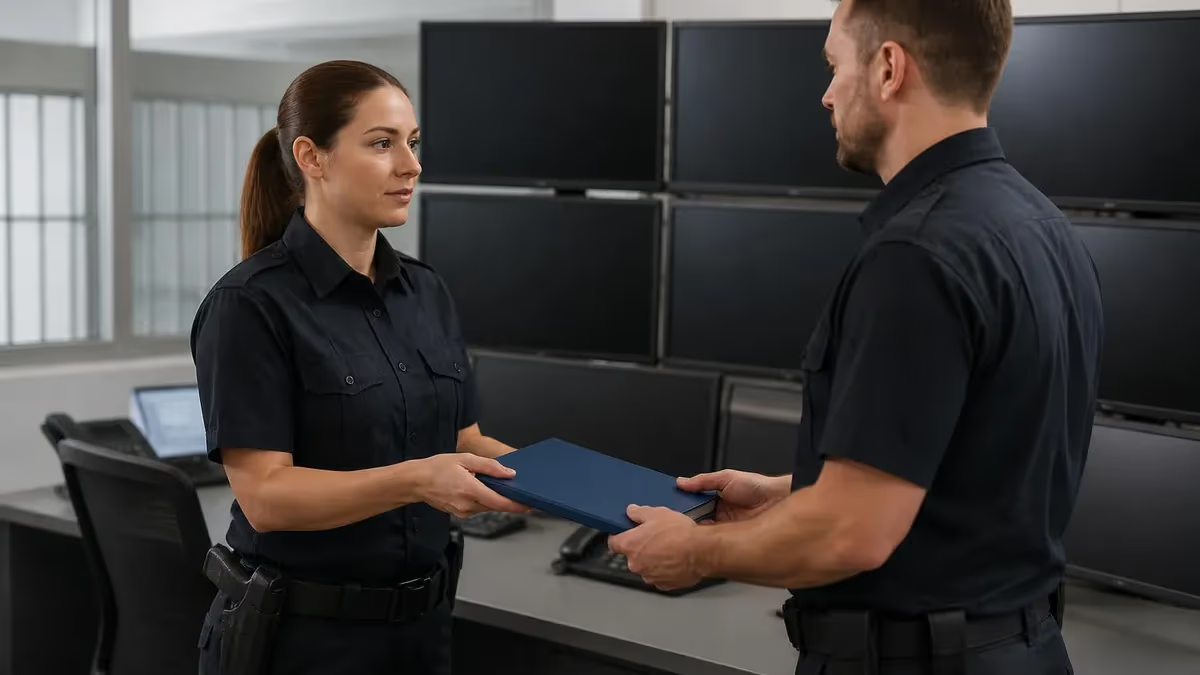
Booking a co dmv appointment is the single biggest time-saver Colorado drivers have at their disposal, and it has become essentially mandatory at most offices in the Denver metro, Boulder, Fort Collins, and Colorado Springs regions. Walk-in availability still exists in some rural counties, but in larger Front Range offices a same-day walk-in can mean a three to five hour wait, while a scheduled visit usually wraps up in under thirty minutes. Understanding the appointment system saves hours of frustration and prevents repeat trips.
The Colorado Division of Motor Vehicles operates one of the more modernized scheduling portals in the country, but it has quirks that catch first-timers off guard. Appointments open on a rolling basis, popular branches book out two to four weeks in advance, and certain transactions like Real ID issuance, road tests, and CDL services have their own dedicated queues. If you pick the wrong appointment type, the office may turn you away at the door without offering an alternative time. Choosing correctly the first time is essential.
This guide walks through every aspect of the Colorado DMV appointment process from start to finish. You will learn how to use the myDMV portal, which transactions actually require appointments and which still allow walk-ins, what identity and residency documents you must bring under the federal Real ID Act, and how to handle reschedules, cancellations, and no-shows without losing your slot in line. We will also cover what happens if you arrive late or with missing paperwork.
Colorado has roughly fifty-six driver license offices spread across sixty-four counties, plus county motor vehicle offices that handle vehicle registration and titling separately from licensing services. This split structure confuses many residents who assume one office handles everything. It does not. Driver services like learner permits, original licenses, renewals, road tests, and ID cards happen at state-run DMV branches. Vehicle services like plates, registration renewal, titles, and VIN inspections happen at county clerk offices, each with their own appointment system.
Whether you are a brand-new teenage driver getting your first instruction permit, a new Colorado resident with sixty days to transfer your out-of-state license, a commercial driver renewing a CDL endorsement, or a senior renewing an expiring license in person, the appointment system applies to you. The penalties for missing or mishandling the process are real: expired credentials that lead to traffic citations, lapsed registration that costs late fees, and in some cases a forced restart of the application process with new fees.
Beyond the mechanics of scheduling, this guide also covers preparation strategies that experienced DMV-goers swear by. We will explain how to pre-fill applications online to cut counter time in half, how to use the wait-time tracker to find slow branches, what to do when your preferred location shows no availability for weeks, and how to interpret confirmation emails so you actually show up at the right address with the right paperwork in hand. Small preparation steps make a measurable difference.
By the end of this article you will have a complete operational playbook for any Colorado DMV visit. You will know exactly which website to use, which documents to gather, how early to arrive, what fees to expect, and which mistakes derail the most appointments. For practical practice on the knowledge test portion of your visit, the CO DMV (Colorado Department of Motor Vehicle) Test Guide walks through every question type Colorado uses on its written exam.
Colorado DMV Appointments by the Numbers

What Services Require a CO DMV Appointment
Original licenses, renewals after age 21, name changes, Real ID upgrades, and instruction permits all require scheduled appointments at state DMV branches across Colorado.
The behind-the-wheel driving test must be scheduled separately from the knowledge exam. Road tests book out 3 to 6 weeks ahead at busy metro branches and Saturday slots fill fastest.
Commercial driver licenses, endorsements, medical certificate updates, and self-certification all require CDL-specific appointment types. General licensing slots will not work for CDL transactions.
First-time Real ID upgrades demand extra documentation review and use a longer appointment block. The clerk will scan four supporting documents and may require originals plus copies.
Plates, titles, and registration renewals happen at county motor vehicle offices, not state DMV branches. Each county runs its own scheduling system separate from myDMV.
Booking a Colorado DMV appointment starts at mydmv.colorado.gov, the official state portal for driver services. The site is mobile-friendly and works in any modern browser, though some older Android tablets struggle with the calendar widget. You do not need an existing account to schedule a one-time visit, but creating a free myDMV profile lets you view appointment history, reschedule with one click, and pre-fill applications so the clerk can finish your transaction in roughly half the usual counter time.
From the homepage select Schedule an Appointment, then choose the service type. The dropdown lists more than twenty options including New Driver License, Renew Driver License, ID Card, Instruction Permit, Drive Test, CDL, Motorcycle Endorsement, Real ID, Name Change, and Reinstatement after suspension. Picking the right service is critical because each one routes to a different staff queue with different document checks. A clerk handling a renewal cannot process a Real ID upgrade if the system never flagged you for one.
After selecting the service, the portal asks for your ZIP code and shows nearby offices with the next three available appointment slots. You can expand any office to see its full two-week calendar. Denver Central, Lakewood, and Aurora typically book out three to four weeks, while smaller offices like Castle Rock, Limon, or Sterling often have slots within a few days. If you can drive forty-five minutes, opening your search radius almost always saves a week or more of waiting time.
Once you pick a date and time, the system asks for your full legal name, date of birth, the last four digits of your Social Security number, and an email address. The email is where your confirmation arrives within ten minutes, and it contains a six-digit confirmation code you should save. If you do not receive the email, check spam first, then call the office directly with your name and date of birth to confirm the booking exists. The portal occasionally creates appointments without sending the email reliably.
Many transactions allow you to pre-fill the application before arriving. After confirming the appointment, look for a Pre-Apply link in the confirmation email. This takes you to a fillable form that captures your address, height, eye color, organ donor preference, voter registration choice, and emergency contact. Completing it in advance trims roughly fifteen minutes from the in-office portion of your visit because the clerk only verifies your documents instead of typing everything from scratch into the state database.
For walk-in availability at the limited offices that still accept them, the portal shows a real-time queue position and estimated wait time, updated every few minutes. Some rural offices in Yuma, Las Animas, and Kit Carson counties handle ninety percent of business as walk-ins because volume is low enough that scheduling overhead would slow things down. Knowing which offices operate this way lets you plan a productive day trip that combines DMV business with errands rather than waiting in a metro queue.
If your needs include a vehicle transaction in addition to driver services, you will likely need two separate appointments at two different offices. The CO DMV Website Guide: myDMV.colorado.gov Services, Appointments & More explains the split between state and county systems in depth and shows how to navigate both portals efficiently in a single day.
CO DMV Practice Test Questions
Prepare for the CO DMV - Colorado Department of Motor Vehicle exam with our free practice test modules. Each quiz covers key topics to help you pass on your first try.
CO DMV Driver's Licensing
CO DMV Exam Questions covering Driver's Licensing. Master CO DMV Test concepts for certification prep.
CO DMV DUI & Impaired Driving
Free CO DMV Practice Test featuring DUI & Impaired Driving. Improve your CO DMV Exam score with mock test prep.
CO DMV Motorcycle Licensing
CO DMV Mock Exam on Motorcycle Licensing. CO DMV Study Guide questions to pass on your first try.
CO DMV Traffic Laws & Rules of the Road
CO DMV Test Prep for Traffic Laws & Rules of the Road. Practice CO DMV Quiz questions and boost your score.
CO DMV Vehicle Registration
CO DMV Questions and Answers on Vehicle Registration. Free CO DMV practice for exam readiness.
CO DMV Commercial Driver's Licenses
CO DMV Mock Test covering Commercial Driver's Licenses. Online CO DMV Test practice with instant feedback.
CO DMV Driving Test
Free CO DMV Quiz on Driving Test. CO DMV Exam prep questions with detailed explanations.
Documents Required for Your CO DMV Appointment
Colorado requires one document proving your full legal name and date of birth. Accepted options include an unexpired U.S. passport or passport card, a certified original birth certificate with a raised seal, a Consular Report of Birth Abroad, a Permanent Resident Card, or a valid foreign passport with an unexpired visa and I-94 record. Photocopies and digital images on phones are never accepted, even if notarized, because the clerk must hold the original document and scan it directly into the state system.
If your current name differs from the name on your birth certificate, you also need legal name-change documentation. This means certified marriage certificates, divorce decrees explicitly restoring a previous name, or court-ordered name change paperwork. Bring every document in the chain if you have changed names multiple times. A common rejection happens when a woman married twice brings only the most recent marriage certificate but cannot show the legal link back to the birth name on file.
Scheduled Appointment vs. Walk-In: Which Should You Choose?
- +Guaranteed start time within 15 minutes of your slot at most offices
- +Average visit completes in 25 to 45 minutes door to door
- +Pre-fill option cuts counter work nearly in half
- +Confirmation email lists exactly which documents to bring
- +Reschedule with one click up to 24 hours before
- +Priority queue separate from walk-in line
- +Available evenings and Saturdays at select branches
- −Front Range offices book 2 to 4 weeks out for prime slots
- −No-shows lose the slot and may face booking restrictions
- −Cannot add extra services on the day of without rescheduling
- −Some rural offices have better walk-in speed than appointments
- −Real ID appointments require longer blocks that fill fastest
- −Road test slots are separate and book even further ahead
Pros and Cons at a Glance
| Pros | Cons |
|---|---|
| Pre-fill option cuts counter work nearly in half | No-shows lose the slot and may face booking restrictions |
| Confirmation email lists exactly which documents to bring | Cannot add extra services on the day of without rescheduling |
| Priority queue separate from walk-in line | Some rural offices have better walk-in speed than appointments |
| Available evenings and Saturdays at select branches | Real ID appointments require longer blocks that fill fastest |
Day-of CO DMV Appointment Checklist
- ✓Arrive 15 minutes early to find parking and clear security screening
- ✓Bring all original identity documents, never photocopies or phone photos
- ✓Carry two proofs of Colorado residency from two different sources
- ✓Have your Social Security card or W-2 if applying for first license
- ✓Bring payment by debit card, credit card, check, or exact cash
- ✓Print or save your confirmation email with the appointment number
- ✓Wear contacts or glasses if you need them for the vision screening
- ✓Remove hats, headphones, and sunglasses before the photo station
- ✓Silence your phone and avoid taking photos inside the office
- ✓Allow at least 90 minutes total even with a confirmed appointment
Federal Real ID enforcement is active at all U.S. airports
Since May 7, 2025, TSA requires a Real ID-compliant license, U.S. passport, or other federally accepted ID for all domestic flights. A standard Colorado license without the gold star will not work at airport security. If you fly even occasionally, book a Real ID upgrade appointment now and bring the four required documents to avoid being turned away at the gate.
Rescheduling a Colorado DMV appointment is straightforward when done at least twenty-four hours in advance. Open the confirmation email and click the Reschedule link, which takes you back into the myDMV portal pre-loaded with your existing appointment. You can then pick any open slot at the same office or switch to a different location entirely. The system releases your original slot immediately so another resident can claim it, which is the polite thing to do even if you only need to shift by a few hours.
Inside the twenty-four-hour window the online reschedule option disappears and you must call the specific office directly. Phone reschedules are slower because staff can only modify appointments during business hours and call volume often runs heavy in the late afternoon. If you cannot reach anyone by phone, the next-best option is to cancel online if cancellation is still available and rebook fresh, accepting that you may lose your preferred time and have to wait a week or more for the next opening at your office.
Cancellations work the same way as reschedules. The portal accepts cancellations up to twenty-four hours in advance with no penalty. Repeated last-minute cancellations or no-shows can trigger a temporary restriction on online booking, requiring you to call to schedule future appointments. Colorado has not publicly disclosed exactly how many strikes lead to restriction, but two no-shows within ninety days appears to be the practical threshold based on resident reports in driver forums.
If you miss your appointment entirely without calling, the office holds your slot for roughly fifteen minutes and then releases it to walk-ins. You can sometimes still be seen as a walk-in that same day if the office has spare capacity, but expect to wait two to three hours and there is no guarantee. Some offices will rebook a missed appointment with priority access to the next available slot, but this requires calling before the end of the business day on which you missed your visit. Otherwise, you go back into the regular queue.
Late arrivals are handled office by office. A grace period of five to ten minutes is standard, after which the clerk has discretion to either fit you in around other scheduled appointments or ask you to rebook. Arriving more than fifteen minutes late almost always means rebooking. The safest practice is to plan for traffic, parking, and security screening so you arrive at the door with fifteen minutes of buffer. Colorado DMV offices do not validate parking and metered street spots near urban offices fill up quickly.
Emergency cancellations like illness or family events do not currently qualify for any formal exception process. Staff will simply rebook you at the next available slot. If you have a license expiration deadline approaching and the next slot is past your expiration date, mention this when calling. Some offices can squeeze in a fifteen-minute renewal between scheduled visits if you bring all paperwork ready to go, but this is granted as a courtesy and is never guaranteed in advance.
For specific Denver-area branch availability, hours, and parking notes, the Denver DMV Locations guide breaks down each office in the metro region with addresses, phone numbers, and tips on which branches typically have the shortest waits during peak hours.

The myDMV system flags accounts after repeated no-shows or last-minute cancellations. Two or more no-shows within a ninety-day window may block online booking and force you to call each office individually to schedule. Always cancel at least 24 hours in advance to keep your account in good standing and preserve your booking privileges across all Colorado offices.
Wait times at Colorado DMV offices vary dramatically by location, day of week, and time of year. Mondays and the day after any federal holiday produce the longest lines because both walk-ins and rescheduled appointments compete for the same capacity. Wednesdays and Thursdays generally run lightest. The first two hours after opening and the final hour before closing also see less traffic at most branches because residents tend to cluster their visits around lunch and mid-afternoon, creating predictable peaks between eleven and two each weekday.
The myDMV portal includes a wait-time tracker showing current queue length at each office, updated every few minutes during business hours. Use this tool the morning of any walk-in attempt to compare nearby branches. A fifteen-minute drive to a less crowded office can save two hours of waiting time. The tracker also helps you decide whether to keep an existing appointment or shift to walk-in mode if your office happens to be running unusually fast on a given day.
Seasonal patterns matter too. Late summer brings a surge of teen drivers seeking instruction permits and first licenses before school starts. December and January see a spike in renewals because many Coloradans put off expiring credentials until the new year. Tax season in March and April adds pressure as residents discover they need updated ID for IRS purposes. Real ID upgrade demand has stayed elevated since federal enforcement began in May 2025, and metro offices report that Real ID appointments now make up nearly half of all daily slots.
For residents in the Aurora and east Denver area, knowing local branch quirks helps tremendously. The Aurora CO DMV guide covers specific operating hours, what services are offered at each Aurora-area location, and which branch handles the highest volume of road tests in the eastern metro region. Picking the right Aurora office can mean the difference between a same-week appointment and waiting nearly a month for the next opening.
Saturday hours are limited but valuable. Only about a dozen Colorado offices operate on Saturdays, and slots disappear within minutes of being released each Monday morning when the new two-week window opens. Setting a phone alarm for nine on Monday and refreshing the portal at exactly that moment gives you the best chance at a weekend slot. If Saturday is essential because of work, consider building flexibility into your booking by accepting any Saturday slot at any office within an hour's drive rather than holding out for your closest branch.
Mobile DMV services exist for limited populations including homebound seniors, residents of long-term care facilities, and some rural communities that lack a full-time office. These services run on a rotating schedule and require advance registration through the state aging services network. They are not available for general convenience scheduling but can be lifesavers for people with mobility limitations who cannot easily reach a standard branch even with an appointment in hand.
Finally, remember that vehicle registration and titling questions go to your county clerk, not the state DMV. Wait times at county offices follow different patterns and often have separate online scheduling systems. The CO DMV Registration: Complete Colorado Vehicle Registration Guide covers the entire county-level process including which counties offer mail-in and online renewal options that skip the office visit altogether for eligible vehicles.
Preparation makes every Colorado DMV appointment smoother, and the best preparation starts a full week before your scheduled visit. Begin by gathering documents into a single folder you can grab on appointment day without scrambling. Verify each document is current, unexpired, and shows your full legal name exactly as it appears on your application. Mismatches between a marriage certificate and a passport are the single most common reason transactions get delayed or rejected at the counter, costing you a return trip and another appointment slot.
Review the knowledge test material if you are applying for your first license or permit. Colorado uses a twenty-five question multiple-choice test drawn from the official driver handbook, and you must score eighty percent or higher to pass. The handbook is free to download from the state website and covers right-of-way rules, speed limits, parking restrictions, DUI penalties, and mountain driving hazards specific to Colorado terrain. Most teens who fail the test on first attempt missed only one or two questions because they skipped the chapters on road signs and pavement markings.
Practice the vision screening at home by reading the smallest line you can see on a chart twenty feet away. Colorado requires twenty-forty vision in at least one eye with or without corrective lenses for an unrestricted license. If you wear contacts or glasses, bring them and tell the clerk before the screening starts. A failed screening does not end your application but does result in a restriction code on your license requiring corrective lenses any time you drive. The restriction is easily removed later with an eye doctor's note.
Plan your route to the office and check parking options in advance. Many Colorado DMV branches sit in busy commercial districts with limited free parking. Some Denver offices charge metered rates that empty out quickly during morning peak hours. Arriving frazzled after circling for parking puts you in the wrong mindset for an exam or photo. Build in fifteen minutes of buffer for parking on top of fifteen minutes for security screening and check-in. Total target arrival should be thirty minutes ahead of your scheduled slot.
Dress simply for your license photo. Solid colors photograph better than busy patterns. Avoid hats, sunglasses, and large jewelry that obscure your face because the clerk will ask you to remove them anyway. Smile naturally with your mouth closed. Religious head coverings are permitted under Colorado law as long as the face from forehead to chin is fully visible. The photo you take will appear on your license for the next five years, so it is worth a quick check in the rearview mirror before walking in.
Bring backup payment options. The state accepts debit cards, credit cards, personal checks drawn on Colorado banks, money orders, and exact cash. Out-of-state checks are sometimes refused. American Express and Discover cards work at most but not all offices. If your primary card is declined for any reason, having a second method prevents a frustrating restart. Total fees vary by service: a standard adult license renewal runs $30.87, a Real ID upgrade adds no extra charge if processed during a regular renewal, and road tests cost $24.93.
After your appointment, you will typically leave with a paper temporary license valid for forty-five days, and the permanent card arrives by mail within ten to fourteen business days. Track the mailing status through your myDMV account if it has not arrived after three weeks. The temporary document is legal for all purposes including TSA verification if you have completed Real ID screening, though some private businesses prefer to see the permanent card. Keep the temporary in a safe place because replacements require another office visit.
Sample CO DMV - Colorado Department of Motor Vehicle Practice Questions
Try these questions from our free CO DMV - Colorado Department of Motor Vehicle practice tests. The correct answer and an explanation follow each question.
If you allow your Colorado auto insurance to lapse, what must you do to restore your driving privileges?
- A. Pay a reinstatement fee and provide proof of new insurance
- B. Simply renew your license plate sticker
- C. File a complaint with the DMV
- D. Wait 90 days automatically
Answer: A. Pay a reinstatement fee and provide proof of new insurance
To restore driving privileges after an insurance lapse in Colorado, you must pay a reinstatement fee and show proof of current insurance.
When must you use your headlights in Colorado?
- A. Only at night
- B. From sunset to sunrise and when visibility is less than 1,000 feet
- C. Only in rain or snow
- D. Whenever you feel unsafe
Answer: B. From sunset to sunrise and when visibility is less than 1,000 feet
Colorado requires headlights from sunset to sunrise and anytime visibility is reduced to less than 1,000 feet.
In Colorado, what device may be required for a DUI offender to drive legally after conviction?
- A. Dash camera
- B. Ignition Interlock Device (IID)
- C. Speed limiter
- D. Alcohol monitoring ankle bracelet
Answer: B. Ignition Interlock Device (IID)
Colorado requires many DUI offenders to install an Ignition Interlock Device (IID) that prevents the vehicle from starting if alcohol is detected on the driver's breath.
In Colorado, what equipment is required for a motorcycle to be street-legal?
- A. Engine, wheels, and a seat are sufficient
- B. Headlight, tail light, brake light, mirrors, horn, and muffler among other requirements
- C. Only headlights and brakes
- D. GPS navigation and a roll cage
Answer: B. Headlight, tail light, brake light, mirrors, horn, and muffler among other requirements
Colorado requires street-legal motorcycles to have headlights, tail lights, brake lights, mirrors, a horn, adequate brakes, and a working muffler among other equipment.
Take the full CO DMV - Colorado Department of Motor Vehicle practice test
CO DMV Questions and Answers



About the Author

Educational Psychologist & Academic Test Preparation Expert
Columbia University Teachers CollegeDr. Lisa Patel holds a Doctorate in Education from Columbia University Teachers College and has spent 17 years researching standardized test design and academic assessment. She has developed preparation programs for SAT, ACT, GRE, LSAT, UCAT, and numerous professional licensing exams, helping students of all backgrounds achieve their target scores.
Join the Discussion
Connect with other students preparing for this exam. Share tips, ask questions, and get advice from people who have been there.
View discussion (8 replies)