
CJBAT Florida: Complete Guide to the Criminal Justice Basic Abilities Test in Broward and Beyond
Pass the CJBAT in Florida 🎯 — Broward County guide covering exam format, score requirements, free practice tests, and study tips for 2026 October.
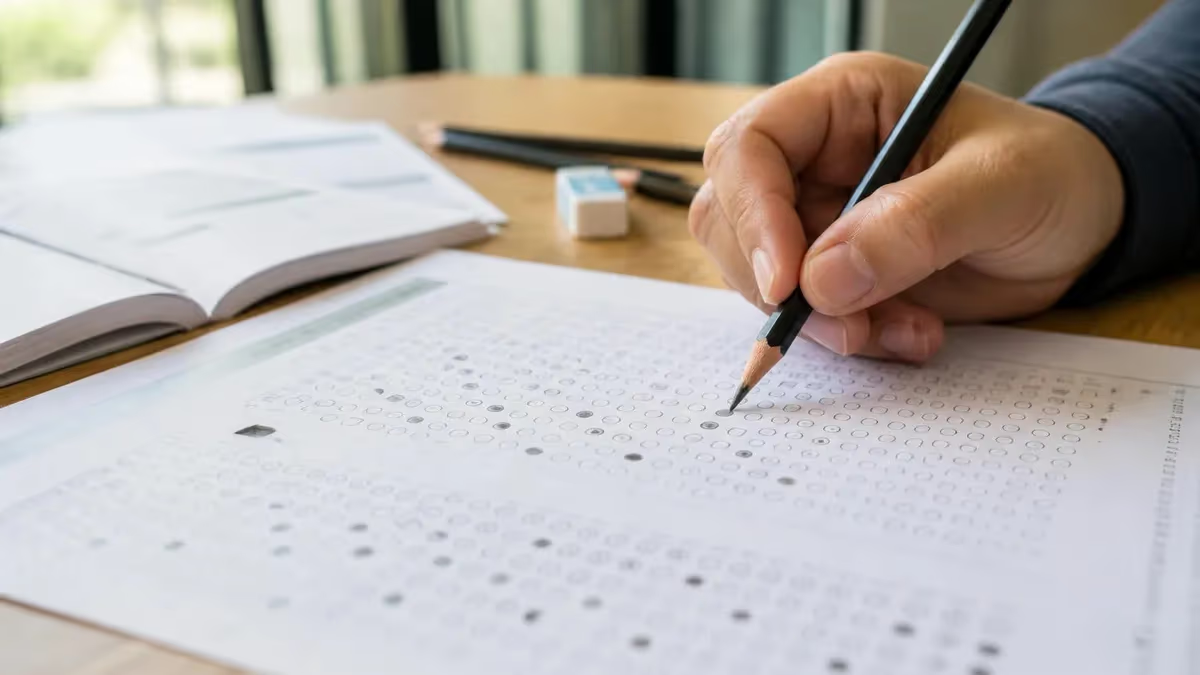
The cjbat — officially known as the Criminal Justice Basic Abilities Test — is the standardized entry-level exam every aspiring law enforcement officer, correctional officer, and detention deputy in Florida must pass before moving forward in the hiring process. If you are pursuing a career in Broward County law enforcement, understanding the cjbat broward requirements is your first real step toward the badge.
Whether you are applying to the Broward Sheriff's Office, a local municipal police department, or a county corrections facility, this exam stands between you and the next phase of the application process. Preparing strategically rather than casually makes a measurable difference in your final score.
Florida's criminal justice agencies rely on the CJBAT because it measures the cognitive abilities most predictive of success in public safety careers. The exam is not a knowledge test about criminal law or police procedures — instead it evaluates your reasoning, reading comprehension, math skills, and ability to make sound judgments under pressure. These are the foundational cognitive skills that allow officers to process incident reports accurately, interpret written orders, calculate distances and timeframes, and communicate clearly with supervisors, colleagues, and the public they serve every day.
Broward County is home to one of Florida's largest law enforcement agencies — the Broward Sheriff's Office (BSO) — which oversees law enforcement, corrections, and court services across 31 municipalities. BSO alone employs thousands of sworn deputies and correctional officers, making Broward one of the most active hiring markets for criminal justice professionals in the entire state. Competition for available positions is significant, and a strong CJBAT score helps your application stand out from hundreds of other candidates who may share similar physical fitness scores and background check results.
Understanding the cjbat exam from a structural standpoint helps you allocate your preparation time wisely. The test is divided into multiple sections that assess distinct abilities, and many candidates discover they are stronger in some areas and weaker in others only after sitting for a practice assessment. That is why taking a cjbat practice test before your official exam date is so valuable — it reveals your personal performance gaps so you can direct your study hours where they will produce the greatest point gains on test day.
Many candidates in Broward and across Florida search for a cjbat study guide because they want structure in their preparation, not just a pile of random questions. A structured approach involves understanding what each section tests, setting a realistic weekly study schedule, tracking your accuracy by question type, and simulating the timed pressure of the real exam. Passive reading of outlines or definitions rarely translates into improved test performance. Active practice — answering questions under timed conditions — is the single most effective preparation strategy for the CJBAT.
The cjbat test is administered through Pearson VUE testing centers, which are located throughout Florida including multiple sites in and around Broward County. This means scheduling your exam appointment is generally straightforward, but popular testing windows do fill up, particularly in the weeks before large agency hiring cycles. Candidates are advised to register early and confirm their preferred testing center location well in advance. Showing up without adequate preparation to a Pearson VUE center is a costly mistake — retesting fees and waiting periods add both expense and time to your hiring timeline.
This comprehensive guide walks you through everything you need to know about the CJBAT in Florida, with a specific focus on Broward County requirements, the exam format, scoring benchmarks, and the most effective study strategies available today. Whether you are taking the exam for the first time or looking to improve a previous score, you will find actionable information in every section below. Let's get started.
CJBAT Florida by the Numbers
Key Facts at a Glance
| Item | Value | Details |
|---|---|---|
| Total Questions | 170 | Multiple choice format |
| Total Exam Time | 3 hrs | Strictly enforced |
| Minimum Passing Score | 70% | Most Florida agencies |
| Score Validity Period | 5 yrs | Accepted by FL agencies |

CJBAT Exam Format
| Section | Questions | Time | Weight | Notes |
|---|---|---|---|---|
| Written Composition | 40 | 45 min | 24% | Grammar, spelling, vocabulary |
| Arithmetic Reasoning | 35 | 45 min | 21% | Math word problems, calculations |
| Reading Comprehension | 40 | 45 min | 24% | Passages and inference questions |
| Situational Judgment | 30 | 30 min | 18% | Decision-making scenarios |
| Written Expression | 25 | 15 min | 13% | Sentence structure and clarity |
| Total | 170 | 3 hours | 100% |
Broward County is one of the most competitive law enforcement hiring markets in Florida, and meeting the cjbat broward expectations means doing more than simply achieving the state minimum passing score. Many Broward agencies — particularly the Broward Sheriff's Office — use CJBAT scores as a ranking tool in their applicant pools.
Candidates who score at or near the 70% threshold are technically eligible, but those who score in the 80th percentile and above move to the top of interview lists and receive priority placement in training academies. Understanding this competitive dynamic should shape how you approach your preparation from the very beginning.
The Broward Sheriff's Office processes hundreds of applications annually for both law enforcement and correctional officer positions. After an initial background screening, qualified applicants are directed to complete the cjbat practice test at a designated Pearson VUE testing center. Broward County has several approved testing locations, including sites in Fort Lauderdale, Miramar, and Pompano Beach. Candidates should verify their preferred center's availability directly through the Pearson VUE scheduling portal, as seat availability varies by week and testing windows close quickly during peak hiring seasons.
Beyond the CJBAT itself, Broward County law enforcement agencies require applicants to meet Florida's standard POST certification prerequisites. These include being at least 19 years of age, holding a high school diploma or GED, passing a comprehensive background investigation, and meeting physical fitness benchmarks. The CJBAT is typically administered after initial eligibility screening, meaning candidates who have not yet cleared the background check stage may be scheduled for the exam simultaneously as the investigation proceeds. Always confirm your specific agency's sequencing with the human resources recruiter assigned to your application.
One important distinction for Broward-area applicants is that different municipalities within the county may have slightly different CJBAT score thresholds. While the Broward Sheriff's Office follows state guidelines, smaller departments like Coconut Creek Police, Deerfield Beach Police, or Sunrise Police may set internal competitive benchmarks. It is always worth contacting each agency's recruitment division to ask whether they apply a minimum score higher than the state floor, and whether they grant any extra consideration for military veterans, bilingual candidates, or applicants with prior criminal justice education or experience.
Candidates who are bilingual — particularly those who speak Spanish, Haitian Creole, or Portuguese in addition to English — often have a significant advantage in Broward County hiring given the county's extraordinarily diverse population. However, language skills do not substitute for a strong CJBAT score. The exam is administered exclusively in English, and all responses are evaluated on standard academic English proficiency. Non-native English speakers are advised to allocate additional preparation time to the written composition and reading comprehension sections, as these sections can pose particular challenges for candidates whose primary language is not English.
The cjbat study guide approach that works best for Broward candidates combines content review with heavy practice testing. Many successful candidates report spending 8 to 12 weeks preparing, dedicating approximately 10 to 15 hours per week to structured study. They divide their time between reviewing grammar rules and mathematical formulas in the first half of preparation, then shift almost entirely to timed practice questions in the second half. This ratio — roughly 40% content review and 60% active practice — reflects how professionals and coaches in the test prep field generally recommend preparing for any standardized cognitive abilities exam.
Score reporting for the CJBAT is handled through the Pearson VUE platform, and candidates often want to know how to viuew my cjbat scores after the exam concludes. Your score report is typically available through the Pearson VUE candidate portal within a few business days of testing.
You will receive a numerical score for each section as well as a composite score, and the report will indicate whether you passed or failed the exam overall. Some Florida agencies also receive score data directly from Pearson VUE on your behalf, but it is your responsibility to understand whether your target agency requires you to self-report or share your results independently.
CJBAT Study Guide: Strategies by Subject Area
Arithmetic reasoning on the CJBAT covers basic math operations applied to real-world law enforcement scenarios. Expect questions involving percentages, ratios, fractions, unit conversions, and multi-step word problems. A typical question might ask you to calculate how many officers are needed to cover a patrol area given certain coverage ratios, or determine the total cost of equipment given per-unit prices. You do not need advanced algebra or calculus — but you do need to perform accurate calculations quickly and without a calculator.
The best strategy for arithmetic reasoning is to practice solving word problems under timed conditions every single day leading up to your exam. Start by reviewing basic formulas — area, rate-time-distance, percentages — then transition to working through 20 to 30 untimed practice problems to build accuracy. Once your accuracy exceeds 80%, introduce a timer. Most candidates need 60 to 90 seconds per arithmetic question; if you regularly exceed two minutes per question, you risk running out of time during the actual exam. Drilling with a stopwatch builds the mental efficiency needed to score in the top percentiles.

CJBAT Exam: Advantages and Challenges for Florida Candidates
- +Score is valid for five years — no need to retest for every agency you apply to
- +Multiple Pearson VUE testing locations in Broward County offer flexible scheduling
- +Free practice resources and study guides are widely available online
- +Passing once qualifies you for any Florida criminal justice agency that accepts CJBAT
- +The exam tests learnable cognitive skills — targeted prep directly improves scores
- +Strong CJBAT scores can offset weaker areas in your overall application profile
- −No calculator is permitted — arithmetic must be performed mentally or by hand
- −The three-hour duration is mentally exhausting without proper stamina training
- −Retesting fees apply if you do not pass on the first attempt
- −A waiting period between attempts limits how quickly you can retest
- −Some agencies have competitive score thresholds well above the state minimum
- −Test anxiety is common and can significantly suppress performance on exam day
CJBAT Test Day Preparation Checklist
- ✓Confirm your Pearson VUE testing center address and verify driving directions at least two days before your exam date
- ✓Bring two valid forms of government-issued ID — at least one must include your photograph and signature
- ✓Arrive at the testing center at least 30 minutes before your scheduled appointment time
- ✓Avoid caffeine overload the morning of the exam — stay hydrated and eat a balanced, light meal beforehand
- ✓Review your weakest subject area briefly the evening before, then stop studying by 8 PM to get quality sleep
- ✓Wear comfortable, layered clothing because testing center temperatures vary and are outside your control
- ✓Practice your pacing strategy — know in advance how many minutes you can spend per question in each section
- ✓Do not bring personal items to the testing room — lockers are provided for phones, bags, and personal belongings
- ✓Use the scratch paper or whiteboard provided by the testing center for arithmetic calculations during the exam
- ✓After completing each section, flag uncertain answers for review rather than leaving them blank
Scoring in the 80th Percentile Doubles Your Callback Rate
Florida law enforcement recruiters confirm that candidates who score 80% or higher on the CJBAT receive interview invitations at roughly twice the rate of candidates who score at the 70% minimum threshold. The extra 10 percentage points require only 17 additional correct answers on a 170-question exam — a gap that four to six weeks of focused practice can reliably close for most candidates.
Understanding how the CJBAT is scored helps candidates calibrate both their preparation targets and their expectations on test day. The exam uses a scaled scoring system, meaning your raw number of correct answers is converted to a standardized score that accounts for slight variations in difficulty across different test versions.
This ensures that a candidate who takes the exam in January receives a comparable score to one who takes a different version of the same exam in June. The minimum passing scaled score is set at approximately 70% across most Florida law enforcement agencies, though the exact number varies slightly by administration.
After completing the cjbat exam at a Pearson VUE center, candidates typically receive a preliminary pass/fail result on screen before leaving the testing room. Your full score report — including section-by-section breakdowns — becomes available through your Pearson VUE account within three to five business days. This detailed breakdown is invaluable if you are planning a retake, because it identifies specifically which sections dragged your composite score below the passing threshold. Rather than studying everything again with equal effort, you can redirect your preparation time strategically toward the lowest-scoring sections.
One frequently asked question involves score sharing: do hiring agencies automatically see your CJBAT results? The answer depends on how you registered for the exam. Some Florida agencies integrate directly with Pearson VUE and receive candidate score data automatically. Others require you to authorize score release manually through the Pearson VUE portal. A few smaller departments request that candidates submit a printed score report along with their application. Always ask your specific agency recruiter how they prefer to receive CJBAT scores, and follow their instructions precisely to avoid processing delays in your application.
Retesting policies are an important consideration for any candidate who does not pass on the first attempt. Florida's criminal justice examination guidelines typically require a waiting period of at least 30 days before a candidate may retest. Some agencies impose their own additional waiting periods on top of the state minimum.
Candidates who fail twice may be required to wait longer before a third attempt is permitted. This makes adequate first-attempt preparation extremely important — the cumulative cost of retesting fees, study materials for multiple preparation cycles, and hiring process delays can add up to thousands of dollars and months of lost time.
Score validity is a major advantage of the CJBAT compared to some other professional entrance exams. Once you earn a passing score, that result is valid for five years in Florida. This means you can apply to multiple agencies across the state — from Miami-Dade to Broward to Palm Beach to Hillsborough — over a multi-year period without retesting.
Candidates who are accepted to one agency but later decide to pursue a different opportunity within their five-year window simply share their existing score rather than sitting for the exam again. This portability makes your CJBAT result one of the most valuable credentials you will earn during the law enforcement application process.
The cjbat pearson vue platform also offers score verification services for agencies that want to confirm the authenticity of a candidate's reported result. This anti-fraud measure means that inflating or misrepresenting your CJBAT score on a job application is not only dishonest but also easily detectable. Law enforcement agencies take integrity violations during the hiring process extremely seriously, and applicants discovered misrepresenting their test scores face automatic disqualification from all hiring processes with that agency — often permanently. Always be accurate and transparent when reporting your CJBAT scores at every stage of the application.
Candidates who want to track their progress between practice sessions and the real exam should use a performance journal. After each practice test, record your total score, your section scores, the types of questions you missed, and the specific errors you made (misread the question, calculation mistake, vocabulary gap, etc.). Over a period of several weeks, patterns emerge that reveal your most persistent weaknesses. Addressing those recurring error categories — rather than simply doing more practice problems without analysis — is what separates candidates who improve significantly from those who plateau after initial gains.
Pearson VUE testing center appointments in the Fort Lauderdale and surrounding Broward County area frequently fill up weeks in advance during peak hiring cycles. If your target agency has a specific application deadline, schedule your CJBAT appointment immediately after receiving confirmation of your eligibility — do not wait until the final week. Missing a testing window due to unavailable seats can delay your application by 30 to 60 days and push you out of the current hiring class entirely.
Choosing the right study resources can make or break your CJBAT preparation experience. The market is full of self-described study guides and test prep materials that vary enormously in quality, accuracy, and alignment with the actual CJBAT content.
When evaluating any resource, check whether it specifically addresses all five sections of the CJBAT, includes timed practice tests with answer explanations (not just answer keys), and has been updated within the past two to three years to reflect the current test format. Outdated materials may test content or question formats that no longer appear on the exam, wasting your limited study time.
Online platforms offer some of the most efficient and flexible preparation options for today's busy candidates. Many candidates now turn to digital cjbat practice test free resources to get started before committing to a paid program. Free practice is a great diagnostic tool — it reveals your starting point and helps you prioritize — but most free platforms provide only a limited bank of questions. Once you have identified your weak areas, a more comprehensive paid resource with hundreds of practice questions and detailed explanations typically produces better improvement than cycling through the same limited free questions repeatedly.
Some candidates search for cjbat practice test quizlet as a starting point because they are familiar with the Quizlet platform from academic study. Quizlet decks can be useful for vocabulary review and memorizing grammar rules or mathematical formulas, but they are not a substitute for full-length timed practice exams. The CJBAT's real challenge is not just knowing facts — it is applying knowledge accurately under time pressure. Flashcard-style review builds familiarity with content but does not train the timed stamina and pacing skills that determine whether a candidate finishes all sections without running out of time.
If you are looking for a cjbat test near me, Pearson VUE's center locator tool is the authoritative source for finding approved Florida testing sites. Simply visit the Pearson VUE website, enter your zip code, and filter for CJBAT-authorized locations. In Broward County specifically, testing centers are available in multiple cities including Fort Lauderdale, Miramar, Pompano Beach, and Weston. Some candidates elect to drive to a center slightly outside their immediate area if it offers more convenient appointment availability, particularly for early-morning testing slots that tend to allow sharper mental performance than afternoon exams.
Group study can be an underutilized preparation strategy. Candidates who study with one or two other serious applicants often report staying more accountable, catching each other's errors, and maintaining motivation over a multi-week preparation period. However, group study should never come at the expense of individual timed practice. The cjbat exam is an individual performance assessment, and no amount of collaborative discussion substitutes for the solo mental work of solving questions under test conditions. Use group sessions for reviewing concepts and discussing difficult questions, then practice independently under realistic exam simulations.
For candidates who are working full-time while preparing for the CJBAT, time management is a genuine challenge. Breaking your preparation into daily 45-to-60-minute focused sessions five days per week is typically more effective than marathon weekend study sessions.
Research on memory consolidation consistently shows that distributed practice — smaller amounts of study spread across many days — produces better long-term retention than massed practice concentrated in fewer, longer sessions. If you can only find 45 minutes per day, use it well: 15 minutes of content review and 30 minutes of timed practice questions, five days per week over eight weeks, produces real results for most motivated candidates.
The cjbat test ultimately rewards candidates who approach it with the same discipline and systematic rigor they will bring to their law enforcement careers. Shortcuts and cramming rarely work for cognitive ability exams because these tests measure underlying mental skills that develop only through sustained practice, not last-minute memorization. Candidates who treat their CJBAT preparation as a professional training program — scheduling sessions, tracking progress, analyzing errors, and adjusting their approach based on data — consistently outperform those who study casually and hope for the best on exam day.
Your final weeks of CJBAT preparation should shift decisively toward simulation — full-length, timed practice tests completed under realistic conditions. By the last two weeks before your exam date, you should have already reviewed all major content areas and should now be focused entirely on building test-taking stamina and refining your pacing strategy. Sit for at least two or three full-length practice exams during this period, ideally at the same time of day as your scheduled real exam. This trains your body and mind to be maximally alert during the specific hours when your performance will actually count.
Reviewing your errors after each full-length practice exam is non-negotiable. Do not simply note which questions you got wrong — analyze why you got them wrong. Was it a careless reading error? A formula you forgot? A word you did not recognize? A judgment call where you second-guessed yourself and switched to the wrong answer? Each error category requires a different corrective action. Careless reading errors call for slowing down slightly and re-reading questions twice before answering. Formula gaps require a targeted review session. Vocabulary weaknesses demand active word-learning exercises rather than passive exposure.
On the morning of your actual CJBAT exam, resist the temptation to cram or review study materials. By that point, your performance is determined by the weeks of preparation you have already completed — not by anything you can absorb in the final hours before testing. Instead, eat a nutritious breakfast, hydrate well, and arrive at your Pearson VUE testing center early enough to complete check-in without rushing.
Give yourself a moment to settle in, take a few slow breaths, and remind yourself that you have prepared systematically for this day. Mental composure during the exam is itself a skill, and candidates who manage test anxiety effectively perform better than their equally prepared but more anxious peers.
Pacing is one of the most underrated test-taking skills for the CJBAT. Because the exam has five sections of varying lengths and time allocations, you need a clear internal benchmark for how much time you can spend per question in each section. For a 35-question arithmetic section with 45 minutes, for example, you have approximately 77 seconds per question.
For a 40-question reading comprehension section with 45 minutes, you have about 67 seconds per question. Knowing these numbers before you sit down prevents the panic of watching the clock run low with questions still unanswered. Practice to these benchmarks during your preparation, and you will feel composed rather than rushed during the actual exam.
Many candidates wonder whether they should guess on questions they cannot answer confidently. The CJBAT uses a scoring system where only correct answers add points — there is no penalty for wrong answers. This means you should never leave a question blank. If you are running out of time, fill in answers for all remaining questions using your best guess.
If you have time remaining, eliminate as many wrong answer choices as possible before guessing among the remaining options. Eliminating even one obviously wrong answer improves your probability of guessing correctly from 25% (one in four) to 33% (one in three), which meaningfully impacts your final score across multiple guessed questions.
Finally, remember that your CJBAT score is just one component of a comprehensive law enforcement application. Agencies evaluate your background investigation, polygraph results, physical fitness assessment, psychological evaluation, and interview performance alongside your exam score. A strong CJBAT result opens doors and improves your ranking, but the full picture of your character, fitness, and communication skills carries equal weight in the final hiring decision. Approach every phase of the application process with the same dedication and professionalism you bring to your exam preparation, and you give yourself the best possible chance of earning a career in Florida law enforcement.
For additional resources to support your preparation, explore the viuew my cjbat scores portal through Pearson VUE and set up your candidate account well before your test date. Having your account fully configured in advance ensures there are no technical delays when your score report becomes available. Bookmark the portal, verify your login credentials, and confirm that your email notification settings are active so you receive an alert the moment your scores are posted. Proactive account management is a small but important logistical detail that many first-time candidates overlook until after their exam is complete.
Sample CJBAT Test Practice Questions
Try these questions from our free CJBAT Test practice tests. The correct answer and an explanation follow each question.
A criminal justice perspective that places an emphasis on the prompt capture and conviction of criminals.
- A. Crime-control model
- B. Public order advocate
- C. Individual rights advocate
- D. Due process Model
Answer: A. Crime-control model
The crime-control model of criminal justice prioritizes efficiency, speed, and the suppression of crime. It emphasizes swift apprehension, conviction, and punishment of offenders to maintain public order. This model often views individual rights as secondary to the goal of controlling crime and protecting society.
A perspective on criminal justice that prioritizes individual rights throughout the entire judicial system's processing.
- A. Crime control model
- B. Due process model
- C. Public order advocate
- D. Individual rights advocate
Answer: B. Due process model
The due process model of criminal justice emphasizes individual rights and constitutional protections throughout every stage of the justice system. It prioritizes fairness, accuracy, and the prevention of wrongful convictions, even if it means a slower or more complex process. This model contrasts with the crime control model, which prioritizes efficiency and swift punishment.
A criminal justice approach assumes that the system's elements cooperate to provide the societal good that we refer to as justice.
- A. Justice Model
- B. Conflict Model
- C. Consensus Model
- D. Criminal Justice system
Answer: C. Consensus Model
The Consensus Model of criminal justice assumes that all components of the system—police, courts, and corrections—work together harmoniously towards a common goal of achieving justice and maintaining social order. It posits a shared understanding of what constitutes crime and justice within society, leading to cooperative efforts.
One who works to safeguard individual liberties during the criminal justice process.
- A. Civil Justice
- B. Social justice
- C. Individual rights advocate
- D. Public order advocate
Answer: C. Individual rights advocate
An individual rights advocate is someone who prioritizes the protection of personal freedoms and constitutional guarantees for all citizens, especially those accused of crimes. They emphasize due process, fair treatment, and safeguarding against government overreach within the criminal justice system. Their focus is on ensuring that individual liberties are upheld throughout the legal process.
CJBAT Questions and Answers

CJBAT Study Book: The Complete Guide to Passing the Criminal Justice Basic Abilities Test

DHS Polygraph Test: What to Expect & How to Prepare
CJBAT Study Guide: Complete Preparation for Test

College Board SAT Practice Test: Free Full-Length Tests

CJBAT - Test: Career Paths, Salary, and Requirements 2026
About the Author

Law Enforcement Trainer & Civil Service Exam Specialist
John Jay College of Criminal JusticeMarcus B. Thompson earned his Master of Arts in Criminal Justice from John Jay College of Criminal Justice and served 12 years as a law enforcement officer before transitioning to full-time academy instruction. He is a POST-certified instructor who has prepared candidates for police entrance exams, firefighter assessments, and civil service examinations across dozens of agencies.