
Civics Practice Test PDF (Free Printable 2026 September)
Pass the Civics exam with confidence. Practice questions with detailed explanations and instant feedback on every answer. 🔎
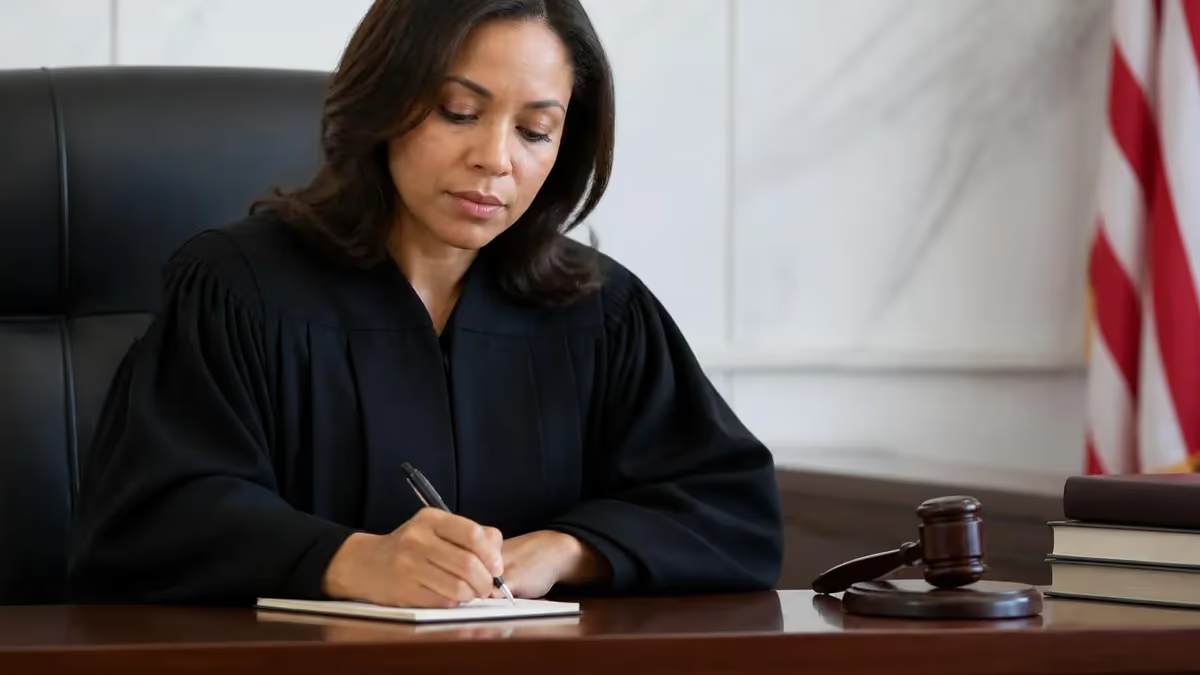
The USCIS naturalization civics test is one of the final steps toward becoming a United States citizen. During the naturalization interview, a USCIS officer reads up to ten questions drawn from the official 100-question civics list. You must answer at least six of those ten correctly — a 60% passing threshold — to move forward. Preparing thoroughly means covering all six content areas on that list, understanding how each branch of government works, and knowing facts specific to your own state such as your governor, senators, and congressional representative. A printable study guide lets you drill these questions anywhere, without needing a screen.
This page gives you immediate access to a free printable PDF so you can begin reviewing offline today. The PDF mirrors the full official question set used in interviews. Pair it with our interactive civics test to track your score and identify the areas where you need more repetition before interview day.
Key Takeaway: Civics Test certification demonstrates expertise in this field. Most candidates spend 4-8 weeks preparing with practice tests before taking the exam.
What the Naturalization Civics Test Covers
USCIS organizes the 100 civics questions into six content areas. Each area tests a different layer of American civic knowledge, from founding documents to modern history. Understanding the logic behind each section makes memorization easier and helps you give confident, complete answers when the officer moves between topics unexpectedly.
Principles of American Democracy
This section covers the Constitution, the Bill of Rights, the subsequent amendments, the rule of law, and the separation of powers. You should be able to explain what the Constitution does, identify the supreme law of the land, describe the economic system of the United States, and name the first ten amendments collectively as the Bill of Rights. Questions also test whether you understand why the Framers separated power across three branches — to prevent any single group from becoming too powerful.
Amendment-specific questions appear frequently. You need to know that the First Amendment protects freedom of speech, religion, assembly, press, and petition. The Fourteenth Amendment granted citizenship to people born or naturalized in the United States. The Nineteenth Amendment gave women the right to vote, and the Twenty-sixth Amendment extended voting rights to citizens eighteen and older. Interviewers often ask which amendment abolished slavery — that is the Thirteenth.
System of Government
The system of government section tests all three branches: the legislative (Congress — Senate and House of Representatives), the executive (President, Vice President, Cabinet), and the judicial (Supreme Court and lower federal courts). You must know the number of senators (100) and representatives (435), the terms of service for each office, and the current names of elected officials at both the federal and state levels. Checks and balances questions ask how each branch can limit the others — for example, the President can veto a bill, but Congress can override that veto with a two-thirds vote.
Voting rights history is also tested here. The Civil War amendments, the Nineteenth Amendment, and the Voting Rights Act of 1965 each expanded who could participate in elections. Know the two major political parties, what it means to be the Speaker of the House, and why there are 100 senators (two per state, fifty states). The President nominates Supreme Court justices, but the Senate must confirm them — that interaction between branches is a classic exam point.
Rights and Responsibilities of Citizens
This section moves from how government works to what citizens owe and receive in return. The First Amendment freedoms — speech, religion, assembly, press, and petition — are tested directly. Beyond rights, USCIS expects applicants to know the responsibilities of citizenship: paying federal taxes, serving on a jury when called, obeying the law, and registering with the Selective Service if you are a male between the ages of eighteen and twenty-five.
Questions also ask who can vote, who can run for federal office, and what it means to be a legal permanent resident versus a citizen. Only U.S. citizens can vote in federal elections and run for President or Vice President. Knowing the difference matters both for the interview and for life after naturalization.
Colonial Period, Independence, and the 1800s
The history sections begin with the thirteen original colonies and the reasons colonists came to America — freedom, political liberty, and economic opportunity. You need to know why the colonists fought the British (unfair taxation without representation was the core grievance), who wrote the Declaration of Independence (Thomas Jefferson, primarily), and when it was adopted (July 4, 1776). The Founding Fathers — Washington, Adams, Jefferson, Hamilton, Franklin, Madison, and others — appear in multiple questions.
The 1800s section covers the Louisiana Purchase (which doubled the size of the country), the Civil War (fought over slavery, states' rights, and economic division between North and South), Reconstruction, and westward expansion. Abraham Lincoln is tested as the president who freed the slaves via the Emancipation Proclamation and led the Union through the Civil War. Susan B. Anthony appears in questions about the women's suffrage movement, which gained momentum throughout the nineteenth century before the Nineteenth Amendment passed in 1920.
Recent American History and Current Events
The final history section spans the twentieth century through today. World War I, World War II, the Cold War, the Korean War, and the Vietnam War all appear. The United States fought in both World Wars as an Allied power. The Cold War pitted the United States against the Soviet Union in an ideological and geopolitical struggle from roughly 1947 to 1991 without direct armed conflict between the two superpowers. The civil rights movement of the 1950s and 1960s — led by figures like Martin Luther King Jr. — brought legal equality to Black Americans and shaped modern American society.
Current-events questions require you to know who the President and Vice President are at the time of your interview, the name of the current Speaker of the House, and who your own state's governor and senators are. These answers change with elections, so verify them on USCIS.gov or your state government's website in the weeks before your interview. Memorizing a list from two years ago will not help if leadership has changed.

- ✓Download and print the PDF — study without screens at least one session per day
- ✓Memorize the six content areas and the broad topics each one covers
- ✓Learn all 27 amendments, focusing on the Bill of Rights (1–10) and key later amendments (13, 14, 15, 19, 26)
- ✓Know the three branches of government, each branch's powers, and current officeholders
- ✓Look up your own state's governor, two senators, and House representative — these change with elections
- ✓Study the 20 starred questions if you are 65 or older with 20+ years as a permanent resident
- ✓Check USCIS.gov to confirm whether the 2008 or 2020 test applies to your application
- ✓Practice speaking answers aloud — the officer evaluates both accuracy and English ability
- ✓Take at least three full timed mock interviews using the PDF before your actual appointment
- ✓Confirm your interview date and bring required documents — arriving unprepared wastes thorough civics study
Consistent daily review of the 100 questions — cycling through the PDF, then testing yourself online — builds the recall speed you need when an officer asks questions in a different order than you practiced. The civics test on this site randomizes question order each attempt, so you train for the unpredictability of a real interview rather than rote sequence memory. Plan at least four to six weeks of preparation if you are starting from scratch, or two to three weeks if you already have a working knowledge of American history and government.