
Chauffeur License: What It Is, Who Needs One, and How to Get It 2026
Pass the Chauffeur License: What It Is, Who exam with confidence. Practice questions with detailed explanations and instant feedback on every answer.
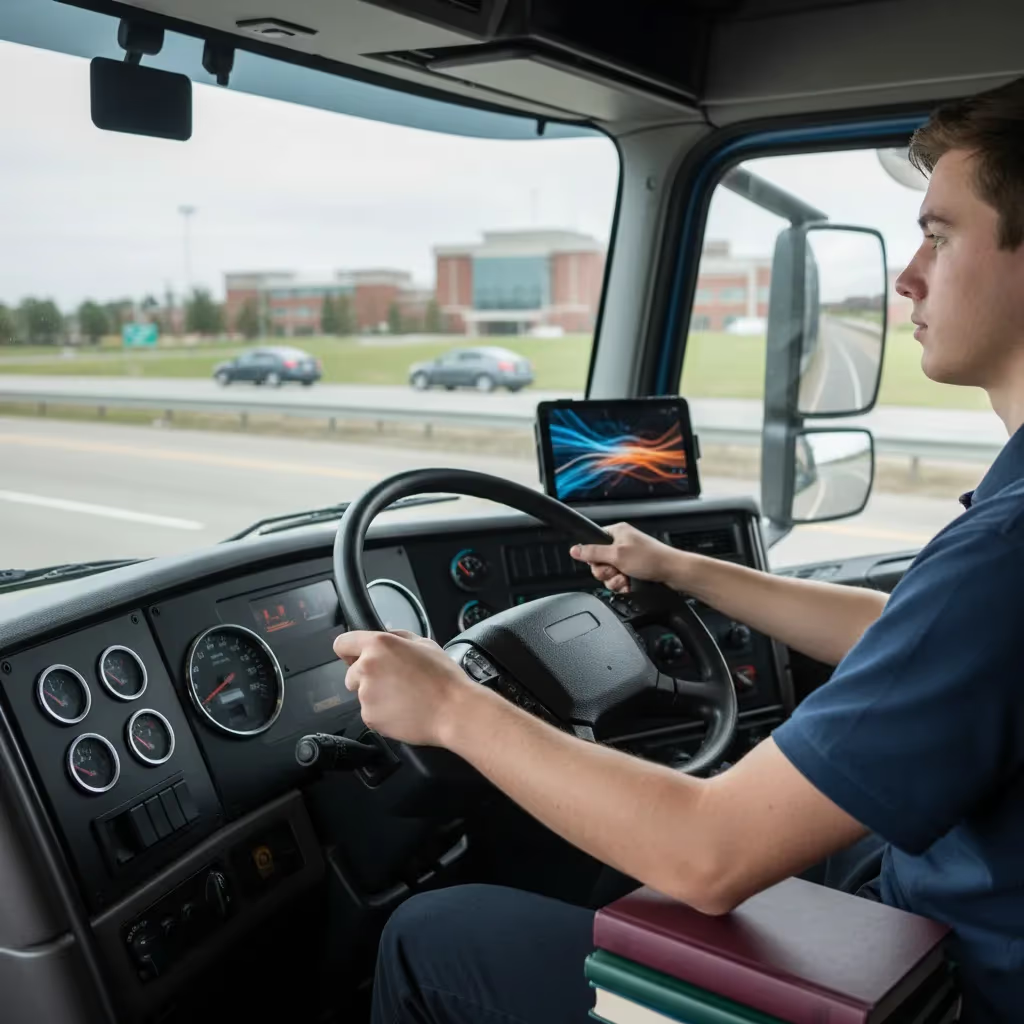
A chauffeur license lets you legally drive passengers for hire in vehicles that don't require a full commercial driver's license. Limos, taxis, airport shuttles, hotel vans — these all fall under the chauffeur endorsement in most states. If you're planning to drive people for money and the vehicle seats fewer than 16 passengers, this is probably the credential you need. Not a CDL. Not a standard Class D license. Something in between.
The michigan chauffeur license is one of the most commonly searched versions because Michigan requires it for a surprisingly broad range of vehicles. Drive a delivery truck over 10,000 pounds? Chauffeur license. Operate a taxi in Detroit? Same deal. The state treats this endorsement seriously — you'll need to pass a written test, pay fees, and meet specific eligibility requirements that go beyond what a regular license demands.
So what is a chauffeur license exactly? It's a state-issued endorsement or separate license class that authorizes you to operate certain commercial and passenger vehicles. The specifics vary — Michigan calls it a chauffeur license, Tennessee uses the term "for-hire endorsement," and other states fold it into their Class E or Class C structures. The common thread: you're driving passengers or goods commercially, but in vehicles smaller than what a CDL covers.
Getting started isn't complicated if you know the steps. You can find a detailed walkthrough on how to get a chauffeur license in michigan that covers the application process, testing requirements, and fees. Most applicants complete the process in a single visit to the Secretary of State office — though studying for the written exam takes real preparation.
This guide breaks down everything: state-by-state requirements, the chauffeur vs CDL distinction, test prep strategies, and what to expect at the DMV. Whether you're in Michigan, Texas, or Florida, you'll find what you need below.
Free CDL Study Tools
Interactive CDL resources on PracticeTestGeeks, free to start:
- CDL Road Signs and Signals Practice Test 1 — 25 questions with instant scoring and answer explanations
- CDL flashcards — review key terms and concepts card by card
- CDL study guide — topic-by-topic overview of what the exam covers
- CDL cheat sheet — one-page printable summary for last-minute review

Understanding what is a chauffeur license means knowing where it fits in the licensing hierarchy. A standard driver's license covers personal use. A CDL handles the big rigs — semis, tankers, buses over 16 passengers. The chauffeur license sits right in the gap. It's designed for drivers who operate commercially but don't need the heavy-vehicle training that a CDL demands.
The chauffeur license test varies by state, but the core content stays consistent. Expect questions on passenger safety protocols, pre-trip vehicle inspection procedures, local traffic regulations specific to commercial operators, and basic defensive driving concepts. Michigan's test runs 50 questions with a 70% passing threshold. Tennessee's for-hire endorsement test is shorter — around 25 questions — but covers similar ground.
Here's what catches people off guard: the chauffeur license test isn't just about driving skill. You won't parallel park a limo. The exam is entirely written, testing your knowledge of regulations, safety procedures, and vehicle operation standards. Some states administer it on a computer at the DMV; others still use paper forms. Either way, you need to study. Winging it leads to a failed attempt and another trip to the testing center.
Most states require you to already hold a valid standard driver's license before applying. You'll also need a clean driving record — typically no major violations in the past 3-5 years. DUI convictions can disqualify you entirely in some jurisdictions. Check your state's specific requirements before you schedule the test, because showing up without the right documentation wastes everyone's time.
If you're in Michigan, the process is straightforward — but it does require preparation. Here's how to get a chauffeur license in michigan: visit any Secretary of State branch office, bring your current valid Michigan driver's license, pass the written knowledge test, pay the $35 fee, and walk out with your chauffeur endorsement. The whole visit typically takes 1-2 hours including wait times, though busy branches in Detroit or Grand Rapids can run longer.
For those researching how to obtain a chauffeur license in michigan, the eligibility requirements are important to understand upfront. You must be at least 18 years old, hold a valid Michigan operator's license (not expired, not suspended), and have no disqualifying criminal convictions. Michigan also requires a vision screening at the time of application — if you wear corrective lenses, bring them.
The written test covers vehicle safety, passenger transportation rules, and Michigan-specific traffic laws. You'll see scenarios about what to do during vehicle breakdowns with passengers aboard, how to handle medical emergencies, proper loading and unloading procedures at designated stops, and rules about transporting minors. Study materials are available through the Michigan Secretary of State website, and several third-party prep courses offer practice tests that mirror the actual exam format closely.
One thing Michigan does differently: the chauffeur license here isn't just for passenger vehicles. If you drive any vehicle weighing over 10,000 pounds for commercial purposes — even without passengers — Michigan requires the chauffeur endorsement. That means delivery drivers, tow truck operators, and even some construction vehicle operators need this credential. It's broader than most states' versions, which focus exclusively on passenger transport.
What Is a Chauffeur License?
A chauffeur license — sometimes called a for-hire endorsement or Class E license depending on the state — authorizes you to operate commercial passenger vehicles that fall below CDL weight and passenger thresholds. Think taxis, limousines, airport shuttles, hotel courtesy vans, and medical transport vehicles. The license confirms you've passed a knowledge test on passenger safety, vehicle inspection, and local transportation regulations. Without it, driving passengers for compensation is illegal in states that require the endorsement.
Meeting the chauffeur license requirements is the first real hurdle. Every state sets its own rules, but common requirements include: minimum age of 18 (21 in some states), a valid standard driver's license, a clean driving record with no major violations in the past 3-5 years, passing a written knowledge test, and paying applicable fees. Some states also require a background check or fingerprinting, especially for drivers who'll transport vulnerable populations like children or elderly patients.
Wondering how to get chauffeur license credentials quickly? The fastest path depends on your state. In Michigan, you can walk into a Secretary of State office, take the test same-day, and leave with your endorsement. Tennessee requires an appointment at a driver service center. Texas doesn't have a "chauffeur license" per se — they use a different classification system that we'll cover in the state-specific section below.
Documentation requirements are where people stumble. You'll typically need your current driver's license, proof of identity (passport or birth certificate), proof of residency (utility bill or lease), and in some states, a completed medical examination form. Michigan waives the medical exam for chauffeur applicants — that's a CDL requirement. But other states like Illinois require a medical certificate even for the chauffeur endorsement.
Background checks add time. States that require them — including Florida and several others — may take 2-4 weeks to process your application after the written test. You can't drive commercially during that waiting period. Plan accordingly if you've got a job lined up that requires the license.
The chauffeur license texas situation confuses a lot of people because Texas doesn't use the term "chauffeur license" at all. Instead, Texas classifies commercial passenger vehicles under different permit structures. If you're driving a taxi or livery vehicle in Texas, you need a local permit from the city or county — not a state-level chauffeur license. Houston, Dallas, Austin, and San Antonio each run their own permitting programs with different requirements, fees, and testing procedures.
The chauffeur license florida process is cleaner. Florida issues a for-hire vehicle license through the Department of Highway Safety and Motor Vehicles. You'll need a valid Florida Class E license, a completed application, fingerprinting, a background check, and proof of insurance. The written test covers Florida-specific traffic laws, passenger safety, and commercial vehicle regulations. Processing takes 2-4 weeks after submission due to the background check component.
Other states worth knowing about: Tennessee requires a for-hire endorsement added to your standard license — similar to Michigan's approach. Illinois uses a chauffeur's license designation for anyone operating vehicles for hire. New York requires a Taxi and Limousine Commission (TLC) license for NYC operators, but upstate drivers follow different county-level rules. Georgia, Ohio, and Indiana have their own variations. The lack of federal standardization means every state experience is different.
California doesn't require a separate chauffeur license for most passenger-for-hire operations. Instead, they use the standard Class C license with specific permits from local authorities. Rideshare drivers in California operate under the TCP (Transportation Charter-Party Carrier) permit system managed by the CPUC. It's a completely different framework than what Michigan or Tennessee uses.
Chauffeur License: Advantages and Drawbacks
- +Faster and cheaper to obtain than a CDL — most applicants finish in one day
- +Opens doors to taxi, limo, shuttle, and medical transport driving jobs
- +No skills test required — written exam only, unlike the CDL road test
- +Lower minimum age requirement (18) compared to interstate CDL (21)
- +Valid for a wide range of commercial passenger vehicles under 26,000 lbs
- +Serves as a stepping stone if you later decide to pursue a full CDL
- −Doesn't qualify you for CDL-class vehicles — semis, large buses are off limits
- −Requirements vary dramatically by state, making it confusing for multi-state drivers
- −Some states require background checks that add 2-4 weeks of processing time
- −Renewal fees and continuing requirements add ongoing costs every 4 years
- −Not recognized across all states — moving may require reapplication from scratch
- −Limited earning potential compared to CDL holders who drive higher-paying routes
Pros and Cons at a Glance
| Pros | Cons |
|---|---|
| Faster and cheaper to obtain than a CDL — most applicants finish in one day | Doesn't qualify you for CDL-class vehicles — semis, large buses are off limits |
| Opens doors to taxi, limo, shuttle, and medical transport driving jobs | Requirements vary dramatically by state, making it confusing for multi-state drivers |
| No skills test required — written exam only, unlike the CDL road test | Not recognized across all states — moving may require reapplication from scratch |
| Serves as a stepping stone if you later decide to pursue a full CDL | Limited earning potential compared to CDL holders who drive higher-paying routes |
A solid chauffeur license study guide focuses on three areas: passenger safety protocols, vehicle inspection procedures, and state-specific traffic regulations. Don't waste time memorizing CDL air brake diagrams or hazmat placarding — that's CDL territory, not chauffeur material. Your test will ask about pre-trip inspections for smaller commercial vehicles, proper passenger boarding procedures, what to do during on-road emergencies, and the legal requirements for operating a for-hire vehicle in your state.
The chauffeur license vs cdl comparison is the question everyone asks. Short answer: a chauffeur license is for smaller commercial and passenger vehicles; a CDL is for the big stuff. A chauffeur license requires a written test only; a CDL demands written tests PLUS a skills test with three components (pre-trip, basic controls, road test). Training for a chauffeur license takes days; CDL training takes weeks to months. The earning potential differs too — CDL holders typically earn $45,000-75,000 annually, while chauffeur license holders earn $30,000-50,000 depending on the role and location.
Study materials are available from multiple sources. Your state's DMV or motor vehicle department website usually publishes a free study guide or handbook. Third-party websites offer practice tests that simulate the actual exam format — these are valuable because they let you identify weak areas before test day. Some commercial driving schools also offer chauffeur license prep courses, though these are less common than CDL programs since the chauffeur exam is significantly easier.
Test-taking strategy matters. Read each question completely before looking at the answers. Eliminate obviously wrong options first. Pay attention to absolute words like "always" and "never" — these are often wrong in regulatory contexts where exceptions exist. If you're unsure about a question, flag it and come back after completing the rest of the exam. Most testing centers give you plenty of time, so rushing helps nobody.
Chauffeur License Application Checklist
- ✓Confirm your state requires a chauffeur license (not all do)
- ✓Verify you meet the minimum age requirement (18 in most states, 21 in some)
- ✓Check your driving record for disqualifying violations or suspensions
- ✓Gather required identity documents (license, passport or birth certificate)
- ✓Obtain proof of residency (utility bill, lease agreement, or bank statement)
- ✓Complete any required medical examination if your state mandates it
- ✓Schedule a background check and fingerprinting if required by your state
- ✓Study using your state's official chauffeur license handbook or study guide
- ✓Take practice tests online to identify knowledge gaps before the real exam
- ✓Visit your local DMV or Secretary of State office with all documents and fees
Is a chauffeur license a cdl? No. This is the single most common misconception about the chauffeur endorsement. A chauffeur license and a CDL are two entirely different credentials with different testing requirements, different vehicle classes, and different career paths. Holding a chauffeur license does NOT mean you hold a CDL. You cannot drive a semi-truck, a large bus, or any vehicle over 26,001 lbs GVWR with just a chauffeur license.
People also ask: is a chauffeur license the same as a cdl? Again — no. The confusion comes from the fact that both are "commercial" driving credentials. But the Federal Motor Carrier Safety Administration (FMCSA) defines CDL requirements at the federal level, while chauffeur licenses are state-level credentials with no federal standard. A CDL is recognized nationwide. A chauffeur license may not transfer when you move to a different state. That's a critical distinction for anyone planning a career in commercial driving.
The practical differences are significant. CDL holders undergo drug and alcohol testing through a federal clearinghouse. Chauffeur license holders generally don't, unless their employer requires it independently. CDL holders must maintain a medical certificate and renew it every two years. Chauffeur license holders follow their state's standard renewal schedule — typically every four years with no medical requirement. CDL violations are tracked in a national database; chauffeur violations stay on your state driving record only.
Can a CDL holder do everything a chauffeur license holder can? Yes. A CDL is a higher-tier credential that covers all chauffeur-class vehicles plus the larger vehicle classes. But the reverse isn't true. Think of it this way: a chauffeur license is a subset of what a CDL covers, not an equivalent or alternative. If you only need to drive taxis, limos, or small shuttles, the chauffeur license is sufficient. If you want maximum flexibility, get the CDL.
The cdl vs chauffeur's license debate really comes down to career goals. If you want to drive long-haul freight, tanker trucks, or intercity buses, you need a CDL — period. No chauffeur license will get you behind the wheel of an 18-wheeler. But if your goal is local passenger transport — taxi driving, limousine service, medical patient transport, hotel shuttles — the chauffeur license gets you there faster and cheaper.
For Michigan residents specifically, the michigan chauffeur license vs cdl comparison matters because Michigan's chauffeur license covers more vehicle types than most states. In Michigan, you need the chauffeur endorsement for ANY commercial vehicle over 10,000 lbs — even if you're hauling cargo, not passengers. That means delivery drivers, tow truck operators, and small fleet drivers all need it. In other states, those same drivers might only need a standard license. Michigan's broader definition makes the chauffeur license more valuable here than elsewhere.
Cost comparison tells an interesting story. A Michigan chauffeur license costs $35 for the endorsement plus whatever your standard license renewal costs. A CDL? You're looking at $3,000-$7,000 for training school alone, plus $100+ in testing fees, plus medical exam costs every two years. The time investment differs dramatically too — a chauffeur license requires a few days of studying and one trip to the Secretary of State. CDL training programs run 3-8 weeks of full-time instruction before you even take the skills test.
Some drivers use the chauffeur license as a career entry point. They start driving taxis or shuttles, build commercial driving experience on their record, and then pursue a CDL later when they want higher-paying freight or bus routes. That's a legitimate career strategy. The chauffeur license experience counts toward the driving history that CDL employers evaluate when hiring, so it's not wasted time — it's a foundation.
Driving a CDL-class vehicle with only a chauffeur license is a serious offense. You could face fines up to $5,000, license suspension, and criminal charges in some states. Always verify which credential your vehicle requires before accepting a driving job. When in doubt, check with your state's DMV or motor vehicle department — not your employer, who may not understand the distinction.
Is a cdl a chauffeur license? Technically, a CDL supersedes a chauffeur license — meaning CDL holders can legally operate any vehicle that a chauffeur license covers. But the CDL itself is not "a chauffeur license." They're separate credentials issued under different legal frameworks. A CDL follows federal FMCSA regulations. A chauffeur license follows state-level rules. If someone asks whether your CDL counts as a chauffeur license, the practical answer is yes — you can do everything a chauffeur license holder can do, and more. But on paper, they're distinct documents.
Is chauffeur license a cdl? No. A chauffeur license is a state credential that exists below the CDL tier. It doesn't grant CDL privileges, doesn't require CDL testing, and doesn't subject you to CDL regulations like the federal drug and alcohol clearinghouse. Some employers mistakenly list "CDL required" when they actually mean "chauffeur license required" — this is common in job postings for taxi companies, limo services, and shuttle operators. If the vehicle you'd be driving weighs under 26,001 lbs and seats fewer than 16 passengers, ask the employer to clarify. You might only need a chauffeur license.
The legal consequences of getting this wrong are real. Operating a CDL-class vehicle without a CDL is a federal violation, regardless of what other credentials you hold. Your chauffeur license won't protect you. Fines range from $2,500 to $5,000 for a first offense, and your driving privileges — including the chauffeur license — can be suspended. Employers who knowingly allow unqualified drivers to operate CDL-class vehicles face their own penalties, including potential loss of their operating authority.
Bottom line: know what you're driving, know what credential it requires, and don't assume one license covers everything. The chauffeur license is a valuable credential for the vehicles it covers. Just don't try to stretch it beyond its legal scope.
CDL Practice Test Questions
Prepare for the CDL - Commercial Driver's License exam with our free practice test modules. Each quiz covers key topics to help you pass on your first try.
CDL Alabama CDL Combination Vehicles Pract...
CDL Exam Questions covering Alabama CDL Combination Vehicles Practice Test. Master CDL Test concepts for certification prep.
CDL Alabama General Knowledge CDL Practice...
CDL Mock Exam on Alabama General Knowledge CDL Practice Test. CDL Study Guide questions to pass on your first try.
CDL Airbrakes Practice Test
CDL Test Prep for Airbrakes Practice Test. Practice CDL Quiz questions and boost your score.
CDL CLASS A COMMERCIAL DRIVER'S LICENSE PR...
CDL Mock Test covering CLASS A COMMERCIAL DRIVER'S LICENSE PRACTICE TEST. Online CDL Test practice with instant feedback.
CDL Hazmat Practice Test
CDL Test Prep for Hazmat Practice Test. Practice CDL Quiz questions and boost your score.
CDL Tanker Practice Test
CDL Test Online for Tanker Practice Test. Free practice with instant results and feedback.
CDL Class A Commercial Driver's License Pr...
CDL Study Material on Class A Commercial Driver's License Practice Test -1. Prepare effectively with real exam-style questions.
The difference between chauffeur license and cdl extends beyond just vehicle size. Training requirements, testing formats, regulatory oversight, renewal procedures, and career opportunities all diverge significantly. A CDL holder undergoes federal oversight through the FMCSA, including mandatory entry-level driver training (ELDT) requirements that took effect in 2022. Chauffeur license holders face no federal training mandate — their requirements are set entirely by the state.
What about the non cdl class c vs chauffeur license distinction? A non-CDL Class C vehicle is any single vehicle under 26,001 lbs GVWR that doesn't meet CDL passenger or hazmat thresholds. In most states, you can drive a non-CDL Class C vehicle with just a standard driver's license — for personal use. But the moment you operate that same vehicle for hire (carrying passengers for compensation), many states require the chauffeur license or for-hire endorsement. The vehicle class doesn't change. The licensing requirement does, based on how you're using the vehicle.
This distinction trips up rideshare drivers regularly. Uber and Lyft drivers operate non-CDL Class C vehicles (their personal cars) for hire. Most states exempt rideshare from chauffeur license requirements through specific legislation. But not all. Michigan, for example, exempts rideshare drivers from the chauffeur endorsement — but that exemption didn't exist until 2016. Before that, every Uber driver in Michigan technically needed a chauffeur license. Regulations evolve, and what's exempt today might not be exempt tomorrow.
If you're evaluating which credential to pursue, consider your five-year career plan. Driving taxis or limos locally? Chauffeur license is sufficient and you can start working within a week. Want to eventually drive freight cross-country or operate large passenger buses? Skip the chauffeur license and invest in CDL training from the start. The chauffeur experience helps your resume, but it doesn't reduce CDL training requirements — you'll still need to complete the full CDL program regardless of how long you've held a chauffeur license.
Sample CDL Practice Questions
Try these questions from our free CDL practice tests. The correct answer and an explanation follow each question.
What is 'liquid surge' in a tanker vehicle, and what is its primary danger?
- A. The movement of liquid load that can push the truck in the direction the liquid is moving, causing loss of control
- B. Air pockets that form in a partially filled tank, reducing effective braking pressure
- C. Overflow of liquid through pressure relief vents during hard cornering
- D. Cavitation in the tank pump that damages the internal baffles over time
Answer: A. The movement of liquid load that can push the truck in the direction the liquid is moving, causing loss of control
Liquid surge is the forward, backward, or lateral momentum of the load that continues after the vehicle changes speed or direction. It can push a tanker through an intersection or cause rollover in curves.
What certification must appear on hazmat shipping papers?
- A. A shipper's certification that the materials are properly prepared
- B. The driver's GPA
- C. A weather waiver
- D. A fuel economy statement
Answer: A. A shipper's certification that the materials are properly prepared
The shipper certifies on the papers that the materials are properly classed, described, packaged, marked, and labeled.
What is 'crack the whip' and why is it more dangerous with doubles/triples?
- A. Rear trailer amplification where each unit swings more violently during maneuvers, increasing rollover risk
- B. A technique for backing doubles into tight spaces
- C. The sound made by improperly connected air lines
- D. A method of braking doubles on downhill grades
Answer: A. Rear trailer amplification where each unit swings more violently during maneuvers, increasing rollover risk
'Crack the whip' refers to the rearward amplification effect where the rear trailer swings more violently than the front unit during rapid lane changes or emergency maneuvers. With doubles and triples, each additional trailer amplifies the lateral movement, making rollovers and jackknifes significantly more likely.
What does it mean when the safety valve opens and releases air?
- A. The pressure has exceeded 150 psi
- B. The system is fully charged
- C. Something is wrong, and a mechanic needs to check it
- D. A and C
Answer: D. A and C
The safety valve is designed to protect the air brake system from excessive pressure, typically opening and releasing air if the pressure in the tanks exceeds 150 psi. If this valve frequently opens, it indicates a malfunction in the air compressor governor, which should be controlling the pressure within the normal range. Therefore, both excessive pressure and a system malfunction are indicated, requiring immediate inspection by a mechanic.
Take the full CDL practice test
CDL Questions and Answers
How this page was made: written with AI tools. Exam facts are checked against the official sources listed below. Not reviewed by a subject-matter expert. Editorial policy
Sources & references
Exam facts on this page (fees, format, dates, passing scores) are checked against these official sources; the date is our last check. Editorial policy