
CFSC Meaning: Canadian Firearms Safety Course Explained 2026 October
CFSC means Canadian Firearms Safety Course. 🆕 Learn what it is, who needs it, cost, exam format, and how it leads to your PAL.
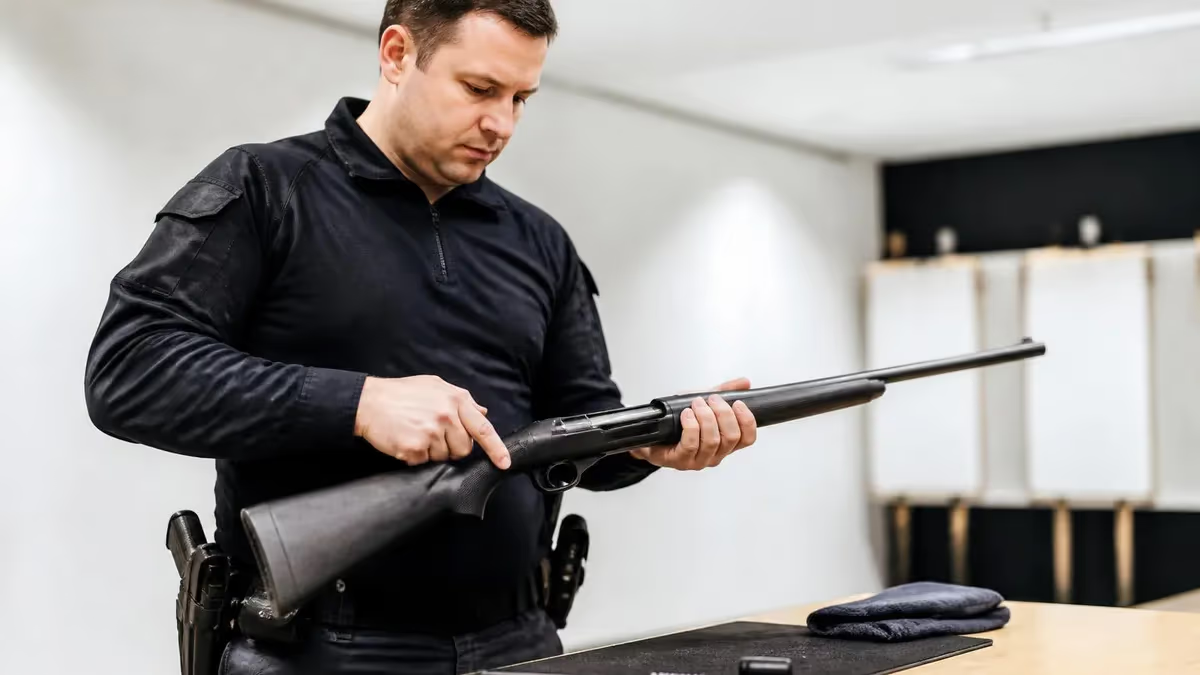
So you keep seeing the acronym CFSC and wondering what it actually means. CFSC stands for the Canadian Firearms Safety Course. It's the federally mandated training program every adult in Canada must complete before they can legally apply for a Possession and Acquisition License (PAL) for non-restricted firearms like rifles and shotguns. No course, no license. No license, no firearm. That's the rule across every province and territory.
This guide walks you through the meaning of CFSC, who needs to take it, what it costs, what's on the test, and how it connects to its restricted cousin (the CRFSC) and the PAL itself. If you're thinking about hunting, target shooting, or just inheriting a family rifle, this is where your journey starts. Pair this article with our canadian firearms safety course cfsc for the full overview before you sign up.
The course exists because Canada takes firearm safety seriously. Federal law has required CFSC certification for non-restricted firearm ownership since the mid-1990s, and the structure has stayed remarkably consistent. The Royal Canadian Mounted Police oversees the program, but actual training is delivered by certified instructors across the country. You won't find this course at a city hall office or a federal building. You'll find it at gun ranges, private training centers, and through community-based hunter education programs.

CFSC = Canadian Firearms Safety Course. A two-day, federally-mandated course (12-15 hours) covering safe handling, storage, transportation, and the law around non-restricted firearms. Includes a 50-question written test and a hands-on practical exam. You need to pass both at 80% or higher before applying for your PAL.
Let's be clear about one thing right out of the gate. The CFSC is the course, not the license. People mix these up constantly. You take the CFSC, you pass it, and then you use the certificate to apply for the PAL through the Royal Canadian Mounted Police (RCMP). The PAL is the actual card in your wallet that lets you buy, own, and transport firearms. Without the course, the application doesn't even leave the post office.
The RCMP delivers CFSC through certified instructors, not directly through the police. You'll find instructors at gun clubs, private ranges, hunter education programs, and through your provincial Chief Firearms Officer (CFO). Pricing varies by region, but most people pay between $100 and $250 for a standalone CFSC course.
Three terms get used interchangeably and they really shouldn't be: CFSC (Canadian Firearms Safety Course — the training), CRFSC (Canadian Restricted Firearms Safety Course — training for handguns), and PAL (Possession and Acquisition License — the legal document). The CFSC and CRFSC are courses you attend. The PAL is the licence you apply for after you pass them. Learn the difference now and you'll save yourself confusion every time you read a forum post or talk to a range officer. Anyone who says "my CFSC" when they mean "my PAL" is being imprecise, and it matters.
What CFSC Covers: Content, Written Test, Practical Test
The classroom portion of CFSC covers a huge amount of material in a short window. Expect to study firearm action types (bolt-action, lever-action, pump-action, semi-automatic, single-shot), ammunition components and types, the four basic rules of safe firearm handling (ACTS and PROVE), the responsibilities of being a firearm owner, safe storage and transportation laws, and the federal regulations that govern non-restricted firearms in Canada. You'll handle real firearms in class, but they'll be deactivated or unloaded for safety.
People often ask if CFSC is hard. Honestly? It's not designed to fail you. The pass rate sits around 85-95% for people who actually prepare. The course is meant to make you safe with firearms, not to weed out applicants. But "prepared" is the key word here. Show up cold, having never touched a firearm and barely glanced at the manual, and you might be the one in ten who fails.
What makes CFSC different from a typical academic test is the dual format. You aren't just answering questions on paper. You're also being watched while you handle real firearms in front of an experienced instructor. Both halves carry equal weight. People who are naturally strong test-takers sometimes flunk the practical because they didn't put in hands-on time. People who are great with mechanical things sometimes flunk the written because they didn't memorize the legal storage rules. Treat both halves as separate exams that both demand serious preparation.
The age range in any given CFSC class is wide. You'll sit next to retirees who grew up around firearms but want their first formal license, alongside university students who've never touched a gun, alongside parents who decided to take the course with their teenage kids. The instructor's job is to bring everyone to the same competence level by Sunday afternoon. Don't be embarrassed if you start the weekend as the complete novice in the room. Most instructors actually prefer beginners because they don't carry bad habits from informal training.
The PROVE Method (Memorize This)
- Action: Point the firearm in the safest available direction
- Why: If something goes wrong, no person is in the line of fire
- Action: Remove all cartridges and ammunition
- Why: Cannot be safe until you confirm no ammo is in the firearm
- Action: Observe the chamber
- Why: Visually confirm the chamber is empty
- Action: Verify the feeding path and magazine
- Why: Make sure no round can feed into the chamber
- Action: Examine the bore for obstructions
- Why: A blocked bore can rupture the barrel when firing
PROVE is the heart of the practical test. You'll do it on a bolt-action rifle, a lever-action rifle, a pump-action shotgun, a semi-automatic rifle, and a gas-operated auto-loading firearm. Every single time. Out loud. The instructor wants to hear you say the steps and see your hands match the words. Muscle memory matters here.
Before PROVE, you do ACTS — Assume every firearm is loaded, Control the muzzle direction, Trigger finger off and out of the trigger guard, See that the firearm is unloaded. ACTS and PROVE together form the safety backbone of every firearm encounter in Canada. Learn them. Live them.
The reason instructors are so particular about verbal recitation is that human memory under stress is unreliable. When you're cold, tired, or distracted in the field, your conscious checklist falls apart. What survives is muscle memory and spoken habit. By forcing you to say the steps out loud during the exam, the instructor is hard-wiring a safety routine into your nervous system. Two years later, when you pull a borrowed rifle out of a friend's truck, ACTS and PROVE should fire automatically. That's the whole point.
This is also why CFSC keeps showing up on lists of practical safety training that genuinely works. The combination of repetition, verbal cues, hands-on demonstration, and immediate instructor feedback hits multiple learning channels at once. Compare that to a purely online course where you just click through slides. The Canadian approach isn't a bureaucratic checkbox — it's behavioral conditioning rooted in real research on how humans actually retain safety procedures under pressure.

From Zero to PAL: The Application Timeline
Step 1: Take CFSC
Step 2: Pass Written Test
Step 3: Pass Practical Test
Step 4: Receive Course Report
Step 5: Apply for PAL
Step 6: Background Check
Step 7: Receive PAL
Step 8: Acquire Firearms
The whole process — from signing up for CFSC to holding a PAL — takes anywhere from 2 to 6 months. The course itself is a weekend. The waiting game is the application processing. RCMP runs background checks, contacts your references (including a previous spouse or partner if applicable in the last two years), and reviews your mental health history. Be honest on the application. Lying on it is a criminal offense.
Plan ahead if you have a target date in mind. People who want to be hunting by fall season often kick off the CFSC paperwork in late spring or early summer. People who hope to compete at a winter sport-shooting league usually start by September. Course slots fill quickly in some regions — rural Ontario and parts of Alberta book out months in advance. Urban centers like Toronto, Vancouver, and Calgary tend to have more frequent course offerings but also more demand. Either way, don't assume you can sign up in October and be licensed by November.
Should You Take CFSC? Pros and Cons
- +Required for legal firearm ownership in Canada
- +Course certification doesn't expire (only the PAL renews every 5 years)
- +Pass rate is high (85-95%) with proper preparation
- +Affordable: $100-$250 for the standalone course
- +Opens the door to hunting, sport shooting, and collecting
- +Two-day commitment for lifelong knowledge
- +Hands-on practice with multiple firearm types
- −PAL application costs another $60 on top of the course
- −Background check and reference calls can feel invasive
- −4-8 week wait after applying for the license
- −Need separate CRFSC course ($100-$150 more) for handguns
- −Storage and transport rules are strict and unforgiving
- −Failing the practical means re-taking the whole course
- −Some provinces have fewer instructors, longer waits to enroll
CFSC and PAL: Cost Breakdown
Key Facts at a Glance
| Item | Value | Details |
|---|---|---|
| CFSC course fee | $100-$250 | |
| PAL application fee (5-year license) | $60 | |
| PAL renewal fee every 5 years | $40 | |
| Total CFSC course duration | 12-15 hrs | |
| Passing score on written AND practical | 80% | |
| Total time from course to PAL in hand | 2-6 mo |
For most people, the total first-time cost to get from zero firearms experience to a fully-functioning non-restricted PAL is around $210 to $310. That includes the CFSC and the application fee. If you want to add handguns into the mix, the CRFSC pushes you closer to $400-$500. After that, you pay $40 every five years to renew. Compared to the lifetime cost of owning firearms, the licensing portion is honestly the cheap part.
If you're hunting for a free, low-pressure way to study before the course, grab the CFSC practice test PDF and run through it a few times. Drilling sample questions is the single most effective prep technique besides reading the manual itself.
Watch out for hidden costs too. Some instructors charge separately for the materials package (manual, sample questions, photocopied legislation excerpts). Others bundle everything. Ammunition for the practical portion is usually provided, but some smaller training operations ask you to bring your own. Range fees are typically included for the course, but if you stay later to practice on your own, expect to pay range time on top. Ask for an itemized quote before you book — "all in" can mean very different things from one instructor to another.

Pre-Course Preparation Checklist
- ✓Download and read the official RCMP CFSC manual (free PDF)
- ✓Take at least 3-5 full-length CFSC practice tests before course day
- ✓Memorize ACTS (Assume, Control, Trigger, See) word-for-word
- ✓Memorize PROVE (Point, Remove, Observe, Verify, Examine) word-for-word
- ✓Familiarize yourself with the five action types you'll handle
- ✓Review basic ammunition terminology (cartridge, bullet, primer, propellant)
- ✓Watch a few CFSC walkthrough videos on YouTube to see PROVE in action
- ✓Eat a real breakfast on course day — long hours, sharp attention required
- ✓Bring eye protection and ear protection if your instructor recommends it
- ✓Wear closed-toe shoes and comfortable clothing for the practical portion
One thing most first-time CFSC students underestimate is the volume of information delivered in a short window. Twelve to fifteen hours sounds like a lot until you're sitting there trying to absorb federal firearms law, mechanical action types, and ammunition variations all at once. Then add hands-on practice. That's why pre-course study isn't optional — it's how you turn a stressful weekend into a manageable one.
A practical study strategy looks like this: spend two evenings reading the RCMP CFSC manual all the way through. Don't skim. Take notes. Then spend a third evening watching CFSC walkthrough videos on YouTube so you can see PROVE and ACTS performed correctly. Spend a fourth evening drilling practice tests until you score 90% or higher consistently. Total prep time: roughly 8-12 hours spread across a week or two. People who do this almost never fail. People who try to cram the night before tend to make sloppy mistakes on the practical that an instructor cannot ignore.
CFSC covers non-restricted firearms — most rifles and shotguns used for hunting and basic sport shooting. CRFSC (Canadian Restricted Firearms Safety Course) is a separate course for restricted firearms — handguns and some rifles. If you want to own handguns or shoot pistols at a range, you need both courses and your PAL must carry the "R" endorsement. Most instructors offer them back-to-back as a combined three-day program for around $200-$400 total.
Who's eligible for CFSC? Anyone 18 or older can take the course and apply for a full PAL. Canadians aged 12 to 17 can take CFSC and apply for a minor's PAL, but it requires parental consent and has stricter limits on what they can do with firearms. Canadian citizens and permanent residents are eligible by default. New immigrants and visitors have more limited paths, often requiring extra documentation or temporary permits.
A criminal record doesn't automatically disqualify you, but it does trigger deeper RCMP review. Violent offenses, weapons charges, domestic violence convictions, or recent serious mental health crises can result in a denial. The application asks specifically about these, and the RCMP cross-references your answers with their databases. Honesty matters. Watch the CFSC practice test video answers playlist if you want walkthroughs of the trickier exam topics before you commit to a course date.
Mental health questions on the application catch some people off guard. The RCMP isn't trying to disqualify anyone who has ever seen a therapist. They are looking for recent acute episodes, hospitalizations for suicidal or homicidal ideation, or ongoing untreated conditions that could affect judgement. If you're under stable treatment, you generally still qualify. If you're in the middle of a crisis, the RCMP will probably ask you to wait. Talk to your physician if you're unsure how to answer truthfully — they can help you frame the situation accurately on the form.
Where and How to Find a CFSC Course
Every province has a Chief Firearms Officer (CFO) who maintains an official list of certified CFSC instructors. Start there. The list is usually free to access on the RCMP or provincial government website. You'll see contact details, locations, and sometimes pricing. This is the most reliable source — every instructor on the list is currently certified and approved.
One question that surprises new shooters: how long is the CFSC certification valid? The answer is forever. Your CFSC Course Report doesn't expire. Once you pass, you're certified for life. What expires is your PAL — that needs renewal every five years. Renewal doesn't require re-taking CFSC. It's just a paperwork update, a new background check, and the $40 fee. As long as your circumstances haven't changed dramatically, renewal is straightforward.
If you let your PAL lapse, you can't legally possess firearms during the gap. You'd have to either transfer them to someone with a valid PAL, store them with a licensed business, or surrender them. Don't let the renewal date sneak up on you. RCMP sends reminders, but they're easy to miss in the mail.
A smart habit is to set a calendar alert nine months before your PAL expires. That gives you plenty of runway to renew without rushing. Some people also link the renewal to a memorable annual event — like "every fifth Canada Day, I check my PAL" — so they never lose track. The renewal application is much simpler than the original. No course, no instructor, no practical demonstration. Just a refreshed background check, current references, and any updated personal information.
What's Tested in the Practical Exam
- ✓Demonstrate ACTS verbally at the start of each firearm encounter
- ✓Demonstrate PROVE on a bolt-action rifle
- ✓Demonstrate PROVE on a lever-action rifle
- ✓Demonstrate PROVE on a pump-action shotgun
- ✓Demonstrate PROVE on a semi-automatic rifle
- ✓Demonstrate PROVE on a gas-operated auto-loading firearm
- ✓Maintain safe muzzle control at all times
- ✓Use proper carry positions (cradle, sling, ready, trail) when asked
- ✓Safely load and unload each firearm correctly
- ✓Engage the safety mechanism appropriately for each action type
- ✓Identify common firearm parts when prompted by the instructor
- ✓Show situational awareness when handing firearms between people
The practical isn't graded just on whether you can physically do the moves. It's about whether you do them every time and in the right order. Skip a step, and the instructor marks it. Get sloppy with muzzle direction, and the instructor marks it. The whole point is to build automatic safe-handling habits that survive stress, distraction, and fatigue when you're out in the field.
If you struggle with one specific action type during practice — say, the lever-action because you've never handled one — ask the instructor for an extra minute with it before the actual exam. Most are generous with extra reps. They'd rather you pass the first time than have to fail you and re-teach the whole course.
Bring questions. Ask why something works the way it does. The students who engage actively in the classroom portion almost always pass the practical with confidence. The students who sit silent in the back tend to freeze when the instructor hands them an unfamiliar firearm. Engagement also makes the day pass faster. Twelve hours of safety material can feel grinding if you're disengaged, but it flies by when you're actively curious about every action type and ammunition variant the instructor demonstrates.
Sample Canadian Firearms Safety Course Practice Questions
Try these questions from our free Canadian Firearms Safety Course practice tests. The correct answer and an explanation follow each question.
What are the four fundamental rules of Canadian firearms safety as taught in the CFSC?
- A. Treat every firearm as if loaded, never point at anything you do not intend to shoot, keep finger off trigger until ready to fire, and know your target and what is beyond
- B. Lock, Unload, Check, Secure
- C. Always use a safety, never shoot alone, always wear hearing protection, never leave a firearm unattended
- D. Check chamber, remove magazine, open action, store safely
Answer: A. Treat every firearm as if loaded, never point at anything you do not intend to shoot, keep finger off trigger until ready to fire, and know your target and what is beyond
The four fundamental CFSC safety rules are: treat every firearm as loaded, never point at anything you do not intend to shoot, keep finger off trigger until ready, and know target and what is beyond.
How does alcohol consumption affect the safe handling of firearms under Canadian law?
- A. It is a criminal offence to handle a firearm while ability is impaired by alcohol or any drug
- B. Alcohol affects reflexes but is not specifically addressed by Canadian firearms law
- C. Low levels of alcohol are acceptable for recreational shooting as long as a sober companion is present
- D. Only restricted firearm users are prohibited from drinking while shooting
Answer: A. It is a criminal offence to handle a firearm while ability is impaired by alcohol or any drug
Under the Canadian Criminal Code, it is a criminal offence to handle a firearm while impaired by alcohol or drugs, regardless of the level of impairment or the type of firearm.
A firearms owner leaves a non-restricted rifle in their unattended vehicle in a mall parking lot. Which of the following storage methods is compliant with Canadian law?
- A. The rifle is unloaded and placed on the back seat, covered by a blanket.
- B. The rifle is unloaded, trigger-locked, and locked in the trunk of the vehicle.
- C. The rifle is loaded and stored in the glove compartment for quick access.
- D. The rifle is unloaded and placed in a locked, transparent gun case on the front seat.
Answer: B. The rifle is unloaded, trigger-locked, and locked in the trunk of the vehicle.
When leaving any class of firearm in an unattended vehicle, it must be locked in the trunk or a similar lockable compartment. If the vehicle lacks such a compartment, the firearm must be placed out of sight inside the locked vehicle.
What is the role of the Chief Firearms Officer in each Canadian province and territory?
- A. To administer the Firearms Act at the provincial level, including issuing licences, approving shooting clubs, and overseeing compliance
- B. To command all armed police officers in the province
- C. To set provincial hunting seasons and quotas
- D. To inspect all firearms manufacturers operating in Canada
Answer: A. To administer the Firearms Act at the provincial level, including issuing licences, approving shooting clubs, and overseeing compliance
The Chief Firearms Officer in each province and territory is responsible for administering the Firearms Act provincially, including licence approvals, shooting club approvals, and compliance oversight.
CFSC Questions and Answers
The bottom line on CFSC: it's not a barrier, it's a gateway. The Canadian Firearms Safety Course exists to make sure every legal firearm owner in this country knows how to handle, store, and transport their firearms without hurting themselves or anyone else. The standards are reasonable. The cost is moderate. The certification lasts forever. And once you're through it, you've got a PAL that opens up hunting, sport shooting, collecting, and a lifetime of responsible firearm ownership.
If you're seriously considering CFSC, your next move is twofold: find a certified instructor through your provincial CFO list, and start studying now. Don't wait until course day. The students who breeze through are the ones who showed up already knowing ACTS, PROVE, the action types, and the legal storage rules. The students who struggle are the ones who treated it like a weekend formality. Treat it like a real exam, prepare like a real exam, and you'll join the 85-95% who pass on the first try.
One final tip: after you pass CFSC and receive your Course Report, store it somewhere safe and make a digital copy. Your PAL application requires the original or a signed certified copy. Some people lose the printed report years later and have to track down their instructor for a duplicate — which is doable but a hassle.
Keep it with your tax records, your passport, your other important documents. Better yet, take a clear photo and email it to yourself for backup. Five years from now, when you're renewing your PAL, you might also want quick access to your original course details.
By the way, if you're also interested in commercial driving credentials in other countries, our LGV theory test overview shows the same structured prep approach in action — different domain, identical study principles.
Good luck on your CFSC journey. Show up prepared, stay calm during the practical, and you'll join the millions of Canadians who own and use firearms safely and legally every year. Whether your goal is hunting waterfowl in the prairies, hitting clay targets at a sporting club, or simply being a responsible heir to a family rifle, this course is your essential foundation for legal Canadian firearm ownership in 2026.
About the Author

Educational Psychologist & Academic Test Preparation Expert
Columbia University Teachers CollegeDr. Lisa Patel holds a Doctorate in Education from Columbia University Teachers College and has spent 17 years researching standardized test design and academic assessment. She has developed preparation programs for SAT, ACT, GRE, LSAT, UCAT, and numerous professional licensing exams, helping students of all backgrounds achieve their target scores.