
CFP Renewal 2026 — CE Requirements, Ethics, and How to Renew Your CFP Certification
Get ready for your CFP Renewal 2026 certification. Practice questions with step-by-step answer explanations and instant scoring. 🏆

CFP: upcoming dates and official changes
- Oct 21, 2026: Registration for the March 16–23, 2027 CFP® exam opens Oct. 21, 2026. (CFP Board)
- Updated Oct 19, 2026: Exam fee is now $925 standard ($825 early bird, $1,025 late) (previously $925 standard ($825 early bird, $1,025 late)).
- Updated Oct 19, 2026: Exam fee is now $925 standard ($825 early bird, $1,025 late) (previously $925 standard ($825 early bird, $1,025 late)).
- Updated Oct 19, 2026: Renewal is now 30 CE hours per reporting period (2 ethics) (previously 30 CE hours per reporting period (incl. 2 ethics)).
Facts verified Oct 19, 2026 against CFP Board. Dates that have passed are removed automatically.
- The CFP® exam is a computer-based exam of 170 multiple-choice questions. (CFP Board)
- The CFP® exam is pass-or-fail, based on the candidate's total score across all sections, and CFP Board does not publish a passing score. (CFP Board)
- The CFP® exam standard registration rate is $925, with an $825 early bird rate and a $1,025 late rate. (CFP Board)
- Candidates who retake the CFP® exam must pay the applicable exam fee for each retake. (CFP Board)
- CFP Board limits candidates to 5 lifetime CFP® exam attempts and requires a one-year wait before a fourth attempt after three failures within 24 months. (CFP Board)
- CFP® certification is renewed every year with an annual certification fee and Renewal Application, and CE is completed every two years. (CFP Board)
- CFP® professionals must complete 30 hours of continuing education each reporting period, including 2 hours of CFP Board Ethics CE. (CFP Board)
- The CFP® exam is computer-based at Prometric test centers, and beginning with the November 2026 exam remote testing is available upon request only. (CFP Board)
- Candidates who have fulfilled CFP Board's certification coursework requirement may sit for the CFP® exam, and the bachelor's degree must be met within five years of passing. (CFP Board)
Facts verified Oct 19, 2026 against CFP Board. Dates that have passed are removed automatically.
CFP Exam at a Glance
| Item | Detail | Official source |
|---|---|---|
| Number of questions | 170 multiple-choice questions | CFP Board |
| Passing score | Pass/fail on total score; no published cut score | CFP Board |
| Exam fee | $925 standard ($825 early bird, $1,025 late) | CFP Board |
| Retake fee | Applicable full exam fee for each retake | CFP Board |
| Retake policy | Max 5 lifetime attempts; 1-year wait after 3 failures in 24 months | CFP Board |
| Validity | Renewed annually (fee + Renewal Application); CE every 2 years | CFP Board |
| Renewal | 30 CE hours per reporting period (2 ethics) | CFP Board |
| Delivery | Prometric test centers; remote by request only from Nov. 2026 | CFP Board |
| Eligibility | CFP Board coursework; bachelor's degree within 5 years of passing | CFP Board |
| Score release | Preliminary immediately; official ~4 weeks after window closes | CFP Board |
| Late registration deadline | Late rate $1,025 in final week | CFP Board |
| Registration opens (March 2027 exam) | Oct. 21, 2026 | CFP Board |
Facts verified Oct 19, 2026 against CFP Board. Dates that have passed are removed automatically.
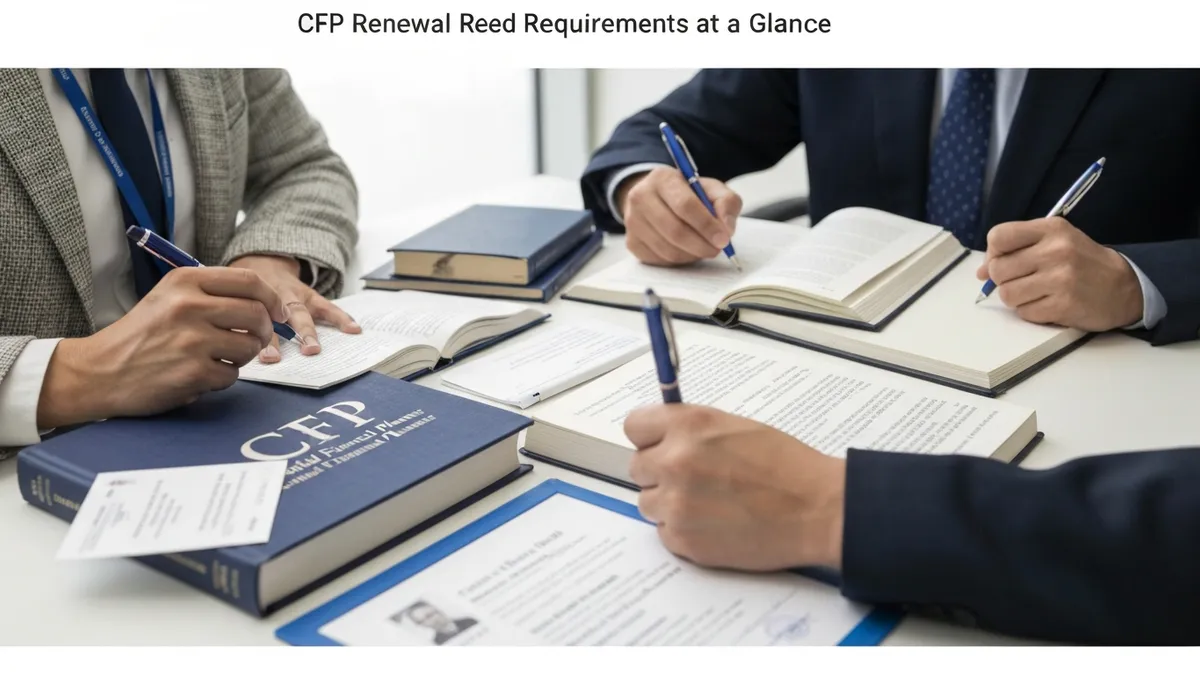
CFP Renewal CE Requirements
Every CFP certificant must complete 30 hours of continuing education every two years to maintain their certification. These CE hours must be completed before your renewal deadline — the CFP Board does not grant extensions or grace periods. Practice with the free CFP - Certified Financial Planner practice test on PracticeTestGeeks (7 questions with answer explanations).
CE topic requirements:
- 2 hours: Ethics CE — Mandatory. Must be a CFP Board-approved ethics CE program that specifically addresses the CFP Board's Code of Ethics and Standards of Conduct. Generic business ethics courses do not satisfy this requirement.
- 28 hours: General CE — Any CFP Board-approved CE program in financial planning topic areas.
Approved CE topic areas include:
- Financial planning process and theory
- Insurance planning and risk management
- Investment planning and portfolio management
- Tax planning
- Retirement savings and income planning
- Estate planning
- Education planning
- Psychology of financial planning (added as a topic area in recent years)
- Diversity, equity, and inclusion in financial planning
- Financial technology (FinTech) and practice management
CE providers: The CFP Board maintains a database of approved CE sponsors and programs. CE can be earned through live seminars, webinars, self-study programs, college courses, and professional organization events. Major CE providers include the FPA (Financial Planning Association), NAPFA, IMCA, and many insurance CE providers. Programs must be pre-approved by the CFP Board — completing unapproved programs does not count.
CE for teaching: CFP certificants who teach CFP Board-registered education programs can earn CE credit for instruction time. Up to 10 hours per renewal period may be earned through qualifying teaching activity.
Pro bono CE credit: CE credit is available for completing CFP Board-approved pro bono financial planning. This recognizes professionals who provide free financial planning services to underserved populations.
Free CFP - Certified Financial Planner Study Tools
Interactive CFP - Certified Financial Planner resources on PracticeTestGeeks, free to start:
- CFP - Certified Financial Planner flashcards — review key terms and concepts card by card
- CFP - Certified Financial Planner study guide — topic-by-topic overview of what the exam covers
- CFP - Certified Financial Planner cheat sheet — one-page printable summary for last-minute review
How to Report CE to the CFP Board
CE hours must be reported to the CFP Board by your renewal deadline. Many CE providers submit CE hours to the CFP Board automatically on your behalf — but you are responsible for ensuring all hours are recorded correctly.
Reporting process:
- Check your CE transcript: Log into the CFP Board's certification portal at cfp.net. Your CE transcript shows all CE hours that have been reported by sponsors to the CFP Board for your ID.
- Self-report missing CE: If a sponsor has not submitted your hours (common with smaller providers or older courses), you can self-report CE by uploading a certificate of completion directly in the portal. The CFP Board may audit self-reported CE — retain certificates and documentation.
- Verify ethics CE is recorded: The portal tracks ethics and general CE separately. Confirm your 2-hour ethics requirement shows as completed, not just counted in your general total.
- Complete renewal: Once 30 CE hours are recorded (including 2 ethics hours), complete your renewal application in the portal and pay the biennial fee.
CE audit: The CFP Board randomly audits CE compliance. If audited, you must provide documentation (certificates of completion, provider confirmation) for all reported CE hours. Maintain CE documentation for at least one renewal cycle after completion.
CFP Renewal Fees
The CFP Board charges an annual certification fee due at renewal. As of 2026, the standard renewal fee is approximately $355 per year. The CFP Board adjusts fees periodically — always verify the current fee in your renewal portal.
No late fee option exists — if you miss the renewal deadline, your certification lapses and you must pay a reinstatement fee (which is higher than the renewal fee) plus meet additional requirements.

CFP Renewal Checklist
- ✓Know your renewal deadline — log into cfp.net and confirm your biennial renewal date well before it arrives
- ✓Complete 2 hours of CFP Board-approved ethics CE specifically covering the CFP Board Code of Ethics and Standards of Conduct
- ✓Complete 28 additional hours of CFP Board-approved general CE in financial planning topic areas
- ✓Verify all CE hours are recorded in your CFP Board certification portal — check both provider-submitted and self-reported hours
- ✓Confirm your ethics CE appears separately in the portal as 'ethics' category, not lumped into general hours
- ✓Retain certificates of completion for all CE programs for at least one full renewal cycle in case of audit
- ✓Complete your renewal application in the CFP Board portal before your deadline date
- ✓Pay the annual certification fee (~$355) — no grace period exists, late means lapse
What Happens If Your CFP Lapses
If you miss your renewal deadline without completing the CE and fee requirements, your CFP certification lapses. A lapsed CFP certificant may NOT use the CFP marks (CFP® or Certified Financial Planner™) until reinstated.
Reinstatement process:
- You must apply for reinstatement through the CFP Board portal
- A reinstatement fee applies (higher than the standard renewal fee — check current CFP Board rates)
- You must complete all outstanding CE requirements that were due at the time of lapse
- Background check may be required depending on how long the certification has been lapsed
- If lapsed more than 5 years, you may be required to retake the CFP exam rather than simply reinstate
To avoid lapse, set calendar reminders 6 months and 3 months before your renewal deadline. Most CE can be completed online in evenings and weekends — 30 hours over 2 years is approximately 1.25 hours per month.
- +Validates your knowledge and skills objectively
- +Increases job market competitiveness
- +Provides structured learning goals
- +Networking opportunities with other certified professionals
- −Study materials can be expensive
- −Exam anxiety can affect performance
- −Requires dedicated preparation time
- −Retake fees apply if you don't pass
Pros and Cons at a Glance
| Pros | Cons |
|---|---|
| Validates your knowledge and skills objectively | Study materials can be expensive |
| Increases job market competitiveness | Exam anxiety can affect performance |
| Provides structured learning goals | Requires dedicated preparation time |
| Networking opportunities with other certified professionals | Retake fees apply if you don't pass |
Sample CFP - Certified Financial Planner Practice Questions
Try these questions from our free CFP - Certified Financial Planner practice tests. The correct answer and an explanation follow each question.
The 'diligence' principle in CFP Board's Code of Ethics requires a CFP® professional to:
- A. Respond to all client inquiries within 24 hours
- B. Provide professional services in a prompt, thorough, and careful manner
- C. Complete a minimum of 40 hours of continuing education per reporting period
- D. Maintain a written business continuity plan for client service interruptions
Answer: B. Provide professional services in a prompt, thorough, and careful manner
Diligence requires that CFP® professionals provide their services in a timely, thorough, and careful manner, ensuring client matters receive appropriate attention and follow-through.
A CFP® professional who becomes aware that a client's tax return contains a material error is required to do which of the following under CFP Board's Code of Ethics?
- A. Immediately notify the IRS on the client's behalf
- B. Inform the client of the error and recommend they take corrective action
- C. Withdraw from the engagement without explanation
- D. Correct the error unilaterally on the next filing
Answer: B. Inform the client of the error and recommend they take corrective action
CFP Board's Standards require the professional to promptly notify the client of the error and recommend corrective action, while respecting client confidentiality.
The CFP Board's enforcement process addresses quality and ethics violations PRIMARILY through:
- A. Investigation, adjudication, and sanctions ranging from private censure to revocation of CFP certification
- B. Referral of all violations to the SEC for federal prosecution
- C. Mandatory client reimbursement orders issued by the Board
- D. Annual re-examination requirements imposed on violators
Answer: A. Investigation, adjudication, and sanctions ranging from private censure to revocation of CFP certification
The CFP Board investigates complaints, conducts hearings, and imposes sanctions — including censure, suspension, or revocation — to enforce its professional standards.
Under the CFP Board's Code of Ethics, which duty requires a CFP professional to act in the client's best interest at all times?
- A. Fiduciary duty
- B. Suitability duty
- C. Disclosure duty
- D. Competency duty
Answer: A. Fiduciary duty
The fiduciary duty requires CFP professionals to place the client's interests above their own in all financial planning relationships.
Take the full CFP - Certified Financial Planner practice test
CFP Renewal Questions and Answers
More CFP Resources
How this page was made: written with AI tools and published by Nathan Beja, founder of Practice Test Geeks, who is responsible for its content. Exam facts are checked against the official sources listed below. Not reviewed by a subject-matter expert. Editorial policy
Sources & references
Exam facts on this page (fees, format, dates, passing scores) are checked against these official sources; the date is our last check. Editorial policy
- cfp.net — Exam dates, fees, late registration, registration deadline, registration, test dates, eligibility, retake policy, renewal, score validity · verified Oct 2026
- prometric.com — Test delivery · verified Oct 2026