
Cat Test Year 7 Practice Papers Free: CAT4 Level D Guide for Parents 2026
🎯 Yes, free Year 7 CAT practice papers exist. See the CAT4 Level D format, 180 questions, scoring and free quizzes.

Yes, you can find cat test year 7 practice papers free online, but the real test is CAT4 Level D, which only schools can buy from GL Assessment. Use free CAT4-style questions across verbal, quantitative, non-verbal and spatial reasoning to build familiarity, then practice against the official 72 timed minutes.
Cat Test Year 7 Practice Papers Free: Key Facts (Updated October 2026)
| Fact | Details | Source |
|---|---|---|
| Test and publisher | CAT4 (Cognitive Abilities Test Fourth Edition), published by GL Assessment, a Renaissance company | GL Assessment |
| Usual Year 7 level | Level D, for ages 10 years 6 months to 12 years 11 months | GL Assessment |
| Structure | 8 tests in 4 batteries: Verbal, Quantitative, Non-verbal and Spatial | GL Assessment |
| Questions (Levels A-G) | 180 in total: 48 per Verbal, Quantitative and Non-verbal battery, 36 Spatial | GL Assessment 2026 Teacher Guidance |
| Timed testing | 72 minutes of timed work, plus about 5 minutes of instructions and practice per test | GL Assessment |
| Who can buy it | Schools only; parents cannot purchase an official sitting | GL Assessment parents page |
| Scoring | Standard Age Score with mean 100 and SD 15; stanines 1 to 9; national percentile rank | GL Assessment |
| Paper report turnaround | 7 to 10 working days, up to 15 during the September and October peak | GL Assessment |
The CAT4, short for Cognitive Abilities Test Fourth Edition, is not a curriculum exam. It measures how well a student reasons with words, numbers, shapes and patterns, which is why parents searching for free Year 7 papers often feel unsure what to practice. In England and Wales, Year 7 means ages 11 to 12, which matches Grade 6 in the United States. Most Year 7 students sit Level D, usually in September or October.
Schools, not families, buy the test. GL Assessment states that only schools can purchase the CAT4, so no parent can book an official sitting or download the live papers. That is why every free resource you find, including ours, is a practice-style set rather than the real thing. If you are starting from scratch, read our main cat 4 test guide first, then return here for the Year 7 specifics and a simple weekly routine.
Year 7 results matter because many secondary schools use them for setting, support planning and target setting. The CAT4 reports a Standard Age Score where 100 is average and 15 is one standard deviation, so about 68 percent of students land between 85 and 115. A score of 127 or higher reaches stanine 9, the top 4 percent. Knowing those bands helps you read the report calmly instead of treating a single number as a verdict.
Free practice has a real, modest purpose. Reasoning tests reward familiarity with question styles, not memorized facts, so a few short sessions can remove surprise. Your child learns what a figure matrix looks like, how an analogy is built, and why the clock matters. What practice cannot do is raise underlying ability very much, and any site promising dramatic score jumps is overselling. Aim for comfort and confidence, not coaching.
Terminology causes confusion online. People type CAT test, CATs, CAT 4, cat4 and even caat, and they get everything from cognitive tests to unrelated organizations. This page covers only the Cognitive Abilities Test used in UK-style schools and international schools worldwide. Later we explain how to tell it apart from similarly named searches, including community CAAT listings and cat4 cable, which is a networking term and has nothing to do with school testing.
Here is how to use this guide. First, confirm what the test contains using the format table below. Second, try the free Figure Matrices and Verbal Classification quizzes linked throughout. Third, follow the checklist and weekly routine, keeping sessions short. Fourth, learn how scores are reported so you can interpret the results with your child's teacher. Each section opens with a direct answer, so you can skip to whatever question matters most to you today.
A quick note on source quality. Facts in the table above come from GL Assessment materials, including its 2026 Teacher Guidance and paper on-the-day guide. Where official information is missing, such as the number of answer options per test or any new norms, we say so rather than guess. If your school tells you something different, such as a different level or sitting date, always trust the school, because it controls registration, timing and how results are shared.
- CAT4 Levels X and Pre-A, for children aged 6 to 8, are taken in two parts of about 30 minutes each. (GL Assessment (GL Education internationally), a Renaissance company)
- CAT4 has no pass mark; results are reported as Standard Age Scores, where the average for each age group is set to 100. (GL Assessment (GL Education internationally), a Renaissance company)
- CAT4 (Cognitive Abilities Test Fourth Edition) can only be bought by schools from GL Assessment, which publishes no public price list; parents cannot buy or book the test themselves. (GL Assessment (GL Education internationally), a Renaissance company)
- GL Assessment advises that a student whose CAT4 score is unreliable can be retested with CAT4 after a gap of at least six months. (GL Assessment (GL Education internationally), a Renaissance company)
- CAT4 is taken at school under formal test conditions, either digitally on a PC or tablet or as a paper test. (GL Assessment (GL Education internationally), a Renaissance company)
- CAT4 is for students aged 6 to 17+, who take the level that matches their age through their school. (GL Assessment (GL Education internationally), a Renaissance company)
- The digital edition of CAT4 is scored automatically when the student finishes, and the school can generate reports on demand. (GL Assessment (GL Education internationally), a Renaissance company)
Facts verified Oct 14, 2026 against GL Assessment (GL Education internationally), a Renaissance company. Dates that have passed are removed automatically.
CAT4 Exam at a Glance
| Item | Detail | Official source |
|---|---|---|
| Time limit (Levels X and Pre-A (ages 6-8)) | 2 x 30 minutes | GL Assessment (GL Education internationally), a Renaissance company |
| Passing score | No pass mark; Standard Age Score average = 100 | GL Assessment (GL Education internationally), a Renaissance company |
| Exam fee | School-purchased only; no public price list | GL Assessment (GL Education internationally), a Renaissance company |
| Retake policy | Retest after at least 6 months | GL Assessment (GL Education internationally), a Renaissance company |
| Delivery | Digital (PC or tablet) or paper, at school | GL Assessment (GL Education internationally), a Renaissance company |
| Eligibility | Ages 6 to 17+, through their school | GL Assessment (GL Education internationally), a Renaissance company |
| Score release (Digital edition) | Scored automatically on completion | GL Assessment (GL Education internationally), a Renaissance company |
Facts verified Oct 14, 2026 against GL Assessment (GL Education internationally), a Renaissance company. Dates that have passed are removed automatically.
Year 7 CAT4 by the Numbers
What Is on the Cat Test for Year 7?
| Section | Questions | Time | Weight | Notes |
|---|---|---|---|---|
| Verbal Battery | 48 | 16 min | 27% | Verbal Classification (8 min) and Verbal Analogies (8 min) |
| Quantitative Battery | 48 | 18 min | 27% | Number Analogies (10 min) and Number Series (8 min) |
| Non-verbal Battery | 48 | 20 min | 27% | Figure Classification (10 min) and Figure Matrices (10 min) |
| Spatial Battery | 36 | 18 min | 20% | Figure Analysis (9 min) and Figure Recognition (9 min) |
| Total | 180 | 72 minutes timed | 100% |
What Do Year 7 CATs Practice Papers Look Like?
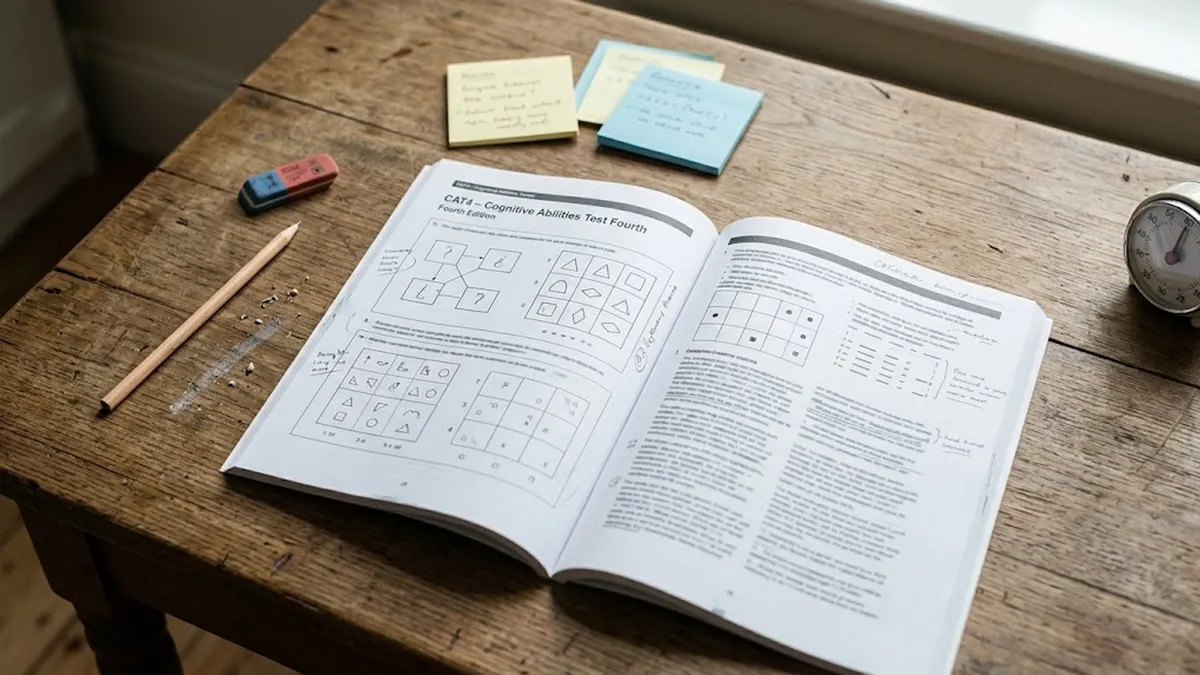
A Year 7 CAT practice paper is a set of short, timed reasoning questions split into four batteries: verbal, quantitative, non-verbal and spatial. Each battery has two sub-tests, giving eight tests in total at Levels A to G. The best free papers copy that structure and keep item types realistic. For the full overview, see our cat4 assessment test page.
The verbal battery uses Verbal Classification and Verbal Analogies. In classification, a student sees three words that share a link, such as oak, birch and willow, and picks the fourth word that belongs, perhaps maple rather than granite. In analogies, they complete a relationship like hot is to cold as up is to what. Success depends on vocabulary, but also on spotting the exact rule, which is why reading widely helps more than word lists.
The quantitative battery contains Number Analogies and Number Series. A series might read 3, 6, 12, 24 and ask for the next value, where the rule is doubling. Analogies compare number pairs, such as 4 to 16 and 5 to what, where squaring gives 25. No advanced mathematics is needed, but fast mental arithmetic and times tables knowledge save precious seconds, since each test lasts only eight to ten minutes.
The non-verbal battery has Figure Classification and Figure Matrices. A matrix shows a three-by-three grid of shapes with one square missing, and the student chooses the piece that completes the pattern. Rules often involve rotation, shading, shape count or positions that change across rows. Our free Figure Matrices quizzes let your child practice noticing these rules one at a time, which is the most valuable habit for this battery.
The spatial battery includes Figure Analysis and Figure Recognition. Figure Analysis asks what a folded or cut piece of paper will look like when opened. Figure Recognition asks the student to find a shape hidden inside a more complicated design. These tasks feel like puzzles, and children who enjoy building, drawing or games often find them natural. Others need more repetition, so give spatial questions a regular but short slot in the weekly plan.
Timing is where free papers often fall short. Official tests are fixed: Figure Classification 10 minutes, Figure Matrices 10, Verbal Classification 8, Verbal Analogies 8, Number Analogies 10, Number Series 8, and Figure Analysis and Figure Recognition 9 each. That totals 72 minutes of timed work, plus about five minutes of instructions and examples per test. When you practice, set a visible timer for the matching duration so pacing becomes automatic.
Choose the right level, too. Level D covers ages 10 years 6 months to 12 years 11 months and is the usual Year 7 level, while Level E suits Year 8 and Level F covers Years 9 and 10. If you also see searches for a year 8 or cat 4 test year 9 paper, remember the question styles stay the same and only the difficulty rises. A confident Year 7 student can safely try a few Level C or E items for stretch.
Which Free CAT4 Practice Papers Suit Year 7 Students Best?
Start with verbal and quantitative items because they connect to schoolwork. Verbal Classification and Analogies reward children who read widely and talk about word relationships. Try five to eight items a day, then discuss why the right answer fits and why each wrong option fails. Explaining the rule aloud builds the same reasoning skill the test measures, and it takes only a few minutes at the kitchen table.
For quantitative practice, write number series on index cards and ask your child to name the rule before solving. Common rules include adding a constant, multiplying, alternating two patterns and adding increasing amounts. Revise times tables up to 12 times 12, since quick recall frees attention for the pattern. If your child freezes on numbers, slow down first and add the clock later, once accuracy is reliably above eighty percent.
Are Free Year 7 CATs Practice Papers Worth It?
- +They cost nothing, so you can try several sets before deciding anything else.
- +They introduce all eight question types so none look strange on test day.
- +Short sessions can reduce anxiety by making the format familiar.
- +They reveal which sub-tests need extra attention.
- +Online quizzes give instant answers and explanations.
- +Printable sets work without a screen, which suits many children.
- −They are not official GL Assessment content, so difficulty can differ from Level D.
- −Timing is often looser than the fixed 8 to 10 minute limits.
- −Quality varies widely between free sites.
- −They cannot predict an actual Standard Age Score.
- −Too much practice can create stress without raising ability.
- −Some free sets skip explanations or leave out spatial questions entirely.
How Do I Prepare My Child for the CAT4 in Year 7?
- ✓Confirm with the school which level and format, digital or paper, your child will sit.
- ✓Review the eight sub-tests so none look unfamiliar.
- ✓Start with five untimed Figure Matrices questions.
- ✓Add a timer that matches the official 8 to 10 minute test lengths.
- ✓Practice three times a week for about 20 minutes.
- ✓Keep a log of scores and the rules your child missed.
- ✓Revise times tables up to 12 times 12.
- ✓Encourage wide reading to strengthen word relationships.
- ✓Try a printed set to practice filling bubbles with an HB pencil.
- ✓Plan an early night and a good breakfast before test day.
Practice builds familiarity, not a higher ability
The CAT4 measures reasoning, so a few short sessions mainly remove surprise rather than raise scores. Focus on understanding each question type and staying calm. Stanine 5 covers Standard Age Scores of 97 to 103, and most children land near it.
How Are Year 7 CATs Scores Reported?
Year 7 CAT4 results are reported as Standard Age Scores, where 100 is the average and the standard deviation is 15. About 68 percent of students score between 85 and 115. GL Assessment standardized the test on 25,000 students and checks it every year against roughly 250,000 more, so the scale stays reliable. Your child receives a score for each of the four batteries, which gives teachers a rounded profile.
Scores are also converted to stanines, a nine-point scale. Stanine 5 covers SAS 97 to 103, the middle of the pack. Stanine 6 is 104 to 111, stanine 7 is 112 to 118, and stanine 8 is 119 to 126. Stanine 9 starts at 127, which is the top 4 percent. At the lower end, stanine 4 is 89 to 96, stanine 3 is 82 to 88, stanine 2 is 74 to 81, and stanine 1 is 73 and below.
Reports also include a National Percentile Rank and a Group Rank. The percentile compares your child with the national sample of the same age, so a rank of 70 means they scored higher than about 70 percent of peers. Group Rank compares them with classmates in the same school. Both are useful, but remember that a student's rank in a high-attaining class can look lower than their national position.
Every score carries a 90 percent confidence band, because no test is perfectly precise. If a student scores 108 with a band of plus or minus six, the true ability probably sits between 102 and 114. That is why teachers look at patterns across batteries rather than single points, and why a small gap between two batteries usually means nothing at all. Treat differences of a few points as noise.
The most interesting information is the profile. A student with a strong spatial score and a weaker verbal score may thrive in design, technology or science practical work yet need extra language support. A student with strong verbal reasoning but lower non-verbal results may benefit from visual strategies in maths. Schools use these patterns to plan support, group classes and set challenge targets, not to label children.
Timing of results depends on format. Digital tests, delivered on a PC or tablet, are scored automatically when the student finishes, and a partly completed session can be resumed within 30 days. Paper tests use HB pencil answer sheets that GL scans and scores, with reports usually returning in seven to ten working days, and up to fifteen during the busy September and October peak. Ask your school which format it uses.
When results arrive, ask three questions. What does the profile say about strengths and gaps? How will the school use it for setting or support? And how do the indicators for later exams, such as KS2 progress, GCSE grades 9 to 1, A level or IB, relate to my child? Avoid comparing scores with friends, since confidence bands, age and sitting dates all differ, and a single sitting is only a snapshot.
GL Assessment sells the CAT4 to schools only, so be cautious of any site selling official or leaked papers. Genuine practice sets are labeled as practice. Never pay for a promise of guaranteed score gains.
Is It the CAT4, a CAAT, or Something Else?
No, searching for CAAT will not lead you to the cognitive test most Year 7 parents mean. The Cognitive Abilities Test is spelled CAT4, and it is published by GL Assessment, a Renaissance company. Many misspelled searches, including caat, land on unrelated pages. Before downloading anything, check that the title says Cognitive Abilities Test, lists verbal, quantitative, non-verbal and spatial sections, and refers to a level such as Level D.
Other look-alikes are common. Community CAAT results often refer to local organizations or programs, and a query such as caat bakersfield adds a city name, which signals a place-based listing rather than a school reasoning test. A phrase like got caat is ambiguous and could mean many things. None of these relates to Year 7 setting or school assessment, so do not rely on them for practice.
Then there is cat4 cable. That is an old network cabling grade, long superseded by Cat5e and Cat6, and it has nothing to do with student assessment. Also remember that the United States has its own similar test, the CogAT, which has different formats and scoring. If you are a US reader following British Year 7 materials, check whether your school really uses the CAT4 before spending time on it.
If your need is cat test year 7 practice papers free, the most direct path is our worked walkthrough with video answers, found at cat test year 7 practice papers free, which explains each question type step by step. Watching a worked solution is often faster than reading an explanation, and it models how to think aloud. Pair every video with a few untimed questions afterward, so understanding turns into independent skill.
Families also search by year group. A cat test for year 4 relates to Level A, ages 7 years 6 months to 9 years 11 months. Year 5 uses Level B, Year 6 uses Level C, Year 8 uses Level E, and Years 9 and 10 use Level F. The reasoning skills are identical across levels, so free Year 7 practice transfers well to neighboring years with only a difficulty adjustment.
International schools use the test widely. Many schools in Dubai, regulated by KHDA, report CAT4 results, so Year 6 and Year 9 families often look for practice sets there too. The core advice does not change: confirm the level, practice the eight sub-test styles, and follow your school's guidance. A Year 6 student will usually meet Level C, while a Year 9 student usually meets Level F.
Finally, do not confuse the CAT4 with every entrance exam. Some schools do use CAT4 results in admissions or placement, while others rely on their own assessments, and these differ in content and stakes. Ask the admissions office exactly which test applies, when it takes place and whether a practice pack is provided, before building a plan around the wrong paper. A five-minute email can save weeks of misdirected practice.
What Are the Best Tips for Year 7 CATs Practice at Home?
The best tip is to keep practice short and regular. Three sessions of 20 minutes a week beat one two-hour weekend cram, because reasoning skills improve through repeated exposure and rest. Begin with five untimed questions, then add the timer once accuracy is solid. Stop while your child still feels capable. A calm, positive attitude on test day contributes more than a last-minute rush through fifty extra questions.
Make mistakes useful. After each session, pick two missed questions and ask your child to explain the rule that was hidden. Write the rule in a notebook, for example shape count rises by one each column, or the second word is a part of the first. Reviewing this list before the next session builds a personal toolkit of patterns, which is more valuable than scoring well on any single practice set.
Use the free quizzes in order. Start with Figure Matrices sets one to three, which train careful pattern checking, then move to Verbal Classification sets one to three. Keep a simple log recording date, score and time. Within two weeks you will see which sub-tests are strongest. Spend extra effort on the weakest one, but keep one strong area in each session so confidence stays high.
Teach a sensible pacing strategy. Because each sub-test has a fixed time limit, a student who stalls on one puzzle for more than about 30 seconds should choose a best guess and move on. Most reasoning tests do not penalize wrong answers, but confirm the marking rules with your school. Practice judging pace by checking how many questions are finished at the halfway point of the timer.
Sort out logistics early. For digital sittings, make sure your child is comfortable using a mouse or touchscreen, since an unfamiliar interface wastes time. For paper sittings, practice filling answer bubbles neatly with an HB pencil, because answer sheets are scanned by machine and faint or messy marks can cause errors. Sleep, breakfast and a quiet morning matter too, since tired children reason more slowly.
If your child prefers paper, print a worksheet from our cat4 test PDF and work through it with a pencil. Printed pages let you annotate, cross out wrong options and draw rotated shapes. Alternate between printed sets and the online quizzes, so your child gets comfortable with both formats. Whichever your school uses, flexible practice means no surprises on the day itself.
Finally, keep perspective. The CAT4 is one snapshot of reasoning on one morning, and it does not measure creativity, effort, kindness or knowledge. Tell your child it is a puzzle session that helps teachers support them, not a pass-fail exam. Children who feel safe usually perform closer to their real ability. Celebrate completion, ask what they found fun, and let the results guide support rather than define who they are.
CAT4 Questions and Answers


About the Author

Educational Psychologist & Academic Test Preparation Expert
Columbia University Teachers CollegeDr. Lisa Patel holds a Doctorate in Education from Columbia University Teachers College and has spent 17 years researching standardized test design and academic assessment. She has developed preparation programs for SAT, ACT, GRE, LSAT, UCAT, and numerous professional licensing exams, helping students of all backgrounds achieve their target scores.
Join the Discussion
Connect with other students preparing for this exam. Share tips, ask questions, and get advice from people who have been there.
View discussion (7 replies)