
Drivers Test: Preparing for Written and Road Examinations 2026 October
Drivers test preparation: 🎓 written knowledge tests, road tests, common mistakes, study resources, and tips for passing on first attempt.

Drivers tests are required examinations for obtaining and maintaining driver licensure across all US states. Most states require both written knowledge test (testing traffic laws, road signs, and safe driving practices) and road test (demonstrating actual driving competence) for initial licensure. Renewal generally requires only renewal payment but some states require periodic vision tests or written tests at certain ages or following violations.
Understanding what to expect from drivers tests and how to prepare effectively supports passing on first attempt — saving time, fees, and stress associated with retests. While requirements vary by state, fundamental approaches to preparation work across various state-specific implementations.
Written knowledge tests typically cover state-specific traffic laws, road sign identification, safe driving practices, alcohol and drug-related driving laws, vehicle equipment requirements, and various other topics from state driver manuals. Tests usually involve 20-50 multiple-choice questions with passing scores typically 70-80% required. Each state publishes free driver manual covering all tested content — these official manuals are the most reliable study resource for state-specific test content. Practice tests modeled on actual exam content support familiarity with question formats and identification of weak content areas needing additional study.
Drivers Test Quick Facts
Two main test types: Written knowledge test plus road test. Written test: 20-50 multiple choice questions typically; 70-80% passing required. Road test: Demonstrate actual driving competence with examiner. Cost: $20-$60 typical for tests plus license fee. Resources: State driver manual (free PDF) is primary study source. Practice tests: Free options available through driver education websites and DMV-affiliated sites. Pass rate: Most candidates pass first attempt with adequate preparation.
Eligibility for drivers tests varies by state and driver category. New drivers under 18 typically require pre-test driver education program completion or enrollment, parental consent, and graduated licensing system compliance. Adults 18+ generally have simpler requirements without driver education prerequisite though education still recommended for new drivers. Out-of-state license transfers usually require written test plus vision screening with road test waived if previous license currently valid. Specific licensure types (commercial, motorcycle, special vehicle classes) have additional specific requirements. Verify current eligibility requirements through state DMV or BMV before applying since rules update periodically.

Drivers Test Components
Multiple choice test covering traffic laws, road signs, safe driving. State-specific content.
Brief vision test verifying minimum visual acuity. Glasses/contacts allowed if needed.
Actual driving demonstration with examiner. Various maneuvers and safety practices evaluated.
Identity, residency, social security verification before testing.
Most new drivers must hold permit for specified period before road test eligibility.
Required for under 18 in most states. Combines classroom and behind-the-wheel training.
Written test preparation typically involves systematic study of state driver manual covering all tested content. Most state manuals cover same major content areas: traffic laws and right-of-way rules, road sign identification (regulatory, warning, construction, guide, service), safe driving practices, drinking/drugged driving laws and consequences, vehicle equipment requirements, special situations including emergency vehicles and school buses, and various other topics.
Plan 10-20 hours of study spread across 1-2 weeks before testing for thorough preparation. Last-minute cramming rarely works as well as spread study supporting better retention. Practice tests under timed conditions build familiarity with question formats and identify weak areas for additional focused study.
Road test preparation requires actual driving practice in various conditions. New drivers typically need 50+ hours total practice with experienced licensed adult during permit period. Practice should cover diverse scenarios including residential driving, highway driving, city traffic, parking maneuvers (parallel parking, perpendicular parking, hill parking), various weather conditions when applicable, and night driving (typically 10+ hours required for under 18 graduated licensing). Quality practice covers diverse situations rather than just routine routes — examiners evaluate ability to handle diverse driving situations safely.
Lessons with professional driving instructor supplement family practice for many new drivers, providing structured instruction and pre-test preparation supporting first-attempt success.
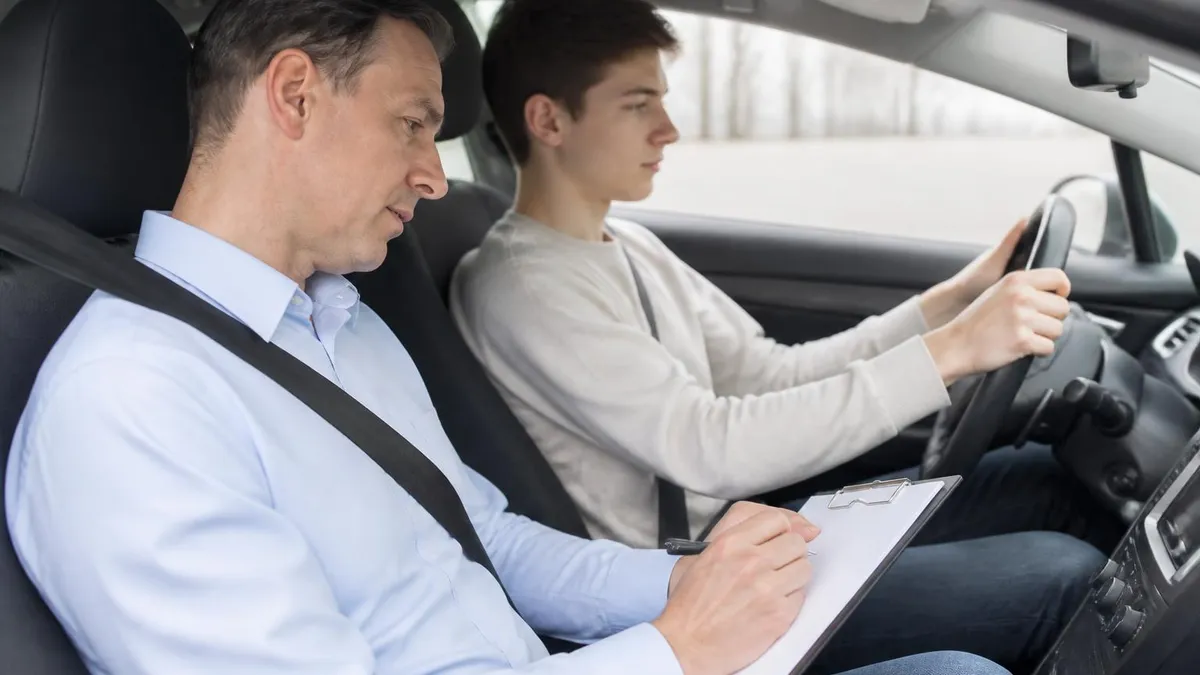
Common road test components include traffic interaction (proper signaling, lane changes, merging), intersection navigation (stops, turns, right-of-way), parking maneuvers (often parallel parking which trips up many candidates), backing and reverse driving, three-point turns or alternative turning maneuvers, observation skills (mirror checks, blind spot checks, head movement), speed control (appropriate for conditions), and overall safety awareness. Each component evaluated through specific scoring criteria. Examiners deduct points for various infractions; total score must meet passing threshold. Major safety violations (running stop signs, dangerous lane changes, hitting curb during parking) result in immediate failure regardless of other performance.
Written test preparation: Download state driver manual (free PDF on DMV/BMV website). Read systematically including all chapters. Pay particular attention to road sign images and meanings. Take multiple online practice tests scoring at least 90% before scheduling actual test. Focus additional study on weak content areas identified through practice tests. Plan 10-20 hours of study spread across 1-2 weeks. Last-minute cramming less effective than spread study. Most candidates pass first attempt with adequate preparation systematically covering manual content.
Common road test failures involve specific patterns examiners watch for. Failing to come to complete stop at stop signs (rolling stops). Inadequate observation including missing mirror checks, blind spot checks, or head movement at intersections. Improper lane changes without signaling or proper observation. Speeding or driving too slow for conditions. Striking curb during parallel parking attempts. Failing to yield right-of-way appropriately. Inappropriate following distance from vehicles ahead. Lane drift indicating inattention. Each pattern reflects either inadequate practice or test-day anxiety affecting performance. Quality preparation addressing common failure patterns substantially improves first-attempt pass rates.
Test anxiety affects road test performance for many new drivers. Practicing under realistic conditions (timed practice tests for written; routine driving with various supervisors for road) builds familiarity reducing test-day anxiety. Adequate sleep before testing supports cognitive performance. Light meal before testing maintains energy without sluggishness. Mental preparation through visualization helps some candidates. Treating test as just another driving session rather than special high-stakes event reduces some anxiety. Professional driving instructor pre-test sessions specifically address test anxiety alongside skill verification supporting confidence on test day.
For people taking road test in personal vehicle, several preparation steps support success. Vehicle must be in safe operating condition with all equipment functional (lights, signals, brakes, horn, mirrors, seat belts, registration current, insurance current). Examiner inspects vehicle before test refusing to test in unsafe vehicle. Bring vehicle owner authorization if not your vehicle. Adjust mirrors and seat to comfortable position before examiner enters vehicle. Have insurance and registration documents accessible. The vehicle preparation prevents day-of-test problems that could prevent testing entirely after substantial preparation invested.
Don't show up unprepared with documentation — missing documents prevent testing. Don't take road test in unsafe vehicle — examiner refuses to test in vehicles with safety issues. Don't skip practice on diverse scenarios — examiners evaluate handling various conditions. Don't neglect parking practice — parallel parking specifically trips up many candidates. Don't underestimate written test difficulty — state-specific laws differ from generic driving knowledge.
State-specific variations in drivers test content and procedures matter substantially. Some states emphasize specific topics more heavily than others (mountain driving rules in mountainous states, hurricane evacuation in coastal states, snow/ice driving in northern states). Road test specific requirements vary including specific maneuvers tested (some states require parallel parking, others alternative tests). Graduated licensing requirements for under 18 vary in specific permit hold periods, practice hour requirements, and probationary license restrictions. Each state's specific requirements available through state DMV/BMV websites. Generic driving knowledge supplemented with state-specific study supports best preparation rather than assuming universal rules apply.
For under 18 drivers, graduated licensing systems typically apply across most states. After passing written test obtaining permit, drivers must hold permit minimum period (typically 6 months) and complete required practice hours (typically 50 total including 10 nighttime) before road test eligibility. Driver education requirements (typically 24+ hours classroom plus 8+ hours behind-the-wheel) apply in most states. After passing road test, probationary license has restrictions including limits on nighttime driving, passenger restrictions, and zero tolerance for traffic violations. Restrictions phase out as driver gains experience. Each requirement supports research showing teen driver safety improves through structured experience-building.
For adults 18+, drivers test process is generally simpler than teen process. No driver education prerequisite typically required though recommended for new drivers. No mandatory practice hour requirements typically. Permit period may be shorter or waived in some states for adults. Road test follows similar format to teen testing. After passing tests, full unrestricted license issued without graduated restrictions. Adults with prior driving experience in other states usually pass more easily than complete beginners. Adults entering driving for first time benefit from professional driver education even when not legally required, since structured instruction supports safer driving habits than informal learning.
Preparing for Drivers Test Success
- ✓Download and study state driver manual systematically
- ✓Take multiple online practice tests scoring 90%+ before scheduling
- ✓Complete required practice hours including diverse scenarios
- ✓Master parking maneuvers particularly parallel parking
- ✓Verify all required documentation before testing day
- ✓Ensure test vehicle meets safety standards and has current registration/insurance
- ✓Plan testing time when you'll be alert and prepared
- ✓Practice mental composure for managing test-day anxiety
For people who fail drivers test, several considerations apply for successful retesting. Use first attempt as learning experience identifying specific weak areas. Most states allow retest after waiting period (typically 1-7 days for written, 1-14 days for road test). Address identified weak areas through additional practice. Consider professional driving lessons specifically targeting weak areas. Most candidates pass second attempt with appropriate additional preparation. Multiple failures suggest insufficient preparation rather than test difficulty — invest in serious additional preparation before continued attempts. Many candidates who fail initial attempt successfully pass with focused improvement work.
Common questions about drivers tests include whether someone can fail vision screening (usually need 20/40 minimum corrected vision; glasses/contacts allowed), whether someone can take test in their own car (yes, as long as vehicle meets safety standards), whether language other than English available for written test (most states offer test in multiple languages), whether someone can use interpreter (varies by state and test type), and whether testing accommodations available for disabilities (yes, request through state DMV in advance). Each question has state-specific answer warranting verification through state DMV before testing. Quality preparation includes understanding specific procedures applicable to your situation.
For commercial drivers license (CDL) applicants, testing requirements substantially exceed standard automobile licensure. Written tests cover commercial driving specific content including specific vehicle types, cargo handling, safety regulations, and various other commercial topics. Road test in commercial vehicle (typically Class A truck for full CDL) demonstrates handling of commercial equipment. Pre-trip inspection demonstrates ability to identify vehicle safety concerns. Skills test evaluates specific maneuvering skills including alley docking, straight-line backing, and various other commercial-specific maneuvers. CDL testing typically takes longer (multiple hours) than automobile testing reflecting more comprehensive evaluation needed for commercial operation.
For specific demographic groups, drivers test considerations may vary somewhat. Senior drivers facing license renewal may need additional vision testing, written tests, or road tests depending on state and individual circumstances. Drivers with medical conditions affecting driving (epilepsy, certain heart conditions, dementia concerns) may need medical clearance and possibly road tests. New US residents transferring foreign licenses may need full testing process or simplified transfer depending on state and country of origin. Each demographic faces somewhat different testing considerations matching their specific situations rather than universal procedures.
For driver education programs serving teen drivers, comprehensive curriculum supports both written and road test success. Classroom content systematically covers state-tested material in structured format. Behind-the-wheel instruction develops driving skills with experienced instructor guidance. Pre-test preparation specifically addresses test format and common challenges. Many programs include practice tests and pre-test road test rehearsal supporting student confidence. Quality driver education programs produce students substantially better prepared for both written and road tests than informal preparation alone. The cost ($300-$600 typical) is investment in safer young drivers and successful test outcomes.
Looking forward at drivers testing evolution, several trends shape future practice. Online written test administration expanding in some states for renewal scenarios though initial licensure typically still requires in-person testing. Road test simulators emerging for some training applications though actual road tests remain physical. Modernized DMV processes supporting better customer experience. Increased focus on graduated licensing for teen drivers based on safety research. Each trend continues evolving drivers testing while core requirements remain stable. New drivers entering licensure today face essentially same fundamental process as previous generations with some modernization improvements affecting specific implementation details.
Drivers Test Quick Stats
Key Facts at a Glance
| Item | Value | Details |
|---|---|---|
| Typical written test passing score required | 70-80% | |
| Typical written test question count | 20-50 | |
| Typical test fee range | $20-60 | |
| Typical road test duration | 15-25 min |
Common Road Test Maneuvers
Often most challenging maneuver for new drivers. Master before test through repeated practice.
Reverse direction in confined space. Tests vehicle control and observation.
Straight backing and curved backing. Tests reverse driving competence and observation.
Complete stop required (no rolling stops). Tests right-of-way understanding and observation.
Proper signaling, mirror checks, blind spot checks. Tests highway driving competence.
Where applicable, demonstrate parking on hills with appropriate wheel turn. Tests safety awareness.
For people facing driver license suspension or revocation, restoration processes vary substantially. Routine expired licenses can typically be renewed with knowledge test and vision screening within reasonable timeframe. Long-expired licenses may require full new licensure process including road test. Suspended licenses for various reasons (DUI, accumulated points, medical issues) have specific restoration processes often requiring substantial documentation, fees, possibly retesting, and possibly other requirements (alcohol education, treatment programs). Each situation has specific requirements through state DMV. Working with DMV directly or qualified attorney for complex situations supports successful restoration when possible.
For people considering whether to take drivers test independently or with formal driver education program support, several factors guide decision. Driver education programs typically provide structured study materials, practice tests, and test preparation as part of overall education. Independent study using free state DMV materials and online practice tests can also produce successful outcomes for disciplined learners.
Cost difference is substantial — driver education programs cost $300-$600 while independent study costs minimal beyond test fees. Most teens benefit from driver education program even when not strictly required because structured learning supports better driving foundations. Adults often choose independent study supplemented with private driving lessons as needed.
For specific test-day strategies that maximize success, several practices help. Get adequate sleep night before testing supporting cognitive performance. Eat light breakfast maintaining energy without sluggishness. Arrive 30+ minutes early avoiding rushed start. Bring all required documentation organized for quick access. Wear comfortable clothing supporting easy movement during driving. Use restroom before testing since tests cannot be paused. Practice deep breathing if anxious supporting calmer state. Mental preparation through positive visualization helps some candidates. Most candidates perform substantially better when arriving prepared, rested, and mentally composed than when arriving rushed, tired, or anxious.
For people with specific concerns about road test performance, several preparation strategies help. Practice in vehicle similar to test vehicle (same general type, transmission). Practice route in area near testing location supporting familiarity. Drive at various times of day matching expected test time. Practice with supervisor providing test-style feedback rather than informal coaching. Take pre-test driving lesson with professional instructor providing realistic test simulation and specific weak area identification. Document any vehicle-specific quirks or observations that examiner might note. Each preparation element supports test-day confidence and performance through familiarity reducing test-day surprises and anxiety.
For people facing test anxiety affecting performance despite adequate preparation, several approaches help. Multiple practice tests under realistic conditions build comfort with test format reducing anxiety through familiarity. Mindfulness or breathing exercises before testing support calmer state. Cognitive reframing thinking of test as opportunity rather than threat reduces stress response. Discussion with supportive friends or family before testing can provide encouragement.
Some candidates benefit from anti-anxiety medication if anxiety severe (discuss with healthcare provider). Most test anxiety improves through repeated practice rather than requiring professional intervention. Recognition that most candidates feel some anxiety supports normalization of feelings rather than treating them as personal failure during the demanding process of obtaining first driver license through state DMV testing procedures.
Drivers Test Process: Pros and Cons
- +Free official study materials available through DMV
- +Multiple practice test resources support preparation
- +Pass rates high for adequately prepared candidates
- +Standardized procedures across most states
- +Permit allows practice driving with proper supervision
- +Foundation for licensure supporting driving privileges
- −State-specific laws differ from generic driving knowledge
- −Documentation requirements complex requiring careful preparation
- −Failing requires retest with additional fee and time
- −Permit hold periods add time before full license for teens
- −Driver education adds substantial cost for under 18
- −Test anxiety affects performance for many candidates
Drivers Test Questions and Answers
About the Author

Educational Psychologist & Academic Test Preparation Expert
Columbia University Teachers CollegeDr. Lisa Patel holds a Doctorate in Education from Columbia University Teachers College and has spent 17 years researching standardized test design and academic assessment. She has developed preparation programs for SAT, ACT, GRE, LSAT, UCAT, and numerous professional licensing exams, helping students of all backgrounds achieve their target scores.