
California Firearms Safety Certificate: FSC Test, Cost & Renewal Guide
California FSC explained: 🧠 30-question test, 75% pass mark, $25 fee, 5-year validity, study guide, renewal rules, and exemptions for handgun and long
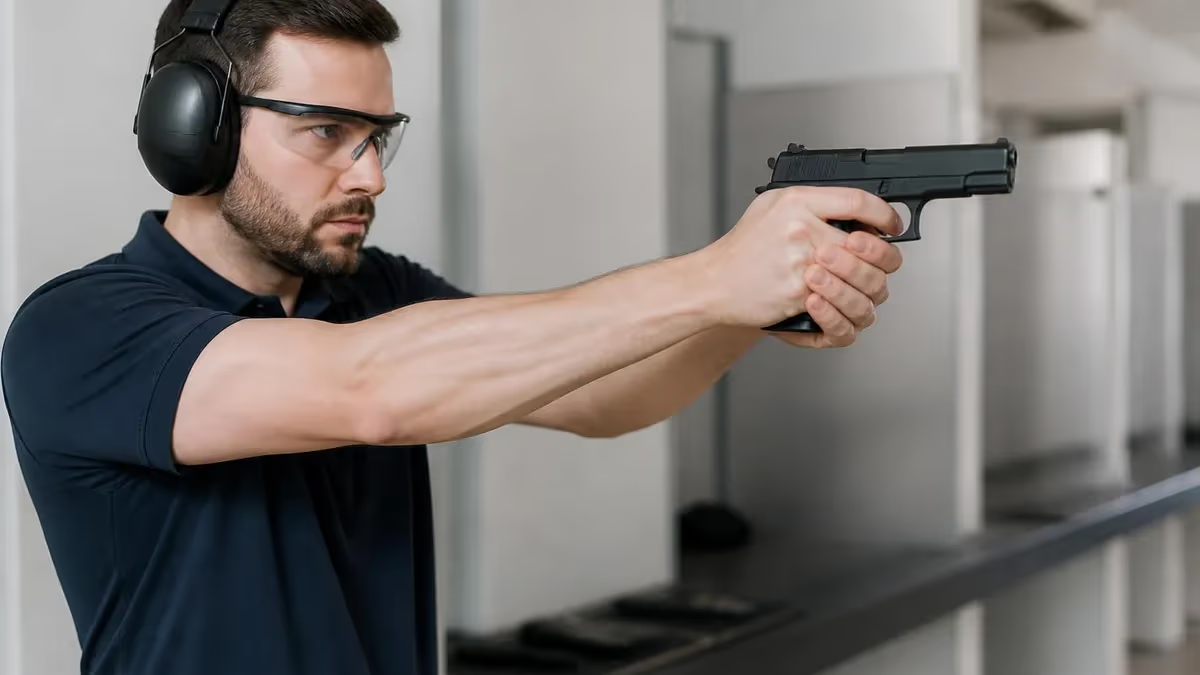
The California Firearms Safety Certificate (FSC) is the document the California Department of Justice asks for before you can walk out of a licensed firearms dealer with a handgun, rifle, or shotgun. No certificate, no transfer. It's that simple, and a lot of first-time buyers find out the hard way at the counter.
You earn the FSC by passing a 30-question written test administered at a DOJ-Certified firearms dealer. Score 75% or better (23 of 30 correct) and you get a five-year certificate stamped with your name. Miss the cutoff and you wait 24 hours before retesting, usually for free if the dealer offers a courtesy retake.
The fee is fixed by statute at $25, and it covers one test plus one retake within the same visit at many shops. That money funds DOJ's firearm safety program, including the certified instructor network and the study materials handed out before each test. The test itself was rolled out in 2015 when the FSC replaced the older Handgun Safety Certificate (HSC), expanding coverage from handguns to all firearms.
This guide walks through everything a buyer needs: who has to take the test, who's exempt, what's actually on the exam, how the renewal process works, and the common mistakes that cost people the pass. We'll also point you to free CA FSC practice questions you can run through tonight before booking your test slot. Get the basics right, study the official guide for a couple of hours, and the FSC becomes a 20-minute formality instead of a roadblock.
California FSC At a Glance
Key Facts at a Glance
| Item | Value | Details |
|---|---|---|
| Multiple-choice questions | 30 | |
| Passing score (23/30) | 75% | |
| Test fee at DOJ dealer | $25 | |
| Certificate validity | 5 yrs |
If you plan to acquire any firearm in California, you almost certainly need an FSC. That covers a purchase from a federally licensed dealer, an intra-familial transfer recorded through a dealer, a curio and relic transaction, and most private party transfers. The certificate must be presented at the time of the Dealer's Record of Sale (DROS) paperwork, before the 10-day waiting period clock even starts.
The rule reaches farther than people expect. A grandparent gifting a deer rifle to a grandchild still needs to route the transfer through a dealer, and the recipient still needs a valid FSC. The same applies to inherited firearms once they cross from the estate into a beneficiary's hands. The only way to skip the paperwork is to fit one of the narrow statutory exemptions covered later in this guide.
You also need to bring a California Driver License or California ID, plus proof of residency for handgun purchases, like a utility bill or vehicle registration. The dealer will verify your identity, run your information through the DOJ background check, and only then hand you the FSC test booklet. A foreign passport alone won't get you to the testing chair, even if you're otherwise legal to own firearms.
Before you head to the shop, run the CA FSC legal requirements quiz to make sure you understand who can sell, who can buy, and what disqualifies a purchaser under California Penal Code §29800 and §29805.
Before January 1, 2015 California issued a Handgun Safety Certificate (HSC) that only covered pistols and revolvers. The FSC replaced it and now covers all firearm types: handguns, rifles, and shotguns. An HSC issued before 2015 is no longer valid for purchase, full stop, even if the printed expiration date hasn't hit. You'll need to test for a fresh FSC at any DOJ-Certified dealer, and the new certificate gives you five fresh years of purchasing power.
The exam itself is 30 multiple-choice questions drawn from a master pool maintained by the California DOJ. You'll see four answer choices per question and a 20-minute window to finish, though most candidates close out the booklet in under 15 minutes. The test is closed-book, but you get to read the California Firearm Safety Certificate Study Guide before you start, and the dealer is required to give you at least one quiet hour with it on premises.
Questions are split roughly across six knowledge areas: handling and operation, ammunition, safe storage, child access prevention, transportation, and California-specific firearm laws. Roughly a third of the test focuses on legal rules, because that's where buyers most commonly get caught out. Expect at least two questions on the 10-day waiting period, several on safe-storage requirements under the Child Access Prevention Act, and one or two on prohibited-person categories.
Score 23 or more and you pass. The dealer prints your FSC on the spot using the DOJ's online system, and the number is logged in the state database that the next dealer will query when you buy your second firearm. Score 22 or below and you can retest after 24 hours have passed. Most shops will let you retake the test for free or at a heavily reduced fee, but policy varies, so confirm before you leave.
The fastest way to feel ready is to drill FSC knowledge questions until you can spot the trick answers without re-reading.
What's on the FSC Test
Safe handling fundamentals, the four cardinal rules of gun safety, loading and unloading procedures for handguns, rifles, and shotguns, plus muzzle control and trigger discipline. Expect at least four to five questions on this topic.
Caliber and gauge identification, ammunition components (case, primer, powder, projectile), the dangers of mismatched ammunition, and the difference between centerfire and rimfire cartridges. Mismatched ammo questions appear on most tests.
DOJ-approved lock boxes, gun safes, trigger locks, cable locks, and how California's Child Access Prevention laws apply at home. Storage questions are a common stumbling block, so pay extra attention to this chapter of the study guide.
How to legally transport handguns and long guns by car, the locked container rule, the unloaded requirement, and the exception for direct-to-range travel. The locked container vs. trunk distinction trips up many test-takers.
10-day waiting period, prohibited persons under PC §29800 and §29805, assault weapons restrictions, magazine capacity limits (10 rounds), and the difference between misdemeanor and felony disqualifiers. Roughly a third of the test focuses here.
Criminal storage statutes (PC §25100-25135), liability when a minor obtains a firearm, required warning signs at point of sale, and the felony enhancement when a minor causes injury. Memorize the statute numbers; they show up verbatim.
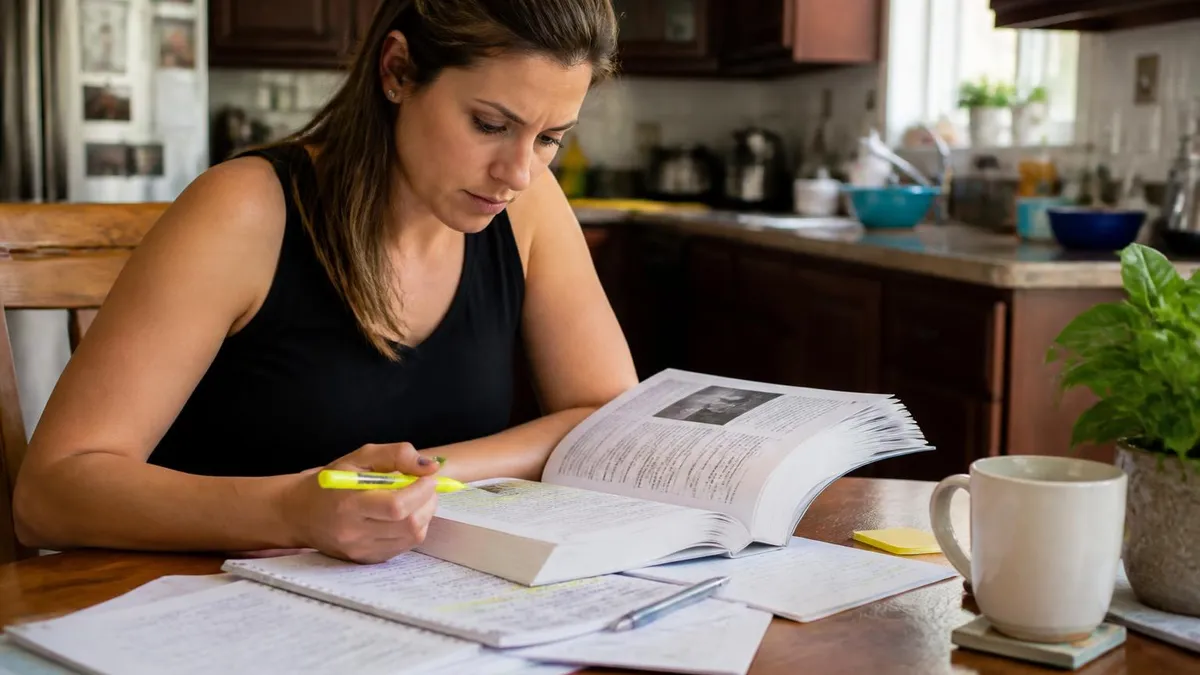
The official prep material is the California Firearm Safety Certificate Study Guide, a 48-page DOJ booklet that the dealer must offer you before the test. The booklet is also free to download from the California Attorney General's website, and a Spanish-language version is available on request at most shops. Plan on two solid reading sessions: one cover-to-cover read and one targeted second pass on the law sections.
Beyond the official guide, the highest-leverage prep tool is question-bank drilling. Multiple-choice tests reward pattern recognition, and seeing the same wording structures multiple times turns the legal language from foreign to familiar. Spend 30 minutes a night for three nights on practice questions, and the actual exam feels like a rerun.
A few specific topics deserve extra attention. Memorize the exact passing score (23 of 30), the waiting period length (10 days), the maximum legal magazine capacity for new sales (10 rounds), and the storage requirements that turn into criminal charges if a child accesses an unsecured firearm. These show up on essentially every test version in some form.
Skip the rumor mills on Reddit and YouTube. Question pools rotate, screenshots from 2018 don't match the 2026 test, and the only reliable source is the current DOJ study guide plus structured practice. Run CA FSC safe storage questions tonight, and you'll see how the wording mirrors what you'll face at the dealer's counter.
FSC Logistics: Cost, Location, ID, and Renewal
The FSC test fee is fixed at $25 by California law and the same statewide. Of that, $14 covers the test itself, $1 goes to DOJ administration, and the remainder pays the dealer for proctoring time and study materials. Some dealers bundle a free retake into the $25, others charge a separate retest fee of $15 or so. Confirm the retake policy before paying, and ask about payment methods because not every shop takes cards for the FSC line item.
California carves out a handful of FSC exemptions, but the list is narrower than internet forums make it sound. The most common qualifying categories are active and honorably retired peace officers (with documented training), active-duty and honorably discharged military personnel with their DD-214 in hand, federal officers carrying out official duties, and anyone holding a current California Hunting License issued by the Department of Fish and Wildlife.
The hunting license exemption is the one most consumers ask about. A valid California hunting license lets you buy long guns (rifles and shotguns) without an FSC. It does not exempt you from FSC requirements for handgun purchases. So if you only hunt deer and pheasant, the hunting license route works fine. The moment you want to add a handgun, you need the FSC.
Other exemptions include certain firearm-collector permit holders for curio and relic transactions, individuals importing firearms when establishing California residency (a one-time exemption), and law enforcement firearms instructors. None of these apply to the average buyer. If you're not sure whether you qualify, assume you don't and take the test, because the cost of being wrong is a refused transfer at the counter.
Crucially, an out-of-state firearm safety certificate, NRA training certificate, or military training record does not exempt you. California recognizes its own document and nothing else. Veterans with extensive firearms training still test, and out-of-state law-enforcement officers still test unless they meet the strict California POST equivalency standard.
If you lose your FSC, the DOJ does not issue duplicates. You must contact the certified instructor or dealer who issued it and request a copy from their records, which they're required to keep for five years. If the original dealer is closed or unreachable, you'll have to retake the test and pay the $25 again. Once your FSC expires, there is no "renewal" path that skips the test, you start fresh. Photograph your certificate the day you receive it and save the image to two locations to avoid this exact headache.
Test day is mostly logistics. Show up with the right ID, pay the fee, and read the study guide on the dealer's premises for at least 30 minutes even if you've already studied at home. The version of the booklet at the shop is guaranteed current; older PDFs floating online sometimes lag a regulation update.
Read every question twice. The DOJ writers favor distractor answers that are almost right, usually with one detail flipped, like swapping "unloaded" for "loaded" or "locked container" for "trunk." Slow down on transportation and storage questions especially. If two answers look equally correct, the one that names a specific statute or container type is usually the keeper.
Watch for negatively phrased questions ("Which of the following is NOT a safe practice?"). These trip up tired test-takers more than any other format. Underline the word NOT in your booklet, even if it feels excessive, so you don't autopilot and pick a true statement that's the wrong answer.
You're allowed to skip difficult questions and circle back. Use it. Answer the easy 25 first, build confidence, then tackle the harder five with a clear head. Don't leave blanks, because blank answers count as wrong. Make an educated guess and move on.
One last tactical note: the test is not adaptive and questions aren't weighted, so a hard question and an easy question count the same. Don't burn five minutes on one stumper when four other questions could secure the pass. Manage the clock, not the difficulty.
FSC Test-Day Checklist
- ✓California Driver License or California ID issued by the DMV
- ✓Proof of California residency dated within 90 days (utility bill, vehicle registration, or property tax statement)
- ✓$25 fee in cash, debit, or whatever payment your dealer accepts
- ✓Study guide reviewed at least once cover-to-cover before arrival
- ✓30 minutes of practice-question drills the night before
- ✓Arrive 20 minutes early to settle in and re-read the law section
- ✓Pen or pencil (some dealers provide, some don't)
- ✓Patience: the full appointment, including paperwork, takes 60-90 minutes
Your FSC stays valid for exactly five years from the date printed on the certificate. There's no early-renewal window, no online portal, and no grace period after expiration. The day after your FSC expires, you cannot complete a firearm transfer until you've sat for a fresh test. The DOJ does not send reminders, so add a calendar alert for year four to give yourself time. A surprising number of buyers discover their FSC has lapsed only when they show up at the counter for a new purchase, and that's a wasted trip plus a delayed transaction.
Renewal is identical to the original process. You walk into a DOJ-Certified dealer, pay $25, read the study guide, and take the 30-question exam. Many seasoned owners breeze through the renewal because the content rarely changes year over year, but skipping prep entirely is risky. Spend 30 minutes refreshing on storage and transportation rules, the two sections most likely to have minor regulatory tweaks. Pay particular attention to the most recently updated chapters, since legislators amend California firearm law nearly every session.
If you move out of California between certificates, you'll need to retest if you ever return and want to purchase here. There is no portability between states, even for buyers who never let their certificate lapse. The same applies to military members stationed out of state: when you return to California and want to buy, you test again unless the original certificate is still within its five-year window. Out-of-state law enforcement transferring to California departments typically retest as part of POST onboarding.
One small bonus: every retest counts as fresh continuing education. The 2026 study guide includes updates on lockbox standards and the most recent prohibited-person categories, so retesting actually makes you a more current owner than your neighbor whose certificate is on year four. Treat the five-year cycle as a built-in refresher rather than a bureaucratic hurdle, and the renewal becomes a quick way to stay current on every legal change that's reshaped California gun ownership since your last test.
FSC Pros and Cons for California Buyers
- +Standardized minimum baseline knowledge for every California firearm buyer
- +Covers all firearm types under one certificate (handguns, rifles, shotguns)
- +Low fixed cost of $25 with no hidden state fees
- +Five-year validity reduces test fatigue compared to annual permits
- +Free retake at most dealers if you miss on the first attempt
- −No online testing option, in-person only at certified dealers
- −Out-of-state safety training and certificates do not transfer
- −No grace period or early renewal window after expiration
- −Lost certificates cannot be reissued by DOJ directly
- −Hunting license exemption only covers long guns, not handguns
The most common reason buyers fail the FSC isn't difficulty, it's overconfidence. Lifelong shooters often skip the study guide because they assume the test is basic. Then they miss three or four questions on California-specific statutes that no other state has, and they fall under the 23-correct threshold. Treat the FSC as a California-law exam first and a firearms exam second.
Another frequent stumble is the residency proof. A buyer brings their driver license, pays the fee, and discovers at the counter that the dealer needs a recent utility bill for the handgun transfer. Now they're rescheduling. Bring the residency document every time, even if you think you don't need it, because some dealers require it for the test itself and not just the DROS paperwork.
Private party transfers cause confusion too. People assume that if they're buying from a friend, the FSC requirement doesn't apply. It does. Every private party handgun transfer must go through a licensed dealer, complete the DROS, observe the 10-day wait, and verify the buyer's FSC. The fee for a PPT is capped at $10 plus DROS fees, but the FSC requirement is identical to a retail purchase.
Finally, double-check the certificate number the dealer prints on your FSC. Typos happen. A wrong digit can cause a database mismatch when you go to buy your second firearm at a different shop, and you'll have to backtrack to fix it. Verify the number against your ID before you leave the counter. If you spot any issue, the dealer can reprint on the spot.
The California Firearms Safety Certificate isn't designed to be hard. It's designed to be a baseline, a guarantee that every legal firearm buyer in California has reviewed the basic rules of safe handling, secure storage, and the state-specific laws that define ownership here. Hit that baseline and you walk out with five years of frictionless purchases. Skip the prep, and a $25 test turns into a $50 cycle of retakes and rescheduled DROS appointments.
The straightforward path is: download the 2026 study guide tonight, read it twice this weekend, run two rounds of practice questions to spot your weak areas, and then book a test slot at any DOJ-Certified dealer that also stocks the firearm you want to buy. You'll knock out the FSC, the DROS, and the start of the 10-day wait all in one visit. Confirm payment methods and ID requirements over the phone first; some shops accept only cash for the FSC fee even though they take cards for the firearm itself.
If you're still uncertain about any single topic, pick the matching practice quiz, run through 20 questions, and re-read that chapter of the guide. Most buyers can go from "never heard of FSC" to "passed first try" inside a single weekend of focused prep. Set aside two hours Saturday morning, take the test Saturday afternoon, and you'll be working through the 10-day wait by Sunday.
The certificate is a five-year asset for a $25 entry fee. That's one of the best deals in the entire California firearm-purchasing process, and it's the gateway to every legal acquisition you'll make until 2031. Treat it seriously, study with intent, and the FSC stops being a barrier and becomes the simple credential it was meant to be.
CA-FSC Questions and Answers
About the Author

Educational Psychologist & Academic Test Preparation Expert
Columbia University Teachers CollegeDr. Lisa Patel holds a Doctorate in Education from Columbia University Teachers College and has spent 17 years researching standardized test design and academic assessment. She has developed preparation programs for SAT, ACT, GRE, LSAT, UCAT, and numerous professional licensing exams, helping students of all backgrounds achieve their target scores.
Join the Discussion
Connect with other students preparing for this exam. Share tips, ask questions, and get advice from people who have been there.
View discussion (7 replies)