
Online BSN to MSN Programs: Cheapest Tuition & FNP Tracks 2026 September
Compare online BSN to MSN programs by cost, FNP & nurse educator tracks, length. 🔎 WGU under $13k, Chamberlain preceptor support, accreditation tips.
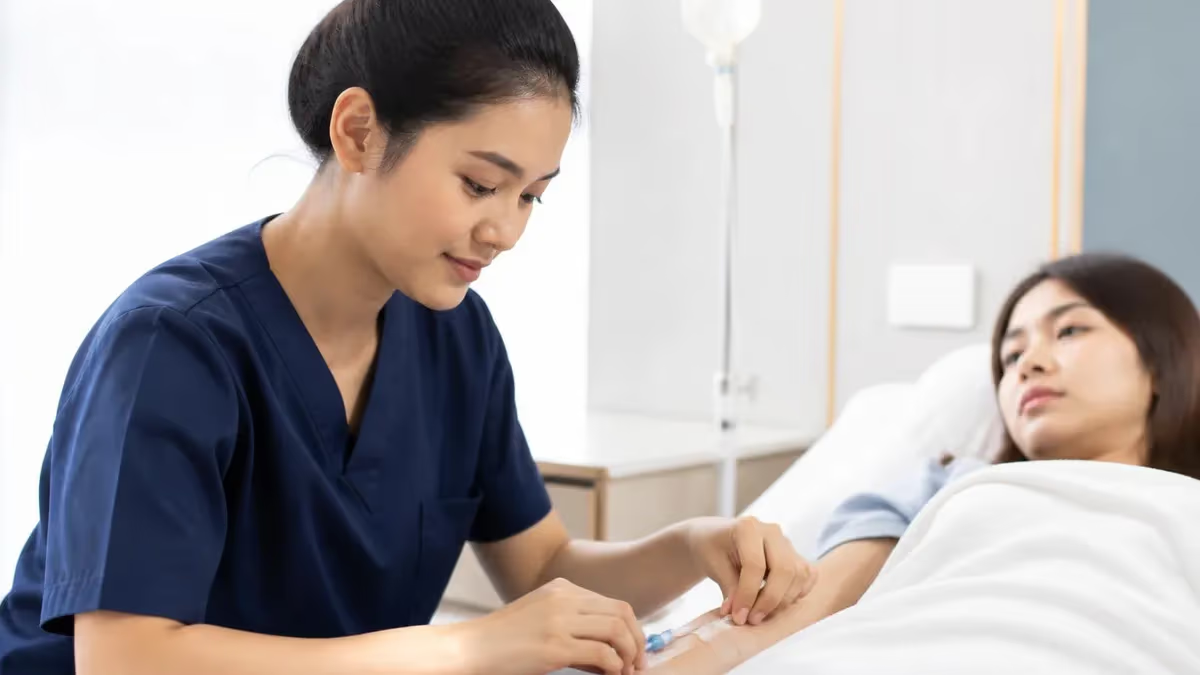
You finished your BSN and you've been on the floor a couple of years. Now the ceiling shows. Charge nurse, sure. Educator role on day shift, maybe. But the bigger jumps — nurse practitioner, informatics lead, director of nursing — those want letters after your name that you don't yet have. That's where the BSN to MSN online programs come in, and the market is bigger than most working RNs realize.
An online MSN lets you keep your paycheck while you climb. You won't sit in a classroom in Boise on a Tuesday night. You'll log into a learning portal at 9pm after the kids are down, finish a discussion post by Wednesday, push through a recorded lecture on the drive home from clinical (audio only, eyes on the road, please). The good programs run 24 to 36 months. The best ones, like Western Governors University's MSN, can be finished in 18 months if you sprint.
Cost is the part that scares people, and it should. Traditional brick-and-mortar MSN tuition runs $40,000 to $70,000 all-in. The online options? Cheaper. Sometimes a lot cheaper. WGU charges roughly $4,295 per six-month term — finish in three terms and you're out the door under $13,000. Chamberlain, Walden, Capella, Grand Canyon University, Purdue Global, Frontier Nursing University — each one has a different price tag, a different clinical model, and a different specialization sweet spot.
Pick wrong and you waste two years and forty grand. Pick right and you walk out with a $110k-base FNP job in 30 months. So let's do this carefully.
BSN to MSN by the Numbers
The numbers above hide a story. American hospitals are short on master's-rn with bsn salary, and the gap is widening as Baby Boomer nurses retire faster than universities can credential their replacements. Nurse practitioners, in particular, are projected to grow 38% through 2032 — the fastest-growing healthcare profession in the country.
What does that mean for you? Leverage. The hospital systems near you almost certainly tuition-reimburse for MSN coursework. Many will pay 60% to 100% of online tuition if you sign a two-year service agreement. Ask before you enroll. A lot of nurses don't, and they leave money on the table.
And the leverage extends beyond money. Magnet-recognized hospitals — there are over 600 in the US — are aggressive about funding MSN coursework because Magnet status itself depends on the percentage of BSN-and-above nurses in the workforce. If you work at one, your CNO has a personal interest in your degree. Use that.
What you need before you enroll
Every online MSN admissions office wants the same five things. Get them ready before you start applications and you'll save 4-6 weeks: (1) active unencumbered RN license, (2) BSN transcript with a cumulative GPA at or above 3.0, (3) one to two years of recent clinical experience, (4) two professional references (one clinical manager, one BSN faculty member is the typical mix), (5) a 500-1000 word personal statement explaining why this specialization, this school, right now. Some schools — WGU, GCU, Capella — waive the GRE. Save yourself $250 and a Saturday and apply to a no-GRE school first.
Not every online MSN looks the same on the inside. The first decision is the specialization track — and that single choice locks in your salary, your scope of practice, and how many clinical hours you'll log in the next two years.
Family Nurse Practitioner (FNP) is the heavy hitter. About 70% of new NPs enter this track. You'll learn primary care across the lifespan — pediatrics through geriatrics — and you'll graduate eligible for the AANP or ANCC FNP boards. Expect 600 to 750 clinical hours, which you arrange yourself in most online programs (Frontier and Chamberlain assign preceptors in some regions; WGU does not).
Then there's Adult-Gerontology Primary Care (AGPCNP), which narrows scope to ages 13 and up. Less peds, more chronic-disease management, geriatrics, end-of-life. Slightly easier preceptor hunt because most adult practices will take you.
Nurse Educator is the cheapest, fastest MSN track on the market. No advanced pharmacology, no clinical-rotation paperwork — instead, a teaching practicum at a community college or a hospital staff-development department. WGU and Capella both run nurse educator MSNs you can finish in 18 months for under $14k. Pay is lower than NP work ($75k-$90k range), but the hours are gentler.
Nurse Leader / Nurse Administrator is the MBA-flavored option. Healthcare finance, organizational behavior, quality-improvement projects, a capstone where you redesign a care pathway. If you want to be a unit director, a director of nursing, or eventually a CNO, this is your path.
Nursing Informatics sits at the crossroads of nursing and IT. You'll work on Epic and Cerner implementations, build clinical decision-support rules, audit data integrity. Demand is climbing — every health system is buried in EHR optimization work and they need clinicians who can speak IT.
MSN Specialization Tracks at a Glance
Primary care across the lifespan. 70% of new NPs pick this. Median $128k. 600-750 clinical hours. AANP or ANCC certification.
Age 13+. Chronic disease, geriatrics. Easier preceptor hunt than FNP. Median $122k.
Highest paid NP track — $130k-$150k. Strong telehealth demand. Preceptor shortage is the bottleneck.
Teach at a community college or in hospital staff development. Cheapest, fastest MSN. Median $80k. Gentle hours.
MBA-flavored coursework. Path to unit director, DON, eventually CNO. Median $108k.
Epic/Cerner work, clinical decision support, data analytics. Median $102k. Strong remote-work options.
Expert clinician within a specialty — oncology, cardiology, peds. Median $115k. Hospital-based.
Frontier University is the dominant online option. Median $122k. Strong rural-health placement pipeline.
One more specialization worth flagging: Psychiatric-Mental Health Nurse Practitioner (PMHNP). It's the highest-paid NP track in the country, averaging $130k-$150k, and the online MSN options have exploded since 2022. Walden, Herzing, and Maryville all run strong PMHNP programs. Caveat: preceptors are scarce, and you'll need to hustle to lock down your psych rotations.
Once you've narrowed the specialization, the next question is which school. There are forty-plus accredited online rn to bsn programs MSN programs in the US — too many to chase. Below are the seven that practicing nurses actually recommend in 2026, with what each one does best and where each one fails.

Top 7 Online MSN Programs Compared
Western Governors University runs a competency-based MSN that's the cheapest accredited option in the country. Per-term flat tuition of about $4,295 means motivated students finish FNP for under $13k. Self-paced — no live lectures, no group projects. You arrange your own preceptor. Best for disciplined, experienced RNs. CCNE accredited. Tracks: Nursing Education, Leadership and Management, Nursing Informatics (not FNP — WGU offers FNP at a different price point).
How do you actually pick from that list? Stop reading rankings. The US News rankings are mostly useless for online MSN programs because they weight research output and selectivity — neither of which matters for a working RN. Instead, run through this checklist before you fill out a single application.
Money matters more than most students admit upfront. Let's get specific.
WGU's MSN program is the cheapest in the country if — and only if — you can finish in two terms. Three terms is roughly $12,885. The catch: you have to be disciplined. WGU is competency-based, which means you can finish a course in three weeks if you already know the material, but you can also drag it out for six months and rack up another $4,295 term. People with strong clinical experience tend to fly through assessment-based courses. People who struggle with self-direction stall.
Chamberlain runs $700-ish per credit hour. An MSN-FNP is 47-50 credits. Math it out: roughly $33,000 to $35,000 in tuition. Add another $2k-$3k for books, exams, and clinical fees. Total all-in: $36,000-$38,000.
Walden is similar — $670 per credit, but they offer aggressive scholarships for working RNs. Real students report finishing FNP for $28,000-$32,000 after scholarships.
Frontier Nursing University, which specializes in midwifery and rural-health NP work, runs about $46,000 for the full MSN. Pricey, but Frontier places nearly all its graduates because the school is a feeder pipeline for underserved-area health systems.
Grand Canyon and Capella sit in the $25,000-$35,000 range depending on transfer credits and how aggressively you finish. Both run six-week courses, so they reward speed.
A handful of online "MSN" programs advertise heavily but lack CCNE or ACEN accreditation. Graduating from one means you can't sit for the AANP or ANCC NP certifying exams, and most state boards of nursing won't recognize the degree for advanced licensure. Before you pay a single tuition dollar, look the school up directly at the CCNE accreditation lookup or the ACEN directory. If it isn't listed, walk away — no matter how good the marketing looks.
Important rule before you write a check: confirm the program is CCNE or ACEN accredited. Both accreditors are accepted by all 50 state boards of nursing and by the AANP and ANCC for NP certification. If a program isn't on that list, walk away — non-accredited MSN credits won't let you sit for boards, and you'll have wasted years.
Time commitment surprises most working RNs. The honest answer: 15 to 25 hours per week of coursework on top of full-time clinical hours. Some weeks are lighter — discussion posts, reading. Other weeks bite hard, like the one where your pharmacology midterm, a clinical case study, and a 12-page evidence-based practice paper all land on the same Sunday.
Most students drop down to 0.7 or 0.8 FTE at the hospital somewhere in semester three. A few push through full-time the whole way. None of them sleep much.
Clinical hours are the part that wrecks timelines. NP tracks need 500 to 750 supervised clinical hours, and in most online programs, you find your own preceptor. That means cold-emailing local NPs and physicians, begging your hospital's medical staff office for introductions, and sometimes driving 90 minutes to a willing rural FNP because there's no other option in your zip code.
Start your preceptor search the day you accept admission. Not semester three. The day you accept. Programs that promise to find preceptors for you (Chamberlain in select states, Frontier in their service regions) are worth the extra tuition if you live somewhere preceptor-poor.
MSN Readiness Self-Check
- ✓Active, unencumbered RN license in at least one state
- ✓BSN cumulative GPA at 3.0 or above (3.2 for competitive FNP tracks)
- ✓At least 12 months of post-licensure clinical experience
- ✓Two strong references — one clinical manager, one BSN faculty
- ✓A specialization picked and defended (FNP vs Educator vs Informatics, etc.)
- ✓Tuition plan — out-of-pocket, employer reimbursement, federal loans, or mix
- ✓Preceptor strategy if you're entering an NP track (start the hunt now)
- ✓Family/partner sign-off on 15-25 hrs/week of coursework for 24+ months
- ✓Backup plan for if you need to drop to 0.7 FTE clinically
- ✓Honest answer to "why this specialization, not a different one?"
Now for the side of the conversation no one likes — when an online MSN is the wrong move.
If you're three to five years out from BSN and still figuring out which floor you like, slow down. An MSN-FNP locks you into primary care or specialty outpatient work. If you secretly love ICU or ED nursing, your MSN should probably be Adult-Gero Acute Care, not Family. Picking the wrong specialization is the single most expensive mistake nurses make.
If you're already burned out on direct patient care, an FNP won't fix that — being an NP is still direct patient care, just with more autonomy and worse documentation burden. Consider Nurse Educator, Informatics, or Leadership tracks instead. Those genuinely change the day-to-day work.
And if your finances are unstable — credit-card debt, no emergency fund, single income household — wait one year. Pay down high-interest debt. Build a runway. Then enroll. MSN programs require focus, and focus is hard when you're worried about the electric bill.
The pros and cons table below assumes you've thought about all of the above and you're still going. Most readers are. The MSN market is too rich, the salary jump too big, and the long-term career protection too valuable to skip.
Online MSN — The Honest Trade-offs
- +Keep working full-time (mostly) while you earn the degree
- +Cheaper than brick-and-mortar — often by $20k-$40k
- +Asynchronous schedule fits 12-hour shift work
- +Same CCNE/ACEN accreditation, same board eligibility
- +$42k median salary bump for NP tracks
- +Strong remote-work options post-graduation (informatics, telehealth NP)
- −Self-arranged preceptors are the #1 reason students delay or drop out
- −Requires serious self-discipline — no professor chasing you to log in
- −Discussion-board participation can feel forced and time-wasting
- −Less peer networking than in-person programs
- −Some hospital recruiters still side-eye online MSN diplomas (this is fading)
- −15-25 hrs/week on top of clinical work is genuinely hard for 24+ months
So what does the day actually look like once you're in? Let's walk through a typical week so the abstraction becomes concrete.
Monday and Tuesday: you're at the hospital, twelve-hour shifts. You don't touch coursework. Or you do — you knock out a 30-minute recorded lecture during your meal break, but it doesn't really stick. That's fine. Plan for it.
Wednesday is the heavy day. Off shift, kids at school, four hours blocked on the calendar. You write your weekly discussion post, read the assigned chapters, work on the case study due Sunday. Coffee at 9am, more coffee at 1pm, done by 3pm so you can go to the gym before pickup.
Thursday: clinical day if you're in the NP track. Eight to twelve hours at your preceptor's clinic. You log your encounter notes in Typhon or eMedley, the clinical-tracking software your school uses. Drive home. Sleep.
Friday: catch-up. Read what didn't get read Wednesday. Start the paper that's due Sunday.
Saturday: morning errands, afternoon study session. Push through the assignment.
Sunday night: submit. Email the discussion-thread classmates who haven't replied yet. Bed.
Repeat for 100 weeks. Then take boards. Then make $40,000 more per year for the next 25 years. Math is good.
Ready to move? Start with the readiness self-check below, and if your honest answer to half of it is yes, you're in better shape than 80% of applicants.
Beyond the readiness piece, plan your timeline backwards from your goal start date. Most online MSN programs admit three times a year: January, May, August. Application deadlines run roughly 60 to 90 days ahead. You'll need transcripts from every nursing program you've ever attended, two letters of recommendation, a current RN license (multi-state compact is fine), and usually a one-to-two-page personal statement. Some schools — WGU, GCU, Capella — skip the GRE entirely. Others, like Vanderbilt or Johns Hopkins online, still want it.
One more thing. Talk to a current student before you commit, not an admissions counselor. Admissions counselors get paid to enroll you. Current students will tell you which professors are nightmares and which clinical-coordinator emails actually get answered. Reddit's r/nursing and r/NursePractitioner are gold for unvarnished reviews.
Take a practice diagnostic quiz on BSN-level material before you start. If you're rusty on pathophysiology or pharmacology, your first MSN semester will be brutal. Sharpen first. Enroll second.
The investment math is straightforward once you stop staring at the sticker shock. A BSN-prepared RN in the US earns a median $86,000 a year. An MSN-prepared NP earns a median $128,000. That's a $42,000 annual jump. Pay $35,000 for the degree and you've recovered the tuition in ten months of post-graduation work. Compound interest on the salary delta over a 25-year career? North of a million dollars.
Nurse Educator and Leadership tracks return less per year but cost less to earn, so the ROI shakes out similarly — roughly 15 to 18 months to recover tuition.
That's why you're reading this. That's why MSN demand isn't slowing down. And that's why picking the right online program — not the loudest one, the right one — matters more than almost any career decision you'll make in your thirties or forties.
Use the resources, take a practice quiz to find your weak spots, then start the application. The hospital ladder isn't going to climb itself.
One last practical note. State NP scope-of-practice laws still vary wildly. Twenty-seven states grant full practice authority — NPs can diagnose, treat, and prescribe independently. Twelve states require a collaborative agreement with a supervising physician. The rest mandate active physician supervision. Before you pick a specialization, check the AANP state practice environment map. If you live in a restricted-practice state and you want true autonomy, factor in relocation costs — or look harder at telehealth NP roles, which let you practice across compact states from your living room.
And licensure compact matters too. The Nurse Licensure Compact (NLC) covers 40-plus states for RN practice but does not yet cover advanced practice. The APRN Compact is rolling out slowly. Until it's universal, NPs who want to work telehealth across state lines have to apply for licensure in each state they treat patients in. It's bureaucratic, it costs money, and most online MSN students don't think about it until graduation. Think about it now.
BSN Questions and Answers
About the Author

Registered Nurse & Healthcare Educator
Johns Hopkins University School of NursingDr. Sarah Mitchell is a board-certified registered nurse with over 15 years of clinical and academic experience. She completed her PhD in Nursing Science at Johns Hopkins University and has taught NCLEX preparation and clinical skills courses for nursing students across the United States. Her research focuses on evidence-based exam preparation strategies for healthcare certification candidates.