
RPSGT Practice Test PDF (Free Printable 2026 October) – BRPT Sleep Technologist Exam Questions
🆕 Pass the RPSGT exam with confidence. Practice questions with detailed explanations and instant feedback on every answer.
Free RPSGT Practice Test PDF – BRPT Polysomnographic Technologist Exam
The Registered Polysomnographic Technologist (RPSGT) credential is awarded by the Board of Registered Polysomnographic Technologists (BRPT) and is the gold-standard certification for sleep technology professionals. To earn the RPSGT, candidates must meet eligibility requirements — typically a combination of formal education in polysomnographic technology and documented hands-on clinical hours — and then pass a comprehensive examination covering sleep medicine science, technical recording skills, and patient care. The exam draws from five major domains: data acquisition and technical skills, sleep scoring and staging, sleep disorders, therapeutic interventions, and patient care and safety.
This free RPSGT practice test PDF is designed for candidates working toward their BRPT exam as well as CPSGT holders pursuing the full RPSGT credential. Print the pages, work through questions independently, then review detailed explanations in the answer key. Offline practice reinforces the scoring rules, waveform recognition, and clinical decision-making knowledge that the BRPT examination tests. Pairing PDF study sessions with hands-on laboratory practice gives you the dual reinforcement that sleep technology demands.
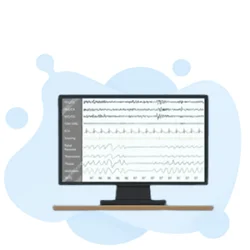
Sleep Stages and AASM Scoring Rules
Sleep staging is the cornerstone of polysomnographic technology, and it receives the heaviest weighting on the RPSGT examination. The American Academy of Sleep Medicine (AASM) scoring manual defines the rules technologists must follow when staging each 30-second epoch of a polysomnogram. Stage W (wakefulness) is characterized by a predominance of alpha activity (8–13 Hz) during eyes-closed relaxed wakefulness and by eye blinks and reading eye movements. Stage N1, the lightest non-REM sleep, is identified by low-amplitude mixed-frequency EEG, slow rolling eye movements, and the presence of vertex sharp waves. Stage N2 is defined by the appearance of K-complexes and sleep spindles (12–15 Hz bursts lasting at least 0.5 seconds), and accounts for the largest proportion of total sleep time in healthy adults.
Stage N3 (slow-wave sleep) is identified when 20% or more of an epoch consists of delta waves — high-amplitude, low-frequency waves below 2 Hz. N3 is most abundant in the first half of the night and is the most restorative sleep stage. REM sleep is scored when the EEG shows a low-amplitude mixed-frequency pattern similar to N1 but is accompanied by the defining features: rapid eye movements, muscle atonia (suppressed chin EMG), and the occasional saw-tooth waves seen just before bursts of REMs. Understanding the rules for switching between stages, handling ambiguous epochs, and scoring arousals, respiratory events, and limb movements according to AASM criteria is essential for passing the RPSGT exam.
Polysomnography Electrode Placement and Technical Recording
Technical data acquisition questions on the BRPT exam test your ability to set up, calibrate, and troubleshoot a complete polysomnographic recording. The International 10-20 system governs EEG electrode placement: landmarks (nasion, inion, left and right preauricular points) are measured in 10% and 20% intervals to place electrodes at standardized scalp positions. For the standard PSG montage, AASM recommends F4-M1, C4-M1, and O2-M1 derivations as primary channels, with backup electrodes at F3-M2, C3-M2, and O1-M2. Understanding why specific derivations are preferred — and how mastoid reference electrodes (M1, M2) affect signal quality — is regularly tested.
EOG (electrooculogram) electrodes capture eye movements that define stage transitions and REM identification. The standard AASM placement positions E1 1 cm below and lateral to the left outer canthus and E2 1 cm above and lateral to the right outer canthus, creating a differential recording that captures both horizontal and vertical eye movements. Chin EMG electrodes placed on the mentalis and submentalis muscles measure muscle tone, and tibialis anterior EMG electrodes on both legs detect periodic limb movements (PLMs). Respiratory channels — nasal pressure transducer, oral-nasal thermistor, chest and abdominal respiratory inductance plethysmography (RIP) belts, and pulse oximetry — complete the standard 16-channel PSG setup. Troubleshooting artifacts (60 Hz interference, electrode pop, sweat artifact, movement artifact) and understanding impedance thresholds (below 5 kΩ for EEG) are practical skills heavily tested on the RPSGT exam.
Sleep Disorders: Recognition and Classification
The RPSGT examination covers the full spectrum of sleep disorders as classified in the International Classification of Sleep Disorders, Third Edition (ICSD-3). Obstructive sleep apnea (OSA) is defined by repetitive episodes of complete or partial upper airway obstruction during sleep, scored as apneas (complete cessation of airflow for at least 10 seconds) or hypopneas (a reduction in airflow of at least 30% with an associated arousal or desaturation). Central sleep apnea (CSA) is distinguished from OSA by the absence of respiratory effort during the respiratory pause, reflecting a failure of the central respiratory drive rather than physical obstruction.
Narcolepsy questions focus on the pathophysiology of hypocretin (orexin) deficiency, the MSLT (Multiple Sleep Latency Test) criteria (mean sleep latency under 8 minutes with two or more sleep-onset REM periods), and the clinical tetrad of excessive daytime sleepiness, cataplexy, sleep paralysis, and hypnagogic hallucinations. Restless legs syndrome (RLS) is a sensorimotor disorder characterized by an urge to move the legs, worsened by rest and evening hours and relieved by movement. Periodic limb movement disorder (PLMD) is its objective PSG counterpart, scored when periodic limb movements with an index above 15 per hour are associated with sleep disruption. Parasomnias — including REM sleep behavior disorder (RBD), sleepwalking, sleep terrors, and confusional arousals — are tested through their PSG signatures and ICSD-3 diagnostic criteria.
PAP Therapy, Titration Protocols, and Pediatric Scoring
Positive airway pressure (PAP) therapy is the first-line treatment for moderate-to-severe OSA, and the RPSGT examination tests both the technical setup and the clinical decision-making involved in a PAP titration study. During a split-night study, the first portion of the night establishes a diagnostic baseline and the second portion involves CPAP titration starting at the recommended pressure of 4–5 cmH2O. Technologists must recognize residual events — obstructive apneas, hypopneas, flow limitation, snoring, and central apneas — and incrementally increase pressure according to the AASM titration protocol. Bilevel PAP (BiPAP) is initiated when CPAP fails to resolve events or is not tolerated, requiring separate IPAP and EPAP settings with a minimum pressure support of 4 cmH2O.
Pediatric polysomnography uses different scoring rules than adult studies, a distinction that appears regularly on the RPSGT exam. Infants and children have higher baseline respiratory rates and different normal oxygen saturation thresholds. AASM pediatric respiratory event scoring defines hypopnea as a 30% drop in amplitude lasting at least two missed breaths (rather than the adult 10-second minimum). N3 slow-wave sleep is more abundant in children and may dominate the first half of the night more dramatically than in adults. REM sleep occupies a larger percentage of total sleep time in neonates and infants (up to 50%) and decreases progressively across childhood. CPSGT candidates should be familiar with these differences even at the technician level, as pediatric patients are encountered across all sleep laboratory settings.
- ✓Memorize AASM epoch-by-epoch staging criteria for W, N1, N2, N3, and REM
- ✓Practice identifying K-complexes, sleep spindles, delta waves, and saw-tooth waves
- ✓Review the International 10-20 system and AASM-recommended PSG electrode derivations
- ✓Study EOG placement logic and how differential recording captures eye movement direction
- ✓Learn AASM apnea and hypopnea scoring rules including the 3% vs 4% desaturation criteria
- ✓Review ICSD-3 diagnostic criteria for OSA, narcolepsy, RLS, PLMD, and major parasomnias
- ✓Study CPAP titration protocol: starting pressure, increment rules, and BiPAP escalation criteria
- ✓Understand pediatric vs adult scoring differences: respiratory rules, REM percentages, N3 norms
- ✓Practice artifact identification: 60 Hz noise, electrode pop, sweat artifact, movement artifact
- ✓Review RPSGT and CPSGT eligibility pathways, continuing education requirements, and renewal timelines
Thorough preparation across all five BRPT exam domains — data acquisition, sleep scoring, sleep disorders, therapeutic interventions, and patient care — gives candidates the best chance of passing the RPSGT or CPSGT examination on the first attempt. Prioritize sleep staging rules and respiratory event scoring early in your study plan, as these require repeated exposure to waveform examples before they become automatic. For additional multiple-choice practice organized by topic, visit the BRPT practice test page on PracticeTestGeeks.
- +Industry-recognized credential boosts your resume
- +Higher earning potential (10-20% salary increase on average)
- +Demonstrates commitment to professional development
- +Opens doors to advanced career opportunities
- −Exam preparation requires significant time investment (4-8 weeks)
- −Certification fees can be $100-$400+
- −May require continuing education to maintain
- −Some employers may not require certification
Sample BRPT - Board of Registered Polysomnographic Technologists Practice Questions
Try these questions from our free BRPT - Board of Registered Polysomnographic Technologists practice tests. The correct answer and an explanation follow each question.
Approximately what percentage of total sleep time is typically spent in REM sleep in healthy adults?
- A. 5–10%
- B. 10–15%
- C. 20–25%
- D. 30–35%
Answer: C. 20–25%
Healthy adults spend roughly 20–25% of total sleep time in REM sleep, with the proportion increasing across successive cycles.
During intake, a patient reports they started taking an over-the-counter sleep aid two nights ago. What is the technologist's most important action?
- A. Advise the patient to stop taking it immediately.
- B. Ignore the information as it is not a prescription medication.
- C. Document the medication and notify the medical director or ordering physician.
- D. Cancel the study and reschedule for a later date.
Answer: C. Document the medication and notify the medical director or ordering physician.
Any medication, including OTC aids, can affect sleep architecture and must be documented. The technologist should document the medication, dosage, and frequency and also notify the ordering physician or medical director, as it may impact the interpretation of the study.
Which brain structure generates sleep spindles through thalamocortical circuits and acts as a relay station for sensory information during sleep-wake transitions?
- A. Hippocampus
- B. Amygdala
- C. Thalamus
- D. Corpus callosum
Answer: C. Thalamus
The thalamus gates sensory input and, via thalamocortical networks, generates the 12–14 Hz sleep spindles that characterize N2 sleep.
In the two-process model of sleep regulation, which process represents the homeostatic sleep drive that accumulates during wakefulness via adenosine buildup?
- A. Process C
- B. Process W
- C. Process S
- D. Process R
Answer: C. Process S
Process S (homeostatic sleep pressure) rises during wakefulness as adenosine accumulates and dissipates during sleep as adenosine is cleared.
Take the full BRPT - Board of Registered Polysomnographic Technologists practice test
Join the Discussion
Connect with other students preparing for this exam. Share tips, ask questions, and get advice from people who have been there.
View discussion (9 replies)