
Border Patrol Agent News: Career Updates, Risks, and Exam Guide 2026 September
💯 Free Border Patrol Agent News: Career practice test with instant feedback and detailed answer explanations. Prepare for your exam.
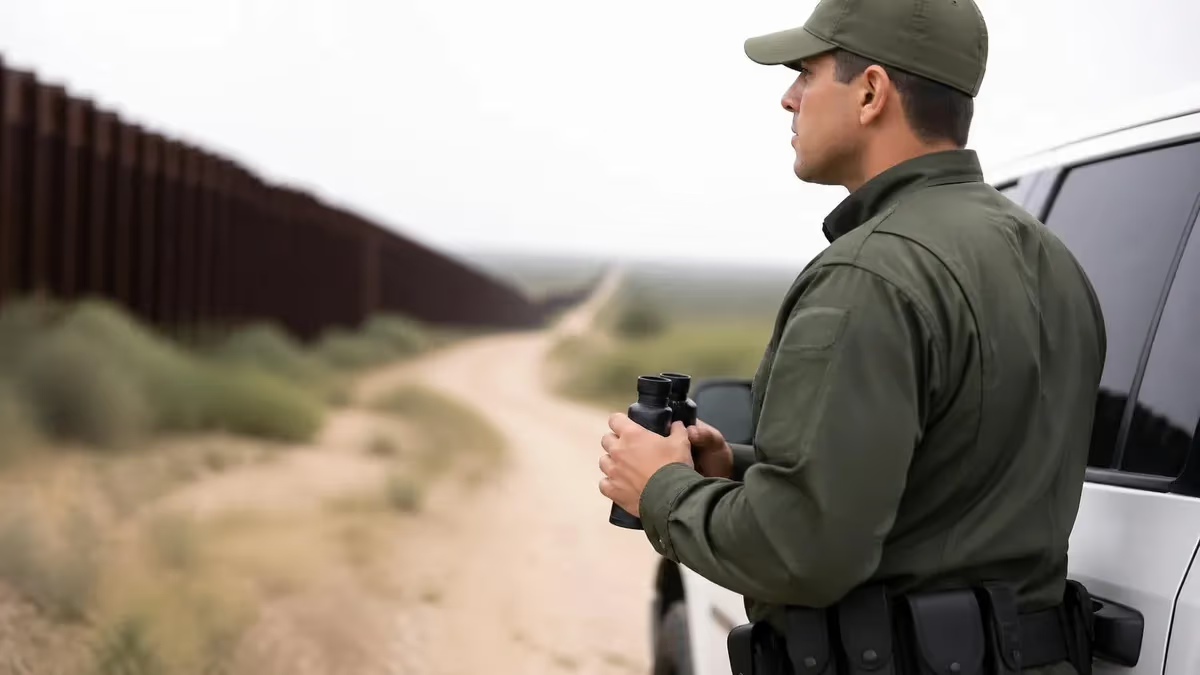
The United States Border Patrol (USBP), a component of Customs and Border Protection (CBP) within the Department of Homeland Security, is the federal law enforcement agency responsible for detecting and preventing illegal entry into the United States between ports of entry. Border Patrol Agents (BPAs) patrol the nearly 2,000 miles of US-Mexico border and roughly 4,000 miles of US-Canada border, operating in some of the most remote and geographically challenging terrain in North America. The work is physically demanding, operationally complex, and carries genuine safety risks — BPAs routinely encounter armed individuals, extreme weather conditions, remote terrain without backup, and the human dimensions of illegal border crossings including migrants in medical distress.
The BPA workforce and the political context surrounding border security have been subjects of significant news coverage in recent years. Staffing levels, pay and retention challenges, new technology deployments, policy changes affecting enforcement priorities, and incidents involving agents in the line of duty all generate ongoing news coverage that is relevant both to citizens following immigration policy debates and to individuals considering a career with the Border Patrol. For prospective BPAs, understanding the current environment — the opportunities, the challenges, the risks, and the operational realities — provides essential context for making an informed career decision and beginning effective exam preparation.
The BPA hiring process has been a persistent news topic due to staffing shortages at US Border Patrol that have accumulated over multiple federal budget cycles. Congress and successive administrations have debated border security funding and staffing levels extensively, with significant implications for the total number of BPA positions authorized, the pace of hiring, the academy training pipeline, and the retention of experienced agents. Understanding where BPA hiring currently stands and what the outlook is for new agents entering the workforce is important context for anyone actively pursuing a Border Patrol career.
The Border Patrol's relationship with the public and with political leadership has shifted considerably over the past decade. The agency has been at the center of national debates about immigration enforcement, humanitarian obligations toward asylum seekers, and the appropriate role of federal law enforcement in managing border crossings during periods of elevated migration. BPAs operate within this contested political environment daily, required to enforce federal law while simultaneously managing the human realities of migration — families with children, individuals fleeing violence, economic migrants seeking opportunity — that do not fit neatly into enforcement categories. Understanding this dual dimension of border patrol work is essential context for any career analysis or news coverage of the agency.
The geographic distribution of BPA assets across 19 operational sectors reflects the concentration of crossing activity along different sections of the southern and northern borders. The Rio Grande Valley Sector in Texas consistently records the highest apprehension numbers and is among the most resource-intensive operations in the USBP. The Tucson Sector in Arizona covers large swaths of desert terrain that is both difficult to patrol and particularly dangerous for migrants attempting crossings. The El Paso Sector, Laredo Sector, and Del Rio Sector in Texas also see significant activity. Northern border sectors — including Blaine Sector in Washington, Swanton Sector in Vermont, and Buffalo Sector in New York — handle the US-Canada border with substantially smaller agent populations given the considerably lower crossing volumes relative to the heavily trafficked southern border.

Incidents involving Border Patrol Agents are among the most newsworthy events in federal law enforcement, and understanding the occupational hazards of BPA service is important for anyone considering the career. Agents face physical dangers from smuggling organizations, individuals who resist apprehension, and the environmental hazards of operating in remote border terrain. CBP's Use of Force Policy governs when agents may use force to protect themselves or others, and CBP's Office of Professional Responsibility investigates incidents in which agents use force or in which civilian complaints are filed. The BPA workforce operates under significant scrutiny — from oversight agencies, from advocacy organizations, and from the news media — which is part of the operational context any prospective agent should understand.
Line-of-duty deaths and serious injuries to Border Patrol Agents occur periodically, though the circumstances vary widely. Some involve violent confrontations with smuggling organizations; others involve vehicle accidents during patrol operations, medical emergencies in extreme heat environments, or accidents involving horses or all-terrain vehicles used in remote areas. CBP's Office of Field Operations maintains statistics on agent safety incidents, and these figures appear regularly in news coverage of border security. The National Border Patrol Council, the union representing BPA agents, actively advocates for improved equipment, staffing levels, and operational policies that agents believe will improve their safety in the field. Understanding the union's role and positions is valuable context for prospective agents who will operate within a unionized federal workplace.
The Border Patrol's operational technology has been a major area of news coverage as CBP invests in remote surveillance capabilities, drone technology, ground sensor networks, and artificial intelligence-assisted detection systems. These technologies change how agents work — reducing the need for agents to be physically present at every sensor activation and improving situational awareness before agents approach potential crossing locations. Technology investments do not eliminate the need for agents but change the nature of patrol work, shifting from reactive coverage of large territories to more intelligence-driven responses to detected activity. Prospective BPAs who understand this technological evolution are better positioned to articulate how their skills complement rather than compete with automated systems during the hiring process.
Pay equity and retention have been ongoing concerns for Border Patrol leadership and the National Border Patrol Council. Agents stationed in remote areas with limited amenities — far from family, quality schools, and urban services — face lifestyle sacrifices that do not always align with what they can achieve through federal pay differentials alone. The agency has experimented with various retention incentives including increased locality pay in certain sectors, housing assistance in remote posting areas, and career development opportunities for high-performing agents. Attrition, particularly among first-term agents who complete their initial commitment and then leave for other federal law enforcement positions or private sector roles, has been a persistent workforce challenge that the agency continues to address through both compensation strategies and improvements to working conditions.
The Border Patrol Academy experience is significant beyond its logistical role in the hiring process. The 117-day residential program at the Federal Law Enforcement Training Center (FLETC) facility in Artesia, New Mexico, immerses recruits in the legal, operational, and cultural foundations of border patrol work. The Spanish language curriculum is particularly intensive for applicants who are not proficient upon arrival — the academy requires that all graduates reach a minimum proficiency level, which means non-Spanish speakers must dedicate very substantial study time to language learning alongside the demanding full academic and physical training program. Recruits who arrive with strong Spanish skills can devote more of their cognitive bandwidth to the operational and legal content, which is one of the most compelling arguments for beginning Spanish study long before submitting a BPA application.
Border Patrol Agent salaries have been a recurring topic in BPA news, particularly in relation to retention challenges in remote posting locations. BPAs are federal law enforcement officers paid on the GL (General Labor) pay scale, with starting pay for entry-level agents typically at GL-5 to GL-7 depending on education and experience — with locality pay adjustments for specific geographic areas adding meaningfully to base compensation. Agents also receive Law Enforcement Availability Pay (LEAP), a 25 percent premium above base pay that compensates for irregular hours and availability for duty beyond a standard schedule. Retention bonuses are also offered for agents who commit to serving in high-need locations or who possess critical skills such as Spanish language proficiency. Total compensation for experienced agents is substantially higher than base salary figures alone suggest, particularly for those who reach supervisory and senior agent levels.
The BPA career path offers substantial advancement opportunities for agents who perform well and seek promotion. Entry-level BPA positions advance through the GL schedule, and higher-grade positions — including Supervisory Border Patrol Agent, Patrol Agent in Charge (PAIC), Deputy Patrol Agent in Charge (DPAIC), and Section Chief — are available for competitive applicants. CBP also offers opportunities to move laterally into specialized units including the Horse Patrol, All-Terrain Vehicle units, K-9 drug detection programs, and Tactical Units (BORTAC and BORSTAR). BORTAC, the Border Patrol Tactical Unit, is CBP's special operations component — similar in function to a SWAT team — and BORSTAR is the Border Patrol Search, Trauma, and Rescue Unit, which responds to medical emergencies and rescues in remote terrain.
Looking ahead, the technological transformation of border security will continue to reshape what BPA field work involves. Remote surveillance technologies reduce the physical exposure of agents by allowing them to assess situations before approaching. Unmanned aerial systems (drones) extend sensor coverage across terrain that would otherwise require ground patrols at significant risk. Artificial intelligence-assisted surveillance analysis enables processing of sensor data volumes that would be impossible to review manually. While these technologies improve agent safety and operational efficiency, they also require agents with the technical literacy to work alongside these systems effectively — understanding how to act on AI-generated alerts, how to coordinate with drone operations teams, and how to document encounters in ways that create an accurate technological record alongside the physical apprehension or encounter documentation.
The BPA career ultimately offers something that few civilian jobs can match: consequential law enforcement work at the physical borders of the nation, with federal benefits, strong retirement provisions, and genuine advancement opportunities for motivated agents. The combination of physical challenge, legal complexity, humanitarian dimension, and operational variety makes border patrol one of the more distinctive federal law enforcement careers available. For individuals who are physically capable, comfortable in remote environments, committed to federal service, and genuinely interested in the complex realities of border security, the Border Patrol Agent pathway — despite its genuine challenges and risks — provides a career foundation that supports professional growth across multiple decades of federal service.
The federal retirement benefits for BPA agents are among the most significant financial advantages of the career. Under the Federal Employees Retirement System (FERS) enhanced provisions for law enforcement officers, BPAs are eligible to retire at age 50 with 20 years of qualifying law enforcement service, or at any age after completing 25 years. The retirement annuity is calculated at a higher multiplier than standard FERS — 1.7 percent per year of service for the first 20 years and 1 percent for each additional year — and agents who retire with 20 years of service receive a supplement equivalent to their Social Security benefit until they reach Social Security retirement age.
Combined with the Thrift Savings Plan (TSP) contribution matching and federal health insurance that continues into retirement, the total benefits package represents a retirement security structure substantially more generous than what is available to most private sector employees, and this comprehensive financial picture is a major reason that many agents make the Border Patrol a full career despite the demanding operational realities.
BPA Hiring and Exam Preparation
The Customs and Border Protection Applicant Test (CBAT) assesses logical reasoning skills that are essential for agent decision-making in the field. The logical reasoning section presents situations requiring deductive reasoning, pattern recognition, and systematic problem-solving under time constraints — skills that can be meaningfully improved with targeted practice. Many applicants supplement CBP's official preparation materials with third-party logical reasoning practice tests and books covering artificial language analysis, which is a distinctive component of the BPA logical reasoning test. Spanish language proficiency is assessed separately: applicants who demonstrate sufficient Spanish proficiency during the application process may receive an automatic best-qualified rating, bypassing additional testing. Applicants without Spanish proficiency must successfully complete a Spanish language training program during the Border Patrol Academy.
The intersection of immigration policy and Border Patrol operations continues to generate significant news coverage that directly affects working conditions for BPA agents. Changes in prosecutorial priorities, asylum processing policies, court orders governing detention conditions, and diplomatic agreements with source countries all affect how agents spend their operational time and what outcomes are possible when they apprehend individuals attempting illegal entry. BPAs are law enforcement professionals who operate under federal law and CBP policy directives — the legal and policy framework within which they work changes with administrations, congressional action, and court decisions, and understanding this framework is part of being an informed BPA or prospective BPA.
Current news coverage of the Border Patrol frequently addresses humanitarian concerns related to migrants — particularly regarding deaths of migrants attempting border crossings in extreme heat environments, the treatment of unaccompanied minors, and conditions in Border Patrol processing facilities. BPAs work within this humanitarian dimension daily, often being first responders to individuals in medical distress, coordinating medical care for injured migrants, and managing the processing of family units under conditions that are frequently difficult for all parties involved. This humanitarian dimension of the work is less visible in recruitment materials than the law enforcement aspects but is a significant feature of day-to-day BPA field operations that new agents should be prepared for emotionally and practically.
Following news coverage of Border Patrol incidents — whether involving agent use of force, migrant deaths, congressional hearings on agency operations, or policy shifts affecting enforcement priorities — with informed context is valuable for both current agents and aspiring ones. The USBP operates in a media and political environment that generates frequent coverage from multiple perspectives, and developing the media literacy to evaluate news about border security critically — distinguishing between factual reporting, advocacy framing, and political messaging — is a professional skill that serves agents throughout their careers. Organizations like the Congressional Research Service, the Government Accountability Office, and CBP's own Office of Inspector General produce detailed analytical reports on USBP operations, staffing, technology, and outcomes that provide more rigorous factual grounding than most news coverage alone can offer.
For prospective agents currently preparing for the CBAT examination and physical fitness test, the most important near-term action is consistent, systematic practice rather than passive study. Logical reasoning skills improve with practice — the more problems you work through, the more naturally you recognize the patterns of reasoning that the exam tests. Similarly, physical fitness standards that seem challenging in the abstract become manageable with a disciplined 12 to 16 week training program. The BPA career path is demanding by design, and agents who successfully navigate the hiring process carry that demonstrated persistence and preparation capacity forward into a field career that requires those same qualities every day.
BPA Application Checklist
- ✓United States citizenship (no dual citizenship restrictions for most positions)
- ✓Age between 17 and 40 years old at time of appointment (exceptions for veterans)
- ✓Valid state driver's license
- ✓High school diploma or GED (college degree helps for higher starting grade)
- ✓No felony convictions or disqualifying criminal history
- ✓Clean drug use history (marijuana use evaluated under federal standards)
- ✓Ability to pass physical fitness test (push-ups, sit-ups, 1.5-mile run)
- ✓Ability to meet CBP medical vision, hearing, and cardiovascular standards
- ✓Willingness to accept initial duty station assignment at Southwest border
- ✓Availability for 117-day residential training at Border Patrol Academy
BPA Career: Pros and Cons
- +Competitive federal salary with LEAP 25% premium and locality pay
- +Strong federal benefits: health insurance, FERS pension, TSP retirement
- +Early retirement eligibility (20 years of service at age 50, or 25 years at any age)
- +Advancement opportunities into specialized units and leadership roles
- +Meaningful federal law enforcement mission with national security significance
- −Most initial assignments in remote Southwest border locations
- −Genuine physical danger: armed smugglers, extreme environments, remote terrain
- −Irregular schedule, frequent overtime, and 24/7 operational demands
- −High political visibility and public scrutiny of all BPA operations
- −Comprehensive background investigation including polygraph is stressful and time-consuming
BPA Questions and Answers

Border Patrol Agent Jobs: How to Become a BPA in 2026
Border Patrol Agent Qualifications: Complete Requirements Guide
Do Border Patrol Agents Get Housing? Benefits Guide
How to Become a Border Patrol Agent: Requirements, Exam, and Hiring Process
Border Patrol Agent Academy: What to Expect and How to Prep
About the Author

Educational Psychologist & Academic Test Preparation Expert
Columbia University Teachers CollegeDr. Lisa Patel holds a Doctorate in Education from Columbia University Teachers College and has spent 17 years researching standardized test design and academic assessment. She has developed preparation programs for SAT, ACT, GRE, LSAT, UCAT, and numerous professional licensing exams, helping students of all backgrounds achieve their target scores.
Join the Discussion
Connect with other students preparing for this exam. Share tips, ask questions, and get advice from people who have been there.
View discussion (8 replies)