
New York Boating Safety Certificate: How to Get Your NY Boating License
Get ready for your New York Boating Safety Certificate: certification. Practice questions with step-by-step answer explanations and instant scoring.
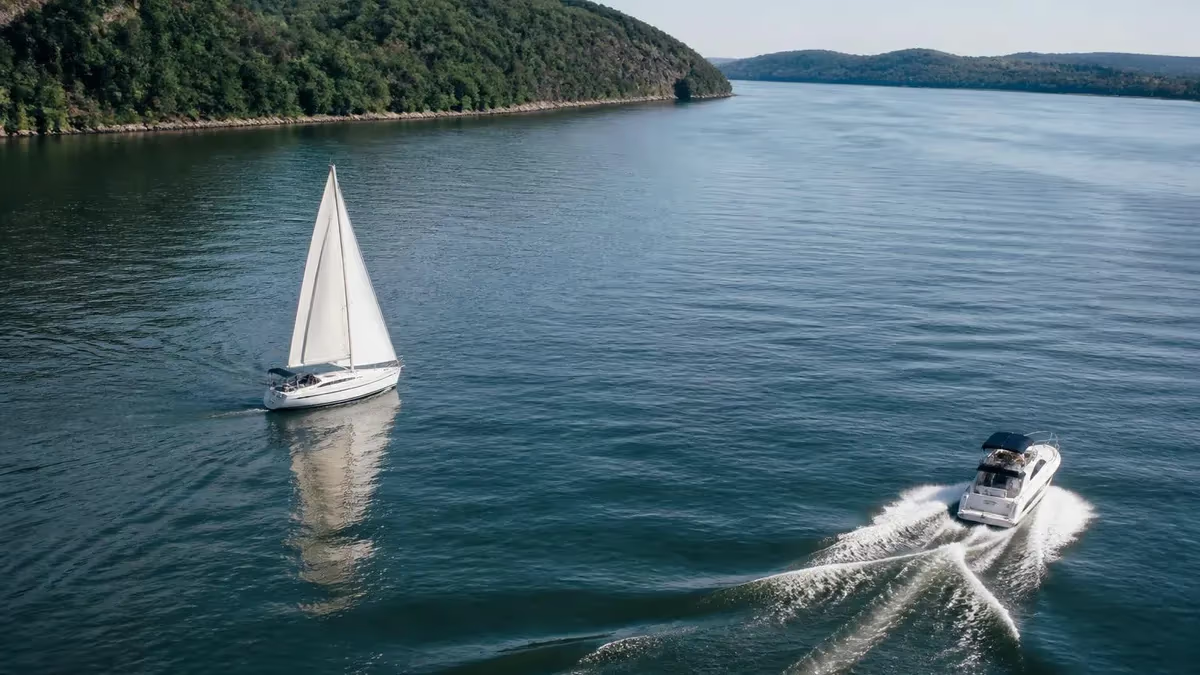
New York has some of the most heavily used recreational waterways in the country — the Hudson River, Lake Champlain, the Finger Lakes, Long Island Sound, and thousands of smaller lakes and rivers. To operate a motorized vessel on these waters legally, most operators need a New York boating safety certificate. Here's everything you need to know to get yours.
Who Needs a New York Boating Safety Certificate?
New York State law (Navigation Law §78) requires anyone born on or after January 1, 1996 to have a boating safety certificate to legally operate a motorized vessel (any vessel powered by a motor, including a sailboat with an auxiliary motor). This requirement applies to powerboats, personal watercraft (jet skis), and any other motorized vessel.
Specifically, you need a New York boating safety certificate if you:
- Were born on or after January 1, 1996
- Are operating a motorized vessel in New York State waters
You do not need a certificate if:
- You were born before January 1, 1996 (though having one is recommended)
- You're operating a non-motorized vessel exclusively (canoe, kayak, rowboat, sailboat without a motor)
- You're operating under the direct supervision of a certified adult who is on board
Age-specific rules: Operators under age 10 cannot operate a motorized vessel under any circumstances. Operators ages 10–17 can operate certain vessels (requirements vary by vessel type and engine size) but must always have a certificated adult on board if under 18 for larger engines.
How to Get a New York Boating Safety Certificate
There are three ways to complete the required boating safety education in New York:
Option 1: Approved Online Course
This is how most people complete the requirement. New York accepts online boating safety courses from providers approved by the National Association of State Boating Law Administrators (NASBLA). Major providers include:
- Boat-ed.com (official provider on NY.gov)
- BoaterExam.com
- Safe Boater
Online courses are self-paced, typically 4–8 hours of instruction, and end with a proctored final exam. "Proctored" in this context usually means you take the exam in a controlled setting at the end of the course — most online providers handle this through their own platform. You must pass the final exam (typically 70–80% passing score) to receive your completion certificate.
Cost is typically $25–$45 for an online course.
Option 2: Classroom Course
The U.S. Power Squadrons and U.S. Coast Guard Auxiliary both offer in-person classroom boating safety courses throughout New York State. These are often taught by volunteers and are frequently low-cost or free. Classroom courses are typically offered in the spring before boating season. Contact your local Power Squadrons chapter or Coast Guard Auxiliary flotilla for schedule information.
Option 3: Home Study Course
New York also accepts the NASBLA-approved home study course option, which involves independent study through printed materials and a mail-in or proctored exam. This option has largely been supplanted by online courses for most people.
What the New York Boating Safety Course Covers
The course content is standardized through NASBLA requirements. You'll learn:
- Rules of the road (navigation rules): Right-of-way rules, give-way vs. stand-on vessel rules, passing and crossing situations, head-on encounters
- Required equipment: Life jackets (types and requirements by vessel size), fire extinguishers, visual distress signals, sound-producing devices, navigation lights
- Safe boat operation: Speed and wake rules, no-wake zones, operating in restricted areas, anchoring
- Personal watercraft (PWC) rules: Additional rules specific to jet skis and similar craft
- Environmental regulations: Discharge regulations, invasive species requirements (particularly important on NY waterways)
- Emergency procedures: Capsizing, man overboard, grounding, fire on board, emergency signals
- Alcohol and boating: BUI (Boating Under the Influence) laws and penalties in New York
- New York-specific regulations: State-specific rules, registration requirements, local no-wake zones
The Boating Safety Test
The final exam for boating safety certification in New York covers all of the above topic areas. Key facts about the test:
- Most providers require a score of 70–80% or better to pass
- Multiple choice format
- Questions cover both federal navigation rules and New York-specific regulations
- You can retake the exam if you don't pass on the first attempt (policies vary by provider)
The test isn't particularly difficult for someone who's engaged with the course material — it's designed to confirm that you've learned the safety rules, not to serve as a barrier to recreational boating.
What You Receive After Completing the Course
After passing the final exam, you receive a New York Boating Safety Certificate — a wallet card issued by the New York State Office of Parks, Recreation and Historic Preservation (OPRHP). Online providers typically issue a temporary certificate immediately upon completion, with the official wallet card arriving by mail in a few weeks.
You must carry proof of certification on board whenever you're operating a vessel. New York State Environmental Conservation Officers (ECOs) can request to see your certificate when you're on the water. The temporary certificate serves as valid proof until your wallet card arrives.
Is the New York Boating Safety Certificate Valid in Other States?
Yes — with important limitations. New York's boating safety certificate is NASBLA-approved, which means it's recognized by most other states under reciprocity agreements. Most states that have boating safety certification requirements will accept a NASBLA-approved certificate from another state.
However, some states have additional requirements. If you're planning to boat in a specific out-of-state location, check that state's boating laws before you go — don't assume your NY certificate covers everything everywhere.
Similarly, out-of-state boaters with NASBLA-approved certificates from their home states can operate in New York under that certificate.
New York PWC (Personal Watercraft) Regulations
Personal watercraft — jet skis, Wave Runners, Sea-Doos — have additional rules in New York beyond the standard boating safety certificate requirement:
- Operators must be at least 16 years old to operate a PWC independently
- No one under 14 can operate a PWC at all
- Ages 14–15 may operate a PWC only under direct supervision of a certificated adult on board
- PWC operation is prohibited between sunset and sunrise
- Jumping the wake of another vessel within 100 feet is prohibited
- Operating within 500 feet of shore at greater than 5 mph is prohibited in many areas
The boating safety course covers PWC-specific rules, but it's worth reviewing them separately if you primarily use a PWC — they're the areas where new operators most commonly get cited.
NY Boating Registration: Separate from the Safety Certificate
The boating safety certificate is not the same as vessel registration. In New York, motorized vessels (and sailboats over 14 feet) must be registered with the state. Registration involves:
- Completing a registration application with the DMV
- Paying a fee based on vessel length
- Displaying registration numbers on the hull
- Carrying the registration certificate on board
New registration runs on a 3-year cycle. The safety certificate and the vessel registration are entirely separate requirements — having one doesn't satisfy the other.
For a broader foundation on all boating certification content, the boating certification test study guide covers what's tested across state certifications. And the boating certification career guide covers how boating credentials connect to marine careers.
Study Tips for the New York Boating Safety Test
Most people pass on their first attempt. Here's what helps:
- Don't skim the navigation rules. Right-of-way and passing rules are the most tested content area in most boating safety exams. Know when you're the stand-on vessel and when you're the give-way vessel, and understand what each means in terms of action required.
- Know the equipment requirements by vessel size. Life jacket requirements specifically vary by vessel length and age of operator — this is a reliable exam topic.
- Pay attention to the New York-specific sections. State-specific rules (wake zones, PWC age requirements, BUI laws) often appear on the final exam alongside federal rules.
- Take the practice quizzes in your course. Online providers typically include practice questions after each section. Use them — they're calibrated to the final exam format.
Important: The Boating Certification Test exam covers multiple domains. Allocate more study time to unfamiliar topics while maintaining review of strong areas.
- ✓Confirm your exam appointment and location
- ✓Bring required identification documents
- ✓Arrive 30 minutes early to check in
- ✓Read each question carefully before answering
- ✓Flag difficult questions and return to them later
- ✓Manage your time — don't spend too long on one question
- ✓Review flagged questions before submitting
Boating Certification Test: Pros and Cons
- +Boating Certification Test credential is recognized by employers and industry professionals
- +Higher earning potential compared to non-credentialed peers
- +Expanded career opportunities and professional advancement
- +Structured learning path builds comprehensive knowledge
- +Professional development that stays current with industry standards
- −Preparation requires significant time and study commitment
- −Associated costs for exams, materials, and renewal fees
- −Continuing education needed to maintain credentials
- −Competition for advanced positions can be challenging
- −Requirements and standards may vary by state or region
Pros and Cons at a Glance
| Pros | Cons |
|---|---|
| Boating Certification Test credential is recognized by employers and industry professionals | Preparation requires significant time and study commitment |
| Higher earning potential compared to non-credentialed peers | Associated costs for exams, materials, and renewal fees |
| Expanded career opportunities and professional advancement | Continuing education needed to maintain credentials |
| Structured learning path builds comprehensive knowledge | Competition for advanced positions can be challenging |
| Professional development that stays current with industry standards | Requirements and standards may vary by state or region |
About the Author

Attorney & Bar Exam Preparation Specialist
Yale Law SchoolJames R. Hargrove is a practicing attorney and legal educator with a Juris Doctor from Yale Law School and an LLM in Constitutional Law. With over a decade of experience coaching bar exam candidates across multiple jurisdictions, he specializes in MBE strategy, state-specific essay preparation, and multistate performance test techniques.
Join the Discussion
Connect with other students preparing for this exam. Share tips, ask questions, and get advice from people who have been there.
View discussion (5 replies)