
Boating License: What It Is and How to Get One in Your State 2026 September
✍🏼 Boating license guide: who needs one, state requirements, how to complete a boater education course online, and what happens if you're caught without one.
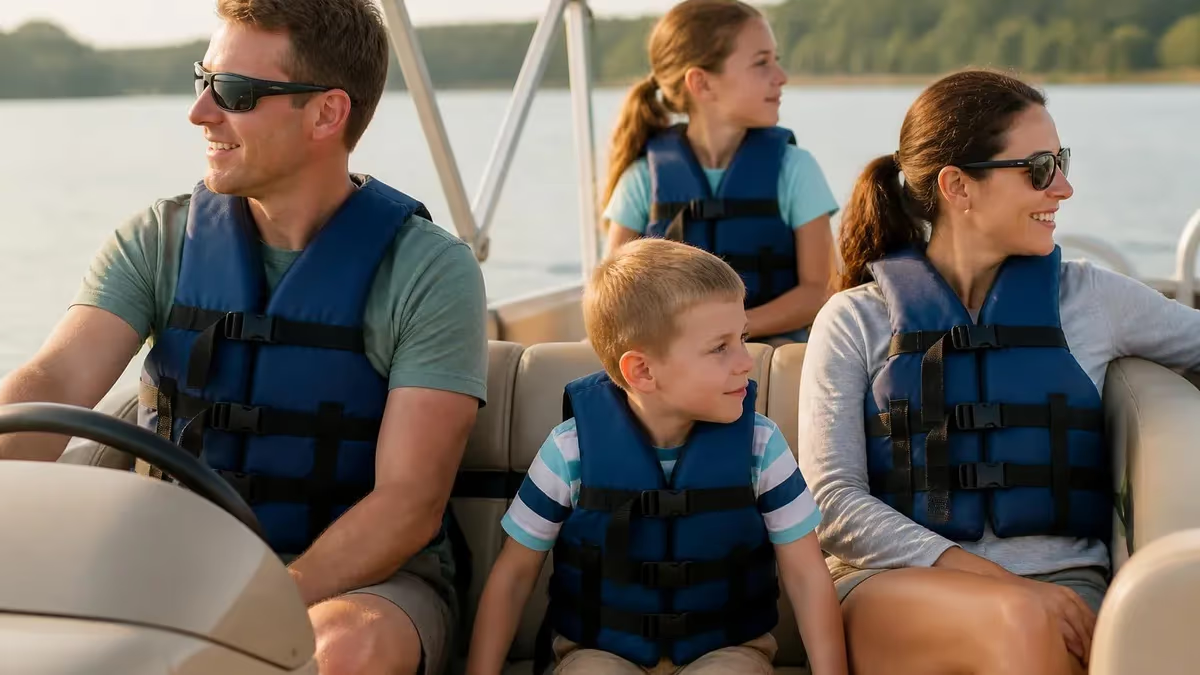
A boating license in the United States isn't a single federal credential — it's a term most people use to mean the boater education certificate required by their state before they can legally operate a motorized boat. There's no national boating license issued by the federal government. Instead, every state sets its own rules about who needs to complete a boater education course, which types of vessels require certification, and what age requirements apply.
The result is a patchwork of state regulations that vary significantly — a course that satisfies Florida's requirements may or may not satisfy California's requirements, and the rules differ based on whether you're a resident, a visitor operating in the state, and the horsepower of the engine on the boat you're running.
What most states require is successful completion of a boater education course approved by the National Association of State Boating Law Administrators (NASBLA). NASBLA is the standards body that certifies course content across state programs, and courses that carry NASBLA approval produce a certificate that's recognized by most states for reciprocity purposes.
This means a boater education certificate earned in Ohio — if the course is NASBLA-approved — is generally accepted in Florida, California, or wherever the boat owner travels. NASBLA-approved courses are available both online and in person through state parks agencies, the United States Power Squadrons, the Coast Guard Auxiliary, and private providers like BoatUS Foundation and Safe Boating Certification.
The terminology around boating credentials can be confusing because different states call the same basic thing by different names. Some states issue a boating safety card, others issue a boater education card, others issue a safe boating certificate, and a few states issue something that looks and feels more like a formal licence. The credential itself — regardless of what the state calls it — certifies that the holder has completed an approved boater education course.
It's worth understanding that a boater education certificate and a boating license are, for most practical purposes, the same thing in American boating law. The distinction matters primarily when traveling between states: while most states recognize NASBLA-approved courses from other states, confirming that your certificate meets the visiting state's requirements before operating there prevents issues on the water.
The United States Coast Guard sets federal safety equipment requirements — life jackets, fire extinguishers, visual distress signals — that apply to all boats in federal waters regardless of the state license or certification status of the operator. State boating laws apply on state waters, which is most lakes, rivers, and coastal waters within three miles of shore. In federal offshore waters beyond three miles, Coast Guard regulations govern.
Operating without the required state boater education certificate is typically enforced by state conservation officers or marine patrol agencies, not the Coast Guard, though the federal safety equipment violations can be cited by either agency. Understanding which law applies to which body of water reduces confusion about which set of rules governs your trip.
The minimum age to operate a boat unsupervised varies by state. Most states allow children under a certain age — often 12 or 14 — to operate a boat only with adult supervision, and require adult certification only after the operator reaches the age at which they can legally operate independently.
Parents who want their teenagers to operate a family boat independently need to understand both the minimum age and the certification requirement for their state. Many states have a youth boater education requirement that kicks in earlier than the adult requirement — teens operating at 14 may need to complete a course even in states where adults born before a certain cutoff are grandfathered.
State boating agencies publish their full operator requirement details publicly, and the most current information is always on the official state fish and wildlife, DNR, or boating authority website. Requirements are updated periodically as states phase in new age groups or modify horsepower thresholds.
Boating License at a Glance
How State Boating Requirements Work
Most states require operators born after a specific date (commonly 1975, 1988, or 1990) or operators under a specific age. Some states require all motorized vessel operators regardless of age.
The National Association of State Boating Law Administrators certifies course content. Completing a NASBLA-approved course produces a certificate accepted for reciprocity across most states.
Most states accept online NASBLA-approved courses. Online courses take 4-8 hours, cost $30-$75, and issue a downloadable temporary certificate after you pass the final exam.
There's no federal boating license. What states require is a boater education certificate or card. Different states use different names — boating safety card, boater card, safe boating certificate — for the same credential.
NASBLA-approved certificates from one state are generally recognized by other states. Confirm reciprocity before operating in a visiting state — some states have specific requirements for visitors.
Most states require the physical card on the water at all times when operating. Digital copies are not universally accepted. Certificates typically don't expire — one-time completion covers most operators for life.
State boating license requirements typically specify minimum operator age, engine horsepower thresholds, and whether the requirement applies to all operators or only residents. Florida, for example, requires anyone born on or after January 1, 1988 to carry a Boating Safety Education Identification Card when operating a motorized vessel in Florida waters. California requires anyone under 35 operating a motorboat of more than 15 horsepower to carry a California Boater Card.
Texas requires operators of motorized vessels born on or after September 1, 1993 to have a boater education certificate. These variations mean that an experienced adult boater who grew up in a state with a grandfathering cutoff may be exempt from the requirement in their home state but required to obtain a certificate when visiting another state with stricter rules.
The typical boater education course covers nautical rules of the road, boat handling fundamentals, navigation aids, weather awareness, emergency procedures, and the specific state laws governing alcohol use on the water, speed limits, no-wake zones, and registration requirements. Most states require passage of a final exam — typically 50 to 70 questions — as part of the certification process.
Online courses are structured as self-paced modules followed by a proctored final exam, and most providers allow unlimited attempts on practice questions before the final. Some states require the final exam to be proctored by a state-approved method, which may include online proctoring with a webcam. First-time test failures can typically be retested after a waiting period, and the course content is detailed enough that candidates who study the material — rather than clicking through without reading — pass on the first attempt at a high rate.
The online course format has made boater education significantly more accessible than the in-person weekend classroom courses that were the standard in previous decades. Most online courses can be completed in four to eight hours of total study time at any pace, accessed from any device. The major online providers — BoatUS Foundation Free Boater Education, Boat Ed (official state partner for many states), NASBLA certified courses through state agency websites — typically charge between $30 and $75 for the full course plus certificate.
Some states offer their own official free or low-cost course directly through the state boating authority website. The certificate issued after passing is typically a permanent credential with no expiry — unlike a driver's licence, most state boating safety certificates don't need to be renewed. The certificate is typically mailed to the holder after passing the final exam, with many providers also offering a temporary certificate immediately available for download while the physical card is in transit.
State boating requirements change as age cutoffs expand and horsepower thresholds are updated. The most current requirements for any state are on the state fish and wildlife, DNR, or boating authority website. The NASBLA website (nasbla.net) also maintains a state-by-state summary of boater education requirements that's updated when states change their rules.
One common question is whether a boater education card is the same as a boating license and whether it needs to be carried on the water at all times. The answer varies by state, but most states require the operator to carry their boater education certificate physically while operating on the water — showing a digital copy on a phone may or may not satisfy the requirement depending on the state's specific rules.
A few states accept digital credentials through official apps, but most still require the physical card. Keeping the original physical card with your boat documents is the standard practice, with a copy kept separately as a backup.
Horsepower thresholds add another layer of complexity to state requirements. Some states only require boater education for operators of boats above a certain engine size — 10 horsepower, 15 horsepower, or similar. Under these thresholds, an operator running a small trolling motor boat is exempt while the same operator running a 50-horsepower ski boat is required to certify.
The practical effect is that most recreational boaters who operate the kinds of boats typically found at marinas, boat ramps, and rentals will be subject to the education requirement regardless of the specific threshold, but operators of small fishing boats with modest motors in grandfathering states may be exempt. When in doubt about whether your boat's engine puts you under the requirement, the state fish and wildlife or DNR website for your state is the authoritative source.
The content of NASBLA-approved boater education courses is standardized enough that completing one gives you a solid foundation for operating safely in any state, not just the state whose requirements the course satisfies. The rules of navigation — who has right of way, what lights are required at night, how to read navigational aids — are federal rules that apply uniformly in all navigable waters.
The state-specific content in courses covers alcohol enforcement, specific speed limits, and local registration requirements, but the core nautical knowledge transfers directly across state lines. Completing a thorough NASBLA-approved course from any approved provider gives you the foundational knowledge to operate responsibly and legally across the United States regardless of where you purchased the certification.
Check These Before Operating in a New State
- ✓Verify whether your home-state certificate is NASBLA-approved
- ✓Check the visiting state's reciprocity rules for out-of-state certificates
- ✓Confirm whether the physical card must be on the vessel (vs digital copy)
- ✓Check if the visiting state has age-based or horsepower-based exemptions that apply to you
- ✓Verify your boat registration is current for the state where it's registered
- ✓Review your boat insurance policy for any operator certification requirements
Florida's boating license requirements are among the most frequently searched in the country because Florida has one of the largest recreational boating populations in the United States. The Florida Boating Safety Education Identification Card is issued by the Florida Fish and Wildlife Conservation Commission (FWC) after completion of an approved course. The card is required for anyone born on or after January 1, 1988 who operates a motorized vessel in Florida waters.
For visitors to Florida operating their own boat, a valid boater education certificate from their home state is accepted — the reciprocity applies in both directions. For visitors renting a boat and holding no prior boater education certificate, Florida's rules apply and the certificate is required. The Florida boating license requirements include specific provisions for temporary visitors and operators of rental boats that differ from the standard resident requirements.
California requires the California Boater Card, issued through the Division of Boating and Waterways, for operators under 35 born after January 1, 2018 (the requirement phases in over several years with age cutoffs expanding through 2025 when all operators become subject to it). California's program phased in younger operators first, with the requirement expanding to progressively older age groups on a schedule.
By January 1, 2025, all operators born on or after January 1, 1990 are required to carry the card. California accepts completion of approved out-of-state NASBLA courses, but the California Boater Card itself is issued only through the California DBW-approved course providers. A boater who passed an Ohio NASBLA course and carries a valid Ohio certificate is generally considered compliant in California, but receiving the California-specific card requires completing a California-approved course.
Alabama is notable for having some of the most straightforward boating requirements: anyone who operates a motorized vessel of more than 10 horsepower must carry an Alabama boating license or equivalent certificate from another NASBLA-approved program. Alabama's requirement applies regardless of age, making it broader than many states that have age-based cutoffs. Alabama courses are available online through multiple NASBLA-approved providers, and completion produces a certificate that satisfies Alabama law and is recognized by reciprocity in other states.
Minnesota's boating license requirements specify that operators of motorized watercraft must complete a water safety course approved by the Minnesota DNR. Course completion is required for operators 13 years old through 17 and for adults born on or after August 1, 1975 operating alone. Minnesota accepts NASBLA-approved courses from other states for reciprocity.
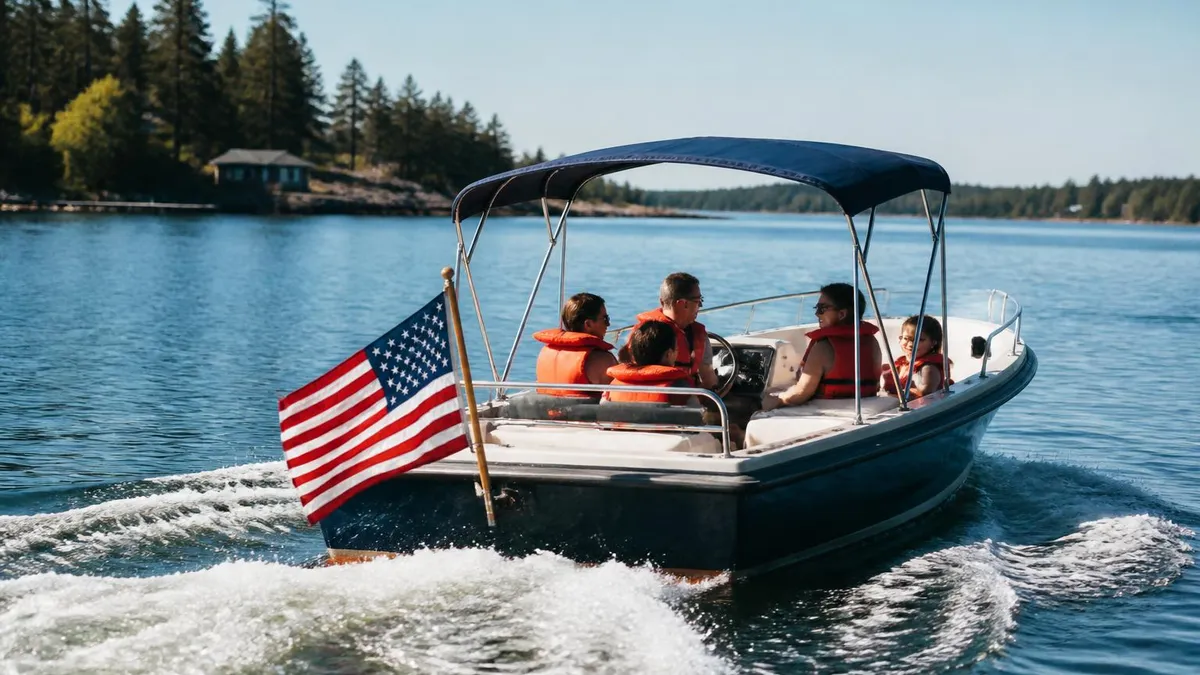
Key State Rules Summary
The consequences for operating without a required boater education certificate range from a written warning on a first offense in some states to a substantial fine and removal from the water in others. In Florida, operating without the required card carries a civil penalty. In California, operating without the California Boater Card is an infraction.
Beyond the legal fine, an unlicensed operator involved in an accident faces significant liability exposure — insurance companies may deny claims where the policy requires a licensed operator and the operator wasn't certified at the time of the incident. Understanding whether your boat insurance policy has a certification clause is worth reviewing before heading out on the water, regardless of which state you're in.
North Carolina's boating license requirements apply to all operators of motorized vessels who were born on or after January 1, 1988, and the state requires course completion for operators between 14 and 16 regardless of birth year. The NC boating license covers the NC Wildlife Resources Commission course requirements and the approved provider list for completing the online certification.
Like most southern states with significant freshwater and coastal boating populations, North Carolina has relatively active marine patrol enforcement during peak summer months. New boaters planning a first season on North Carolina waters are better served completing the certification before launching for the first time than trying to get it done the weekend before their first trip.
Boat registration, while a separate requirement from boater education certification, is often confused with the licensing question. All motorized vessels above a minimum length must be registered with the state in most jurisdictions. Registration produces a certificate and a set of decals for the hull. Boater education certification is about the operator; registration is about the vessel.
A properly registered boat operated by an uncertified operator violates the education requirement. A certified operator on an unregistered boat violates the registration requirement. Both are required, and both are enforced by marine patrol independently. Some states have combined the boater education and registration processes for new boat buyers to make the compliance requirements easier to fulfill simultaneously.
Getting Your Boating License: What to Do
- ✓Check your state's specific age and horsepower requirements — rules vary significantly
- ✓Verify whether your existing NASBLA certificate from another state satisfies local requirements
- ✓Choose an online or in-person NASBLA-approved course that issues your state's accepted certificate
- ✓Complete all course modules before attempting the final exam
- ✓Pass the final exam — most states require 70–80% to pass
- ✓Download or print a temporary certificate immediately after passing while the physical card ships
- ✓Carry the physical boater education card on the water at all times when operating
- ✓Check visiting state requirements before operating in a different state
- ✓Review your boat insurance policy to confirm any operator certification requirements
- ✓Keep the original card safe — replacement card fees and processes vary by state
Boating License by State Type
States like Florida, California, and New York have broad boating license requirements that apply to most adult operators regardless of age. These states typically have large boating populations, significant accident histories, and active enforcement. Florida's year-round boating season and large number of out-of-state visitors on rental boats has driven strong enforcement of the boater education card requirement. California's phased implementation is nearly complete, and compliance rates are increasing as enforcement actions increase. Visitors to these high-requirements states should confirm their certificate is NASBLA-approved and carries adequate documentation of the issuing state.
Getting a Boating License: Benefits and Considerations
- +Required by most states — avoids fines and being removed from the water by marine patrol
- +NASBLA-approved certificates recognized by most states for reciprocal travel
- +Online courses can be completed in 4–8 hours at your own pace
- +Certificates typically have no expiration — one-time completion for most operators
- +Safety knowledge reduces accident risk — boating fatalities correlate with uncertified operators
- −State requirements vary enough that a certificate from one state may not satisfy another
- −Physical card must be carried on the water — digital copies not universally accepted
- −Online final exam must typically be proctored, adding a scheduling step in some states
- −Physical card delivery takes 2–4 weeks after passing — plan ahead before your first trip
- −Rental boat exemptions vary by state — don't assume a rental operator's verbal clearance is enough
Boating License Questions and Answers
About the Author

Master Mariner & Maritime Certification Specialist
Massachusetts Maritime AcademyCaptain David Harrington is a US Coast Guard licensed Master Mariner with a Bachelor of Science in Marine Transportation from Massachusetts Maritime Academy. He has 22 years of deep-sea and coastal navigation experience aboard commercial vessels and specializes in preparing maritime candidates for USCG licensing exams, STCW certification, dynamic positioning (DPO), and officer-of-the-watch qualifications.
Join the Discussion
Connect with other students preparing for this exam. Share tips, ask questions, and get advice from people who have been there.
View discussion (6 replies)