
BLS Certification Classes: How to Pick, Pay, and Pass on the First Attempt
Compare BLS certification classes by format, cost, and pass rate. Free practice questions, skill checks, and tips to pass your AHA BLS exam first try. ✏️
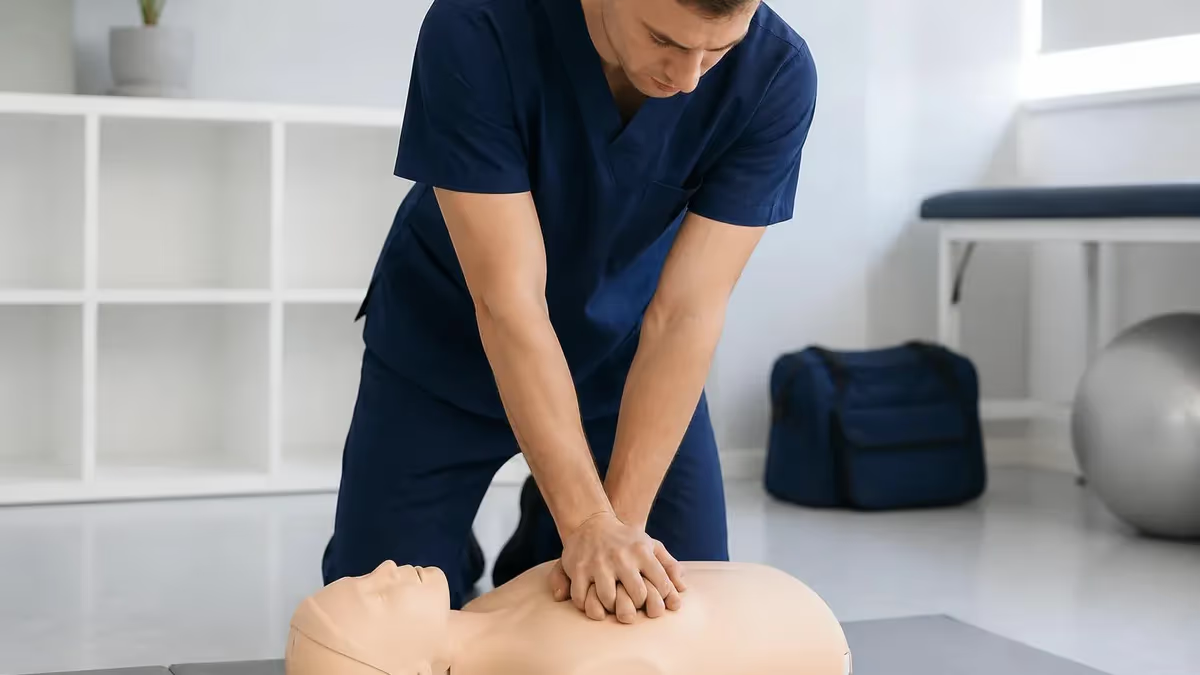
BLS certification classes look interchangeable from the outside. Pick any provider, sit through a few videos, perform two minutes of chest compressions on a manikin, walk out with a card. That is roughly true for the people who pass. It is wildly misleading for the people who fail.
The ones who fail almost always trip on the same three things: the megacode scenario, two-rescuer infant CPR, and the written test questions that mix recovery position with stroke recognition. You can dodge all three by choosing the right class format for how you actually learn and by drilling the test bank before you show up. Most candidates skip the drilling step and rely on the in-class video alone, which is the single biggest predictor of a retest fee.
This guide walks through every realistic option: classroom, blended, online challenge, hospital onboarding, and community-college continuing-ed. We compare cost, time on site, skill-check style, and what your employer will actually accept. We also cover the written exam and what to drill before you sit it.
The credential you walk out with is the AHA BLS certification, the version hospitals, dental offices, EMS agencies, and most clinical-rotation sites require. The Red Cross BLS for Healthcare Providers credential meets the same Joint Commission standard, but some employer HR systems list AHA by name in their policy manual. Either card opens the same doors in nearly every U.S. healthcare setting if your employer accepts both, which most do.
BLS by the Numbers

Who Actually Needs a BLS Card
Walk into any acute-care hospital and the badge clipped to every clinical employee is backed by a BLS card on file. Nurses, respiratory therapists, surgical techs, phlebotomists, radiology techs, and physical therapists all renew on the same two-year cycle. Medical and nursing students need it before their first clinical rotation, usually in semester two.
Dental hygienists, dental assistants, and dentists themselves need it for state licensure in most states. EMTs and paramedics carry BLS as a baseline credential beneath their ACLS and PALS cards. Outside the hospital, lifeguards, ski-patrol members, athletic trainers, school nurses, and corrections officers commonly hold a current card.
If you are a layperson with no clinical role, you probably want Heartsaver CPR or Heartsaver First Aid instead. Heartsaver is shorter, cheaper, and skips the two-rescuer scenarios and bag-valve-mask work that pad BLS. Some workplaces, such as daycare centers and assisted-living facilities, specify Heartsaver in their policy, so double-check before you sign up for a class you do not need.
Stop right here if you are not clinical
If your job is not in healthcare, lifeguarding, or fitness, you almost certainly want Heartsaver CPR or First Aid, not BLS. BLS includes two-rescuer techniques and bag-valve-mask work that retail employers do not require and will not reimburse. Confirm with HR before booking the wrong class because the two credentials are not interchangeable on every audit.
The Four Class Formats, Honestly Compared
The classroom-only initial runs roughly four hours in a single sitting. An instructor walks the room through the cognitive material, runs the video, then leads pairs through compressions, breaths, AED operation, and the team-based megacode. Showing up cold to a classroom-only initial is a known fail risk because there is no remediation gap before the skills test.
The blended heartcode bls cpr answers path is the dominant 2026 format. You complete the cognitive portion online at home in about ninety minutes, then book a thirty- to forty-five-minute in-person skills session where an instructor watches you perform compressions, ventilations, AED use, and choking relief. The legitimate online BLS certification path is HeartCode, not pure online.
Online-only challenge courses sound tempting at thirty dollars but are not AHA-recognized. The Joint Commission requires hands-on skills verification with a live instructor. Employer-paid onboarding classes are the fourth path. Hospitals and large dental groups run their own internal BLS classes through staff-development in week one of orientation, alongside fire-safety and EHR training.
Class Format Decision Map
Four hours in person. $45 to $95. Best for people who learn by doing and want it done in one sitting. Higher fail rate when attempted cold without prior study.
Online module plus 30 to 45 min skills session. $75 to $110. The dominant 2026 format. Self-paced cognitive learning then compressed in-person time.
Avoid. Not AHA-recognized. Employer HR will reject for clinical roles. Joint Commission audits will flag a fully online card.
Zero cost, fixed schedule. Hospitals run these in week one of orientation. Pre-study HeartCode at home if your start date is locked.
What You Actually Pay
The published price is rarely what hits your card. Add a card-printing fee of three to ten dollars at some sites. Add parking if the class is downtown. Add a pocket mask if the instructor requires you to bring your own, about twelve dollars on Amazon. If you fail and need to retest, expect a retake fee of twenty-five to fifty dollars, though some hospital training centers waive the first retake as a courtesy.
Reimbursement is often available but rarely automatic. Hospital staff usually submit a receipt to their education department after the card is issued. Travel nurses and agency staff normally pay out of pocket and deduct it on Schedule C. Nursing students at community colleges sometimes have BLS bundled into a clinical-readiness fee billed by the registrar, in which case there is no separate transaction and no receipt to chase.
If your employer requires BLS but does not reimburse, push back. Most hospital systems will pay for credentials they require, even if the policy is not advertised. The education or staff-development office is the right contact, not HR. Bring a printed copy of the receipt and the policy reference if you can find it. The reimbursement is usually processed in the next pay cycle, sometimes as a separate check, sometimes as a line item on your regular check.
A fully online BLS card will not pass Joint Commission audit. Hospitals and dental boards require live skills verification by an instructor. Pay the extra $40 for blended HeartCode BLS, which is the legitimate online-plus-in-person path. Anything cheaper that claims to be fully online is essentially worthless to a clinical employer.
The Skills Test: Adult Station
You will check the scene, check responsiveness, send someone for help and an AED, check breathing and pulse simultaneously for no more than ten seconds, begin chest compressions at 100 to 120 per minute and a depth of at least two inches, allow full recoil, and minimize interruptions.
After thirty compressions you deliver two breaths with a barrier device. When the AED arrives you turn it on, attach pads correctly, clear the patient, deliver the shock if advised, and immediately resume compressions. The instructor scores compression rate, depth, recoil, hand placement, ventilation volume, AED pad placement, and the safety clear. Miss two or more critical actions and you fail this station. Our BLS CPR walkthrough details the exact sequence instructors watch for.

Skills Test Cheat Sheet
30:2 compression-to-breath ratio. Compression depth at least 2 inches. Rate 100 to 120 per minute. Full recoil after every compression. Minimize interruptions. Apply AED as soon as it arrives and follow voice prompts.
The Skills Test: Infant Station
You and a partner alternate roles. One performs compressions using the two-thumb encircling hands technique on an infant manikin at a depth of one and a half inches, the other delivers breaths via bag-valve-mask. The ratio is fifteen compressions to two breaths in two-rescuer infant resuscitation, which trips up almost every candidate who has only practiced adult 30:2.
You will also be asked to demonstrate switching positions every two minutes with minimal pause and to perform infant choking relief using back slaps and chest thrusts. The bag-valve-mask seal is what most people fail. Practice the E-C clamp grip at home with a stuffed animal if you have to. The seal matters more than the volume on infant ventilations.
The Written Test
Twenty-five multiple-choice questions. The AHA passing score is 84 percent, which means you can miss four and still pass. You have about thirty minutes, but most people finish in twelve. Questions are pulled from a bank that covers sequence of care, compression depth and rate, AED operation, choking algorithms, recovery position, opioid overdose response, team dynamics, and high-quality CPR criteria.
The trickiest questions are not the algorithm ones. They are the team-dynamics questions: who calls for the AED, what closed-loop communication sounds like, how the team leader assigns roles, what to do when a team member is performing a task incorrectly. Spend ten minutes specifically on team-communication terminology and you will likely gain four to six points.
The second trickiest cluster covers opioid-associated emergencies. The 2020 AHA guidelines folded naloxone administration into BLS, and many candidates last certified before 2020 have never seen these questions. Know that naloxone is given when an opioid overdose is suspected, that it does not replace CPR, and that the responder continues high-quality CPR while another rescuer administers the dose.
Pre-Class Checklist
- ✓Complete the HeartCode online module at least 24 hours before your skills session
- ✓Save the completion certificate as a PDF on your phone and to a cloud folder
- ✓Practice at least two full timed sets of BLS multiple-choice questions before the test
- ✓Score 92 percent or higher on practice tests before booking the skills session
- ✓Wear comfortable clothes; you will kneel on tile for 30 minutes
- ✓Bring photo ID and your training center confirmation email
- ✓Arrive 10 minutes early; late arrivals are often rejected by the instructor
How to Pass the Blended Course
HeartCode BLS is the most popular path, and there is a reliable way to clear it on the first attempt. Block ninety minutes for the online module on a day when you have not just worked a twelve-hour shift. The simulations include branching paths where the wrong answer drops your score, and a tired brain skips over the safety check before compressions, which the system penalizes hard.
After you complete the module, save the completion certificate as a PDF immediately, because the AHA portal occasionally fails to attach it to your skills session record. The day before your skills session, do a full timed run-through of the written practice questions at home. Treat any score under 92 percent as a flag that you need to revisit the team-dynamics or opioid-response sections.
At the skills session, narrate what you are doing as you do it. "Scene safe, gloves on, checking responsiveness, no response, calling for help, sending Sarah for the AED, checking breathing and pulse, no pulse, beginning compressions." This narration is the closed-loop communication the team-dynamics module is built around, and instructors are trained to score it. Silent compressions get you a needs-improvement even when the mechanics are perfect.
BLS Certification: Pros and Cons
- +Two-year card opens almost every clinical door in the US
- +Blended format keeps in-person time under 45 minutes
- +Most employers reimburse the cost after issuance
- +AHA e-card means no lost wallet card to track
- +Practice resources are widely available for free
- −Online-only cards are widely rejected by employers
- −Lapsed cards over 30 days past expiry pay full initial rate
- −Infant two-rescuer station fails more candidates than anything else
- −Team-dynamics questions surprise renewers who certified before 2020
- −Skills sessions require physical kneeling that some find painful
Renewals vs Initial Certifications
Renewals are shorter, cheaper, and have a higher pass rate. A renewal HeartCode session typically runs twenty to thirty minutes in person, costs sixty to eighty dollars total, and assumes you remember the basics. The catch is the AHA grace period. Your card expires on the last day of the month it was issued two years prior.
Many providers offer a thirty-day grace window for renewals at the lower price; show up on day thirty-one and you pay the full initial-certification rate, which is twenty to forty dollars more. See our BLS recertification guide for state-by-state nuances. If your card lapsed more than a year ago, most training centers require the full initial course regardless of your professional background. A twenty-year ICU nurse who let her card expire for thirteen months will sit through the same four-hour initial class as a brand-new nursing student.
Choosing a Class Provider
Search the AHA Atlas tool for nearby training centers and filter by HeartCode BLS if you want the blended option. Read the Google reviews specifically for comments about the instructor. A good instructor matters more than the price by a wide margin and tends to outweigh location convenience for most candidates.
Watch for reviews that mention rushed skills sessions, missing equipment, or instructors who fail people for trivial reasons. Watch equally for reviews praising classes as easy and finished in twenty minutes, because that signals an instructor who is not actually testing skills, which means your card may not survive an employer audit. Both kinds of provider exist in every metro area.
Community colleges, hospital staff-development offices, fire departments, and independent training centers all train to the same AHA standard, so the credential is identical. Independent training centers run by paramedics tend to be the most efficient on time and the most rigorous on skills, which is what you want if your employer audits cards. Compare options in our Red Cross BLS classes breakdown if you want a non-AHA path.
Reviews that praise a class as easy and finished in 20 minutes signal an instructor who is not actually testing skills. Your card may technically be valid but will not survive a Joint Commission audit at your employer. A real BLS skills session takes at least 30 minutes per candidate and includes critical-action scoring.
After the Class
You will receive an e-card from the AHA within twenty-four to seventy-two hours, sometimes the same day. The physical wallet card is largely phased out. Your e-card has a QR code that anyone can scan to verify it is current and unaltered, which is how hospital HR audits work in 2026. Save the PDF of your card to your phone, to a cloud folder, and to your employer's credentialing system the day it arrives.
Mark your renewal date in two places: your phone calendar with a sixty-day warning and your employer's credentialing system if it allows reminders. Renew during the grace window to keep the lower price. A lapsed card means missed shifts because credentialing software auto-flags expired BLS and locks staff out of the schedule until the card is updated.
Keep the AHA card number written somewhere outside the AHA portal. The portal occasionally orphans cards when training centers close or merge, and reissuing a card by number takes a phone call and a few business days. If you change employers, transfer the card record before your old credentialing access ends, because pulling it after the fact can require a new verification scan and additional fees. The same advice applies if you move to a different state and switch hospital systems entirely, since some regional credentialing databases do not talk to each other and reverify cards from scratch.
Renewal Calendar Reminders
Phone calendar reminder. Book your renewal slot. Confirm employer accepts your provider.
Start HeartCode online module. Save certificate PDF immediately to phone and cloud.
Run two timed practice tests. Target 92 percent or higher before booking skills.
Comfortable clothes, photo ID, printed certificate. Arrive 10 minutes early. Narrate every action.
If You Fail
Most training centers allow one free retake within thirty days. After the second failure you usually pay a retest fee. A third failure typically requires reenrollment in the full course. Failures break down predictably: most are at the infant two-rescuer station, second most at the adult AED scenario for missing the safety clear, third most on the written test for team-dynamics questions.
None of these are mysterious. Practice with a partner, narrate every action, and run the written practice tests until 95 percent is consistent. If you cannot get a partner, use a stuffed animal and verbalize the role swap so the timing becomes automatic. The infant station almost always fails on the bag-valve-mask seal, not on the compression count, so drill the E-C clamp grip until it is one motion.
A failure is not a permanent mark on your record. The AHA does not track failed attempts across training centers, and employers see only the issued card date, not the path to get there. Reset, identify the station that broke down, drill specifically that pattern, and rebook. Most candidates who fail an initial pass the retake comfortably because the second visit removes the unknown-environment penalty that trips up first-timers.
BLS Questions and Answers
About the Author

Registered Nurse & Healthcare Educator
Johns Hopkins University School of NursingDr. Sarah Mitchell is a board-certified registered nurse with over 15 years of clinical and academic experience. She completed her PhD in Nursing Science at Johns Hopkins University and has taught NCLEX preparation and clinical skills courses for nursing students across the United States. Her research focuses on evidence-based exam preparation strategies for healthcare certification candidates.
Join the Discussion
Connect with other students preparing for this exam. Share tips, ask questions, and get advice from people who have been there.
View discussion (8 replies)