
How to Get a Bartending License: Requirements by State, Training Options, Steps, Costs, and Online Certification
How to get a bartending license: state-by-state requirements, training options (TIPS, ServSafe Alcohol), application steps, cost, online 🎯
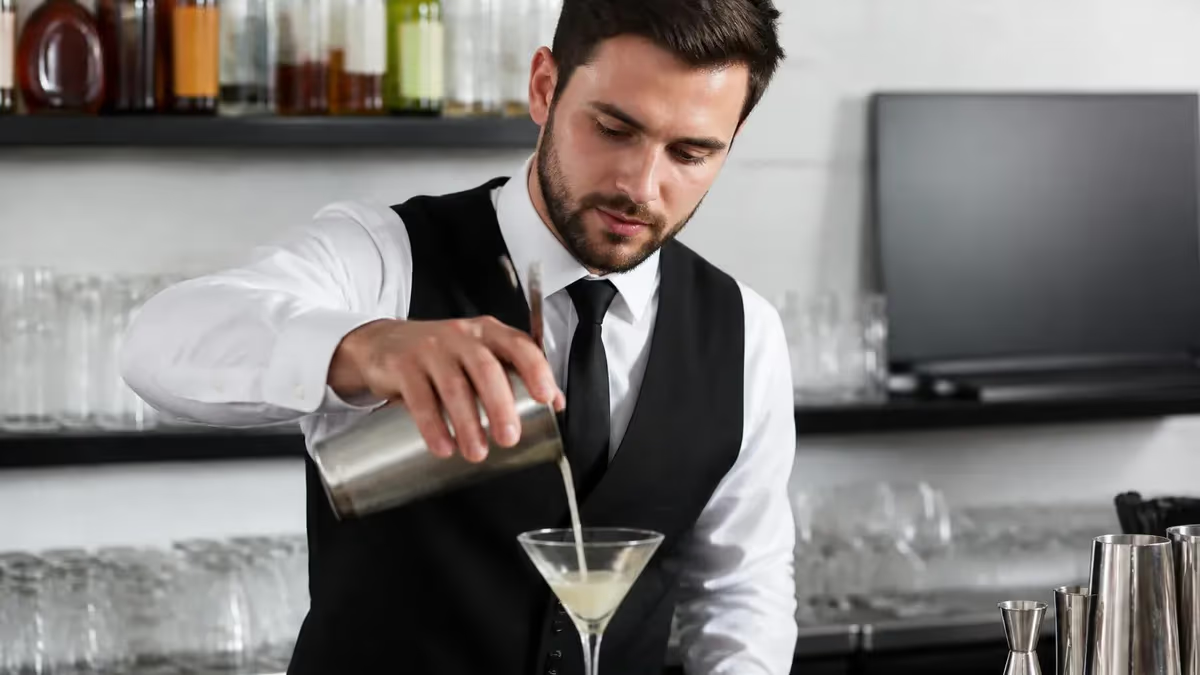
Getting a bartending license is more variable than most people expect. There's no single national bartending license — each US state has its own requirements, ranging from no formal credential needed (Florida, Nevada) to state-issued licenses (Utah's Alcohol Server Training, Alaska's Server Training) to municipal licenses (Wisconsin's Operator's License) to certification-only requirements (California's RBS, Texas's TABC).
Before pursuing any license or certification, the first step is determining what your state actually requires. The terminology varies: 'bartending license,' 'alcohol server certification,' 'responsible beverage server (RBS) training,' 'liquor handler license,' and 'permit' all refer to different credentials depending on the state. Some states require both a state-level certification and an additional municipal license. Knowing the specific terminology for your state prevents wasted money on the wrong credential.
For most states with mandatory training, the process is similar: complete a state-approved Responsible Beverage Server (RBS) training course, pass the exam, receive a certificate, and either work directly (if state accepts the certificate) or apply for additional licensing (if state requires more). The training itself typically runs 4-6 hours, costs $15-50 depending on provider, and can be completed online in most cases.
The most popular training providers nationally are TIPS (Training for Intervention Procedures), ServSafe Alcohol, and Learn2Serve. These three are accepted in most states with mandatory training requirements. State-specific providers exist for states with unique requirements — California has its own RBS-approved providers, Wisconsin has Server Alert, Texas has TABC-certified trainers, etc.
Total cost from start to finish typically ranges $15-100 depending on state. The breakdown: training cost ($15-50), state certification fee (often $0; some states $5-30), municipal license fee where required ($10-50). Most bartenders complete the entire process for under $50 total. Wisconsin's higher fees ($25-75 total) represent the upper end.
Time investment is similarly modest. The training itself is 4-6 hours, processing takes 1-14 days depending on state and method, total time from decision to license-in-hand is typically 1-3 weeks. Most prospective bartenders should plan to begin the process 2-3 weeks before they need the license.
This guide covers the bartending license requirements for each major US state, the most common training providers, the application process, online vs in-person training options, and how to choose the right approach. It's intended for prospective bartenders evaluating training options, current servers who realize they need additional certification, and those moving between states.
Key Bartending License Information
- National license: No — each state sets its own requirements
- State varieties: State certification, municipal license, both, or neither
- Common training: TIPS, ServSafe Alcohol, Learn2Serve, state-specific programs
- Training duration: 4-6 hours typical
- Training cost: $15-50 (online); $25-75 (in-person)
- State fee where required: Usually $0-30
- Municipal fee where required: $10-50 typical
- Total cost most states: $15-75 typical
- Validity: Usually 2-3 years
- Time to obtain: 1-3 weeks typical
State-by-state bartending license requirements. The variation is substantial — verify your specific state before pursuing any training to ensure you complete the right program.
California: Mandatory Responsible Beverage Service (RBS) training. Must complete RBS course approved by ABC (Alcoholic Beverage Control). Approved providers include ABC's own course, ServSafe Alcohol, TIPS, and several others. No state fee for the certification itself. Cost: $15-50 for training. Validity: 3 years. No additional municipal license required.
Texas: TABC (Texas Alcoholic Beverage Commission) certification is mandatory. Must complete a TABC-approved course. Cost: $10-30 for online certification. Validity: 2 years. No additional municipal license. Reciprocity with some neighboring states.
New York: Alcohol server training is voluntary in most cities, but required by some specific municipalities (e.g., some NYC boroughs require ATAP — Alcohol Training Awareness Program). For most NY bartenders, no state credential is required; check your specific city.
Florida: No state-level bartending license or training required. Some employers may require TIPS or ServSafe Alcohol as company policy. Otherwise no formal credential needed to bartend.
Nevada: Las Vegas requires Alcohol Awareness Card from local alcohol commission. Statewide otherwise no requirement. Las Vegas bartenders must obtain the Awareness Card before working.
Wisconsin: Municipal Operator's License required (issued by city/village/town). Approved RBS training required. Total cost: $25-75 depending on municipality. Validity: 2 years.
Illinois: BASSET (Beverage Alcohol Sellers and Servers Education and Training) certification required for most counties. Some Chicago-area requirements. Cost: $20-40. Validity: 3 years.
Arizona: Title 4 Training mandatory for alcohol service workers. Must complete a state-approved Title 4 course. Cost: $20-30. Validity: 3 years.
Utah: Utah Alcohol Server Training mandatory. State-issued certification. Cost: $35-50. Validity: 3 years.
Alaska: TAPS (Training for Alcohol Professionals) mandatory. Cost: $20-40. Validity: 3 years.
Other states with mandatory training: Massachusetts, Oregon, New Mexico, Vermont, Rhode Island, Connecticut (some), New Jersey (some), Indiana, Ohio (some cities), and others. Verify your state specifically.
States without mandatory training: Florida, North Carolina, South Carolina, Tennessee, Kentucky, West Virginia, Virginia (most areas), Maryland, Delaware, and others. These states allow bartenders to work without formal credentials. Some employers may still require certification as policy.
State Requirement Categories
CA, TX, AZ, IL, OR, MA. Complete state-approved training, receive certification, work.
WI, some IL counties, parts of NV (Vegas). State cert plus municipal license required.
NY, FL, NC, SC, TN, KY. Not required by state. Some employers require as policy.
Some areas in WI, parts of WA, OR. Municipal license without separate state training.
UT, AK. State issues actual license, not just certification. Stricter process.
Cruise lines, military bases, hotel chains may have additional requirements regardless of state.
The most common training providers and what they offer. Choosing the right provider depends on your state and personal preference.
TIPS (Training for Intervention Procedures): Most widely recognized. Accepted in most states with mandatory training. Cost: $25-40 for online certification. Duration: 4 hours. Validity: 3 years in most states. Online and in-person formats available. Good choice if you may work in multiple states.
ServSafe Alcohol: National brand from National Restaurant Association. Accepted in most states. Cost: $30-45 online. Duration: 4-6 hours. Validity: 3 years typically. Strong corporate brand recognition. Good choice for those targeting corporate restaurant chains.
Learn2Serve: Online platform with many state-approved courses. Cost: $20-40 depending on state version. Validity varies by state. Convenient online format. State-specific certifications available.
State-Specific Providers: Many states have specific approved providers beyond TIPS/ServSafe. Wisconsin has Server Alert; California has ABC's own RBS course; Texas has multiple TABC-certified trainers. State-specific providers may be cheaper but only valid in that state.
BASSET (Illinois): Beverage Alcohol Sellers and Servers Education and Training. Illinois-specific. Cost: $20-40. Required for most Illinois alcohol service.
BASSET-equivalent: Some states recognize BASSET as equivalent to their own training. Others don't. Verify before assuming cross-state acceptance.
RAMP (PA): Pennsylvania's Responsible Alcohol Management Program. PA-specific. Cost: $30. Required for Pennsylvania liquor license holders.
Free/low-cost alternatives: Some states have free training options. Verify with your state's alcohol commission. Most states use commercial training providers; free options are rare.
In-person vs online: Most providers offer both. In-person costs $5-15 more typically. Online is fully self-paced and flexible. Both produce the same valid certificate. Online is the default choice for most bartenders.
Group training discounts: Some establishments arrange group training for staff. Discounts of 20-50% are common for groups of 10+. If you're starting a job, ask if employer arranges group training.
Training Provider Comparison
Key Facts at a Glance
| Item | Value | Details |
|---|---|---|
| TIPS cost (online) | $25-40 | |
| ServSafe Alcohol cost | $30-45 | |
| Learn2Serve cost | $20-40 | |
| TIPS validity | 3 years | |
| ServSafe validity | 3 years | |
| State certs validity | 2-3 years | |
| Online training duration | 4-6 hours | |
| In-person training time | 4-6 hours |
The application process step-by-step. The path from no certification to working bartender takes 1-3 weeks in most cases.
Step 1: Determine your state's requirements. Visit your state's Alcoholic Beverage Control (ABC), Alcohol Commission, or Department of Revenue website. Search 'bartending license [state]' on Google. Verify the specific terminology your state uses (license, certification, training, permit). Note any municipal-level requirements for your specific city.
Step 2: Choose your training provider. For maximum portability across states, choose TIPS or ServSafe Alcohol. For state-only career, state-specific providers may be cheaper. Verify the provider's certification is accepted by your state's regulating body.
Step 3: Complete the training. 4-6 hours of self-paced online course (or in-person if you prefer). Take notes. Pass the final exam (typically 75-80% passing score; usually allows retakes at no extra cost).
Step 4: Receive certificate. Most online providers email the certificate within minutes of passing. Print multiple copies — one for your application (if needed), one for your records, one for your employer.
Step 5 (if state requires only certification): You're done. Show certificate to employer when hired. Display per local requirements. Start working.
Step 5 (if state requires municipal license, like Wisconsin): Visit your municipality's clerk office. Submit application form, photo ID, training certificate, application fee, and photo. Submit fingerprints if required. Wait 5-14 days for processing.
Step 6 (municipal): Pick up license. Show ID. Carry license card to work.
Step 7: Get hired. Apply to bars and restaurants. Submit your certification/license with application materials. Background check may be conducted as part of hiring (especially for major chains and high-end venues).
Step 8: Display credential. Most workplaces require credential to be on file with HR. Some require display at workstation. Verify your specific employer's requirements.

License Process Timeline
Day 1: Research State Requirements
Day 1-2: Enroll in Training
Days 2-3: Complete Training
Day 3-4: Submit Application (if needed)
Days 4-14: Processing
Day 14-21: Receive License
Day 21+: Working Bartender
What you learn in alcohol service training. The content is consistent across most certification programs because the core topics are universally relevant.
Topic 1: Alcohol laws specific to your state. Legal drinking age (21 in all US states; 18 with parental presence in some), hours of legal alcohol service, restrictions on specific venues, restrictions on specific events (private parties, weddings), and dram shop liability for your state. The state-specific content is what makes the training valuable.
Topic 2: Identifying signs of intoxication. The visible and behavioral signs: slurred speech, unsteady balance, glassy eyes, slow reaction time, impaired judgment, repeating themselves, increasingly emotional, dropping items. Bartenders must track customer state throughout the evening, not just at moment of ordering.
Topic 3: Refusing service. Tactful techniques for declining service. Calling a manager. Offering alternatives (water, food, non-alcoholic options). De-escalation when customers resist. Documentation of refusals.
Topic 4: ID verification. Acceptable forms of ID (state license, ID card, passport, military ID, foreign passport with caution). Spotting fake IDs (texture, holograms, weight, photo quality, font irregularities). When to ask for additional verification. Refusing service for invalid ID.
Topic 5: Dram shop liability. The legal concept that establishments are responsible for damages caused by over-served customers. Common dram shop scenarios. Personal vs. establishment liability. Insurance implications.
Topic 6: Special situations. Pregnant customers (legally allowed to refuse service in most states). Drug interactions (alcohol + medications). Underage attempts to drink. Customers visibly already drunk on arrival. Mass-quantity events.
Topic 7: Documentation. Recording incidents (refusals, escorting customers out, calling cabs). Importance of consistent documentation for liability protection.
Topic 8: Personal safety. Handling aggressive customers. Working alone late at night. Cash handling safety. Crisis response.
Most courses end with a final assessment — typically multiple-choice questions covering all topics. Passing score is 75-80% in most providers; you can retake if you fail.
Training Topics Deep Dive
Drinking age (21 US standard, 18 with parental presence some states). Service hours by jurisdiction. Restrictions on minors in alcohol-serving venues. Restrictions on specific events. Special permits required for certain venues.
Common questions about bartending licenses. Understanding these helps avoid wasted time and money on wrong credentials.
Can I bartend immediately after passing training? Depends on state. States requiring only training certification: yes, immediately. States requiring additional municipal license (Wisconsin): no, you must wait for license processing. Verify your specific state before scheduling work.
What if I move to a different state? Most state certifications aren't directly transferable. You'll likely need to complete the new state's required training. Some states have reciprocity agreements (rare); most require fresh certification. Research before relocating.
Can I work as a bartender without any training/license? In states with mandatory requirements: no, illegal. In states without requirements (Florida, etc.): yes, but employers may still require certification as company policy. Read job postings carefully.
How do I renew my certification? Most providers send renewal notices before expiration. Renewal usually costs less than initial certification ($15-30). Refresher courses are typically 2-3 hours. Validity periods restart after renewal.
What if I let my certification expire? You cannot legally serve alcohol with an expired credential. Most providers allow renewal for 60-90 days past expiration; longer than that may require full re-certification. Don't let it lapse.
Do I need different credentials for different alcohol types (beer/wine/spirits)? In most states, no — one alcohol service credential covers all alcohol types. Some specialty roles (sommelier, brewer) have additional credentials but those aren't required for general bartending.
How much money can I make with this credential? Bartending pay varies widely. Entry-level: $15-22/hr including tips. Mid-level: $20-30/hr. Upscale: $25-40+/hr. Tips often comprise 30-60% of total earnings. The credential opens the door; experience and venue determine actual pay.
What about working at a private event or party as a bartender? Most states' alcohol service laws cover all commercial alcohol service. Private parties are typically covered. Some states have specific event permits separate from regular licenses. Verify event-specific requirements.
Common Licensing Mistakes
Completing TIPS when your state requires state-specific (e.g., Texas TABC). Verify before paying.
Certification expires unnoticed. Renew 30+ days before expiration to avoid lapse.
Moving states without re-certifying. Most certifications don't transfer. Research before move.
Failing background check by lying on application. Always disclose past convictions honestly.
Choosing unaccredited provider for $15. Not accepted by employers or state. Wasted money.
Starting job before completing process. Illegal in most states. Risks job + criminal charges.
Not all alcohol service training programs are approved by all states. Before paying any provider, verify that your state's regulatory body accepts their certification. Check your state's website or call the alcohol commission. Common scam: cheap online programs claiming to be 'accepted nationally' but not actually approved in your specific state. After paying $30-50, you discover the certificate isn't valid where you work. Most reputable providers (TIPS, ServSafe Alcohol, Learn2Serve) are accepted in most states, but verify yours specifically. State websites typically list approved providers. Confirm before clicking 'pay.'
Specialized situations and additional considerations. Some bartending situations have unique licensing requirements beyond standard state credentials.
Mobile/event bartending: Companies that provide bartenders for weddings, corporate events, parties. Same state alcohol service requirements apply. Some states require additional event-specific permits. Operating your own mobile bartending business adds business licensing requirements (LLC, state business permit, insurance).
Hotel bartending: Same state requirements. Most major hotel chains require additional company-specific training (Marriott has their own program, Hilton has theirs, etc.). Hotel bartending is regarded as upscale; salary tends to be higher than independent bars.
Cruise ship bartending: Different rules entirely. Cruise lines operate under international maritime law and the laws of the cruise line's flag country. Cruise bartenders typically don't need US state licensing for shipboard work but do need cruise line internal training. Some bartenders move from US state-licensed work to cruise ships and back.
Private club bartending: Subject to standard state requirements. Some clubs require additional vetting (background checks, references) but the state license is the legal requirement.
Convention center / venue bartending: Same state requirements. Large venues may require additional employer-specific training. High-volume work pays well but is demanding.
Festival / outdoor event bartending: Often requires additional event-specific permits. The promoter typically obtains these; you provide your standard state certification.
Sports bar bartending: Same state requirements. High customer volume, high pressure during games. Solid training prepared you for the volume and intensity.
Fine dining bartending: Standard state requirements plus typically the establishment prefers candidates with bartending school certificates or extensive experience. Less reliance on speed; more on cocktail knowledge and customer interaction.
Starting work before completing your licensing process is illegal in most states. Many new bartenders assume they can begin while applications are processing, but states with mandatory requirements (Wisconsin, California, Texas, etc.) require the credential to be in hand before any alcohol service. Working without a valid license risks: citations for both you and your employer, criminal misdemeanor charges in some states, immediate termination, ban from future licensing applications, and personal liability for any alcohol-related incidents. Plan ahead: complete training 2-3 weeks before your intended start date. Wait for the license. Don't risk it.
How Pros and Cons
- +How certification is recognized by employers as verified competency
- +Provides a structured knowledge framework beyond just the credential
- +Certified professionals report 10–20% salary increases on average
- +Maintenance requirements create ongoing professional development
- +Differentiates candidates in competitive hiring and promotion decisions
- −Certification fees, materials, and renewal costs add up over a career
- −Requirements change — delaying may mean facing updated content
- −Salary ROI varies significantly by geography and industry
- −Preparation requires significant time alongside existing responsibilities
- −Validates knowledge at a point in time, not ongoing real-world performance
BARTENDER Questions and Answers
Getting a bartending license is the first practical step into the profession. The process is straightforward in most states — complete approved training, pass an exam, receive certification, and begin working. The total investment ($15-75 and 1-3 weeks) is small relative to the income potential of bartending careers. Wisconsin and a few other states require slightly more involved municipal licensing, but the basic path remains the same.
For prospective bartenders, the key insight is: verify your specific state's requirements first, then choose an approved training provider, then complete and submit. Don't waste money on wrong programs or skip steps. The credential opens doors; the actual job and skills are the foundation of a real career. With license in hand and basic skills built through practice and on-the-job experience, you'll be working as a professional bartender within a month or two of starting the process.
About the Author

Executive Chef & Culinary Arts Certification Educator
Culinary Institute of AmericaChef Marco Bellini is a Certified Executive Chef and graduate of the Culinary Institute of America with over 20 years of professional kitchen experience in Michelin-recognized restaurants. He teaches culinary arts certification, food safety, and hospitality exam preparation, having guided thousands of culinary students through their ServSafe, ProStart, and professional chef certifications.
Join the Discussion
Connect with other students preparing for this exam. Share tips, ask questions, and get advice from people who have been there.
View discussion (7 replies)