
Bartending Tools: Complete Guide for Certification and Working Bartenders
Complete bartending tools guide: shakers, jiggers, strainers, muddlers, glassware. Build a kit, pass the certification exam, work behind any bar. 📚
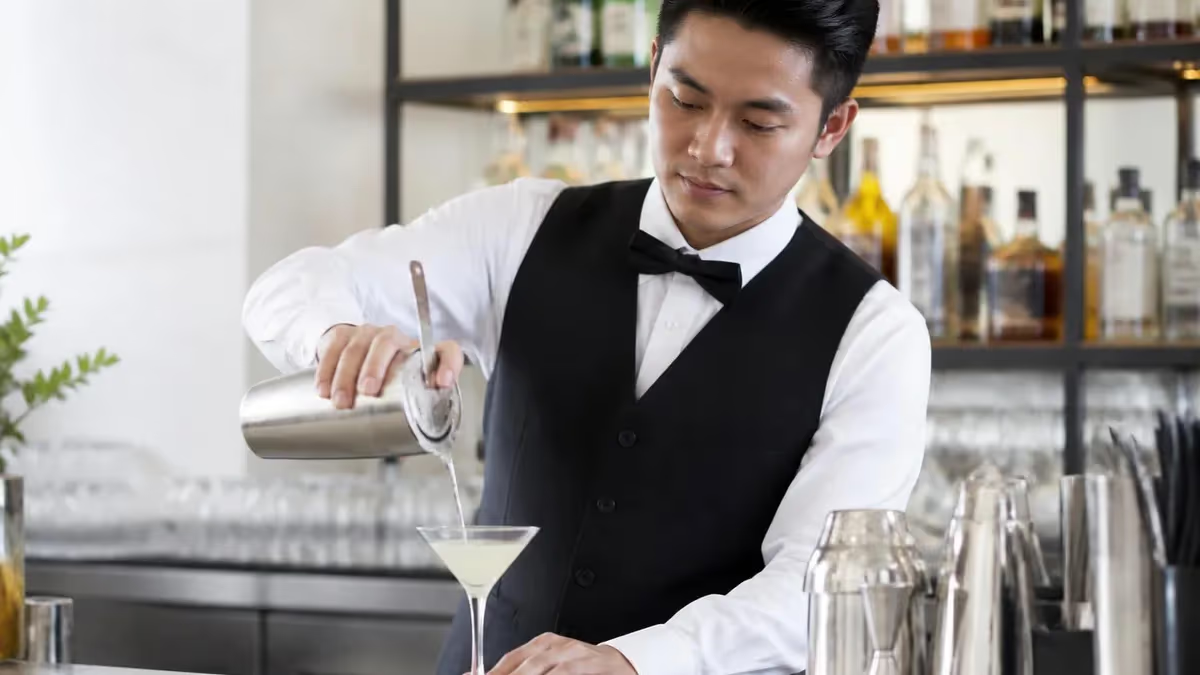
Walk behind any working bar and you'll see the same handful of tools again and again: a shaker, a jigger, a strainer, a bar spoon. They look simple. They're not. Each one shapes the drink in a specific way — temperature, dilution, texture, timing — and the difference between a sloppy cocktail and a clean one comes down to whether the bartender picked the right tool and used it right.
If you're studying for a certification, building a home kit, or just trying to figure out what all those metal cups do, this guide breaks down the essentials. The good news? Most bar tools are inexpensive, durable, and forgiving — you can build a real working kit for under a hundred dollars and learn nearly every technique you'll be tested on.
Most certification exams test bartending tools in the bar tools and glassware section. It's one of the easier domains to score well on if you actually handle the gear. Reading about a Hawthorne strainer is fine. Holding one and feeling how the coil spring catches ice while letting liquid through is better.
There's a reason every serious bar program in the country requires hands-on tool training before testing. You can read about a jigger for an hour, but the moment you pick one up, you understand the small details — how the weight balances when half-full, how the lip catches at exactly the right line, how the two sides nest into the heel of your hand differently. Reading skips all of that.
Most professional bartenders own their own tools. Sets get inherited from mentors, gifted between coworkers, accumulated over years. A well-loved Boston shaker has dents in specific places where the bartender's palm has struck it thousands of times. The jigger sides show wear on the rims from constant pouring. None of this matters for performance — but it tells you the tools have done their job.
Bartending Tools at a Glance
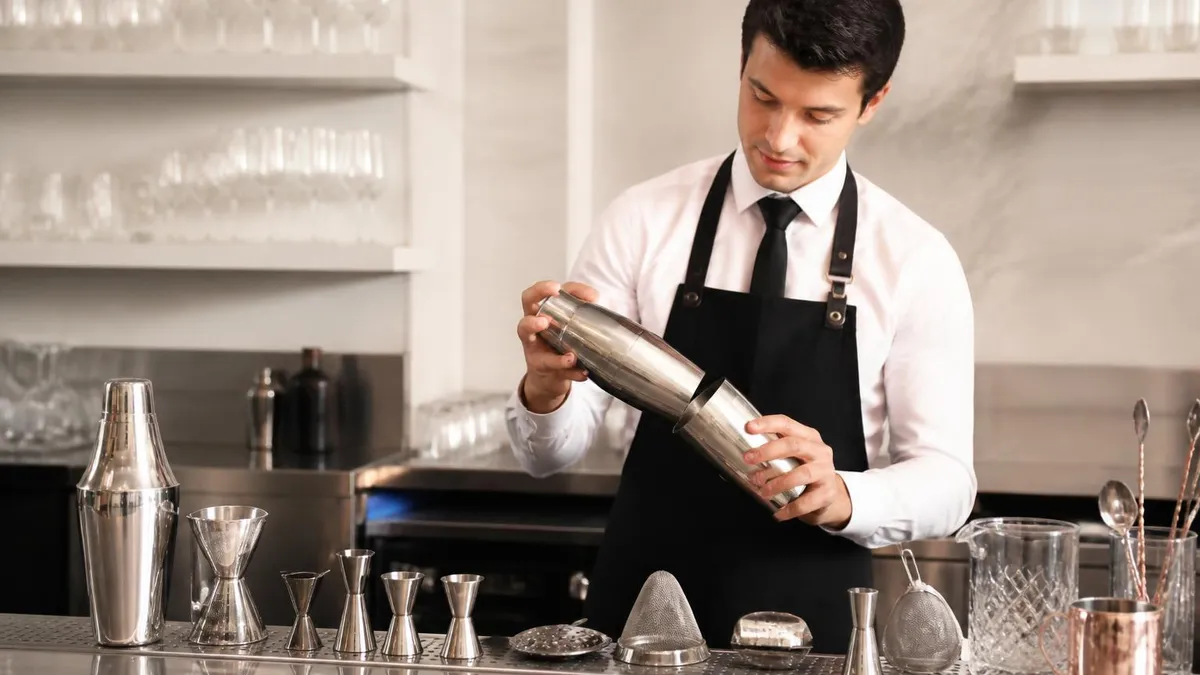
The shaker is where most people start, and there's more than one kind. The Boston shaker — two pieces, usually a metal tin and either a glass or a smaller tin — is what professionals reach for. It chills fast, seals with a firm tap, and breaks apart with a heel-of-the-hand strike.
The cobbler shaker is the three-piece tourist version: tin, built-in strainer, cap. It looks elegant, but the cap freezes shut and the strainer holes are too coarse for fine work. Pick a Boston tin-on-tin if you can. They cost less, last longer, and you'll see them in every bartending school from day one.
Beyond Boston and cobbler, the French shaker (sometimes called a Parisian shaker) sits in the middle ground. Two pieces, both metal, but with a tapered fit instead of the snap-seal of Boston tins. French shakers look elegant on a bar and require less force to open, but they're slower to chill and prone to separating mid-shake if the seal isn't perfect.
Size matters too. Standard Boston shaker sets pair a 28-ounce tin with an 18-ounce tin or pint glass. The big tin gets the ice, the small one gets the liquid, and they nest together for the shake. Smaller sets exist for home use, but bar-grade tools are sized for the full shake volume of a double or triple cocktail batch.
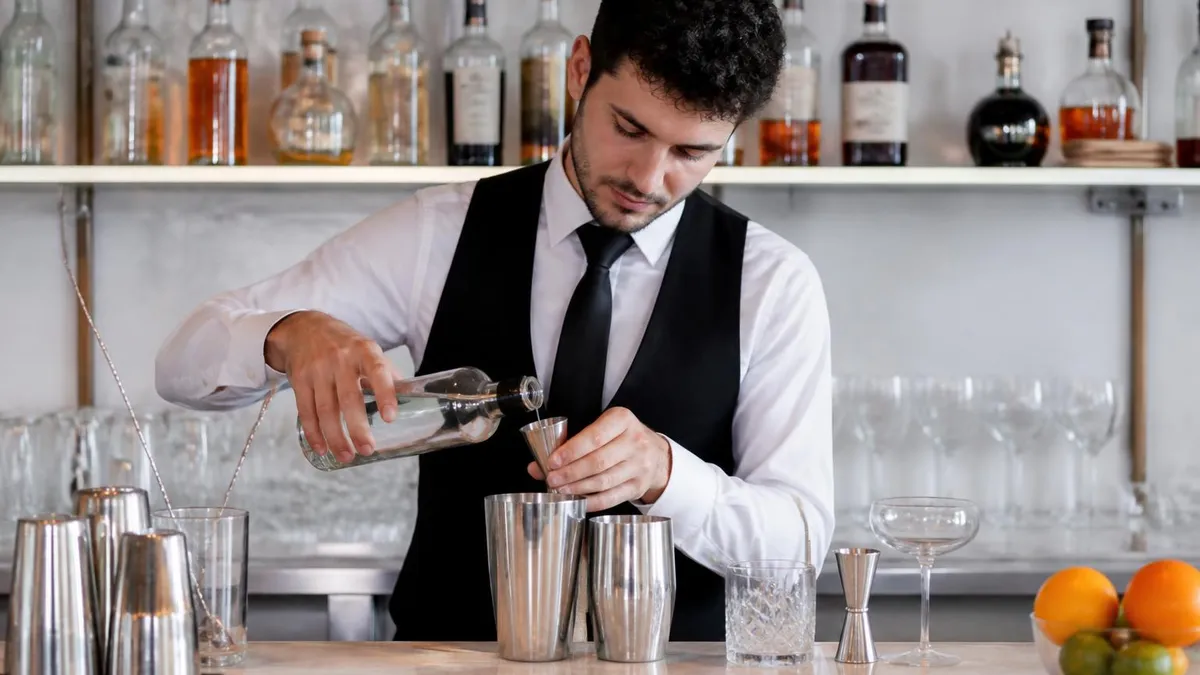
Free-pouring looks impressive, but it costs you money and consistency. Studies of bar operations show that free-pourers over-pour by 15-25% on average compared to jigger-measured drinks. That translates into hundreds of dollars per shift in wasted liquor and unbalanced cocktails that taste different every time. The jigger is the single tool that separates consistent professional bartenders from inconsistent ones, no matter how many years of experience they have.
Get a Japanese-style double jigger marked at 1 ounce and 2 ounce, plus interior etched markings showing half and quarter measures. Measure every drink, every time, no exceptions for the first six months. Speed comes from practice and muscle memory, not from skipping the measurement step. Bartenders who learn properly with a jigger become both faster AND more accurate than those who try to free-pour from the start.
Strainers come in three flavors and you want all three eventually. The Hawthorne — that flat disk with the coiled spring — fits over a shaker tin and catches ice and pulp on the way out. The julep strainer is a perforated metal spoon that sits inside a mixing glass for stirred drinks.
The fine mesh strainer (sometimes called a tea strainer) is the second-stage filter for citrus-heavy cocktails, catching pulp and small ice shards. Pros call this combination a double-strain, and it's how you get that glassy, particle-free look on a daiquiri or a margarita.
The bar spoon does more than stir. A good one has a long twisted shaft, a small flat disk on the end, and a teardrop bowl that holds roughly a teaspoon. Twisted shafts let you spin the spoon between your fingers — the technique for stirring without splashing a Manhattan.
Bar spoon length is its own subject. Standard professional bar spoons are 30-40cm long — long enough to reach the bottom of a tall mixing glass without sinking your hand. Shorter spoons feel awkward and force you to grip too high. Longer spoons (50cm+) exist for specific tasks like layering pousse-cafés but are unnecessary for most work.
The end of the bar spoon also varies. Some have a small flat disk (called a muddler or tamper) for lightly pressing herbs or sugar. Others have a fork tine for spearing cherries or olives. The most common is a smooth teardrop counterweight that balances the spoon's grip. All work fine — pick what feels right in your hand and stick with it.
Core Bartending Tools
Two-piece tin set sized at 28-ounce big tin paired with 18-ounce small tin. Used for chilling and aerating shaken cocktails. Faster, more durable, and easier to open than cobbler shakers. Professional bar standard for over a century.
Tall, narrow double jigger marked at 1 oz and 2 oz on opposite sides, with interior etched markings at half and quarter measures. The accuracy tool every bar relies on for consistent pours, costed drinks, and balanced cocktails.
Flat disk-shaped coil-spring strainer that fits across the top of a shaker tin. The internal spring traps ice cubes, citrus pulp, and herb fragments from entering the glass. Standard for all shaken cocktails.
Long twisted-shaft spoon, 30-40 centimeters in length, with a teardrop bowl holding roughly a teaspoon. The twisted shaft allows you to spin the spoon between your fingers, the technique for stirring without splashing or over-aerating.
Wooden, plastic, or food-grade silicone pestle for pressing herbs, fruit, and sugar in the bottom of a glass to release oils and juices. Essential for Mojitos, Caipirinhas, Old Fashioneds, and muddled fruit cocktails. Should press, not pulverize.
Heavy crystal pitcher with weighted base and tight-pouring spout. Holds ice and liquid for stirred cocktails without warming too quickly. Yarai-pattern cut glass is the professional standard, providing grip and thermal mass.
Muddlers are the most abused tool behind the bar. People grind, twist, and pulverize when they should press. The point of muddling is to express oils from herbs and juice from fruit — not to shred. A few firm presses with a quarter-twist is all you need for mint.
Wooden muddlers feel traditional but stain and absorb flavors. Food-grade silicone or plastic with a textured head is easier to clean and won't transfer last night's basil into this morning's strawberry. Don't use a muddler on hard ice — that's what cracked spoons and broken glass are for.
Mixing glasses get overlooked because they look like a regular pitcher. They're not. A real one is heavy crystal with a weighted base, a tight spout, and walls thick enough to slow heat transfer over ice. The Yarai pattern isn't just decorative — the texture helps your hand grip when working fast.
One muddler tip from working bartenders: don't twist hard. The instinct is to grind like a mortar and pestle, but herbs especially respond better to gentle pressure plus a quarter-twist. Mint leaves bruised too aggressively release chlorophyll and turn the drink bitter. Citrus zest pulverized into the glass releases bitter pith oils instead of the clean citrus essence you want.
Yarai mixing glasses come from Japan and have become the standard for professional cocktail bars worldwide. The Japanese-developed cut pattern, weighted base, and balanced spout are now the template every other manufacturer copies. A real Yarai costs $40-60 — pricey, but it's the kind of tool that lasts a working bartender a decade with normal care.
Tools by Drink Type
Boston shaker, jigger, Hawthorne strainer, fine mesh strainer. Examples: Margarita, Daiquiri, Whiskey Sour, Cosmopolitan, Sidecar. Shake hard for 15-20 seconds with cubed ice.
Glassware deserves its own deeper look because it shows up on every exam and on every shift. The rocks glass (also called an Old Fashioned glass) is a short, wide tumbler holding 8-10 ounces. It's built for spirits over ice and for stirred-and-built cocktails like the Old Fashioned or the Negroni.
Highball and Collins glasses are taller and narrower — Highballs at 10-12 ounces, Collins at 12-14 ounces — for spirit-and-mixer drinks needing vertical space to preserve carbonation. The thick base of a rocks glass lets you press a muddler against it without cracking, which matters for built drinks.
Stemware changes things. The coupe is a wide, shallow bowl on a stem, used for shaken cocktails served up. The Nick and Nora is a smaller, narrower coupe with a tapered rim that concentrates aroma — perfect for stirred drinks like Martinis and Manhattans.
Specialty glassware shows up in advanced exams. Hurricane glasses for tiki drinks. Snifters for brandies and aged spirits. Pilsner and weizen glasses for specific beer styles. Margarita glasses for blended frozen drinks. Most working bars stock four or five core glass types, but exam questions often test you on the more obscure ones — so it's worth learning the full set.
Glass thickness affects drink temperature. Thin, delicate glasses warm faster than thick rocks tumblers. That's why champagne flutes are thin (you want bubbles to release) but rocks glasses are heavy (you want spirits to stay cold). Match glass weight to drink type, and your cocktails will hold temperature longer through the first few sips.
Broken glass behind a bar is the most common bartender injury, accounting for the majority of bar workplace incidents reported each year. Never use a mixing glass with chips or cracks — discard it immediately and replace. Never twist a Boston shaker if you suspect a stuck seal; tap it firmly with the heel of your hand at the point where the tins meet to break the seal cleanly.
Channel knives, citrus peelers, and ice picks should be stored point-down in dedicated slots or sheathed in protective covers. Sharps left loose in drawers cause cuts. Most certification exams include at least one question about safe tool handling and proper storage — see the bar sanitation and safety practice section for review questions and procedural details.
Ice is a tool too, and the gear that handles it matters. An ice scoop — never a glass, never your hands — is required by every health code in the country. Use a metal scoop with a comfortable handle and store it outside the ice bin between uses, not buried in the ice.
A Lewis bag and mallet crush ice for juleps and tiki drinks without splashing meltwater everywhere. Ice tongs let you place a single large cube into a rocks glass for an Old Fashioned without spinning it across the bar top. Different drinks demand different ice formats: cubed, crushed, pebble, or single large rock.
Bar setup and organization exam questions often test glassware-to-drink pairings and ice-handling rules. You don't need every glass for every drink, but matching glass and ice to cocktail is one of the small details that signals a real bartender on the line.
Ice format affects dilution rates dramatically. Cubed ice melts slowly and is the default for most cocktails. Crushed ice melts faster and is used in juleps and swizzles where you want quick dilution. A single large rock (the 2-inch cube or sphere served in upscale Old Fashioneds) melts very slowly, keeping the drink cold without diluting it down. Exam questions sometimes test these relationships.
Ice quality matters too. Cloudy ice contains trapped air and impurities, and it melts faster and looks worse than clear ice. High-end bars use directional-freeze ice machines to produce crystal-clear cubes. Home bartenders can approximate this with insulated containers and slow freezing. None of this is required for certification, but it shows up in advanced mixology training.
Starter Bartending Kit Checklist
- ✓Boston shaker tin-on-tin set including 28-ounce large tin and 18-ounce small tin in 18/8 stainless steel
- ✓Japanese-style double jigger marked at 1 ounce and 2 ounce with interior etched half and quarter measures
- ✓Hawthorne strainer with tight-coil spring fitting standard 28-ounce shaker tin without play
- ✓Fine mesh strainer (tea-strainer style) for double-straining shaken citrus and herbal cocktails
- ✓Weighted bar spoon, 40 centimeters long, with twisted shaft and teardrop counterweight bowl
- ✓Yarai-pattern mixing glass, 500 milliliters, weighted base, tight-pour spout for stirred cocktails
- ✓Food-grade silicone or plastic muddler with textured head for herbs, fruit, and sugar muddling
- ✓Channel knife and Y-peeler for cutting twists, strips, and garnish flags from citrus peel
- ✓Stainless steel ice scoop with comfortable handle plus ice tongs for single-cube placement
- ✓Spring-loaded metal speed pourers in a four-pack or six-pack for consistent flow across the well
- ✓Bottle opener for crown caps plus a wine key (sommelier knife) for foiled and corked bottles
- ✓Rubber bar mat with grid pattern plus lint-free microfiber bar towels in multiple colors for task separation
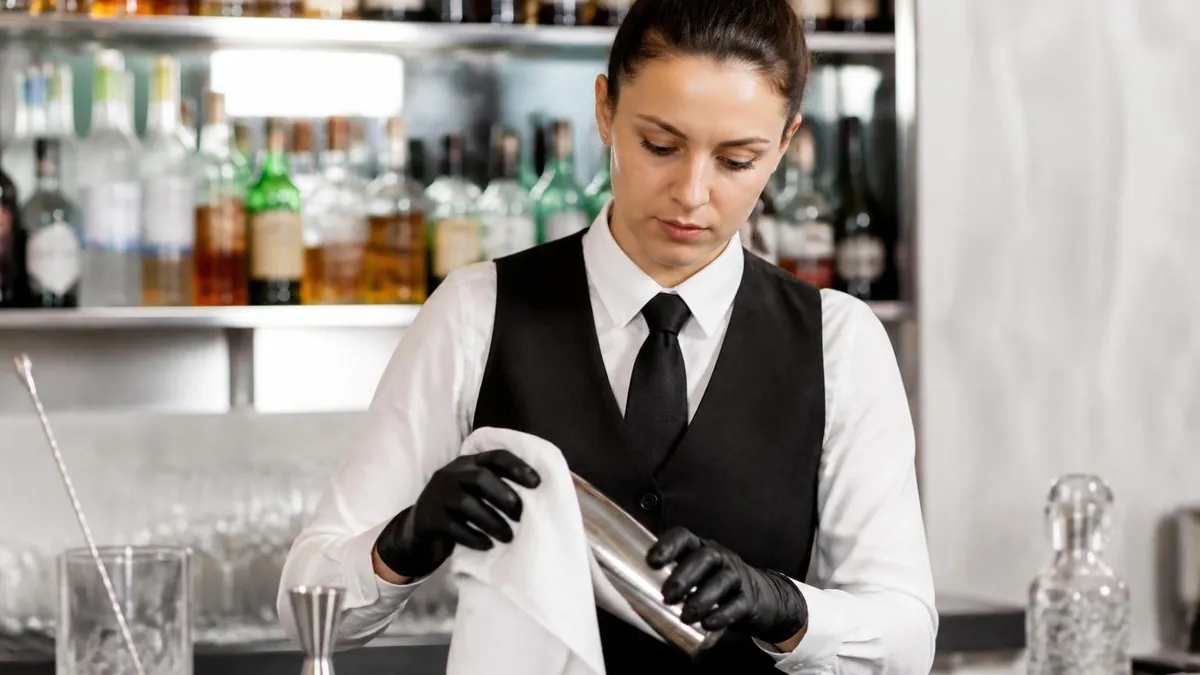
Speed pourers slot into the neck of every spirit bottle on a working bar. They control flow rate so a four-count gives you roughly a one-ounce pour. Cheap plastic pourers drip and clog with sugar. Spring-loaded metal pourers cost a few dollars more and last for years.
Match the pour speed across your whole well — mismatched pourers throw off timing and costs. Behind a busy bar, consistency in tools is consistency in drinks, which is the entire point of training and certification. A bartender who has used the same gear for two years works faster than one who switches constantly.
Cleaning tools matter for exams. A clean bar spoon, a sanitized shaker tin, a fresh bar mat — these aren't optional, they're regulatory. Three-compartment sinks, sanitizer test strips, and color-coded cloths show up on inspections and exams. Expect questions on sanitizer concentrations (50-100 ppm chlorine, 200 ppm quat) and the wash-rinse-sanitize-air-dry sequence.
Pourers come in different flow rates. Standard speed pourers deliver about one ounce per four-count, but slower pourers (used for expensive spirits where waste matters more) and faster pourers (used for low-cost mixers) exist. Color-coded collars help you identify which is which at a glance. Most bars standardize on one pourer type across the whole well to keep timing consistent.
Three-compartment sink procedure is mandatory in every US jurisdiction. Wash compartment holds hot soapy water (110°F minimum). Rinse compartment holds clean warm water. Sanitize compartment holds chemical sanitizer at the correct concentration. Air-dry after — never towel-dry, which recontaminates surfaces. Tool storage matters too: stored tools should be clean, dry, and protected from splash.
One area worth its own attention is the difference between cheap and professional jiggers. A $3 plastic jigger from a discount store will give you rough measurements but won't hold up. Painted lines wear off after a few weeks of washing. The plastic warps under hot water in a sanitizer.
A $15 Japanese-style stainless steel jigger has engraved interior markings that never fade, a balanced shape that pours cleanly without dripping down the side, and a weighted feel that helps you find it on a crowded bar top. Over a year, the better jigger pays for itself in saved liquor alone.
The same logic applies to strainers. The Hawthorne strainer's spring wears out first. Cheap strainers use thin wire that stretches and loosens after a few hundred uses, letting ice through. Professional strainers use a tightly-coiled stainless spring that holds shape for years. Quality gear is cheap insurance for a working bartender.
Beyond shakers and jiggers, a quality bar towel is one of the most underrated tools. Lint-free microfiber towels (sometimes called bar mops) wipe down glassware without leaving streaks, polish chilled glasses without warming them, and clean spills without depositing fibers. Cheap cotton towels shed lint that ends up in cocktails. Professional bars use specific bar towels for specific tasks — never the same towel for hands, glasses, and spills.
Bar mats are similarly task-specific. The rubber grid mat at the bartender's station catches drips and provides a non-slip surface for setting glasses during builds. Service mats sit between the bar and the customer to catch spills before they reach the bar top. Drain mats line glass shelves to let washed glasses dry without pooling water.
Budget vs Professional Bar Tools
- +Budget kits ranging from thirty to fifty dollars work fine for home practice, basic technique learning, and exam preparation
- +Most exam knowledge comes from technique mastery and tool function understanding, not from premium brand recognition or expensive gear
- +Plastic muddlers, cheap pourers, and basic strainers are inexpensive enough to replace as they wear out without significant cost
- +Cobbler shakers, while not professional-grade, work fine for beginners learning shake mechanics, seal techniques, and ice handling fundamentals
- −Cheap Hawthorne strainers use thin-wire springs that warp under regular use, letting ice slip through and ruining drink texture
- −Plastic jiggers lose accuracy rapidly as painted markings wear off from washing and warping occurs under sanitizer-grade hot water
- −Lightweight mixing glasses transfer heat fast and over-dilute stirred drinks before serving, ruining the careful balance
- −Single-piece pourers without springs drip constantly, waste expensive product, and clog with sugar in liqueurs and syrups
Exam writers love to test specific tool functions in multiple choice format. The most common pattern is matching a tool to a drink technique: which strainer for which drink, which shaker for which volume, which spoon for which stir. Memorizing definitions only gets you partway.
What works is grouping tools by the technique they support and learning the technique. If you understand why a Hawthorne strainer's spring exists (to catch ice while letting the drink flow), you'll never confuse it with a julep strainer (no spring, fits inside a mixing glass).
Stainless steel tools should be washed with mild soap, rinsed, and dried completely — never left wet. Citrus residue pits metal over weeks. Wooden muddlers should be hand-washed only and oiled occasionally with food-grade mineral oil. Mixing glasses crack from thermal shock — no sudden hot-cold cycles. Bartending classes usually cover tool maintenance, and it's worth attention because broken gear during service costs real money.
A common trick question covers jigger sizes by region. US standard jiggers are 1oz/2oz. UK and European measurements use 25ml/50ml, and Japanese-style jiggers often run 30ml/45ml. If you're testing in the US, default to ounces. If your certification is international, learn both.
Exam pacing for the tools section: aim for under one minute per question. Tool questions tend to be short and concrete, with one clearly correct answer rather than judgment calls. If you find yourself spending more than 90 seconds on a single tool question, flag it and move on — coming back fresh after finishing the easier ones almost always reveals the answer.
After certification, the real test is the working bar. Speed comes from familiarity, not from raw skill. A bartender who has used the same shaker, jigger, and strainer for two years works faster than one who switches gear constantly. Settle on a kit early.
Building Your Skills Over Time
Week 1-2
Month 1
Month 2-3
Month 4-6
Month 6+
Bartending Tool Cost Breakdown
BARTENDER Questions and Answers
About the Author

Executive Chef & Culinary Arts Certification Educator
Culinary Institute of AmericaChef Marco Bellini is a Certified Executive Chef and graduate of the Culinary Institute of America with over 20 years of professional kitchen experience in Michelin-recognized restaurants. He teaches culinary arts certification, food safety, and hospitality exam preparation, having guided thousands of culinary students through their ServSafe, ProStart, and professional chef certifications.
Join the Discussion
Connect with other students preparing for this exam. Share tips, ask questions, and get advice from people who have been there.
View discussion (7 replies)