
Bartending Schools: Programs, Cost, Duration, Online Options, Job Placement, and How to Choose the Right School
Bartending schools guide: program types, $300-$700 typical cost, 40-hour duration, online vs in-person, top schools, job placement, ROI for new bartenders. 💡
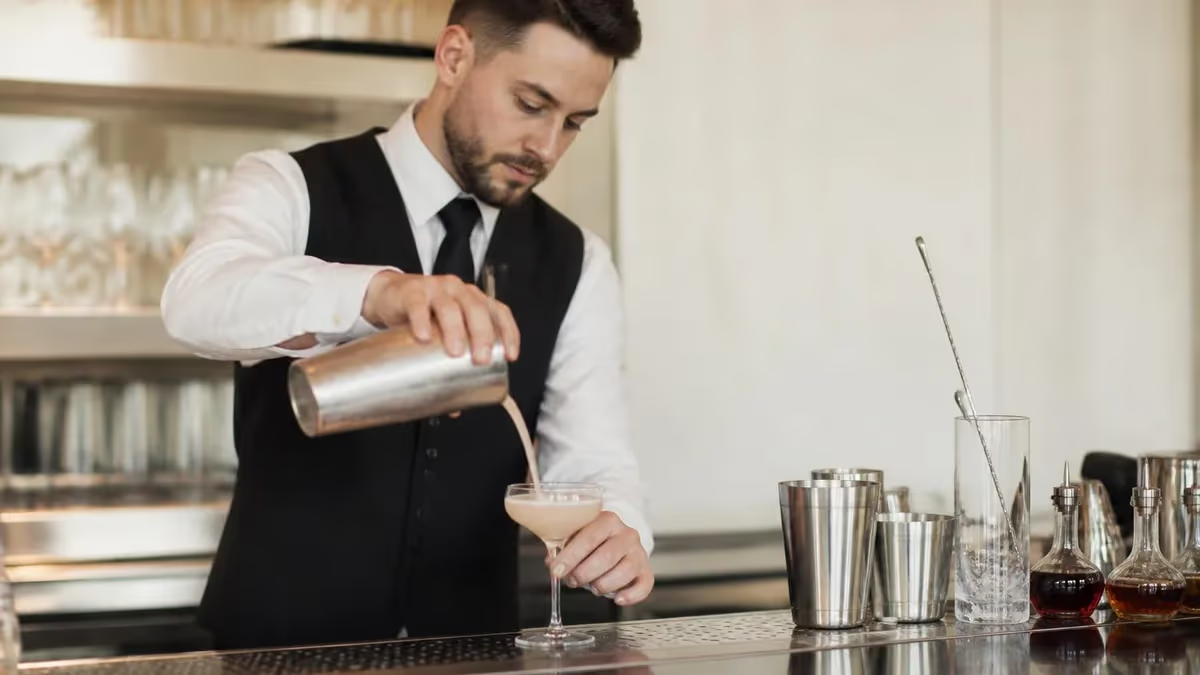
Bartending schools teach the skills needed to work as a professional bartender — drink recipes, mixology technique, speed and efficiency behind the bar, customer service, and the operational knowledge required in real bar environments. They differ from required alcohol service licenses (like Wisconsin's Operator's License or California's RBS) in that they're optional, focused on professional skills rather than legal compliance, and not government-regulated.
Most bartending schools run programs ranging from 1-2 weeks (40 hours) to several months. Short programs cover fundamentals; longer programs add advanced topics like cocktail history, food pairing, bar management, and wine/beer expertise. Tuition ranges from $300-700 for short programs to $1,500+ for comprehensive courses. Online programs cost less but offer reduced hands-on practice.
The bartending school decision is essentially: is the credential and structured training worth the cost compared to learning on the job? For some career paths (high-end cocktail bars, hotels, cruise ships), formal training accelerates hiring and pays back quickly. For other paths (casual bars, restaurants, beer/wine focus), on-the-job training works adequately and saves the school cost.
Most bartending schools claim job placement rates of 80-95%. These numbers should be viewed skeptically — they typically count any job placement (often through generic referrals), and the data isn't independently verified. Reality is that experienced bar managers value the school certificate but care more about your attitude, work ethic, and basic competency in practice. The school helps; it doesn't guarantee.
This guide covers what to look for in a bartending school, comparison of program types (in-person vs online, short vs long, certificate vs degree), cost analysis, top schools by region, job placement realities, and how to decide whether attending school is right for your situation. It's intended for prospective bartenders evaluating training options, career-changers considering bartending, and current bartenders looking to upgrade skills.
For context, bartending school is more popular in regions where formal credentials are valued (major US cities, upscale hospitality, cruise lines) and less popular in regions where on-the-job training is the norm (smaller cities, casual bars, family-owned establishments). The right choice depends on your target career path and local market.
One important distinction upfront: bartending school certificate is NOT a legal license to serve alcohol. Most states still require additional certifications (alcohol service training like TIPS or ServSafe Alcohol) or licenses (Wisconsin's Operator's License). Bartending school teaches the craft; alcohol service certification covers the legal compliance side. Both are typically needed for a working bartender.
Key Bartending School Information
- Typical duration: 40 hours (1-2 weeks) for short programs; 80-200+ hours for comprehensive programs
- Cost range: $300-700 for short; $1,500-3,000+ for comprehensive
- Online cost: $50-200 typical (significantly less than in-person)
- Format: In-person hands-on, online theoretical, or hybrid
- Certificate: School-issued certificate of completion
- NOT a license: Doesn't replace required alcohol service certifications
- Job placement: Most schools advertise 80-95% rates (verify independently)
- Top regions: NYC, LA, Las Vegas, Miami, Chicago
- Online providers: Bartending College, Master of Mixology, Udemy courses
- ROI: Pays back in months if you land a good bartender role
Types of bartending schools and programs. The market includes everything from 1-week crash courses to multi-month professional programs. Choosing the right type depends on your goals, budget, and current skill level.
Short certificate programs (1-2 weeks, 40 hours): The most common format. Quick entry into the profession. Covers basic cocktail recipes (50-100 drinks), basic technique (free-pouring, jigger pouring, garnishing, glassware), customer interaction basics, and standard bar setups. Typical cost: $300-700. Schools include local independents in most major cities. Best for career-changers wanting a quick path into bartending.
Comprehensive programs (4-12 weeks, 80-300+ hours): More depth on cocktail history, mixology techniques, food pairing, wine and beer expertise, bar management, inventory and ordering, and entrepreneurship. Typical cost: $1,500-3,000+. Better positioning for upscale roles, hotel bars, cocktail-focused establishments. Best for those committed to bartending as a long-term career.
Online bartending courses ($50-200): YouTube-style or platform-based courses. Master of Mixology, Bartending College, Udemy, Coursera all offer programs. Limited hands-on practice. Useful for theory, recipe memorization, learning specific cocktail families. Not sufficient alone for a competitive resume but supplements in-person training.
Mixology-focused schools: Specialized in craft cocktails, often run by working mixologists. Cost: $1,000-3,000. Smaller class sizes, more individualized attention. Better preparation for craft cocktail bars and high-end venues. Schools like BarSmarts, Beverage Alcohol Resource (BAR) Smarts, and major craft bartender organizations offer these.
Hospitality industry programs: Some hotel chains and cruise lines run their own training programs. Marriott, Hilton, Royal Caribbean, etc. These are typically free for employees or job candidates, and lead directly to employment with that chain. Less transferable but excellent if you target a specific brand.
Apprenticeships and on-the-job training: Not a 'school' per se, but the traditional path. Start as a bar back, learn from experienced bartenders, get promoted to bartending. Costs $0 (you earn while learning) but takes 6-12 months to reach standalone bartender level. Some establishments offer formal mentorship programs.
College and university programs: Less common but available. Some community colleges offer hospitality management programs that include bartending modules. Schools like Le Cordon Bleu, Culinary Institute of America have related programs. Cost: $5,000-20,000+ for full programs. Best for those pursuing hospitality management careers, not just bartending.
Program Types Comparison
$300-700. Quick entry. Basic recipes, technique. Best for career-changers.
$1,500-3,000+. Depth on mixology, management. Best for long-term commitment.
$50-200. Theory and recipes. Limited hands-on. Supplement to in-person, not replacement.
$1,000-3,000. Craft cocktails depth. Best for upscale and craft bar career path.
Often free (employee training). Brand-specific. Direct employment after.
$0 cost. Earn while learning. 6-12 months to standalone. Traditional path.
What you learn at bartending school. Curriculum varies by school and program length, but the core topics are consistent across most reputable programs.
Drink recipes and categories: Most short programs teach 50-100 cocktails covering all major categories — Highballs (gin & tonic, Cuba libre), Sours (margarita, daiquiri, whiskey sour), Old Fashioned style, Manhattans, Martinis, Mules, Mojitos, Negronis, Old Cubans, etc. Memorization is essential. Most schools require students to demonstrate 50+ drinks by graduation.
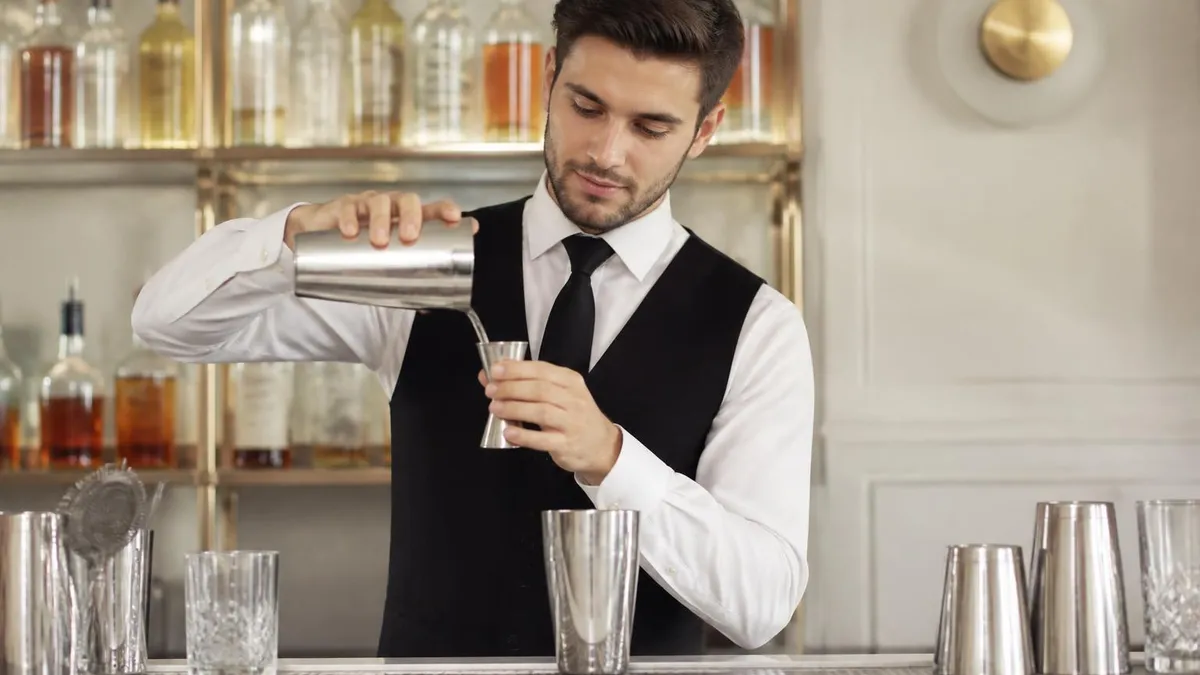
Bartending technique: Free-pouring (estimating volume by count), jigger pouring (using measuring tools), stirring vs. shaking, double-straining, building drinks layered, flame technique (for specific drinks), and proper glassware selection. Speed builds through practice; most graduates are slower than experienced bartenders for 3-6 months after school.
Spirits knowledge: Categories of distilled spirits — vodka, gin, rum, tequila, whiskey (rye, bourbon, scotch, Irish), brandy, mezcal, etc. Production processes, flavor profiles, premium vs. well brands. Wine and beer basics. Cocktail history and the development of modern mixology.
Bar setup and operations: Speed rail organization, bar inventory, garnish preparation, glass washing, cleaning standards, bar back tasks (stock rotation, ice management). POS systems for tabs and payment.
Customer service: Reading customers (intoxication levels, mood, needs), table side service, handling complaints, refusing service tactfully, handling cash and tipping systems, managing tabs and groups.
Legal and regulatory: Alcohol service laws specific to your state, ID verification, signs of intoxication, dram shop liability, harassment policies. Some schools include this; others assume you'll get this via separate alcohol service certification.
Bar management basics (longer programs): Inventory and ordering, cost control, P&L for a bar, staffing, supplier relationships, menu development. Essential for those targeting bar manager roles.
Practical exam: Most programs end with a hands-on test — typically prepare 5-10 cocktails under time pressure, demonstrating speed and consistency. Some schools also require a written exam covering recipes and legal knowledge.
Bartending School Curriculum
50-100 classic cocktails covered in short programs; 200+ in longer programs. Categories: Highballs, Sours, Martinis, Manhattans, Old Fashioned, Mules, Mojitos, Negronis, Old Cubans, classic punches, layered drinks, hot drinks, frozen drinks, and modern craft cocktails. Memorization is essential — most graduations require 50+ from memory.
How to choose a bartending school. Not all programs are equal. The factors below help separate reputable schools from low-quality ones.
Factor 1: Hands-on practice time. The most important factor for in-person programs. Quality programs offer 20+ hours of hands-on bartending practice during the program. Lower-quality programs spend more time on lectures and less on actual practice. Ask each school: 'How many hours behind the bar do students get during the program?'
Factor 2: Class size. Smaller classes (8-15 students) typically mean more individualized attention from instructors. Larger classes (20-30+) reduce hands-on time per student. For practical bartending, smaller is generally better.
Factor 3: Instructor experience. Ask about instructors' actual bartending experience. A 15-year veteran bartender who's worked in upscale bars brings different value than a young trainer who's primarily taught the curriculum. Look for instructors with substantial real-world bar experience.
Factor 4: Equipment and facilities. Visit the school in person if possible. Are the bars stocked with real bottles (or training bottles)? How many bar stations are there relative to class size? Is the equipment professional-grade or beginner-level? Quality schools invest in realistic facilities.
Factor 5: Curriculum scope. Does the program cover what you need? For most people, basic mixology + customer service + standard cocktails is sufficient. For craft bar careers, deeper mixology knowledge matters. For management, business and operations content is important.
Factor 6: Job placement assistance. What specific help does the school provide for job placement? Connections with local bars? Resume coaching? Job board access? On-campus career counseling? Specific placement rates by program (not aggregate). Beware of inflated placement claims without specifics.
Factor 7: Reviews and reputation. Search for student reviews on Google, Yelp, Reddit, and industry forums. Look for patterns: complaints about specific issues (poor instruction, equipment, placement support), positive themes (good instruction, clean facilities), recency of reviews. Old reviews may not reflect current quality.
Factor 8: Cost vs. value. Compare total cost including supplies, materials, exam fees. Some 'cheap' programs add up to expensive programs with hidden fees. Check what's included before enrolling.
Factor 9: Schedule flexibility. Evening and weekend programs allow current workers to attend without leaving their jobs. Full-time intensive programs are faster but require dedicated time. Choose based on your availability.
Factor 10: Alumni success. Where are graduates working? Successful schools have alumni in good restaurants, bars, hotels, and cruise lines. Some schools publish alumni profiles; others can connect prospective students with recent grads.

Cost and Time Investment
Key Facts at a Glance
| Item | Value | Details |
|---|---|---|
| Short program duration | 40 hours (1-2 weeks) | |
| Comprehensive duration | 80-300+ hours | |
| Online course cost | $50-200 | |
| Online duration | 10-40 hours self-paced | |
| Tuition payback time | 2-4 months avg |
Top bartending schools by region. The schools below have established reputations. Specific recommendations within each region depend on your needs.
New York City: ABC Bartending School (multiple locations), Mixology Bartender School, Bartender Bootcamp NY. NYC schools benefit from connections to the city's massive hospitality scene. Cost: $400-800 for short programs; $1,500+ for comprehensive.
Los Angeles: American Bartenders School, Studio City Bartender School, Mixology School of LA. LA's entertainment industry creates demand for skilled bartenders. Strong job placement in LA bars, restaurants, event venues.
Las Vegas: International Bartender Academy, Las Vegas Bartender School. Vegas trains many cruise ship and resort bartenders. Strong industry connections for cruise placement.
Miami: South Beach Bartending School, Mixology Academy Miami. Strong for Caribbean cruise lines, beach resorts, nightclub scene.
Chicago: Chicago Bartender School, Mixology Chicago, ABC Bartending. Chicago's vibrant cocktail scene supports several quality schools.
Other regions: ABC Bartending operates in many cities (search for your area). Professional Bartending Schools also has multiple locations. Local independent schools exist in most major cities.
Online programs (location-independent): Master of Mixology, Bartending College (online certificate), Udemy bartending courses, BarSmarts Online. Lower cost but less hands-on. Best as supplement to in-person training or for those who can't access local schools.
Specialty schools: BarSmarts (formal mixology credentials), Cicerone (beer certification, different focus), Wine & Spirit Education Trust (WSET, wine and spirits), Court of Master Sommeliers (sommelier path). These are for specialized careers beyond bartending.
Free alternatives: YouTube channels (Cocktail Chemistry, Diffords Guide), free online courses (Coursera intro courses), library books (Difford's Guide to Cocktails, Death & Co cocktail book, Cocktail Codex). For self-motivated learners, these can substitute for paid school in basic cases.
Most bartending schools advertise job placement rates of 80-95%. These numbers should be viewed skeptically. Schools count any job placement (often through generic referrals to job boards) and the data isn't independently verified. The reality: experienced bar managers care more about your attitude and basic competency than your certificate. The school helps you get in the door; it doesn't guarantee you'll be hired. Verify claims by: asking for specific placement statistics (where graduates work, average time to first job), talking to recent graduates, checking local bars to see how many cite the school in their resume, and reviewing online forums for honest student feedback. Be skeptical of schools that won't share specifics.
Is bartending school worth it? The honest assessment depends on your goals and starting point.
Definitely worth it when: You're targeting upscale establishments (hotels, fine dining, cocktail bars, cruise lines) where certificates carry weight in hiring. You have zero hospitality experience and need formal training to get hired anywhere. Your local market has many bartending school graduates competing for jobs (the certificate becomes basic table-stakes). You want to fast-track your career path to bartending and don't want to spend 6-12 months as a bar back.
Probably worth it when: You're targeting casual restaurants, sports bars, or chain establishments. The certificate helps but isn't required. The structured training accelerates your readiness compared to learning ad hoc. Your local market values certificates moderately. You have some hospitality background (server, food runner) and want to upgrade to bartender.
Probably not worth it when: You have substantial hospitality experience and good networking in the local bar industry. You can land bar back or junior bartender positions through your network. You're starting your career in a small market where on-the-job training is the norm. You can't afford the $500-1,500 program cost without significant strain.
Not worth it when: You're considering bartending as a part-time/seasonal job rather than career. The school cost wouldn't pay back. You're targeting management-level roles where bartending school is supplementary to broader hospitality experience. You can self-teach via YouTube and books and have the discipline to do it.
For maximum ROI, the optimal path for many people: Take a short certificate program ($300-700) to learn fundamentals. Use the certificate to get hired at an entry-level bar back or junior bartender role. Learn on the job for 6-12 months. Then either continue as a bartender or pursue more advanced training (mixology programs, hospitality management).
For someone with no hospitality experience: Investing in a quality short program saves substantial time getting hired anywhere. Without any credentials, hiring managers won't take a chance on a complete stranger to alcohol service. The $500 investment often returns within 3 months of bartending work.
For someone with hospitality experience: You may be hired as a bar back even without certificate. The certificate adds 5-10% to your chances but isn't necessary. Your existing references and experience matter more.
ROI Decision
Targeting hotels, cocktail bars, cruise lines. Certificate carries weight. Strong ROI.
Need credentials to get in the door. School fast-tracks entry. Often pays back in 2-3 months.
Many graduates locally. Certificate is table-stakes. Investment necessary to compete.
Moving from another field. Structured training accelerates learning. Solid investment.
Server or food-runner. Can upgrade through internal promotion. Moderate ROI.
Disciplined learner with budget constraint. Free resources (YouTube, books) work. Skip school.

What happens after bartending school. The transition from student to working bartender takes 1-3 months typically, depending on local market and your effort.
Immediately after graduation: Build a resume with your certificate. Apply to bar positions through Indeed, restaurant career sites, and direct visits to local establishments. Visit bars during slow hours (3-5 PM weekdays) — managers are less busy and more receptive. Bring a portfolio of skills (drink list, photos of garnishes if you've practiced at home).
First job timing: 2-8 weeks is typical for finding first bar position. Bar back roles are easier to land than full bartender roles. Many graduates start as bar back ($15-20/hr) and work up to bartender ($20-30/hr) within 3-6 months.
Learning on the job: The school taught you fundamentals; the bar will teach you their specific menu, customer base, and operational quirks. Be humble with experienced bartenders — they know things schools can't teach (regular customer preferences, supplier relationships, manager dynamics).
Speed development: This is the biggest gap between school and real work. Schools allow 2-3 minutes per cocktail; real bars want 30-60 seconds. Speed builds with repetition. Most new bartenders take 2-4 months to reach professional speeds.
Required additional certifications: Most states require alcohol service certification (TIPS, ServSafe Alcohol) and possibly a state-specific license (Wisconsin's Operator's License, California's RBS). The school may have covered these or may not have. Verify what's legally required in your state and get certified before working.
Long-term career: With 1-2 years of bartending experience, you can pursue more advanced roles — head bartender, bar manager, beverage director, opening new bars, or moving to specialized bars (craft cocktails, hotel bars, fine dining). Each step typically pays 20-40% more than the previous.
Tip income: Often the largest part of bartender pay. Tip income varies widely by venue ($5-20+ per hour in tips depending on bar type and customer base). Many bartenders earn more in tips than base salary. Tip income is reported income, subject to taxes.
Career longevity: Bartending is physically demanding. Most bartenders shift to bar management or other hospitality roles by their 30s. Some build long careers in bartending; many transition to management, ownership, or related fields after several years.
From School to Career
Weeks 1-2: Job Hunt
Weeks 3-8: First Job
Months 2-4: Skill Building
Months 4-6: Promotion
Year 1-2: Solidify
Year 2+: Career Advancement
Common questions and concerns about bartending school. Understanding these helps make informed decisions.
Will I learn enough to be a real bartender? A quality 40-hour program teaches enough to start working as a junior bartender or bar back. You'll learn the fundamentals — basic recipes, technique, customer service. You won't be expert; experience builds expertise. School provides the foundation; the job provides the polishing.
What if I'm shy/introverted? Many bartenders are introverts. The job involves repetition and routine, not deep social interaction. You'll learn customer service techniques that work for most personality types. The 'gregarious bartender' is a stereotype; many quietly competent bartenders thrive without being extroverted.
Do I need to drink to be a bartender? No. Many bartenders don't drink. The job is about service, not personal consumption. Some bartenders test new cocktails by sipping; others use their senses (smell, look) without consuming. Drinking on the job is typically prohibited regardless of personal preference.
How physical is the job? Substantially. You'll stand 6-10 hours per shift. Lift kegs, cases of beer (40+ lbs). Move quickly between tasks. Some bartenders develop back/wrist/hip issues over years. Maintain fitness if pursuing long career. Wear supportive footwear.
Income predictability: Tips create variable income. Some shifts are great ($150+ in tips for 6-hour shift); others modest ($40-60 in tips). Wage portion is predictable; tip portion varies. Plan finances around the wage; treat tips as bonus.
Career advancement timeline: Bar back → junior bartender (3-6 months) → bartender (6-12 months) → senior bartender (1-2 years) → head bartender or bar manager (3-5 years). Faster in upscale establishments where competition for senior roles is intense; slower in casual venues where titles matter less.
Specialization options: Cocktail bartender (craft cocktails focus), beverage director (whole drinks program), sommelier (wine specialist), beer specialist (cicerone certification), event bartender (mobile/event services), bar owner (entrepreneurship). Each requires different training and experience.
Bartending school certificates are NOT legal licenses to serve alcohol. They're proof of training and skill, but most states still require additional certifications (TIPS, ServSafe Alcohol, or state-specific licenses) to legally serve alcohol commercially. Wisconsin requires the Operator's License from your municipality. California requires RBS certification. Some states require nothing additional. Verify your state's legal requirements separately from any bartending school certificate. Don't assume the school certificate covers everything you need to work legally — it doesn't, in most states.
Bartending Pros and Cons
- +Bartending has a publicly available content blueprint — you know exactly what to prepare for
- +Multiple preparation pathways accommodate different schedules and budgets
- +Clear score reporting shows specific strengths and weaknesses
- +Study communities share current insights from recent test-takers
- +Retake policies allow recovery from a difficult first attempt
- −Tested content scope requires substantial preparation time
- −No single resource covers everything optimally
- −Exam-day performance can differ from practice test performance
- −Registration, prep, and retake costs accumulate significantly
- −Content changes between versions can make older materials less reliable
BARTENDER Questions and Answers
Bartending school is one path among several into the profession. For career-changers and those targeting upscale venues, the structured training pays back within months through faster hiring and better starting positions. For those with existing hospitality experience or in smaller markets, the value is less clear and on-the-job training may work equally well. The right decision depends on your goals, current experience, local market, and budget.
For prospective bartenders ready to commit, the optimal path is typically: take a quality short program ($300-700), get state alcohol service certification ($25-45), apply to local bars/restaurants immediately, and learn the rest on the job. Within 3-6 months, you'll have a real bartender role with income that quickly pays back the training investment. The certificate opens doors; experience and skill keep them open. Combined, they form the foundation of a sustainable bartending career.
About the Author
Executive Chef & Culinary Arts Certification Educator
Culinary Institute of AmericaChef Marco Bellini is a Certified Executive Chef and graduate of the Culinary Institute of America with over 20 years of professional kitchen experience in Michelin-recognized restaurants. He teaches culinary arts certification, food safety, and hospitality exam preparation, having guided thousands of culinary students through their ServSafe, ProStart, and professional chef certifications.
Join the Discussion
Connect with other students preparing for this exam. Share tips, ask questions, and get advice from people who have been there.
View discussion (7 replies)