
Is the Bar Exam Multiple Choice? Format, Scoring, and Sample Questions Explained
🎯 Is the bar exam multiple choice? Partly: the MBE has 200 questions, but essays and performance tests count too. Formats, scoring, tips.
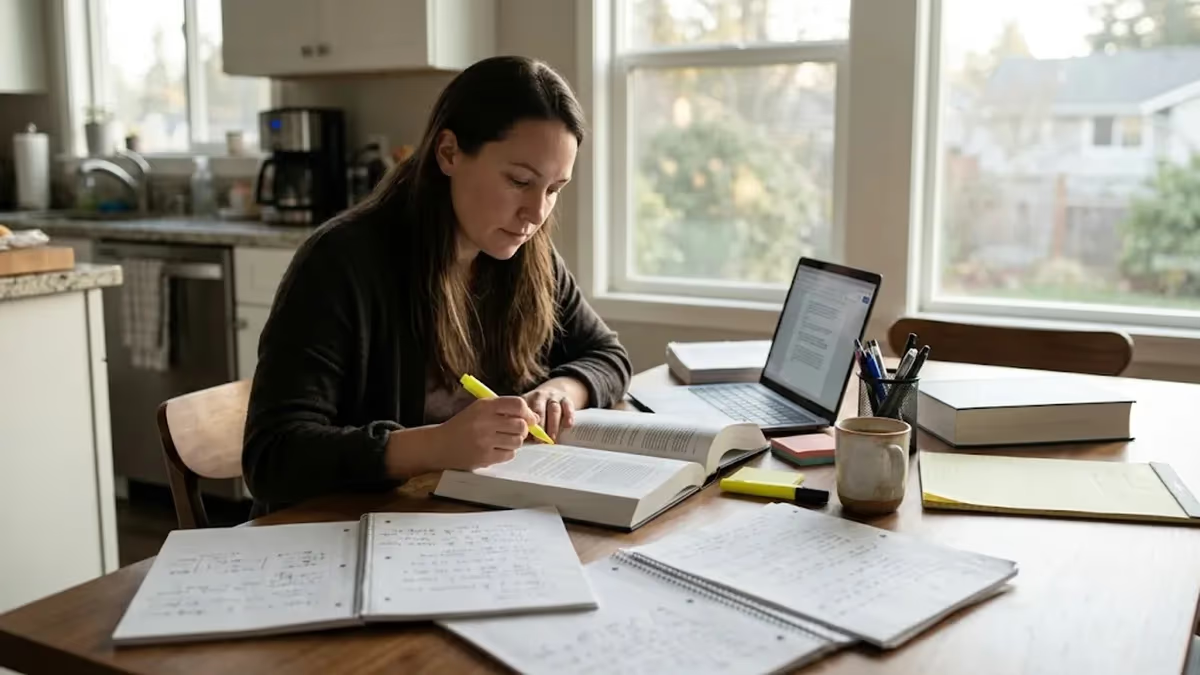
Partly. The bar exam is not all multiple choice: the Multistate Bar Examination (MBE) is a 200-question multiple-choice test, but most states also require essays and a performance test. In Uniform Bar Exam states, multiple choice makes up 50% of your score, while written sections carry the other 50%.
Is the Bar Exam Multiple Choice: Key Facts (Updated October 2026)
| Fact | Details | Source |
|---|---|---|
| Multiple-choice section | The MBE has 200 multiple-choice questions: 175 are scored and 25 are unscored pretest questions. | NCBE: Multistate Bar Examination |
| Legacy UBE weighting | 400-point scale, weighted 50% MBE, 30% MEE and 20% MPT. Each jurisdiction sets its own minimum passing score. | NCBE: UBE Scores |
| NextGen UBE scoring | Scores are reported on a 500–750 scale. Announced passing scores range from 610 to 620. | NCBE: NextGen Scores and Portability |
| NextGen delivery | Taken on your own laptop at in-person, proctored testing locations using a secure online platform. | NCBE: About NextGen |
| NextGen fee | $149 technology fee paid to NCBE, separate from your jurisdiction's bar application fee. | NCBE: Registering for the NextGen UBE |
| Registration | You apply through your jurisdiction. NextGen examinees must finish all NCBE pre-exam steps at least 72 hours before exam day. | NCBE: Registering for the NextGen UBE |
| Upcoming dates | February 23–24, 2027; July 27–28, 2027; and February 22–23, 2028. | NCBE: NextGen UBE |
So, is the bar exam multiple choice? The honest answer is that it depends on the jurisdiction and the test version, but the multiple-choice portion is always the single biggest piece. Nearly every U.S. state uses the MBE, which NCBE writes and scores. For a full list of study resources, visit our bar exam practice hub, then work backward from your own jurisdiction's format and test date.
What is the bar exam, structurally? Think of it as two skill checks stacked together. The MBE measures whether you can read a fact pattern, spot the legal issue, and pick the best of four answer choices in about 1.8 minutes per question. The written sections measure whether you can organize an argument from scratch. Because the MBE is machine-scored and carries the largest weight, many candidates build their preparation around it, then layer essay practice on top.
The seven MBE subjects are Civil Procedure, Constitutional Law, Contracts, Criminal Law and Procedure, Evidence, Real Property, and Torts. Each subject contributes roughly 25 scored questions, which means no single topic can rescue or sink you on its own. Of the 200 questions, 175 count toward your score and 25 are unscored pretest items NCBE uses to test future questions. You cannot tell which are which, so treat every question as if it counts.
Not every state follows the same recipe. Some jurisdictions add their own multiple-choice or essay components, and the weighting can shift from one board to the next. When you compare a stand-alone exam, like the bar exam california candidates face, against a Uniform Bar Exam state such as Ohio, the mix of question types and the scoring scale can look quite different, even though the MBE itself stays the same.
The format is also changing. NCBE is rolling out the NextGen UBE, which mixes multiple-choice questions with written responses and tests skills inside integrated question sets. NextGen candidates test on their own laptops at proctored locations. The next national administration is February 23–24, 2027, so if you plan to test in 2027, confirm with your jurisdiction whether you will sit the legacy exam or the NextGen version before you commit to a study plan.
Why does the multiple-choice share matter so much for your plan? Because it rewards volume. Candidates who work through 2,000 to 3,000 practice questions before test day tend to build the pattern recognition that makes four-option questions feel manageable. Reviewing every wrong answer, and writing down the rule you missed, turns each practice set into a mini lesson. That habit is more valuable than rereading outlines for hours without ever testing yourself.
The rest of this guide answers the questions people search most: whether the exam is all multiple choice, how California compares, what the questions look like, and how to practice. You will also find a format table, a checklist, and a study approach you can start today. Use the facts above as your baseline, and always verify dates, fees, and passing scores with your own jurisdiction's board of bar examiners before you register.
Is the Bar Exam Multiple Choice? The Numbers
Is the Bar Exam All Multiple Choice?
| Section | Questions | Time | Weight | Notes |
|---|---|---|---|---|
| Multistate Bar Examination (multiple choice) | 200 | 6 hours (two 3-hour sessions) | 50% | 175 scored, 25 unscored |
| Multistate Essay Examination (essays) | 6 | 3 hours | 30% | Written answers, not multiple choice |
| Multistate Performance Test (tasks) | 2 | 3 hours | 20% | Two 90-minute lawyering tasks |
| Total | 200 | 2 days | 100% |
Does the Bar Exam Have Multiple Choice Questions in Every State?
Yes, nearly every state's bar exam has multiple choice questions, because almost all jurisdictions use the MBE as a core component. The MBE is the only part of the exam that is entirely multiple choice, and it is usually given on the second day, in two sessions of 100 questions each. You get three hours per session with a break in between, so stamina matters as much as knowledge.
States that give the UBE combine the MBE with six Multistate Essay Examination questions and two Multistate Performance Test tasks. On NCBE's 400-point legacy scale, the MBE is weighted 50%, the MEE 30%, and the MPT 20%. Each jurisdiction then sets its own minimum passing score, which is why the same performance can pass in one state and fall short in another. For a deeper breakdown, see this guide to bar exam scoring.
Stand-alone states build their own exams. Many still include the MBE but add state-specific essays, local-law multiple-choice sections, or both. Always read your board's current rules rather than assuming a thread on bar exam reddit or a friend's experience matches today's format, because these rules change. Forum stories are useful for morale and study tips, but they are anecdotes, and the official specifications from your licensing board win when the two conflict.
California deserves its own note because so many candidates search for the ca bar exam format. California does not use the UBE. It has historically combined essays and a performance test with a multiple-choice section, and it scores on a 2,000-point scale with a currently published passing score of 1,390. The format has also shifted in recent years, so check the State Bar of California before you commit to a plan. For eligibility paths, see our overview of ca bar exam requirements.
Florida candidates often ask the same question. The Florida Bar Examination includes the MBE alongside Florida-specific essay and performance components, so multiple choice is a major part of it but not the whole exam. The MBE topics are the same seven subjects tested everywhere. Florida-specific content appears in the written portions, so you study national rules for the multiple-choice section and state rules for the essays. Verify the latest structure with the Florida Board of Bar Examiners.
A common misconception is that the written sections are optional or that one strong MBE score can carry you. In UBE states, the scores are combined, so a strong MBE can offset weaker essays and vice versa, but you still must sit every section. Abandoning a section can produce a zero for that component and sink your total. Practice all three formats so you do not discover a weakness in the exam room.
Time pressure is the real test in the multiple-choice session. With 100 questions in three hours, you have about 1.8 minutes per question. Many successful candidates aim for roughly 90 seconds on easier items and bank the saved time for long fact patterns. If you are stuck after two minutes, flag the question and move on. Leave no blank answers, since there is no penalty for guessing on the MBE.
Is the California Bar Exam Multiple Choice?
Yes, the California bar exam includes multiple choice, but it is not purely multiple choice. Candidates answer a block of multiple-choice questions, write essays, and complete a performance test. California runs its own exam rather than the UBE, so scores do not transfer automatically to most other states. The State Bar sets the question mix, scoring scale, and test dates, and the number and source of the multiple-choice items have changed between recent administrations.
California also uses its own 2,000-point scoring scale, with a currently published passing score of 1,390. Because the format has shifted, never rely on a study plan built for an older year. Confirm the current structure on the State Bar of California website, then match your practice to it. Treat any forum advice about the California bar exam as a starting point rather than the final word, and verify details before registering.
Is Bar Exam Multiple Choice Easier Than Essays?
- +Scoring is objective, with no grader subjectivity
- +There is no penalty for guessing, so every question can be answered
- +The seven fixed MBE subjects make the scope predictable
- +Practice questions are widely available for unlimited drilling
- +Practice sets give instant feedback on weak subjects
- +MBE scores are comparable across jurisdictions
- −Four answer choices include plausible distractors built to tempt you
- −The pace is only about 1.8 minutes per question
- −Questions test fine distinctions between similar rules
- −Two 100-question sessions demand serious stamina
- −Unscored pretest questions look identical and add to fatigue
- −A strong MBE cannot replace weak written sections
How Do You Practice Bar Exam Multiple Choice Questions?
- ✓Take a 50 to 100 question diagnostic before studying new material.
- ✓Confirm your jurisdiction's exam format and test date on its official board website.
- ✓Learn the seven MBE subjects one at a time, then mix them.
- ✓Answer 50 to 75 practice questions per subject each week.
- ✓Predict the answer before reading the four choices.
- ✓Write one sentence explaining why each wrong choice fails.
- ✓Log every missed rule in a notebook or flashcard deck.
- ✓Run timed blocks of 33, then 100 questions at real exam pace.
- ✓Never leave an answer blank, since guessing carries no penalty.
- ✓Take at least two full-length practice exams before test day.
Review beats volume
Doing 100 questions and reviewing them deeply beats doing 200 and skimming the answers. Spend more time on explanations than on answering, and track misses by subject so your next study block targets the rules you actually get wrong.
What Do Sample Bar Exam Multiple-Choice Questions Look Like?
Sample MBE questions follow a predictable pattern: a short fact pattern of three to eight sentences, a call of the question, and four answer choices labeled A through D. Your job is to pick the best answer, not a perfect one. Reviewing bar exam sample questions from any state gives you the same structure, since the MBE is national and written to one style.
Here is a simplified Contracts example. A buyer and seller agree orally on a sale of 500 widgets for $4,000, with nothing in writing. The buyer later refuses to pay. The question asks whether the seller can enforce the agreement. The key rule is the UCC statute of frauds, which requires a writing for goods priced at $500 or more, subject to exceptions such as specially manufactured goods or admissions. Spotting the dollar threshold decides the answer.
An Evidence example might describe a witness who testifies that a bystander shouted 'The car ran the light!' just after a collision. The call asks whether the testimony is admissible. Hearsay is the issue, but exceptions such as present sense impression and excited utterance may apply. The correct choice names both the rule and the exception. Wrong choices usually state a true rule that does not fit these particular facts.
A reliable method is to read the call of the question first, then the facts, then the answer choices. Cover the options and predict the answer before looking. Eliminate choices that misstate the law, that go beyond the facts given, or that are correct statements answering a different question. Most questions can be cut to two plausible choices, and your odds improve sharply from there, even when you are unsure.
Performance on multiple choice drives outcomes, which is why candidates ask about the bar exam pass rate. Pass rates vary by jurisdiction and by whether you are a first-time or repeat taker, and they change with each administration. Look for official statistics from your state board rather than third-party estimates, and read them as context, not destiny. Your preparation and practice volume matter far more than any published average.
Common distractor patterns are worth learning. One wrong answer often uses the right rule on the wrong party. Another uses absolute words like always or never. A third reaches a correct conclusion for the wrong reason, which is tempting when you rush. Writing a one-line reason for each practice answer exposes these traps, because you must justify why the three losing choices fail, not only why the winner works.
Track your results by subject. If you score 75% in Torts and 55% in Real Property, that tells you where the next ten hours belong. Build accuracy first, then speed. A reasonable target in the final month is 65% to 70% correct on mixed, timed sets of 100 questions, which many instructors treat as a healthy sign. Always compare yourself against your own jurisdiction's required score, not a generic benchmark.
Registration deadlines are set by each jurisdiction, and NextGen UBE examinees must finish all NCBE pre-exam steps at least 72 hours before exam day. The $149 NextGen technology fee is separate from your bar application fee, so budget for both.
Did Kim Kardashian Pass the Bar Exam, and Was It Multiple Choice?
Did Kim Kardashian pass the bar exam? She has publicly said she passed the California First-Year Law Students' Examination, often called the baby bar, in December 2021 after failing it earlier. That test is separate from the full bar exam, and passing it lets a law-office student keep earning credit toward eligibility. To confirm any person's current licensure, use the State Bar of California's attorney search rather than headlines or social media.
The Kim Kardashian bar exam story went viral because it showed how California's route differs from most states. California allows some candidates to qualify by studying in a law office or judge's chambers instead of attending law school, one of only a handful of states that do. Those candidates must pass the baby bar to continue. Many people searching assume the full licensing exam was passed, which conflates two different tests.
Was the baby bar multiple choice? In part. It is a one-day exam that combines 100 multiple-choice questions with four essays, covering Contracts, Criminal Law, and Torts. That structure mirrors the full bar exam in miniature: a multiple-choice section plus written answers. Candidates who find the baby bar tough often discover the same pattern later, with strong rule knowledge but weak timing, which is exactly what drills under real conditions are designed to fix.
The baby bar has historically been much harder to pass than the full bar exam in many administrations, which is why multiple attempts are common among law-office students. Pass rates change from one administration to the next, so look at the State Bar's published statistics for current figures. The lesson for any candidate is that a hard exam is beatable through repetition, structured review, and a plan that does not depend on a single lucky sitting.
Her story illustrates a practical point about multiple choice: repetition works. The best rehearsal is a full practice bar exam, meaning 200 questions in two 100-question blocks under real timing. Our guide to turning a practice bar exam into a score estimate explains how to read your results. Retaking practice sets until the rules stick builds the speed and confidence that the real test demands.
What is the bar exam, in one sentence? It is the licensing test a lawyer must pass to practice in a given state, designed to protect the public by confirming minimum competence. It is not a school exam. Law school grades do not substitute for it, and a degree alone does not let you practice. The multiple-choice section is the part standardized across states, which makes it the most transferable skill you can build.
Finally, understand that being barred from exam sittings is a separate risk. Candidates can be barred from exam participation for late applications, unresolved character and fitness issues, or testing-rule violations such as unauthorized materials. Read your board's rules on conduct and identification before exam week, because a violation can invalidate your scores. Taking the rules as seriously as the law keeps your preparation from being wasted on a preventable mistake.
How Should You Prepare for Bar Exam Multiple Choice Questions?
Start with a diagnostic of 50 to 100 mixed MBE questions under timed conditions, before you study any new material. The result shows your baseline by subject and tells you how many weeks you need. Most full-time candidates study 8 to 10 weeks at roughly 40 to 50 hours weekly, while working candidates often need 12 to 16 weeks at 20 to 25 hours. Adjust honestly based on your diagnostic.
Build a weekly rhythm: learn one or two subjects early in the week, then do 50 to 75 practice questions per subject, then review. Review takes longer than answering. Spend about two minutes per question reading explanations, and write each missed rule in a notebook or on a flashcard. Revisit those rules every few days with spaced repetition, because the MBE tests the same black-letter rules in endlessly different disguises.
Add timed blocks as the exam approaches. Practice 33 questions in 60 minutes at first, then work up to 100 questions in three hours. Simulate the testing environment: no phone, a scheduled break, and the same start time as the real exam. Laptop setup matters for NextGen examinees, who test on their own computers, so check your device early and complete NCBE pre-exam steps at least 72 hours ahead.
Do not neglect the written portion. Because essays and performance tests make up 50% of a legacy UBE score, schedule at least two or three essay or performance task sessions each week. A strong MBE alone rarely compensates for blank or weak written answers. Many candidates alternate writing and multiple-choice days so they stay sharp on both skills without burning out in the final month.
Protect your sleep and routine. Cramming at night reduces recall, and the exam spans two long days. In the last week, taper: do lighter review, reread your rule notebook, and visit the test center if possible. Prepare your ID, admission ticket, and approved items the night before. Small logistics errors cause avoidable stress that follows you into the first session and drains focus you need for the questions.
After the exam, expect a wait. Timing differs by jurisdiction, and NextGen scores appear in your NCBE account only after your jurisdiction announces results and authorizes release. Read our guide on how long does it take to get bar exam results for what to expect, and keep a plan for a retake in case you need it. Staying busy with a job search or a rest week helps.
If you do not pass, treat the score report as data. Compare your MBE scaled score against the required total and decide whether the multiple-choice or the written portion was the gap. Retake rules, including limits and waiting periods, are set by each jurisdiction. Most candidates who improve on a retake change their method, not just their hours: more practice questions, earlier feedback on essays, and tighter timing under realistic conditions.
Bar Questions and Answers
Bar Exam Practice Test

Ohio Bar Exam: Complete Guide to Requirements, Format, and How to Pass
Bar Exam Eligibility: Who Can Sit and What You Need (2026)

Bar Exam Scoring: Complete Guide to How the Bar Exam Is Scored
New York Bar Exam: Dates, Pass Rate & NY Registration

New York Bar Exam Results: Release Dates, Scoring, Pass Rates and What to Do Next
About the Author
Attorney & Bar Exam Preparation Specialist
Yale Law SchoolJames R. Hargrove is a practicing attorney and legal educator with a Juris Doctor from Yale Law School and an LLM in Constitutional Law. With over a decade of experience coaching bar exam candidates across multiple jurisdictions, he specializes in MBE strategy, state-specific essay preparation, and multistate performance test techniques.