
Waterbury Bail Bonds Agent: Career Overview, Duties, Licensing & How to Become One
Become a waterbury bail bonds agent — duties, licensing steps, salary & exam prep. ✅ Full career overview for US bail bond agents.
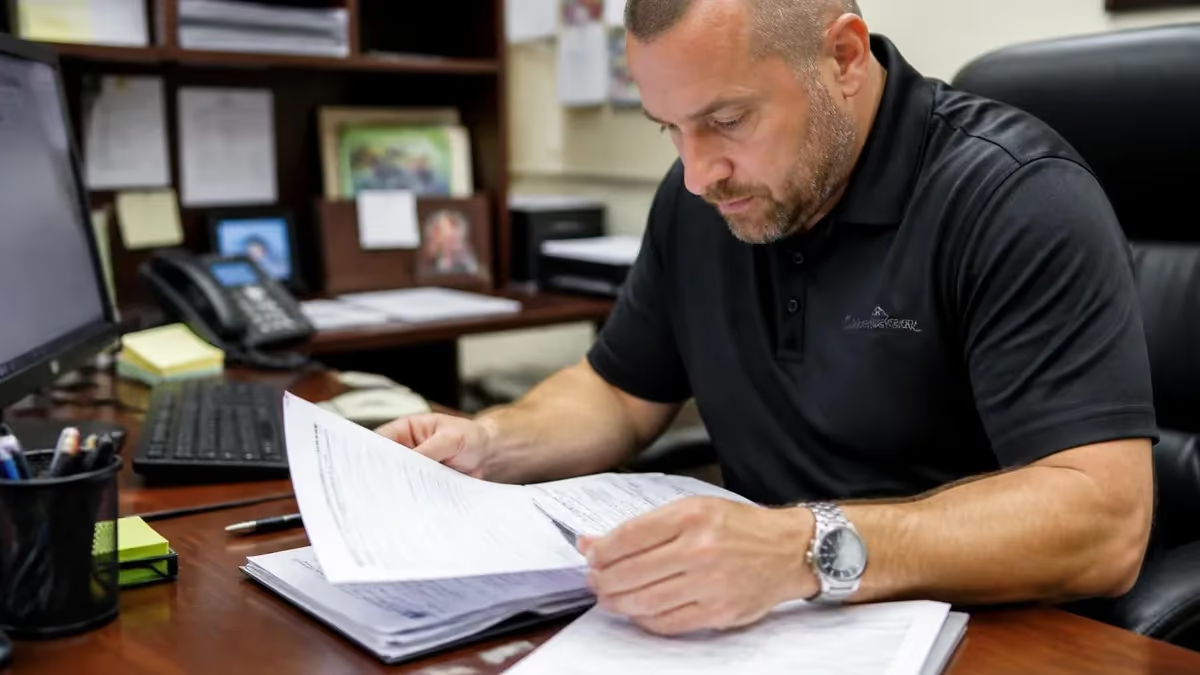
A waterbury bail bonds agent plays a critical role in the American criminal justice system, acting as the financial guarantor who pledges money or property to secure the temporary release of a defendant awaiting trial. In cities like Waterbury, Connecticut — where court calendars are dense and detention can stretch for weeks — a licensed bail bonds agent provides a vital service that balances public safety with the defendant's constitutional right to pretrial freedom. Understanding what this career entails is the first step toward entering one of the most unique professions in the legal services industry.
Bail bonds agents, sometimes called bail bondsmen or bail enforcement agents, operate as independent business owners licensed and regulated by their state's Department of Insurance. They earn a non-refundable premium — typically 10% of the total bail amount set by the court — in exchange for posting a surety bond that guarantees the defendant will appear at all scheduled court dates. If the defendant fails to appear, the agent is financially liable for the full bail amount, which creates a powerful economic incentive to keep close tabs on every client they bond out of jail.
The profession blends elements of insurance, law, customer service, and at times, fugitive recovery. A bail bonds agent must be comfortable working evenings and weekends, since arrests happen around the clock and families often seek help immediately after a loved one is booked. The job demands sharp communication skills, a thorough understanding of local court procedures, and the emotional intelligence to deal with frightened, distressed families during some of the worst moments of their lives.
In Connecticut and across the United States, bail agents are regulated primarily through the state insurance code rather than the criminal justice code. This means aspiring agents must satisfy insurance licensing requirements, complete pre-licensing education, pass a state examination, and secure a sponsoring surety company before they can legally write a bond. The path to licensure is structured, and preparation matters enormously — the licensing exam tests knowledge of insurance principles, bail statutes, and ethical obligations that govern every transaction.
Career prospects in the bail bond industry have been shaped by ongoing debates about bail reform, but licensed bail agents remain essential in the majority of U.S. jurisdictions that still rely on commercial bail. States like Connecticut, Texas, Florida, and California each have distinct frameworks, and agents working in border regions or metro areas often develop expertise in navigating multiple court systems. Waterbury's Naugatuck Valley corridor provides a steady volume of cases across Superior Court, giving local bail agents consistent work throughout the year.
Beyond the financial and legal mechanics, a successful bail bonds agent must also manage risk like an underwriter. Before agreeing to post a bond, they assess the defendant's flight risk based on factors like employment history, community ties, prior failure-to-appear records, and the severity of the charges. Making a poor risk assessment can result in a forfeiture — a costly outcome that impacts the agent's relationship with their surety company and can ultimately cost them their license if it happens too often.
Whether you are considering this career for yourself, studying for the Connecticut bail licensing exam, or simply trying to understand how the bail bond industry works, this comprehensive guide covers every aspect of being a bail bonds agent — from daily responsibilities and earning potential to licensing requirements, exam preparation strategies, and the evolving landscape of pretrial release policy in America.
Bail Bonds Agent Career by the Numbers

How to Become a Licensed Bail Bonds Agent: Step-by-Step
Meet Basic Eligibility Requirements
Complete Pre-Licensing Education
Pass the State Licensing Exam
Secure a Surety Company Appointment
Submit Your License Application
Maintain and Renew Your License
Understanding the financial side of a bail bonds agent's career is essential for anyone considering this profession. Unlike salaried employees, most bail agents operate as independent contractors or small business owners, which means income varies significantly based on how many bonds they write, the size of the bail amounts they handle, and how effectively they manage their business expenses. In active markets like Waterbury, where Superior Court handles a high volume of criminal cases, a productive agent can write dozens of bonds per month.
The standard premium in most states is 10% of the total bail amount set by the court, and this fee is non-refundable even if charges are later dropped or the defendant is found not guilty. On a $25,000 bail bond, the agent collects $2,500 upfront. Out of that premium, the agent typically pays a portion — often 25–40% — to the surety company as a risk fee. The remainder is the agent's gross revenue, from which they pay operating expenses like office rent, licensing fees, advertising, and any bounty hunter fees incurred when a defendant skips court.
New agents starting out in smaller markets may earn $35,000–$45,000 per year as they build their client base and referral network. Experienced bail agents in busy metro areas commonly report gross revenues of $100,000–$200,000 annually, though net income depends heavily on how many bonds forfeit and the associated recovery costs. Building strong relationships with defense attorneys, criminal law firms, and jail staff is one of the most effective long-term strategies for steady referrals and sustainable income growth.
Business costs can be substantial. Professional liability insurance, surety appointment fees, state licensing fees, continuing education, and marketing expenses all add up. Agents who hire field enforcement agents or bounty hunters to track down defendants who have skipped court face additional labor costs. Many successful agents invest early in a professional website and local search optimization, since families searching for help at midnight will typically choose the first credible bail agent they find online.
Some bail agents expand their income by becoming bail recovery agents (bounty hunters) themselves, or by training and managing teams of agents under a bail agency umbrella. Agency owners who recruit and supervise multiple licensed agents can earn override commissions on every bond their agents write, creating a used income model. In states that allow it, large bail agencies also negotiate preferred rates with surety companies, improving margins as volume grows.
Tax planning is another critical financial consideration. Since bail agents are self-employed, they are responsible for both the employee and employer portions of Social Security and Medicare taxes — totaling 15.3% of net earnings in addition to federal and state income tax. Setting aside 25–30% of gross revenue for taxes, maintaining careful records of all business expenses, and working with a CPA familiar with the bail industry are strongly recommended practices for any agent building a long-term career in this field.
It is also worth noting that bail reform legislation in some states has reduced the volume of commercial bail bonds as courts shift toward personal recognizance releases or pretrial monitoring programs. Agents in markets facing reform pressures may see reduced case volumes, making it even more important to differentiate through excellent service, fast response times, and competitive payment plan options that help families who cannot pay the full premium upfront.
Core Duties of a Bail Bonds Agent: What You Do Every Day
When a defendant's family contacts a bail agent, the first task is gathering information: the defendant's full name, booking number, jail location, charges, and the bail amount set by the judge. The agent then evaluates flight risk by reviewing employment status, family ties, prior criminal history, and whether the defendant has ever failed to appear in court before. This intake process typically takes 30–60 minutes and culminates in the agent deciding whether to write the bond.
If the agent agrees to proceed, they collect the premium (or arrange a payment plan), have the indemnitor — usually a family member — sign a legally binding indemnity agreement, and then deliver the bond paperwork to the jail. Once accepted by jail staff, the defendant is released, usually within a few hours. The agent logs the case details, sets up court date reminders, and begins the monitoring phase that continues until the case is fully resolved by the court.

Pros and Cons of a Career as a Bail Bonds Agent
- +High earning potential — experienced agents in active markets earn $80,000–$150,000+ annually
- +Entrepreneurial independence — most agents operate their own businesses with flexible schedules
- +Meaningful community role — you help families navigate one of the most stressful experiences of their lives
- +Low barrier to entry compared to law or medicine — licensing typically takes weeks, not years
- +Steady demand — criminal arrests happen every day, creating consistent business opportunities
- +Diverse daily work — no two clients or cases are exactly alike, keeping the job intellectually engaging
- −Financial risk — a skipped defendant can cost thousands of dollars in forfeiture and recovery expenses
- −Irregular hours — arrests occur 24/7, and families expect help at any time of day or night
- −Emotional strain — working with distressed families and defendants in crisis situations is mentally taxing
- −Regulatory complexity — bail laws vary by state and are subject to ongoing reform efforts that can reduce business volume
- −Reputational challenges — the bail industry is sometimes portrayed negatively in media, requiring agents to actively build trust
- −Physical safety considerations — defendant tracking and apprehension situations can occasionally involve confrontational or dangerous individuals
Pros and Cons at a Glance
| Pros | Cons |
|---|---|
| Entrepreneurial independence — most agents operate their own businesses with flexible schedules | Financial risk — a skipped defendant can cost thousands of dollars in forfeiture and recovery expenses |
| Meaningful community role — you help families navigate one of the most stressful experiences of their lives | Emotional strain — working with distressed families and defendants in crisis situations is mentally taxing |
| Low barrier to entry compared to law or medicine — licensing typically takes weeks, not years | Regulatory complexity — bail laws vary by state and are subject to ongoing reform efforts that can reduce business volume |
| Steady demand — criminal arrests happen every day, creating consistent business opportunities | Reputational challenges — the bail industry is sometimes portrayed negatively in media, requiring agents to actively build trust |
| Diverse daily work — no two clients or cases are exactly alike, keeping the job intellectually engaging | Physical safety considerations — defendant tracking and apprehension situations can occasionally involve confrontational or dangerous individuals |
Bail Bond Agent Exam Prep Checklist: 10 Steps to Pass Your Licensing Test
- ✓Obtain the official content outline from your state's Department of Insurance before beginning any study plan.
- ✓Complete all required pre-licensing education hours through a state-approved provider — do not skip or rush this material.
- ✓Study the specific bail statutes in your state, including rules on premium rates, indemnity agreements, and forfeiture timelines.
- ✓Master surety bond mechanics — understand the roles of the principal, obligee, and surety in a three-party agreement.
- ✓Review insurance fundamentals including contract law, insurable interest, and the difference between admitted and non-admitted carriers.
- ✓Take at least 3–5 full-length practice exams under timed conditions to build exam stamina and identify weak areas.
- ✓Focus extra study time on ethics questions — state exams heavily weight agent conduct and fiduciary duty scenarios.
- ✓Create flashcards for key definitions: bail, bond, indemnitor, exoneration, forfeiture, surrender, and bench warrant.
- ✓Schedule your exam at least one week after completing pre-licensing coursework to allow time for targeted review.
- ✓Arrive at the testing center early with required identification, and read each question carefully before selecting your answer.
Your Surety Relationship Is Your Most Valuable Business Asset
A bail agent without a strong surety company appointment cannot write a single bond. Surety companies evaluate agents based on forfeiture history, financial stability, and professionalism. Agents who maintain a low forfeiture rate and communicate proactively with their surety representative consistently receive better terms, higher bond capacity, and preferential treatment when market conditions tighten. Protecting that relationship starts on day one and requires disciplined risk assessment on every single bond you write.
Risk management is the invisible skill that separates thriving bail agents from those who wash out of the industry within a few years. Every bond an agent writes represents a financial commitment that could become a liability if the defendant disappears. Because the agent is personally on the hook for the full bail amount if the defendant fails to appear and is not recovered within the state's grace period, the decision to write a bond must be treated as a serious underwriting exercise, not simply a transaction to close as quickly as possible.
The primary factors agents evaluate include the defendant's ties to the community — home ownership, family relationships, steady employment, and length of local residence are all positive indicators that a person is unlikely to flee. Conversely, defendants with no fixed address, no local family, active warrants in other jurisdictions, or a documented history of failing to appear represent substantially improved flight risk. Experienced agents learn to spot red flags quickly during the initial intake conversation, often making their risk determination within the first few minutes of speaking with the defendant's family.
The nature of the charges also matters significantly. Defendants facing minor misdemeanors with modest bail amounts are generally lower risk than those charged with violent felonies set at $250,000 or more. High-bail cases produce larger premiums but also larger potential forfeitures — a single missed court date can wipe out months of smaller-bond revenue. Many agents develop personal policies around the types of cases they will accept, focusing on charge categories where they have the most experience and the clearest understanding of typical defendant behavior patterns.
Financial collateral is another critical risk management tool. When flight risk is improved, agents may require collateral — typically real estate, vehicles, jewelry, or cash — that can be liquidated to offset a forfeiture loss. The indemnitor, who is usually a family member or friend posting the premium, must sign a collateral agreement and provide documentation of ownership and value. Agents who consistently require adequate collateral on risky bonds build a financial buffer that protects them even when defendants do not comply with court requirements.
When a defendant does fail to appear, the agent's response speed is critical. Most states begin the forfeiture clock the moment the court records the missed appearance, and the grace period for recovery — during which the agent can surrender the defendant and have the bond reinstated — can be as short as 90 days. Agents who have their own bail recovery networks or established relationships with licensed bounty hunters can respond within hours of a missed court date, dramatically improving recovery rates and minimizing financial exposure on forfeited bonds.
Ongoing monitoring technology has become increasingly important in modern bail agency operations. Many agents now use software platforms that track court dates automatically, send automated reminders to defendants and indemnitors, and flag upcoming appearances weeks in advance. Some agencies offer GPS ankle monitoring as an added service — charging a monthly fee to the indemnitor — which both reduces flight risk and creates an additional revenue stream. Embracing technology is no longer optional for agents who want to compete in the market; it is a baseline expectation for professional, high-volume bail operations.
Insurance coverage is the final pillar of a sound risk management strategy. Professional liability insurance (errors and omissions coverage) protects agents against claims arising from mistakes in the bond-writing process. Some states require it; others recommend it. Either way, an agent who makes an administrative error that causes a client financial harm — for example, writing a bond for the wrong defendant or miscalculating the premium — can face civil liability that far exceeds the value of any individual bond. Carrying adequate coverage is a professional obligation, not merely a regulatory checkbox.

Several states and municipalities have moved to eliminate or significantly restrict commercial bail in recent years. New Jersey, for example, implemented sweeping bail reform in 2017 that drastically reduced the use of monetary bail. Before investing in bail agent licensing in any jurisdiction, research current legislative proposals and the volume of commercial bail bonds being written locally. Agents in markets facing reform pressure should diversify their services or consider relocating to states with stable commercial bail frameworks.
Career advancement in the bail bond industry takes several distinct forms, and agents who plan deliberately can build far more than a one-person operation. Many successful agents begin by focusing intensively on a single geographic territory — such as the Waterbury area's Naugatuck Valley corridor — developing a reputation for fast service, fair pricing, and reliable follow-through that generates strong word-of-mouth referrals. Once that foundation is established, expansion typically follows one of three paths: building an agency, specializing in a niche, or branching into related fields.
Building a bail agency means recruiting and training other agents who write bonds under your agency's surety appointment. As an agency owner or managing agent, you earn override commissions on every bond your licensed agents write. This model scales income without requiring you to personally write more bonds, but it does require strong management, training, and compliance oversight skills. State regulations governing agency structures vary — some states require a designated responsible licensed agent (RLA) for each agency location, with specific liability and oversight obligations.
Specialization is another powerful advancement strategy. Some bail agents focus exclusively on high-value bonds — cases involving $100,000 or more in bail — where premiums are larger and the client base is more financially stable. Others develop expertise in federal bail bonds, which are written through the federal court system and involve a different regulatory framework than state bail. Immigration bail bonds — used to secure the release of detainees held by Immigration and Customs Enforcement — represent yet another specialized niche requiring knowledge of immigration law and ICE bond procedures.
Bail recovery, or bounty hunting, is a natural extension of the bail agent career for those who are comfortable with the investigative and physical demands of apprehending fugitives. In states that allow it, bail recovery agents can charge fees ranging from 10–20% of the bond value for locating and surrendering a fugitive. Some agents develop parallel recovery businesses that serve not just their own forfeitures but those of other agents in their market, creating an additional revenue stream that uses their investigative skills and local knowledge.
Continuing education and professional certification also play important roles in career advancement. Organizations like the Professional Bail Agents of the United States (PBUS) and state-level bail associations offer advanced certifications, legislative advocacy, and networking opportunities that help agents stay at the forefront of the industry. Agents who invest in professional development are better positioned to advise clients, navigate complex cases, and maintain the regulatory standing needed to preserve their surety relationships long-term.
Teaching and consulting represent the most senior tier of bail agent career development. Experienced agents who have operated successfully for ten or more years often transition into roles as licensing exam instructors, compliance consultants for large bail agencies, or expert witnesses in civil litigation involving bail bond disputes. These roles use accumulated expertise in ways that are less physically demanding than active bond writing while maintaining engagement with the industry and generating substantial consulting income.
For agents committed to long-term success, community involvement and reputation management are not optional activities — they are strategic business investments. Sponsoring community events, maintaining an active presence in local court corridors, cultivating relationships with public defenders and private criminal defense attorneys, and accumulating positive online reviews all compound over time into a referral network that sustains the business through market fluctuations, legislative changes, and economic cycles. The most durable bail agent careers are built on trust, and trust is built one bond at a time.
Preparing for the bail bond agent licensing exam requires a structured, disciplined approach that goes beyond simply reading the pre-licensing textbook once. The exam is designed to test not just factual recall but your ability to apply bail law and insurance principles to realistic scenarios — the same judgment calls you will face every day in the field. Candidates who treat preparation as an immersive learning experience rather than a box-checking exercise consistently outperform those who cram at the last minute.
Start by building a study schedule at least three to four weeks before your planned exam date. Block out dedicated study time daily — even 60–90 minutes of focused study is more effective than marathon weekend sessions. Prioritize the topics most heavily weighted on your state's content outline: bail statutes and procedures, agent duties and ethics, surety bond mechanics, and premium calculation rules. These core areas consistently account for 60–70% of questions on most state bail agent exams.
Practice tests are your most powerful preparation tool. Taking full-length practice exams under timed conditions does two things simultaneously: it reinforces content knowledge through active recall, and it builds the exam-day stamina and pacing skills needed to complete the test confidently within the allotted time. After each practice exam, review every incorrect answer in detail — understanding why a wrong answer is wrong is often more instructive than reviewing material you already know well.
Flashcards are particularly effective for mastering the vocabulary-heavy sections of the exam. Terms like exoneration, surrender, indemnity, principal, obligee, forfeiture, and bench warrant appear frequently in exam questions and must be instantly recognizable. Creating handwritten flashcards rather than using a digital app has been shown in learning research to improve retention through the kinetic reinforcement of writing each term and definition by hand.
Group study with other exam candidates — whether in person or via online forums — adds another dimension to your preparation. Discussing difficult scenarios with peers exposes you to interpretations and reasoning approaches you might not have considered independently. Many state bail agent associations and pre-licensing education providers host study groups specifically for exam candidates, and these resources are worth taking advantage of even if you feel confident in your preparation level.
On exam day, manage your time deliberately. Most bail agent exams are multiple choice and allow 2–3 hours for 50–100 questions — a pace of roughly 1–2 minutes per question. If you encounter a question you are unsure about, mark it and move on rather than spending excessive time on it. Return to flagged questions after completing the rest of the exam. Often, information in later questions provides context that helps you resolve earlier uncertainties.
After passing your exam, the work of becoming a truly competent bail bonds agent is just beginning. The licensing exam tests minimum competency — field experience, mentorship from a senior agent, and ongoing professional development are what build genuine expertise. Seek out a seasoned bail agent willing to mentor you through your first several bonds, ask questions constantly, and approach every new case as an opportunity to deepen your understanding of this uniquely demanding and financially rewarding profession.
Sample Bail Bonds Practice Questions
Try these questions from our free Bail Bonds practice tests. The correct answer and an explanation follow each question.
What licensing requirement applies to bail enforcement agents in states that regulate them?
- A. A separate bail enforcement or bail recovery agent license in addition to or distinct from a bail agent license
- B. Only a general private investigator license
- C. A federal firearms permit
- D. No license—only the surety's authorization is needed
Answer: A. A separate bail enforcement or bail recovery agent license in addition to or distinct from a bail agent license
Many states require bail enforcement agents to hold a specific bail recovery or bail enforcement license, separate from the bail agent license.
Why do most states require bail bond agents to pass a written licensing exam?
- A. To test physical fitness
- B. To verify knowledge of bail laws and procedures
- C. To check typing speed
- D. To assess driving ability
Answer: B. To verify knowledge of bail laws and procedures
The exam ensures agents understand the legal and procedural framework of bail bonding.
How many hours of training are required to become a temporary bail enforcement agent and are approved by the commissioner?
- A. 120 hours of training
- B. 80 hours of training
- C. 12 hours of training
Answer: B. 80 hours of training
The specific training requirements for bail enforcement agents are set by state regulations and vary by jurisdiction. However, a common requirement for temporary or initial licensing is a substantial number of classroom hours, such as 80 hours, to ensure agents are adequately trained in legal procedures, ethics, and apprehension techniques. This ensures professionalism and compliance within the industry.
What is the typical grace period given to a bail agent to return a defendant before a forfeiture becomes a final judgment?
- A. 180 days in most states
- B. 30 days
- C. 2 years
- D. 60 days
Answer: A. 180 days in most states
Most US states provide approximately 180 days after forfeiture for the agent to surrender the defendant and seek to have the forfeiture set aside.
Bail Bonds Questions and Answers

If Bond Is $2,500 What Is Bail? Complete Guide to Bail Bond Calculation

YLS Bail Bonds San Antonio: Complete Guide to Bail Bonds Services, Costs, and What to Expect

Immigration Bail Bonds by State: A Complete Guide to Understanding the System

Hillsborough Bail Bonds Services: Complete Guide to Posting Bail, Working with Agents, and Navigating the System

$0 Down Bail Bonds in Glendale: How to Secure Release Without Upfront Cash
About the Author

Educational Psychologist & Academic Test Preparation Expert
Columbia University Teachers CollegeDr. Lisa Patel holds a Doctorate in Education from Columbia University Teachers College and has spent 17 years researching standardized test design and academic assessment. She has developed preparation programs for SAT, ACT, GRE, LSAT, UCAT, and numerous professional licensing exams, helping students of all backgrounds achieve their target scores.