
AWS Welding Certification Practice Test PDF (Free Printable 2026)
Free AWS Welding Certification practice test with instant feedback and detailed answer explanations. Prepare for your exam. 🎯
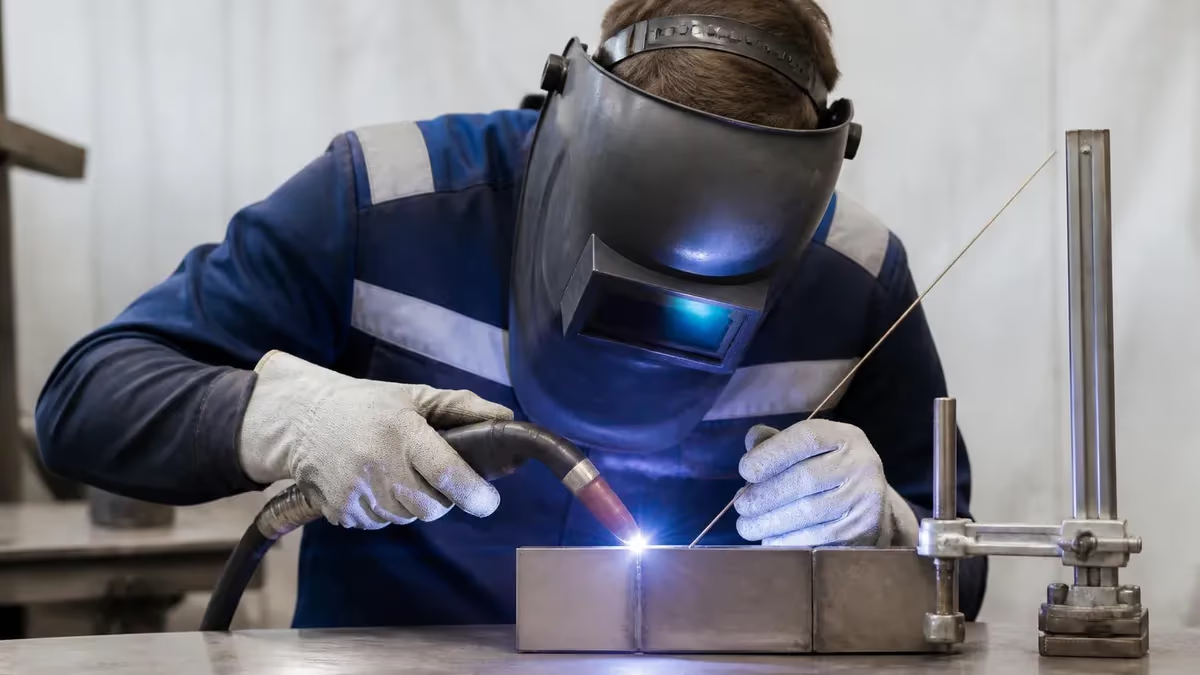
The american welding society certification portfolio is the industry standard for recognizing welding competence in the United States and in over 70 countries worldwide. From the foundational CWI (Certified Welding Inspector) credential to the senior-level SCWI and specialized educator designations, AWS certifications are used by fabricators, construction firms, pipeline companies, shipyards, and aerospace manufacturers to verify that their inspection and supervision personnel understand welding science, code compliance, and quality documentation. Preparing for any AWS exam requires working through a significant volume of practice questions because the exams test applied knowledge — you must interpret real welding symbols, apply code acceptance criteria, and select the correct nondestructive examination method for a given scenario, all under timed conditions.
This page provides a free printable AWS welding certification practice test PDF drawn from the subject areas covered by the CWI exam, which is the most widely pursued AWS credential. Download the PDF, print it, and work through the questions with the relevant code books and reference materials you plan to bring to your exam. Use the answer key to identify the sections of the body of knowledge that need more study before your scheduled test date.
- Part A (Fundamentals) of the AWS Certified Welding Inspector exam has 150 questions on destructive testing, fabrication math, safety, metallurgy, nondestructive testing, welding symbols, WPS/PQR and welding fundamentals. (American Welding Society)
- The AWS CWI Part B practical exam consists of hands-on activities using equipment provided by AWS and 46 questions related to those activities. (American Welding Society)
- Each computer-based part of the AWS CWI exam (Part A and Part C) allows two hours of exam time, with a total seat time of two and a half hours. (American Welding Society)
- AWS CWI candidates must score at least 72% on each of the three exam parts (A, B and C) to earn the credential. (American Welding Society)
- The initial AWS Certified Welding Inspector (CWI) exams cost $1,255 for AWS members and $1,520 for non-members, and the non-member price includes a 3-year AWS Individual Membership. (American Welding Society)
- Retesting one AWS CWI exam part (Part A or Part C) costs $445, retesting both Parts A and C costs $870, and retesting Part B costs $385. (American Welding Society)
- Under AWS QC1, CWI applicants may take up to two reexaminations within one year (12 months) of their original test date. (American Welding Society)
- The AWS Certified Welding Inspector certification is valid for nine years and requires a renewal application at years three and six after initial activation. (American Welding Society)
- Parts A and C of the AWS CWI exam are computer-based at more than 450 Prometric exam centers worldwide, while the Part B practical is given at AWS seminar locations. (American Welding Society)
Facts verified Oct 15, 2026 against American Welding Society. Dates that have passed are removed automatically.
AWS Exam at a Glance
| Item | Detail | Official source |
|---|---|---|
| Number of questions (CWI Part A (Fundamentals)) | 150 questions | American Welding Society |
| Number of questions (CWI Part B (Practical)) | Hands-on activities plus 46 questions | American Welding Society |
| Number of questions (CWI Part C (Code Book)) | 50 to 65 open-book questions | American Welding Society |
| Time limit (CWI Parts A and C) | 2 hours per part (2.5 hours seat time) | American Welding Society |
| Passing score (Certified Welding Inspector (CWI)) | 72% on each part | American Welding Society |
| Exam fee (Certified Welding Inspector (CWI)) | $1,255 (AWS member) / $1,520 (non-member) | American Welding Society |
| Retake fee (Certified Welding Inspector (CWI)) | $445 per part (A or C); $870 for Parts A and C; $385 for Part B; $915 member / $1,180 non-member for all parts | American Welding Society |
| Retake policy (Certified Welding Inspector (CWI)) | Up to 2 reexaminations within 12 months of the original test date | American Welding Society |
| Validity (Certified Welding Inspector (CWI)) | 9 years, with renewals at years 3 and 6 | American Welding Society |
| Delivery (Certified Welding Inspector (CWI)) | Parts A & C at 450+ Prometric centers; Part B at AWS seminar locations | American Welding Society |
| Eligibility (Certified Welding Inspector (CWI)) | Vision test + education/work experience (e.g., HS diploma + 5 years welding-based work) | American Welding Society |
| Score release (Certified Welding Inspector (CWI)) | About 2 weeks after Parts A and C | American Welding Society |
| Registration deadline (CWI Part B (Practical)) | About 6 weeks before the Part B exam date (US); Parts A & C are flexible | American Welding Society |
Facts verified Oct 15, 2026 against American Welding Society. Dates that have passed are removed automatically.
Key Takeaway: AWS certification demonstrates expertise in this field. Most candidates spend 4-8 weeks preparing with practice tests before taking the exam.
What the AWS CWI Exam Tests
Welding Processes: SMAW, GMAW, GTAW, SAW, and FCAW
The fundamentals portion of the CWI exam (Part A) tests knowledge of the five major arc welding processes along with their advantages, limitations, and quality characteristics. Shielded metal arc welding (SMAW), commonly called "stick welding," uses a consumable flux-coated electrode and requires no external shielding gas — making it highly portable and suitable for field construction and repair work. Its limitations include relatively slow deposition rates, slag inclusions if not properly cleaned between passes, and limited applicability for materials below approximately 1/8 inch thickness due to burn-through risk. The exam often presents a scenario describing a field welding condition and asks which process is most appropriate based on portability, weather conditions, or material thickness.
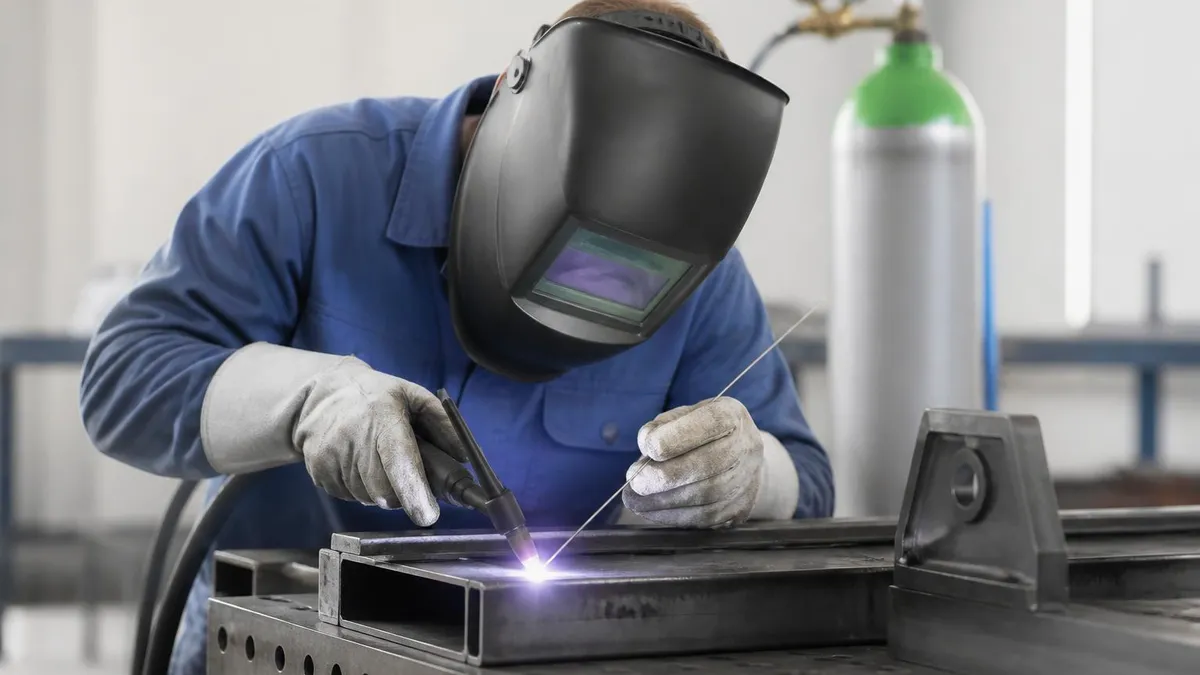
Gas metal arc welding (GMAW), known as MIG welding, uses a continuously fed solid wire electrode and a shielding gas — typically argon, carbon dioxide, or a blend — to protect the molten weld pool from atmospheric contamination. GMAW is faster than SMAW and produces less slag, but it is more sensitive to wind and drafts, which can displace the shielding gas and cause porosity. Gas tungsten arc welding (GTAW), or TIG welding, uses a non-consumable tungsten electrode and separate filler metal, providing excellent control and the cleanest weld quality of any arc process. GTAW is the preferred process for root passes on pipe, for thin materials, and for stainless steel and aluminum where surface appearance is critical. Its limitation is low deposition rate and the skill required to coordinate torch, filler rod, and foot pedal simultaneously.
Submerged arc welding (SAW) buries the arc under a layer of granular flux, which shields the weld completely and allows very high current levels and deposition rates — it is used almost exclusively for flat or horizontal groove and fillet welds on heavy structural members, pressure vessels, and ship hulls. Flux-cored arc welding (FCAW) uses a hollow wire electrode with flux inside the core and may or may not use an external shielding gas depending on the variant (FCAW-S is self-shielded, FCAW-G uses gas). FCAW combines the speed and continuous wire feed of GMAW with better out-of-position performance and tolerance for mill scale and contamination. CWI exam questions frequently compare deposition rates, shielding mechanisms, and applicable positions across these five processes and ask the candidate to identify discontinuities that are characteristic of each.
Metallurgy: Carbon Steel, Stainless Steel, Aluminum, and Heat-Affected Zone
A welding inspector must understand how heat affects the base material, because many weld defects originate not in the weld metal itself but in the heat-affected zone (HAZ) — the narrow band of base material adjacent to the fusion line that is heated above the transformation temperature but not melted. In carbon steel, rapid cooling of the HAZ can produce martensite, a hard and brittle microstructure that is susceptible to hydrogen-assisted cracking (also called cold cracking or delayed cracking). Preheat and interpass temperature controls are specified in welding procedure specifications (WPS) to slow the cooling rate and allow hydrogen to diffuse out before the steel fully cools. The exam tests minimum preheat requirements for various carbon equivalent values and asks candidates to identify the consequences of skipping preheat on high-carbon or alloy steels.
Stainless steel presents the risk of sensitization — precipitation of chromium carbides at grain boundaries when the material is held in the 425–870°C temperature range. Sensitized stainless steel is susceptible to intergranular corrosion in service, particularly in chemical process and food industry applications. The solution is to use low-carbon grades (304L, 316L) or stabilized grades (321, 347) that resist carbide precipitation. Aluminum welding introduces different challenges: aluminum forms a refractory oxide layer (Al2O3) that must be removed by the welding arc's cleaning action (using AC current for GTAW) or mechanical cleaning before welding. Aluminum also has high thermal conductivity and coefficient of thermal expansion, which increases distortion risk, and is susceptible to hot cracking in alloys with high alloying element content. The exam presents metallurgical scenarios and asks the candidate to identify the correct pretreatment, heat input control, or post-weld heat treatment response.
Discontinuity Classification and AWS D1.1 Acceptance Criteria
Understanding the difference between a discontinuity and a defect is fundamental to inspection work. A discontinuity is any interruption in the physical structure of a weld — porosity, a crack, incomplete fusion, undercut, overlap, or an inclusion. A defect is a discontinuity that exceeds the acceptance criteria of the applicable code for the joint classification and loading type. The CWI exam Part B tests acceptance criteria directly from the candidate's chosen code book, requiring them to look up specific tables and apply numerical limits to a described discontinuity. For AWS D1.1 Structural Welding Code — Steel, the acceptance criteria vary by weld category (statically loaded vs. cyclically loaded structures) and by the type of discontinuity.
Porosity — gas pockets trapped in solidified weld metal — is assessed by frequency, individual size, and total accumulation within a defined length of weld. Cracks of any type (longitudinal, transverse, crater, toe cracks) are rejectable under virtually all structural codes because cracks propagate under cyclic loading. Incomplete fusion — failure of the weld metal to fuse with the base metal or the preceding weld pass — and incomplete joint penetration (IJP) in groove welds designed as complete joint penetration (CJP) joints are also rejectable as-found because they reduce the effective throat and create stress concentration points. Undercut — a groove melted into the base metal at the weld toe — is permitted in limited depths for statically loaded members but has tighter limits for cyclically loaded connections. The exam requires the inspector to locate the correct table, read the applicable limit, and make a pass/fail decision on a described weld condition.
Nondestructive Examination Methods and Their Applications
The CWI exam tests five primary NDE methods: visual testing (VT), radiographic testing (RT), ultrasonic testing (UT), magnetic particle testing (MT), and liquid penetrant testing (PT). Visual testing is the most fundamental and is performed on all welds — it can detect surface cracks, undercut, overlap, incorrect profile, and surface porosity, but it cannot detect subsurface discontinuities. Radiographic testing uses X-rays or gamma rays to create a film or digital image that reveals internal voids, porosity clusters, inclusions, and incomplete fusion, but it is relatively insensitive to tight planar discontinuities such as cracks parallel to the radiation beam. Ultrasonic testing uses high-frequency sound waves that reflect from internal discontinuities, providing information about discontinuity depth, height, and through-thickness extent — UT is more sensitive than RT for tight cracks and is widely used for thick-section welds on pressure vessels and pipelines.
Magnetic particle testing uses a magnetic field and iron particles to detect surface and near-surface discontinuities in ferromagnetic materials — it cannot be applied to austenitic stainless steel or aluminum. Liquid penetrant testing uses a dye that seeps into open surface discontinuities by capillary action; after developer is applied, the trapped dye bleeds back to the surface and is visible under white light (visible dye PT) or UV light (fluorescent PT). PT can be applied to any material regardless of magnetic properties, including stainless steel, aluminum, and titanium. The exam tests the capabilities and limitations of each method, asks which method is appropriate for a described inspection scenario, and covers procedural requirements such as surface preparation, magnetization direction, dwell time, and final acceptance under the relevant code section.
- ✓Obtain the current AWS CWI Candidate Handbook and review eligibility requirements before registering
- ✓Select your Part B code book (AWS D1.1 for structural, D1.2 for aluminum, API 1104 for pipeline) and tab it thoroughly
- ✓Study all five welding processes: SMAW, GMAW, GTAW, SAW, FCAW — advantages, limitations, typical discontinuities
- ✓Memorize the HAZ and heat input concepts for carbon steel, stainless steel, and aluminum
- ✓Practice the discontinuity vs. defect distinction and locate acceptance criteria tables in your code book
- ✓Learn all five NDE methods: VT, RT, UT, MT, PT — capabilities, limitations, material applicability
- ✓Study weld symbol interpretation: arrow side vs. other side, groove weld dimensions, fillet weld size and leg
- ✓Review inspection documentation requirements: WPS, PQR, WPQ (welder performance qualification)
- ✓Practice timed questions under open-book conditions — Part B is code-lookup speed under time pressure
- ✓Complete the AWS CWI practical (Part C) preparation by reviewing visual examination tools: fillet weld gauges, undercut gauges, Hi-Lo gauges, and weld profile templates
Consistent practice with code book navigation is the single most important preparation activity for the CWI Part B exam. Candidates who can locate a specific acceptance criteria table in AWS D1.1 within 60 seconds have a significant advantage over those who are still indexing at the two-minute mark — over 40 questions, that time adds up. The PDF on this page helps you practice the types of questions asked, and you can find additional timed quizzes in the full american welding society certification practice test library on this site. Use both resources together: work through the PDF with your code book beside you to simulate exam conditions, then take the online quizzes to track your performance by subject area and identify which sections of the body of knowledge need the most attention before your scheduled exam date.
Sample AWS - American Welding Society Certification Practice Questions
Try these questions from our free AWS - American Welding Society Certification practice tests. The correct answer and an explanation follow each question.
What information is found in the tail of a welding symbol in welding symbols & blueprint reading?
- A. Groove depth
- B. Weld size
- C. Welding process notes
- D. Base metal type
Answer: C. Welding process notes
The tail of a welding symbol is an optional but important component used to convey supplementary information that cannot be expressed directly by other symbols. This often includes specific welding processes, filler metal specifications, post-weld treatments, or other instructions relevant to the welding operation. It acts as a designated space for additional notes or references.
Which welding process uses a non-consumable tungsten electrode and is best suited for precision welding of thin materials?
- A. SMAW
- B. GMAW
- C. GTAW
- D. FCAW
Answer: C. GTAW
GTAW (TIG welding) uses a non-consumable tungsten electrode and provides precise heat control, making it ideal for thin materials and critical applications.
Which welding process is best for welding aluminum?
- A. Stick Welding
- B. TIG Welding
- C. Flux Core Welding
- D. Submerged Arc Welding
Answer: B. TIG Welding
TIG welding is generally considered the best process for welding aluminum due to its ability to produce very clean and high-quality welds. The use of AC current in TIG welding helps to break up the tenacious aluminum oxide layer, which is crucial for achieving good penetration and a strong, defect-free weld. This precision is vital for aluminum's properties.
A welder notices that a long steel beam is bowing upward after welding along its bottom flange. Which corrective measure is most appropriate BEFORE welding?
- A. Pre-camber the beam opposite to the expected distortion direction
- B. Increase interpass temperature to soften the steel
- C. Use a higher heat input to fully penetrate the joint
- D. Apply post-weld quenching with water
Answer: A. Pre-camber the beam opposite to the expected distortion direction
Pre-cambering positions the workpiece opposite to anticipated distortion so that after welding, the part returns to the desired geometry.
Take the full AWS - American Welding Society Certification practice test