
AP Anatomy and Physiology: Complete Study Guide for Students 2026 October
AP anatomy and physiology study guide covering body systems, key topics, exam prep tips, and practice resources for high school and college students. 🎓
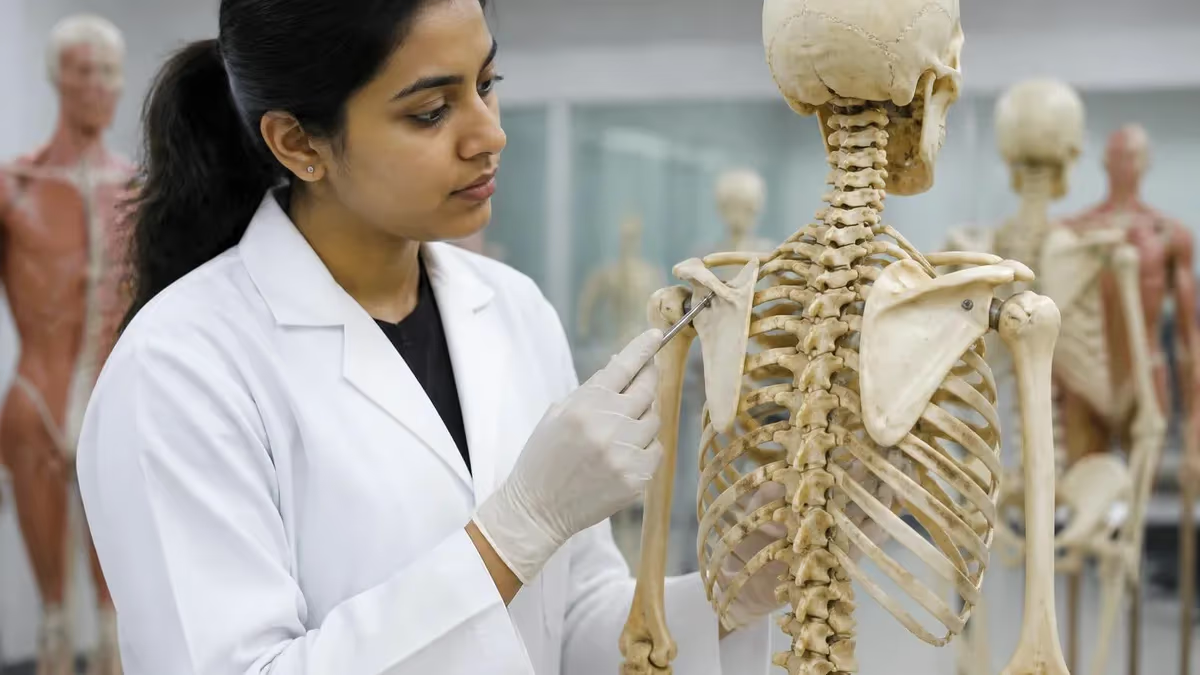
AP anatomy and physiology sits at a strange crossroads in the science curriculum. It is not a College Board AP course in the official sense, yet thousands of high schools label their advanced human biology offering exactly that way, and colleges run rigorous A&P sequences that read just like AP work in pace, depth, and lab expectations.
Whether you are taking a high school advanced placement style course or a college level human anatomy and physiology class, the demands feel similar. You will memorize, you will reason through systems, and you will be tested on tiny details that connect to enormous concepts.
The subject covers the human body from the smallest cell organelles to the coordinated dance of eleven organ systems. Students typically need to know skeletal structures by name, muscle origins and insertions, cardiovascular blood flow patterns, neuron signal transmission, endocrine feedback loops, digestive enzyme actions, and renal filtration mechanics. That volume of detail trips up even strong students. The trick is layering, where you build vocabulary first, then anatomy, then physiology, then clinical connections. Each layer reinforces the previous one.
This guide walks through what AP anatomy and physiology actually covers, how the workload compares to other AP sciences, which study strategies pay off most, and where to find practice questions that mirror real exams. It also addresses the common stumbling blocks students hit, especially around histology slides, cadaver labs, and the volume of memorization that hits students who took breezier biology in earlier grades.
One useful frame for new students: think of the course as three layers stacked on top of each other. The first layer is pure vocabulary, words like cytoplasm, osteoclast, nephron, and myocardium. The second layer is structural relationships, knowing which structures sit next to which and how they connect anatomically. The third layer is physiology, the moving picture of how those structures actually function in real time.
Most students try to tackle all three at once and drown. The fix is to learn them in order. Get the words down first, even if you do not yet know what they do. Then place them anatomically. Then study function. Each layer builds on the previous, and skipping layers wastes hours that could have been productive.
Worth noting that this subject is one of the most enjoyable courses in any biology curriculum once you commit to it. The material is genuinely fascinating because it is about you. Every concept connects to something you can feel, observe, or test on yourself. Take a pulse, that is cardiovascular physiology. Stretch your fingers, that is musculoskeletal anatomy. Smell coffee in the morning, that is olfactory nerve function. The constant feedback between coursework and personal experience makes learning stick in ways that abstract chemistry or distant ecology cannot match.
Learn more in our guide on Anatomy and Physiology Textbook: Top Picks and Buying Guide. Learn more in our guide on Anatomy and Physiology Overview: Body Systems, Core Concepts, and Professional Practice. Learn more in our guide on What Is Anatomy and Physiology? A Complete Guide for Students. Learn more in our guide on Anatomy and Physiology Online Course: Complete Guide to Learning.
AP Anatomy and Physiology at a Glance
Course length matters because content density is enormous. A standard college A&P I and II sequence packs nearly 30 chapters of textbook material into two semesters, with weekly labs that demand their own preparation. High school courses calling themselves AP anatomy spread similar content across one academic year but often include cadaver pre-lab work, virtual dissections, or partnership programs with local hospitals. Expect three to five hours of out-of-class study for every classroom hour during exam weeks, more if labs include practical identification tests.
One quirk that surprises students: there is no official College Board AP exam for anatomy and physiology. The course title "AP" in this subject usually means advanced placement style coursework graded by the school, with possible dual-enrollment college credit if your district has an articulation agreement. Some students take the CLEP biology exam to claim general college credit, others enroll directly in a community college section while in high school. Check with your registrar before assuming credit transfers.
Beyond textbook learning, plan to use 3D anatomy apps that let you rotate models, peel away layers, and isolate single structures. Visible Body, Complete Anatomy, and Primal Pictures are widely used by college programs. Free alternatives like BioDigital Human cover the basics adequately for most high school work. Spending fifteen minutes a day with one of these apps reinforces classroom learning better than rereading notes for the same time. Visual rotation builds the mental model practicals demand.

Honest answer: yes, but not in the way AP Chemistry is hard. The challenge is volume rather than abstraction. You do not need calculus or deep mathematical reasoning. You need a working memory that can hold hundreds of structural names, the connections between them, and the physiological mechanisms each performs. Students who excel are typically organized note-takers who review nightly rather than cramming weekly. Those who struggle usually wait until exam week and try to absorb a chapter of histology in one sitting, which never works.
Pacing is the silent killer in this course. The first unit usually covers chemistry of life, cells, and tissues, and feels approachable because students remember bits from earlier biology. By unit three or four, when bone tissue, articulations, and skeletal anatomy arrive, the workload doubles. Then comes muscular anatomy, which doubles it again. Students who treated weeks one through four casually fall behind permanently. The fix is simple to describe and hard to execute: build flashcards from day one, not after the first poor quiz score.
Labs deserve their own warning. A practical exam asks you to walk up to a station, look at a tagged bone, model, or microscope slide, and write down the exact structure name in twenty seconds before moving to the next station. Common station counts range from 50 to 100. Spelling matters in most courses. There is no multiple choice safety net. Students who can ace written tests sometimes flunk practicals because they recognize structures only in textbook orientation, not the rotated, dyed, or partial view in front of them.
Time management cuts both ways. Students who treat this course as their hardest class often improve in their other AP courses because the daily discipline transfers. Conversely, students who let A&P slide tend to slide in their other subjects too because guilt and panic distract from everything. Build the habit early and the rest of your schedule benefits.
If you are between courses and trying to decide, consider what comes after high school. Health career bound students should take A&P even if it is harder than the alternative. Students aiming at engineering, business, or humanities can probably skip it without harm, especially if a higher GPA in a different AP would help applications more. There is no shame in choosing strategically.
Eleven Organ Systems You Will Master
Skin, hair, nails, glands. The body's largest organ and first defense layer.
Bones, cartilage, joints. Support, movement use, and mineral storage.
Skeletal, cardiac, smooth. Movement, posture, and heat generation.
Brain, spinal cord, nerves. Rapid signaling and information processing.
Hormone-producing glands. Slow chemical signaling for growth and metabolism.
Heart, blood vessels, blood. Transport of gases, nutrients, and wastes.
Lymph nodes, vessels, white cells. Fluid balance and defense.
Lungs, airways. Gas exchange between blood and outside air.
Mouth to anus tube plus accessory organs. Nutrient breakdown and absorption.
Kidneys, ureters, bladder. Filters blood, balances fluids and electrolytes.
Gonads and ducts. Produces gametes and supports fertilization.
Teachers vary in how they sequence these systems. Most start with chemistry and cells, then build up through tissues to integumentary as the gateway organ system. Skeletal and muscular usually come next because they pair so well with each other. Then nervous and endocrine make sense together since both involve signaling. The remaining systems can be taught in any order, though cardiovascular often comes before respiratory because gas exchange depends on understanding blood flow first. A few teachers reverse the second semester entirely, opening with reproductive to grab attention.
Whatever the order, you should be able to sketch each system from memory by the end of the unit. Not a textbook-quality illustration, just a clear functional diagram with major structures labeled. If you cannot draw the heart's four chambers with valve names and direction of blood flow without help, you do not yet know cardiovascular anatomy. The drawing test exposes shallow learning faster than any flashcard deck.
Pay attention to integumentary as the first organ system because it teaches you the textbook's pattern. Each system chapter follows the same template: gross anatomy, microscopic anatomy, physiology, common pathologies, and clinical applications. Once you learn that template for skin, you can apply it to every other system that follows. Students who waste energy figuring out chapter structure for each new system fall behind. Recognize the pattern and the workload drops noticeably.
Year-Long Study Plan by Semester
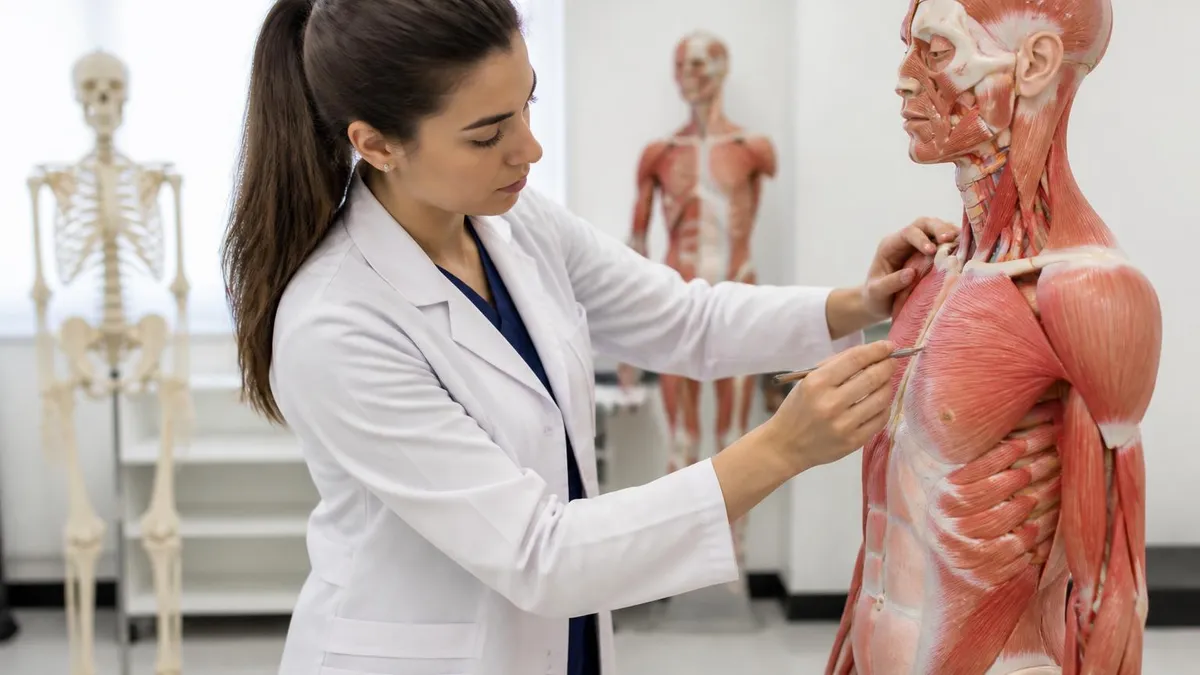
Weeks 1-4 cover chemistry of life, cell structure, cellular respiration, and tissue types. Build a glossary notebook with every term as you meet it. Weeks 5-8 hit integumentary then move into skeletal, where you learn all 206 bones with surface features. Use a model skeleton if your school has one, even if labs feel basic. Weeks 9-12 cover joints and muscular system, the heaviest memorization block of the course. Make muscle origin-insertion-action tables. Weeks 13-16 introduce nervous system anatomy of brain, spinal cord, and peripheral nerves. Expect a cumulative semester exam covering everything from cells onward.
Study tools that pay off range from old-school to high-tech. Flashcards remain the gold standard for raw vocabulary, with apps like Anki letting you space repetition automatically so you spend more time on weak terms. Coloring books, surprisingly, work well for skeletal and muscular anatomy because the act of coloring forces you to look at each structure individually. Online dissection tools like virtual cadaver software supplement school lab time without the formaldehyde smell. None of these tools replace classroom learning. They reinforce it.
Study groups can be powerful or pointless depending on group dynamics. A focused group of three that quizzes one another in twenty-minute intervals beats a six-person group that drifts into off-topic talk. The teach-back method works best, where each person explains a topic to the others, gets corrected, and moves on. If your group cannot keep that structure, study alone and use group time for practical drills only.
Note-taking method matters more than you might guess. Cornell notes work well for lecture material because the cue column on the left invites active recall during review. Concept maps work well for physiology because they show relationships. Outline notes work well for pure anatomy because the hierarchy mirrors body organization. Most students benefit from using two or three methods depending on content type rather than forcing one method to handle everything.
Office hours are wildly underused. Most professors have hours posted but get few visitors. Showing up with one specific question, like why does action potential propagation slow at the nodes of Ranvier, gets you targeted help and shows the instructor you care. That relationship pays off later when you need a recommendation letter or a tiebreaker grade boost.
The biggest grade-killer is treating anatomy and physiology as one subject. Anatomy is structure, physiology is function, and they are tested differently. Students who can name every bone but cannot explain how bone tissue remodels during stress will fail half of any physiology question. Second mistake: ignoring lab. Practicals carry weight in most courses, and they cannot be crammed from a textbook. Third mistake: using AI chatbots to summarize without verifying. Several common chatbot answers conflate structures or invent muscle origins that do not exist. Always confirm against your textbook or instructor.
Memorization techniques have evolved since the days of pure rote recitation. Memory palace methods, where you mentally place each structure inside a familiar room of your house, work well for ordered lists like the cranial nerves or carpal bones. Mnemonics for cranial nerves are practically a tradition: "On Old Olympus' Towering Tops A Finn And German Viewed Some Hops" gives olfactory, optic, oculomotor, trochlear, trigeminal, abducens, facial, auditory, glossopharyngeal, vagus, spinal accessory, hypoglossal in order. Build your own mnemonics for muscle groups, vessel branches, and enzyme cascades.
Active recall trumps passive rereading every time. Close your book, write down everything you remember about a topic, then check what you missed. Repeat until your written recall matches the textbook. Spaced repetition matters more than total study hours. Twenty minutes daily for a week beats two hours on Saturday alone. This is well documented in cognitive science research and equally well ignored by students who cram. Do not be one of those students.
Sleep is part of studying. Memory consolidation happens during deep sleep, and pulling all-nighters before exams measurably hurts performance compared to a normal seven to nine hour night. This is true even when you feel awake on caffeine. Your retrieval speed drops, your error rate climbs, and you cannot recover those lost hours during the exam. Plan to be done studying by eleven the night before any test.

Weekly Study Checklist for Top Grades
- ✓Review lecture notes within 24 hours and rewrite confusing sections
- ✓Build 20-30 new flashcards per week for new vocabulary
- ✓Complete textbook end-of-chapter questions before class quizzes
- ✓Sketch one organ system or anatomical structure from memory
- ✓Spend 30 minutes minimum on lab manual preparation before each lab
- ✓Use practice questions covering both anatomy and physiology each week
- ✓Form or attend a focused study group session of 60-90 minutes
- ✓Identify weak topics on Sunday and front-load Monday review
Practice questions matter more than most students realize. Reading the textbook builds recognition memory but not recall memory. Answering practice questions forces your brain to retrieve information, which is exactly what tests require. Aim for at least one full practice set per week during regular study and two to three per week leading into exams. Time yourself on later attempts to simulate exam pressure. If you consistently miss histology questions, that is your weak area and you need targeted slide review, not more general reading.
Question style varies. Multiple choice questions often test single facts, fill-in-the-blank tests precise vocabulary, short answer rewards full explanations, and labeling questions test visual memory. Modern A&P exams blend all four. The lab practical adds a fifth style: rapid recognition with handwritten answers. Practice each style separately so no question format surprises you on exam day.
One more nuance about exam structure. Many A&P programs run mini practicals scattered across the term rather than one giant practical at the end. This is genuinely good news because it forces consistent lab study. Treat each mini practical as a hard deadline rather than a soft suggestion. Students who ace the first one tend to ace the rest because they have built the recognition habit. Students who flunk the first one rarely catch up because they are now learning two practicals worth of material for the second exam.
Group dynamics in lab matter. If your bench partner is disengaged, you will end up doing the practical work alone and missing parts. If your partner is over-eager and takes over, you will not develop the manual identification skills practicals demand. Ideal partners share the work in clear turns, quiz each other between stations, and check each other's answer keys before lab ends. If your assigned partner is a poor fit, ask the instructor to switch quietly rather than tolerating a bad pairing all term.
Taking AP Anatomy and Physiology in High School
- +Earns potential college credit through dual enrollment or CLEP
- +Strong preparation for nursing, premed, and allied health programs
- +Builds lasting medical vocabulary that helps in any health field
- +Lab experience that few high schoolers get elsewhere
- +Signals serious science interest on college applications
- −Time commitment can crowd out other AP courses
- −Memorization volume exceeds most other high school science classes
- −No official AP exam means credit transfer varies by college
- −Some colleges require their own anatomy course regardless
- −Cadaver or animal lab work is not for everyone
Pros and Cons at a Glance
| Pros | Cons |
|---|---|
| Earns potential college credit through dual enrollment or CLEP | Time commitment can crowd out other AP courses |
| Strong preparation for nursing, premed, and allied health programs | Memorization volume exceeds most other high school science classes |
| Builds lasting medical vocabulary that helps in any health field | No official AP exam means credit transfer varies by college |
| Lab experience that few high schoolers get elsewhere | Some colleges require their own anatomy course regardless |
| Signals serious science interest on college applications | Cadaver or animal lab work is not for everyone |
For students aiming at nursing, physical therapy, athletic training, or premed pathways, this course is genuinely useful preparation. The vocabulary you learn here returns in every health professions program. The body systems thinking you develop becomes second nature. The lab skills, especially careful observation and quick identification, transfer directly to clinical settings. Students who take the course seriously gain a real head start over peers who arrive at college without anatomy background.
For students not interested in health careers, the value depends on personal curiosity. The course teaches you remarkable things about your own body. It builds disciplined study habits that transfer to any rigorous subject. It demonstrates resilience under heavy workload. These are not small benefits. They simply may not justify the time investment if you would rather take a different AP that aligns better with your major.
Diagram quality on your notes matters for review later. Spend the extra two minutes drawing a labeled sketch when you encounter a complex structure, even if a printed handout exists. The act of drawing forces your eye to trace each line and your hand to commit to placement. Your re-read three weeks later will be far more productive when you encounter your own messy diagram with labels in your handwriting than a perfect textbook image you have already glanced past dozens of times.
Sample Anatomy Exam Practice Questions
Try these questions from our free Anatomy Exam practice tests. The correct answer and an explanation follow each question.
Which nerve provides sensory innervation to the lateral surface of the thigh?
- A. Femoral nerve
- B. Lateral femoral cutaneous nerve
- C. Obturator nerve
- D. Sciatic nerve
Answer: B. Lateral femoral cutaneous nerve
The lateral femoral cutaneous nerve (L2-L3) provides sensory innervation to the anterolateral thigh; its compression causes meralgia paresthetica.
Which artery directly supplies blood to the kidney?
- A. Superior mesenteric artery
- B. Renal artery
- C. Gonadal artery
- D. Lumbar artery
Answer: B. Renal artery
The renal artery, a direct lateral branch of the abdominal aorta, is the primary blood supply to the kidney.
Which layer of the calvaria is the primary site of diploic veins?
- A. Outer table
- B. Inner table
- C. Diploë
- D. Periosteum
Answer: C. Diploë
Diploic veins run within the diploë, the spongy cancellous bone sandwiched between the outer and inner tables of the calvaria.
The term 'ipsilateral' refers to structures located on:
- A. Opposite sides of the body
- B. The same side of the body
- C. The anterior surface
- D. The inferior portion
Answer: B. The same side of the body
Ipsilateral refers to structures on the same side of the body, for example, the right arm and right leg are ipsilateral to each other.
Anatomy and Physiology Questions and Answers
Closing thought. Anatomy and physiology rewards consistent effort more than raw intelligence. The smartest student who skips flashcards loses to the average student who builds them daily. Pace yourself across the year, treat lab as seriously as lecture, and use practice questions to test recall rather than recognition.
By the end of the course you will know your own body better than most adults ever do, and you will carry that knowledge into whatever career or curiosity follows. That payoff is worth the work. Use the resources on this site to fill gaps, drill weak areas, and walk into every exam with the confident knowing that comes from real preparation.
Color coding becomes essential as the course progresses. Arteries red, veins blue is the obvious one, but the same logic applies to muscle groups, nerve branches, and digestive layers. Pick a small palette of four or five colors and stick to it across all notes. Consistency lets your brain treat color as data rather than decoration. By the time you are studying cranial nerve distributions, you will look at your notes and know instantly which structure is which without rereading labels.
About the Author

Educational Psychologist & Academic Test Preparation Expert
Columbia University Teachers CollegeDr. Lisa Patel holds a Doctorate in Education from Columbia University Teachers College and has spent 17 years researching standardized test design and academic assessment. She has developed preparation programs for SAT, ACT, GRE, LSAT, UCAT, and numerous professional licensing exams, helping students of all backgrounds achieve their target scores.