
Aviation Maintenance Technician Jobs: AMT Career Guide 2026 September
Free Aviation Maintenance Technician Jobs: 🟢 practice test with questions and answer explanations. Prepare for the 2026 September exam with instant scoring.
Aviation Maintenance Technician Jobs Overview
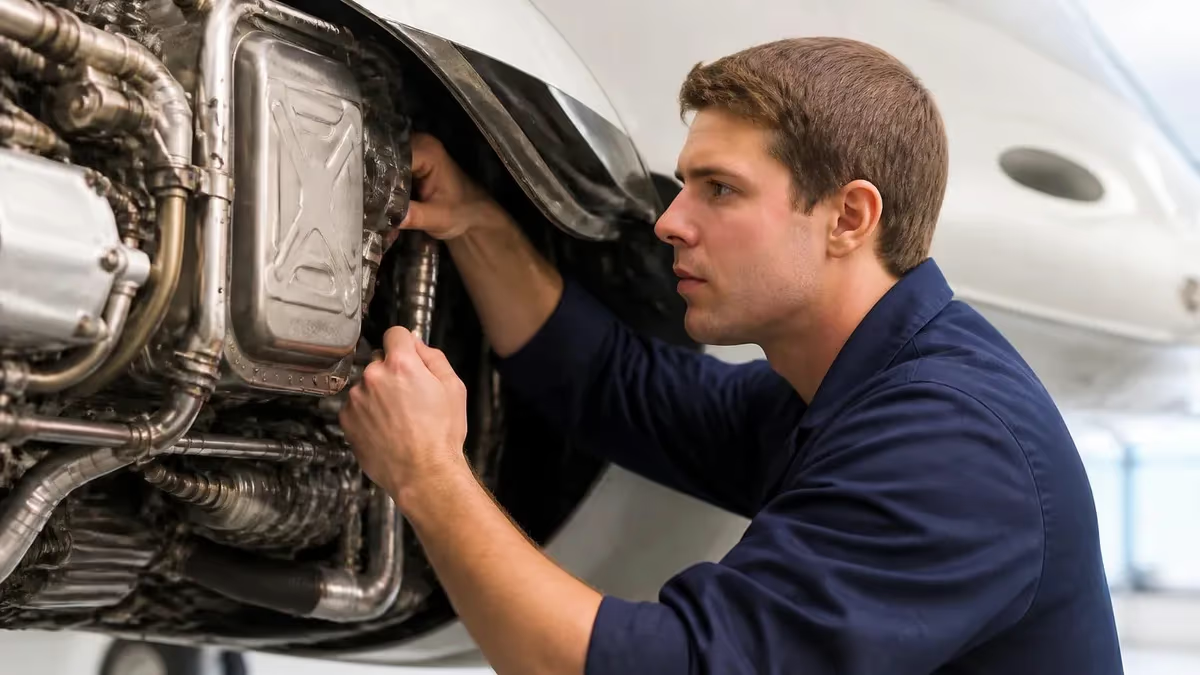
Aviation maintenance technicians (AMTs) are the skilled professionals who inspect, maintain, repair, and overhaul aircraft to keep them airworthy and safe. AMT jobs exist across a wide range of aviation sectors — commercial airlines, regional carriers, cargo operators, military, corporate aviation, general aviation, and Maintenance, Repair, and Overhaul (MRO) facilities that service aircraft for multiple operators. The core responsibility of every AMT role is the same: ensuring that aircraft systems, structures, and powerplants meet FAA airworthiness standards and that every maintenance task performed is documented accurately in the aircraft's maintenance records.
Most AMT positions in the United States require the FAA Airframe and Powerplant (A&P) certificate. The A&P certificate is issued by the Federal Aviation Administration and authorizes the holder to perform a wide range of maintenance, repair, and inspection tasks on aircraft.
Candidates earn the A&P certificate by completing an FAA-approved aviation maintenance technician school program (typically 18 to 24 months), passing written exams, oral exams, and practical skills tests administered by FAA-designated examiners. Some candidates earn their A&P through the military experience pathway or through on-the-job experience at an FAA-certificated repair station — each pathway requires demonstrating proficiency across both the Airframe and Powerplant disciplines.
The aviation industry has faced a well-documented technician shortage that has intensified in recent years. Major airlines, regional carriers, and MRO facilities compete actively for qualified A&P mechanics, which has driven meaningful wage growth and signing bonuses across the industry. Boeing's workforce outlook projections and industry workforce studies have repeatedly highlighted the shortage as one of the most significant near-term constraints on aviation industry growth. This demand environment makes AMT jobs highly accessible to recently certified A&P mechanics — graduates of FAA-approved programs typically receive multiple job offers before completing their certification.
Major airline AMT jobs at carriers such as Delta, United, American, Southwest, UPS, and FedEx are among the most sought-after positions in aviation maintenance. These employers offer union-negotiated wages (often through the International Association of Machinists or the Transport Workers Union), comprehensive benefits packages, travel benefits, and structured career progression. Starting wages for airline AMTs at major carriers typically range from $28 to $45 per hour, with top-scale mechanics at senior classifications earning $50 to $75 per hour or more, depending on the airline and the applicable labor agreement. Annual earnings including overtime for experienced airline mechanics frequently exceed $100,000.
Beyond the major airlines, AMT jobs exist at regional carriers, fractional ownership operators, business aviation maintenance facilities, aircraft manufacturers, military contractors, and independent MRO shops. Each employment context offers different trade-offs: regional carrier jobs may pay less than major airlines but offer faster advancement and more varied work experience; MRO facilities often require working on many different aircraft types across multiple customers, building broad technical exposure; general aviation and corporate aviation jobs may involve closer relationships with aircraft owners and more autonomy but typically pay less than commercial aviation maintenance roles.
Aviation Maintenance Safety Culture and Documentation
Aviation maintenance operates within one of the most demanding safety and regulatory frameworks of any technical profession. Every decision an AMT makes — from which approved data to use for a repair to how a maintenance record is written — is governed by FAA regulations, manufacturer maintenance manuals, and airline or MRO operations specifications. Understanding why these requirements exist and internalizing aviation's safety culture is as essential to a successful AMT career as mastering the technical skills.
The physical demands of AMT work are real. Aviation maintenance technicians regularly work in confined spaces, at heights on aircraft and stands, outdoors in heat and cold, and with exposure to hydraulic fluids, lubricants, and other aviation chemicals. Proper use of personal protective equipment, situational awareness around moving aircraft, and adherence to safety protocols are non-negotiable aspects of the job.
Aviation maintenance has a strong safety culture — airlines, MRO facilities, and regulatory standards all emphasize that the safety of the traveling public depends directly on the quality and accuracy of every maintenance task. AMTs who embrace this responsibility and take professional pride in their work are the foundation of aviation safety.
The documentation requirement in aviation maintenance is as important as the technical work itself. Every maintenance task — no matter how minor — must be recorded in the aircraft maintenance logbook, work order system, or electronic maintenance tracking platform.
FAA regulations require that a certificated mechanic or supervisor sign off on completed maintenance tasks, certifying that the work was performed in accordance with approved data (the aircraft manufacturer's maintenance manual, FAA-approved repair specifications, or other approved documentation). Incomplete or inaccurate maintenance records can ground aircraft, trigger FAA enforcement actions, and in serious cases contribute to safety events. New AMTs who develop rigorous documentation habits early in their careers protect themselves and their employers from regulatory and safety risks.
International AMT career opportunities are also available for mechanics who want to work abroad or for international carriers. Many countries have bilateral aviation safety agreements with the United States that allow FAA-certificated mechanics to qualify for foreign airworthiness authority credentials (such as the European Union Aviation Safety Agency PART-66 license or Transport Canada aircraft maintenance engineer license) through validation processes rather than starting from scratch.
International carriers operating in the US, US carriers with international maintenance facilities, and global MRO companies all employ AMTs across multiple countries. Language skills and willingness to work internationally can open additional career pathways beyond the domestic US aviation maintenance market.

What AMTs Do: Daily Responsibilities and Specializations
The daily responsibilities of an aviation maintenance technician depend significantly on the work environment. Line maintenance technicians at airlines work on aircraft at gates and hardstands between flights — performing pre-departure checks, troubleshooting defects reported by pilots, replacing line-replaceable units (LRUs), and clearing minimum equipment list (MEL) items that allow the aircraft to dispatch with certain known issues deferred. Line maintenance work demands speed and accuracy under schedule pressure, as aircraft turnaround times are tight and delays cost airlines substantial revenue.
Heavy maintenance AMTs work on aircraft during planned maintenance events — C checks, D checks, and structural checks — where the aircraft is taken out of service for extended periods to accomplish major inspections and repairs. Heavy maintenance work involves opening access panels throughout the aircraft, inspecting structural components for corrosion and fatigue damage, replacing aging components, and performing systems overhauls. Heavy maintenance shops are typically organized in specialized work areas — sheet metal, powerplant, avionics, interiors — and AMTs in these environments often develop deep expertise in a specific discipline rather than maintaining broad generalist skills.
Powerplant technicians focus on aircraft engines, including piston engines for general aviation aircraft and turbine engines for commercial jets and turboprops. Engine maintenance at the airline level involves performing power plant changes when an engine requires shop work, completing borescope inspections to assess internal engine condition, and performing test cell runs after engine overhauls to verify performance parameters. Engine shop work is a specialized field where AMTs work at overhaul shops that disassemble, inspect, repair, and reassemble engines to approved manufacturer and FAA standards.
Avionics technicians are a specialized category within aviation maintenance focused on aircraft electronics — communication and navigation systems, flight management systems, autopilot systems, surveillance equipment, and increasingly, the complex integrated avionics suites found in modern commercial aircraft. While traditional A&P mechanics focus on airframe and powerplant systems, avionics technicians typically hold or pursue the FAA Repairman certificate or work at FAA-certificated avionics repair stations. The growing complexity of aircraft electronics has increased demand for avionics technicians across all aviation sectors, and qualified avionics professionals command premium wages relative to general A&P mechanics.
Inspection Authorization (IA) is an FAA authorization that allows eligible A&P mechanics to perform annual inspections and approve aircraft for return to service following major repairs or alterations. Earning an IA requires holding an A&P certificate with both Airframe and Powerplant ratings for at least three years, working actively in aviation maintenance, passing an IA knowledge test, and receiving authorization from an FAA Flight Standards District Office.
AMTs who hold the IA can operate independent maintenance businesses and take on work that requires annual inspection authority, making the IA a meaningful career advancement milestone for A&P mechanics in general aviation and smaller maintenance operations.
Composite structures have become increasingly common in modern commercial aircraft, driven by the use of carbon fiber reinforced polymer in airframes for aircraft like the Boeing 787 and Airbus A350. AMTs working on these aircraft need training in composite inspection and repair techniques that differ significantly from traditional metallic airframe maintenance.
Airlines and MRO facilities that work on composite-heavy aircraft invest in training their mechanics in approved composite repair methods, and AMTs who develop composite repair skills are sought after as the fleet transitions toward these advanced materials. Manufacturer-specific training programs and FAA-certificated composite repair courses provide the credentials that employers require for composite-qualified mechanics.
The FAA's Aviation Workforce Development Grant program and partnerships between airlines, unions, and community colleges have created new pipelines for aviation maintenance technician training. Programs like the 100,000 Mechanics Initiative championed by industry organizations represent multi-stakeholder efforts to accelerate A&P mechanic production by funding training programs, equipment, and scholarships for students entering aviation maintenance careers. AMT candidates who research these programs may find that scholarship funding, apprenticeship stipends, or employer-sponsored training pathways reduce the financial burden of attending an AMTS and entering the field with reduced student debt.
AMT Salary, Job Outlook, and Career Advancement
Aviation maintenance technician salaries vary by employer, location, experience level, and union status. Entry-level A&P mechanics at regional carriers and general aviation shops typically earn $45,000 to $65,000 annually, while mid-career mechanics at major airlines often earn $75,000 to $110,000. Top-scale mechanics at major carriers under strong labor agreements can earn $130,000 to $150,000 or more annually when overtime is included. The Bureau of Labor Statistics reports median annual wages for aircraft mechanics and service technicians consistently above $65,000 — and the wage trend has been upward as the technician shortage intensifies competition for qualified mechanics.
Geographic location significantly affects AMT compensation. Aviation maintenance hubs with dense concentrations of airline maintenance facilities — Atlanta, Dallas-Fort Worth, Miami, Seattle, Minneapolis, and Cincinnati — typically offer higher base wages and more overtime opportunities than smaller markets. Cost of living differences affect real purchasing power, but aviation maintenance careers generally support solid middle-class incomes across most US markets, particularly for mechanics who work at unionized carriers and access top-scale wages over a career spanning 10 to 20 years.
The job outlook for aviation maintenance technicians is positive through the mid-2030s according to both BLS projections and industry workforce studies. The root causes of the technician shortage — an aging workforce with large numbers of experienced mechanics reaching retirement age, constrained pipeline of newly certified A&P mechanics, and growing commercial aviation fleets globally — are expected to persist for at least a decade. This structural shortage means that newly certified AMTs entering the workforce face exceptionally favorable conditions compared to many other technical fields, where entry-level candidates must compete intensely for limited openings.
Career advancement paths for AMTs typically lead toward lead mechanic, crew chief, shift supervisor, quality assurance inspector, technical representative, or maintenance manager roles. Quality assurance inspectors work alongside line mechanics to verify that maintenance tasks are performed correctly and documented accurately — a role that requires deep technical knowledge plus communication skills to work effectively with mechanics, engineers, and regulatory inspectors. Technical representatives and field service engineers work for aircraft manufacturers or component vendors, supporting operators in diagnosing complex problems and implementing engineering solutions. These roles typically require significant operational experience plus strong analytical and communication abilities.
The AMT career also offers pathways into aviation management, engineering support, and training. Experienced mechanics who develop management skills can move into maintenance control, planning and reliability, or aviation maintenance management positions that involve scheduling maintenance events, managing budgets, overseeing vendor relationships, and ensuring regulatory compliance. Some AMTs transition into aviation maintenance instruction at FAA-approved schools, where their operational experience provides practical depth that complements the theoretical instruction in the curriculum. Technical writing, regulatory compliance, and safety management careers are also accessible to AMTs who combine operational experience with additional professional development.
Retirement and succession dynamics in aviation maintenance create ongoing advancement opportunities. As the cohort of mechanics hired during the airline expansion periods of the 1990s and 2000s reaches retirement age, promotional openings cascade through maintenance organizations as senior mechanics retire and everyone below moves up. New hires who enter aviation maintenance today are entering at the bottom of seniority systems but at organizations that are actively planning for this succession wave — meaning the career trajectory for today's entry-level AMTs includes real advancement opportunities within a reasonable timeframe, not decades of waiting for movement.
Peer networks and professional associations matter in aviation maintenance careers. The Aviation Maintenance Technicians Society (AMTS), Professional Aviation Maintenance Association (PAMA), and Aircraft Electronics Association (AEA) for avionics professionals offer networking events, technical seminars, and career resources. AMTs who participate in these communities stay current on regulatory changes, emerging maintenance techniques, and industry trends — and build relationships with peers at other organizations that can support career moves and technical problem-solving throughout a long and rewarding career in aviation maintenance.

AMT Career Launch Checklist
- ✓Complete training at an FAA-approved Aviation Maintenance Technician School (AMTS) or qualify through military/experience pathway
- ✓Pass FAA written, oral, and practical tests for both Airframe and Powerplant ratings
- ✓Build A&P work experience through entry positions at MRO, regional carrier, or general aviation shop
- ✓Maintain accurate logbook documenting all maintenance tasks performed for career progression and IA eligibility
- ✓Research major airline AMT hiring programs — Delta TechOps, United MRO, American Airlines, Southwest
- ✓Consider pursuing Inspection Authorization (IA) after 3+ years of active A&P experience
- ✓Join aviation professional associations (AMT Society, PAMA) for networking and continuing education
- ✓Explore avionics certification or composite repair training for specialized roles with premium pay
Becoming an Aviation Maintenance Technician
Earn the FAA Airframe and Powerplant certificate through one of three pathways: (1) Graduate from an FAA-approved Aviation Maintenance Technician School (18-24 months); (2) Accumulate 18 months of work experience under a certificated mechanic for each rating; or (3) Military aviation maintenance training and experience. All pathways require passing FAA written exams, oral exams, and practical skills tests. Both Airframe and Powerplant ratings are typically pursued together for maximum employability.

- +Strong job security and high demand — technician shortage creates favorable entry conditions
- +Competitive wages at major airlines, especially with union representation
- +Direct, tangible work — you see the aircraft fly after your maintenance tasks
- +No four-year degree required — 18-24 months of training leads to a skilled career
- +Travel benefits at most airline employers extend to family members
- −Shift work is standard — nights, weekends, and holidays are common, especially for new hires
- −Physically demanding — working in tight spaces, on ladders, outdoors in all weather
- −High responsibility and accountability — maintenance errors have severe safety consequences
- −Entry wages at regional carriers and general aviation can be modest before advancing to major airlines
- −Major airline seniority systems mean entry-level employees start at bottom of shift choice and vacation priority
AMT Questions and Answers
About the Author

Commercial Pilot & FAA Certification Specialist
Embry-Riddle Aeronautical UniversityCaptain Jennifer Walsh graduated with honors in Aerospace Engineering from Embry-Riddle Aeronautical University and holds FAA Airframe & Powerplant and Airline Transport Pilot certificates. With 11 years of commercial aviation experience and 6 years as a ground school instructor, she guides aviation mechanics and student pilots through FAA written exams and practical tests.
Join the Discussion
Connect with other students preparing for this exam. Share tips, ask questions, and get advice from people who have been there.
View discussion (9 replies)