
Periodic Table ACS: Complete Guide to Understanding Chemistry's Most Essential Tool
Master the periodic table for ACS exams. Learn element trends, groups, and test strategies. 🧠 Essential 2026 September prep guide for chemistry students.
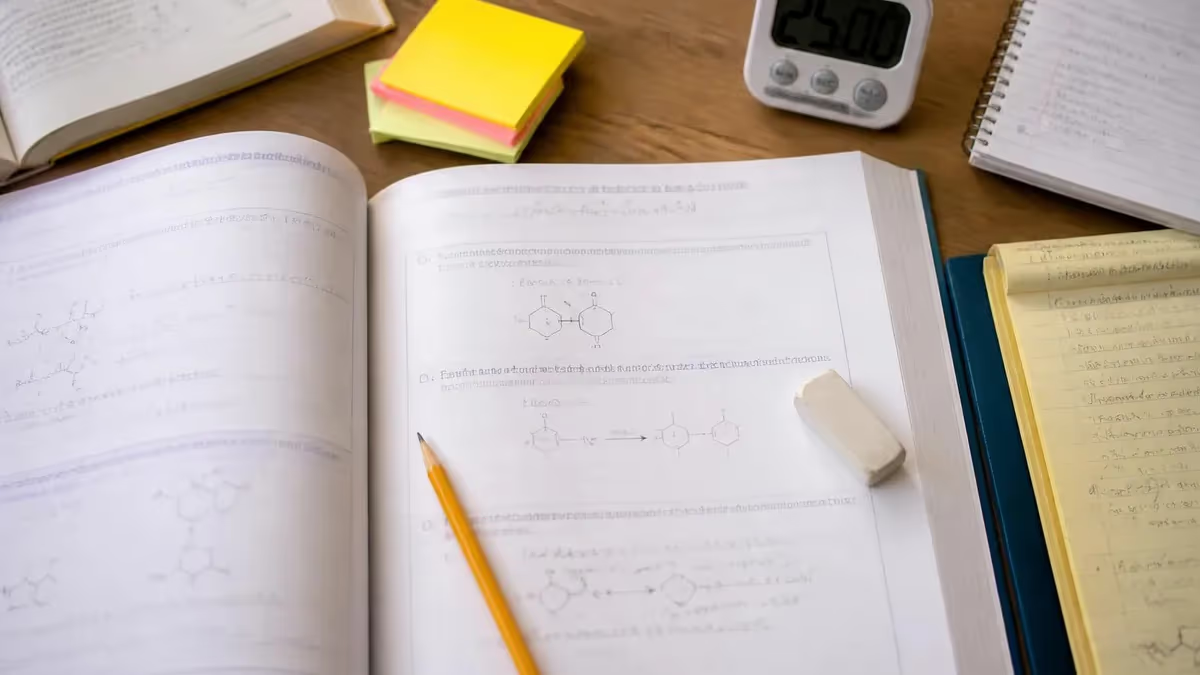
The periodic table acs represents one of the most fundamental and enduring frameworks in all of science, organizing every known element into a coherent, predictive system that chemists rely on every single day. For students preparing for American Chemical Society standardized exams — whether at the general chemistry or organic chemistry level — understanding the periodic table in depth is not optional. It is the foundation upon which virtually every other chemistry concept rests, from atomic structure and bonding to reaction mechanisms and thermodynamics.
The ACS has long championed rigorous chemistry education, and their standardized exams reflect that commitment by testing not just rote memorization of element symbols, but genuine conceptual understanding of periodic trends, group properties, and the reasoning behind the table's organization. Students who treat the periodic table as a simple lookup chart typically struggle on ACS exams, while those who understand the underlying quantum mechanical principles and can predict element behavior based on position consistently outperform their peers.
One of the most critical things to understand about the periodic table in the context of ACS exam preparation is that questions rarely ask you to simply name an element or recite its atomic number. Instead, examiners design questions that require you to compare elements, predict relative properties like electronegativity or atomic radius, and explain why certain reactions occur based on electronic configuration. This means your preparation must go beyond memorization and into genuine conceptual mastery of periodic relationships.
The periodic table currently contains 118 confirmed elements, organized into 18 groups (vertical columns) and 7 periods (horizontal rows). Each element's position encodes a tremendous amount of information: its electron configuration, its likely oxidation states, its reactivity patterns, and its physical properties. Understanding how to read this positional information is a core ACS exam skill that separates average performers from top scorers. Students who internalize this positional logic can answer questions about unfamiliar elements by reasoning from first principles.
Historically, the periodic table was developed through the work of Dmitri Mendeleev in 1869, who organized elements by atomic mass and noticed recurring patterns in chemical behavior. The modern quantum mechanical understanding replaced atomic mass ordering with atomic number ordering — the number of protons in the nucleus — which resolved the inconsistencies Mendeleev had encountered. The ACS frequently includes questions about the historical development of the periodic table, making this context valuable exam knowledge rather than mere trivia.
For ACS general chemistry exams specifically, the periodic table topics most heavily tested include: periodic trends such as ionization energy, electron affinity, atomic radius, and electronegativity; group properties and the characteristic chemistry of alkali metals, alkaline earth metals, halogens, and noble gases; transition metal properties including variable oxidation states and coordination chemistry; and the distinction between main group and d-block elements. Each of these areas requires both conceptual understanding and quantitative reasoning skills.
This guide will walk you through every major periodic table concept tested on ACS exams, providing clear explanations, practical examples, and strategic advice for maximizing your score. Whether you are studying for your first general chemistry final or preparing for a more advanced ACS standardized exam, the content here will give you the tools you need to approach periodic table questions with confidence and precision. Consistent practice with ACS-style questions, combined with deep conceptual understanding, is the most reliable path to exam success.
Periodic Table ACS by the Numbers

How the Periodic Table Is Organized
The 7 horizontal rows of the periodic table represent energy levels. As you move across a period from left to right, electrons fill the same principal energy level, causing atomic radius to decrease and ionization energy to generally increase due to greater nuclear charge.
The 18 vertical columns group elements with the same number of valence electrons, giving them similar chemical properties. Groups 1 and 2 are the s-block, groups 3–12 are the d-block transition metals, and groups 13–18 are the p-block main group elements.
The periodic table is divided into four blocks based on which orbital subshell is being filled. The s-block contains groups 1–2, the p-block groups 13–18, the d-block the transition metals, and the f-block the lanthanides and actinides in the two bottom rows.
A staircase line on the right side of the periodic table separates metals (left) from nonmetals (right). Elements touching the staircase — boron, silicon, germanium, arsenic, antimony, tellurium — are metalloids with intermediate properties that appear frequently on ACS exam questions.
An element's position directly encodes its electron configuration. The period number tells you the highest principal quantum number, the block tells you which subshell is filling, and the group number tells you how many electrons occupy that subshell — a critical ACS exam skill.
Periodic trends are among the most heavily tested topics on ACS exams, and mastering them requires more than memorizing which direction a property increases or decreases. You need to understand the underlying physical reasons for each trend so you can apply your knowledge to novel situations that you have never seen before. The three forces that drive most periodic trends are nuclear charge (the number of protons attracting electrons inward), shielding (inner electrons repelling outer electrons outward), and the principal energy level (which determines how far outer electrons are from the nucleus).
Atomic radius follows a clear and testable pattern: it decreases across a period from left to right and increases down a group. Across a period, nuclear charge increases while the number of electron shells stays constant, pulling electrons closer to the nucleus. Down a group, each new period adds an entire electron shell, dramatically increasing the distance of outer electrons from the nucleus despite the increase in nuclear charge. ACS questions often ask you to rank a series of elements by atomic radius or identify which element in a set has the largest or smallest radius.
Ionization energy — the energy required to remove an electron from a neutral gaseous atom — shows the opposite pattern from atomic radius. It generally increases across a period and decreases down a group.
The ACS exam frequently exploits the subtle exceptions to this trend: ionization energy dips slightly between group 2 and group 13 (because the p electron in group 13 is slightly shielded by the filled s subshell) and again between groups 15 and 16 (because group 16 elements have a paired p electron that experiences extra repulsion). Knowing these exceptions can be the difference between a correct and incorrect answer.
Electronegativity measures an atom's tendency to attract bonding electrons toward itself in a covalent bond. Fluorine is the most electronegative element at 4.0 on the Pauling scale, and electronegativity generally increases across periods and decreases down groups following the same logic as ionization energy. ACS exam questions use electronegativity extensively in the context of bond polarity, dipole moments, and intermolecular forces — making it one of the most consequential periodic trends to master thoroughly before your exam date.
Electron affinity, which measures the energy change when an atom gains an electron, is perhaps the trickiest trend because it is less monotonic than the others. Generally, electron affinity becomes more negative (more energy released) across a period, meaning atoms become more eager to gain electrons. However, noble gases have near-zero electron affinity because their shells are completely filled. The halogens have the highest electron affinities of any group, which explains why they are such powerful oxidizing agents in both organic and inorganic reactions.
Metallic character — the tendency of an element to lose electrons and form positive ions — decreases across a period and increases down a group. This trend is directly related to ionization energy: elements with low ionization energies lose electrons easily and are therefore highly metallic. Cesium and francium are the most metallic elements, found at the bottom left of the periodic table, while fluorine and neon at the top right are the least metallic. ACS exam questions connecting metallic character to reactivity, conductivity, and ion formation are common in both general and organic chemistry contexts.
When studying periodic trends for your ACS exam, it is highly effective to practice with comparative questions that ask you to rank three or four elements simultaneously. For example: "Which of the following has the largest first ionization energy: Na, Mg, Al, Si?" Answering correctly requires knowing not only the general trend but also the exception between Mg (group 2) and Al (group 13). Building this kind of multi-element comparison skill through deliberate practice is the most reliable way to improve your performance on ACS periodic table questions and boost your overall score.
Element Groups: Properties ACS Exam Students Must Know
Alkali metals (Group 1: Li, Na, K, Rb, Cs, Fr) are the most reactive metals, each having a single valence electron they readily donate to form +1 ions. Their reactivity increases dramatically down the group — lithium reacts slowly with water, while cesium reacts explosively. ACS exam questions often test reaction of alkali metals with water, their flame test colors, and why they are stored under mineral oil or inert gas atmospheres to prevent oxidation.
Alkaline earth metals (Group 2: Be, Mg, Ca, Sr, Ba, Ra) have two valence electrons and form +2 ions. They are harder, denser, and less reactive than alkali metals but still quite reactive compared to most elements. Calcium and magnesium are biologically essential elements. ACS questions frequently cover solubility rules for alkaline earth metal compounds — for instance, calcium sulfate is sparingly soluble while calcium nitrate is highly soluble — as well as the role of magnesium in chlorophyll and calcium in bone structure.

Memorization vs. Conceptual Understanding: What Works for ACS Periodic Table Questions?
- +Conceptual understanding lets you answer questions about unfamiliar elements by reasoning from position
- +Understanding trends means you need far fewer memorized facts to answer comparative questions
- +Quantum mechanical principles explain all major exceptions, eliminating the need to memorize them separately
- +Strong conceptual grasp makes organic chemistry connections to periodic properties much more intuitive
- +Students with conceptual mastery recover more easily from partial forgetting under exam pressure
- +Understanding why electrons are configured as they are enables fast electron configuration writing without lookup
- −Building conceptual understanding takes significantly more study time than simple memorization
- −Some ACS questions genuinely require memorized facts like specific element names, symbols, and atomic numbers
- −Conceptual reasoning under time pressure can be slower than recalling a memorized rule directly
- −Exceptions to periodic trends still require some memorization even with strong conceptual foundations
- −Students who over-rely on reasoning may miss questions that test straightforward factual recall
- −Without regular practice, conceptual knowledge can feel abstract and difficult to apply quickly on exam day
Pros and Cons at a Glance
| Pros | Cons |
|---|---|
| Conceptual understanding lets you answer questions about unfamiliar elements by reasoning from position | Building conceptual understanding takes significantly more study time than simple memorization |
| Understanding trends means you need far fewer memorized facts to answer comparative questions | Some ACS questions genuinely require memorized facts like specific element names, symbols, and atomic numbers |
| Quantum mechanical principles explain all major exceptions, eliminating the need to memorize them separately | Conceptual reasoning under time pressure can be slower than recalling a memorized rule directly |
| Strong conceptual grasp makes organic chemistry connections to periodic properties much more intuitive | Exceptions to periodic trends still require some memorization even with strong conceptual foundations |
| Students with conceptual mastery recover more easily from partial forgetting under exam pressure | Students who over-rely on reasoning may miss questions that test straightforward factual recall |
| Understanding why electrons are configured as they are enables fast electron configuration writing without lookup | Without regular practice, conceptual knowledge can feel abstract and difficult to apply quickly on exam day |
ACS Periodic Table Mastery Checklist
- ✓Memorize the symbols and names of all 118 elements, especially the first 36 (H through Kr).
- ✓Write electron configurations from memory for any element using the Aufbau principle and the diagonal rule.
- ✓Identify and explain the two major electron configuration exceptions: chromium (Cr) and copper (Cu).
- ✓Predict relative atomic radii, ionization energies, and electronegativities for any set of elements.
- ✓Recognize and explain the two exceptions to the ionization energy trend across Period 3 (between Mg/Al and P/S).
- ✓Describe characteristic chemical reactions for each main group family (alkali metals, halogens, alkaline earth metals, etc.).
- ✓Identify metals, nonmetals, and metalloids from position on the periodic table without referencing a legend.
- ✓Explain why transition metals exhibit variable oxidation states using d-orbital theory.
- ✓Connect electronegativity differences to bond type: ionic (>1.7), polar covalent (0.4–1.7), or nonpolar covalent (<0.4).
- ✓Practice 20+ ACS-style periodic table questions under timed conditions to build speed and accuracy.
The Diagonal Rule Predicts ~95% of Electron Configurations
The diagonal (Madelung) rule for filling electron subshells — 1s, 2s, 2p, 3s, 3p, 4s, 3d, 4p... — correctly predicts electron configurations for the vast majority of elements. The two major exceptions are chromium ([Ar] 3d5 4s1 instead of 3d4 4s2) and copper ([Ar] 3d10 4s1 instead of 3d9 4s2), both of which prefer half-filled or completely filled d subshells for stability. Memorizing these two exceptions specifically, while trusting the diagonal rule for everything else, is the most efficient use of your study time.
Transition metals occupy groups 3 through 12 in the periodic table and represent some of the most chemically rich and practically important elements in existence. Their defining feature is the presence of partially filled d orbitals, which give rise to properties that set them apart dramatically from the main group elements on either side. For ACS exam purposes, the transition metals are tested both in general chemistry courses, where oxidation states and basic coordination chemistry are introduced, and in more advanced contexts where ligand field theory and spectroscopic properties become relevant.
One of the most frequently tested aspects of transition metal chemistry on ACS exams is the assignment of oxidation states in compounds and complex ions. The standard approach is to use known oxidation states of surrounding atoms — oxygen is almost always -2, hydrogen is +1 in most compounds, and halides are -1 — to calculate the transition metal's oxidation state by ensuring the overall charge balances.
For example, in K2Cr2O7 (potassium dichromate), knowing that potassium is +1 and oxygen is -2 allows you to calculate that chromium must be +6. This type of calculation appears frequently on ACS general chemistry exams.
The colors of transition metal complexes are a direct consequence of crystal field theory, which describes how the surrounding ligands (molecules or ions bonded to the central metal) split the five d orbitals into groups of different energy. When visible light passes through the solution, photons of specific wavelengths are absorbed as electrons transition between these split d orbital energy levels.
The color you observe is the complement of the absorbed wavelength. This is why copper(II) sulfate solution appears blue — it absorbs red and orange light — and why chromium(III) complexes appear violet or green depending on the ligands present.
The spectrochemical series ranks ligands by their ability to split d orbital energies, from weak-field ligands like iodide (I-) and bromide (Br-) to strong-field ligands like cyanide (CN-) and carbon monoxide (CO). This ranking has profound consequences for the electronic configuration of transition metal complexes: weak-field ligands often produce high-spin configurations where electrons spread across all d orbitals before pairing, while strong-field ligands produce low-spin configurations where electrons pair in the lower energy set of orbitals first.
ACS upper-level exam questions test this concept by asking students to predict whether a given complex is high-spin or low-spin based on the ligand field strength.
Transition metals serve as extraordinarily effective catalysts in both biological and industrial contexts, and this practical significance makes catalysis a recurring theme on ACS exams. Iron is the catalytic core of hemoglobin and cytochrome enzymes, using its ability to cycle between Fe2+ and Fe3+ to transport oxygen and help electron transfer reactions. Platinum catalyzes the hydrogenation of organic molecules by adsorbing both hydrogen gas and the unsaturated substrate onto its surface, bringing them into reactive proximity. Vanadium pentoxide catalyzes the oxidation of sulfur dioxide to sulfur trioxide in the industrial Contact Process for sulfuric acid production.
The lanthanides and actinides, which appear as the two separate rows at the bottom of the standard periodic table layout, are the f-block elements. Their f orbitals are being filled, and this happens deeper inside the electron cloud than the d orbitals of transition metals, making the lanthanides chemically very similar to each other — so similar that separating them industrially is notoriously difficult.
The actinides include all the radioactive heavy elements from thorium through oganesson, and the ACS exams occasionally include questions about nuclear chemistry topics such as radioactive decay series, half-lives, and the distinction between alpha, beta, and gamma radiation.
When preparing for ACS exam questions about transition metals and f-block elements, focus your study time on four key areas: writing correct electron configurations including the correct placement of electrons in d and f subshells; assigning oxidation states in ionic compounds and coordination complexes; understanding why these elements exhibit variable oxidation states (unlike main group metals which typically have only one stable oxidation state); and connecting the d orbital splitting concept to the observable properties like color and magnetism. These four areas cover the vast majority of transition metal questions that appear on ACS standardized exams at every level.
Many readers pair this guide with the acs general chemistry study guide to check their readiness before exam day.

Many students incorrectly write transition metal ion configurations by simply removing the last electrons written in the Aufbau filling order. However, when transition metals are ionized, the 4s electrons are removed BEFORE the 3d electrons — not after. This is because once the 3d orbitals are occupied, they become lower in energy than the 4s orbital. So Fe (iron) has configuration [Ar] 3d6 4s2, but Fe2+ is [Ar] 3d6 — NOT [Ar] 3d4 4s2. This distinction is a classic ACS exam trap that catches students who memorize filling order without understanding why ionization reverses it.
Developing a strategic, well-structured study plan for periodic table content on ACS exams requires an honest assessment of where your current knowledge has gaps. Most students entering ACS exam preparation have some familiarity with the periodic table from prior coursework, but that familiarity is often uneven — strong on memorized element names and symbols, weaker on quantitative periodic trend comparisons, and weakest of all on explaining the quantum mechanical basis for the trends they know. Identifying and prioritizing these specific gaps is the foundation of efficient preparation.
Begin your periodic table review with electron configurations, since every other periodic trend flows from this foundation. Practice writing configurations for at least the first 36 elements (hydrogen through krypton) from memory using the Aufbau principle and the diagonal rule. Then practice writing configurations for representative transition metals and a few f-block elements. Once you can do this fluently, you will find that ionization energies, atomic radii, and other trends are far more intuitive because you can visualize exactly which electrons are being added or removed and how that affects the atom's stability.
Next, systematically work through each major periodic trend — atomic radius, ionization energy, electron affinity, electronegativity, and metallic character — using a three-step approach: state the direction of the trend, explain the reason in terms of nuclear charge and shielding, and identify any known exceptions. Writing these explanations out in your own words, rather than simply reading them, dramatically improves retention and prepares you to generate answers under exam conditions rather than just recognizing them among multiple-choice options.
Practice ACS-style multiple choice questions extensively, because the format of ACS exam questions differs from typical course exams in important ways. ACS questions are carefully written to test conceptual understanding rather than calculation, often presenting four options that are all numerically reasonable but only one of which correctly reflects the underlying chemistry. Learning to identify the distractors — the wrong answers designed to catch students with common misconceptions — is as important as knowing the right answers. After each practice session, review not just the questions you got wrong but also any you answered correctly by guessing.
Group properties deserve dedicated study sessions because ACS exams test specific knowledge about each major element family. For alkali metals, know the reaction with water (2M + 2H2O → 2MOH + H2) and how reactivity changes down the group. For halogens, know the oxidizing power trend and displacement reactions (F2 displaces all other halogens from their salts, Cl2 displaces Br- and I-, but Br2 cannot displace Cl-). For noble gases, know their electron configurations and the conditions under which the heavy noble gases form compounds. These specific facts appear regularly enough on ACS exams to justify focused memorization.
Many students find it valuable to use periodic table mnemonics for element group names and properties, but the most effective mnemonics are ones you create yourself based on your own mental associations. Rather than memorizing someone else's memory trick, spend a few minutes connecting each group's properties to something concrete and personally meaningful. The act of creating the mnemonic itself reinforces the underlying chemistry, and personal associations tend to be more durable under exam-day stress than borrowed ones.
In the final weeks before your ACS exam, shift from learning new content to consolidating and testing what you already know. Take full-length timed practice exams using ACS official study guides, which are the most authentic preparation materials available. After each practice exam, categorize your errors by topic (electron configuration, periodic trends, group properties, etc.) and use that analysis to direct any remaining focused review.
Students who use this feedback-driven approach in the final preparation phase consistently see score improvements even over a short time period. Remember, consistent engagement with the material over weeks beats cramming in the days immediately before the exam.
On the day of your ACS exam, the periodic table questions you encounter will demand both speed and accuracy — a combination that only develops through deliberate, timed practice. One of the most practical strategies for handling periodic table questions efficiently is to immediately locate each element mentioned in the question on your mental map of the periodic table.
Without looking at a physical table (most ACS exams provide a periodic table, but using it costs time), knowing approximately where an element sits — its period, group, and block — lets you quickly assess its properties and compare it to other elements in the question.
For questions involving periodic trends, always work systematically: identify the direction of the trend (across the period or down the group), determine which element is furthest in the direction that maximizes or minimizes the property, and check for any applicable exceptions. This three-step process takes only a few seconds once you have internalized the trends, but it virtually eliminates careless errors caused by rushing or misremembering the direction of a trend. On ACS exams where each question carries equal weight, avoiding careless errors on the straightforward questions is just as important as solving the difficult ones.
When you encounter an unfamiliar element on an ACS exam — one you have never specifically studied — use its position in the periodic table to reason about its properties. An element in period 4, group 15 (arsenic, As) shares properties with nitrogen and phosphorus above it, and you can predict it is a metalloid, forms -3 and +5 compounds, and has intermediate electronegativity. This positional reasoning is exactly what ACS exam designers intend to test, and it is far more powerful than trying to memorize specific facts about every element individually.
Time management on ACS chemistry exams is critical. The standard ACS general chemistry exam gives you approximately 110 minutes for 70 questions — about 94 seconds per question. Periodic table questions, when approached systematically, should take 45 to 75 seconds each, leaving time in your budget for the more calculation-intensive questions about stoichiometry, equilibrium, and thermodynamics.
If you find yourself spending more than 90 seconds on a periodic table question, mark it and move on. You can return to it after completing the rest of the exam and often find that the answer comes more easily when you approach it fresh.
Group studying can be particularly effective for periodic table preparation when structured around active recall rather than passive review. Instead of reviewing notes together, take turns quizzing each other on element properties, trend directions, and electron configurations. Explaining a concept to a peer — even if your explanation turns out to be imperfect — forces you to identify exactly what you understand and what you are fuzzy on. This kind of retrieval practice is supported by substantial educational research as one of the most effective methods for consolidating chemistry knowledge before an exam.
Make extensive use of the ACS official study guides and the sample exams published by the ACS Exams Institute, which is the division of ACS responsible for producing and distributing standardized chemistry exams. These materials are written by the same community of chemistry educators who develop the actual exams, making them by far the most authentic practice resources available. The Exams Institute publishes study guides for general chemistry, organic chemistry, analytical chemistry, physical chemistry, and several other subdisciplines, each with carefully calibrated questions that reflect the actual exam's emphasis and difficulty distribution.
Finally, remember that the periodic table is not just a testing tool but a genuine intellectual achievement of chemistry — a framework that predicted the existence of undiscovered elements, unified disparate chemical observations under a single organizing principle, and continues to guide research in fields ranging from materials science to drug discovery.
Students who approach the periodic table with genuine curiosity, not just exam anxiety, tend to retain the information longer and apply it more flexibly. Cultivating that curiosity alongside your strategic preparation is what transforms an exam score into lasting chemical literacy that will serve you throughout your career in science.
ACS Questions and Answers

Journal Impact Factor Directory for the American Chemical Society

ACS Organic Chemistry Study Guide: Complete 2026 Prep Roadmap for the American Chemical Society Exam

ACS General Chemistry Practice Test: Complete 2026 Prep Guide for the American Chemical Society Exam

Organic Chemistry Final Exam ACS: 2026 Complete Study Guide to the American Chemical Society Standardized Test

ACS Exam Organic Chemistry Practice Test: Complete 2026 Prep Guide
About the Author

Educational Psychologist & Academic Test Preparation Expert
Columbia University Teachers CollegeDr. Lisa Patel holds a Doctorate in Education from Columbia University Teachers College and has spent 17 years researching standardized test design and academic assessment. She has developed preparation programs for SAT, ACT, GRE, LSAT, UCAT, and numerous professional licensing exams, helping students of all backgrounds achieve their target scores.
Join the Discussion
Connect with other students preparing for this exam. Share tips, ask questions, and get advice from people who have been there.
View discussion (8 replies)