
3D Product Rendering 2026 October
❓ Boost your 3D Product Rendering exam score with practice questions and detailed answer explanations. Track progress with instant feedback.
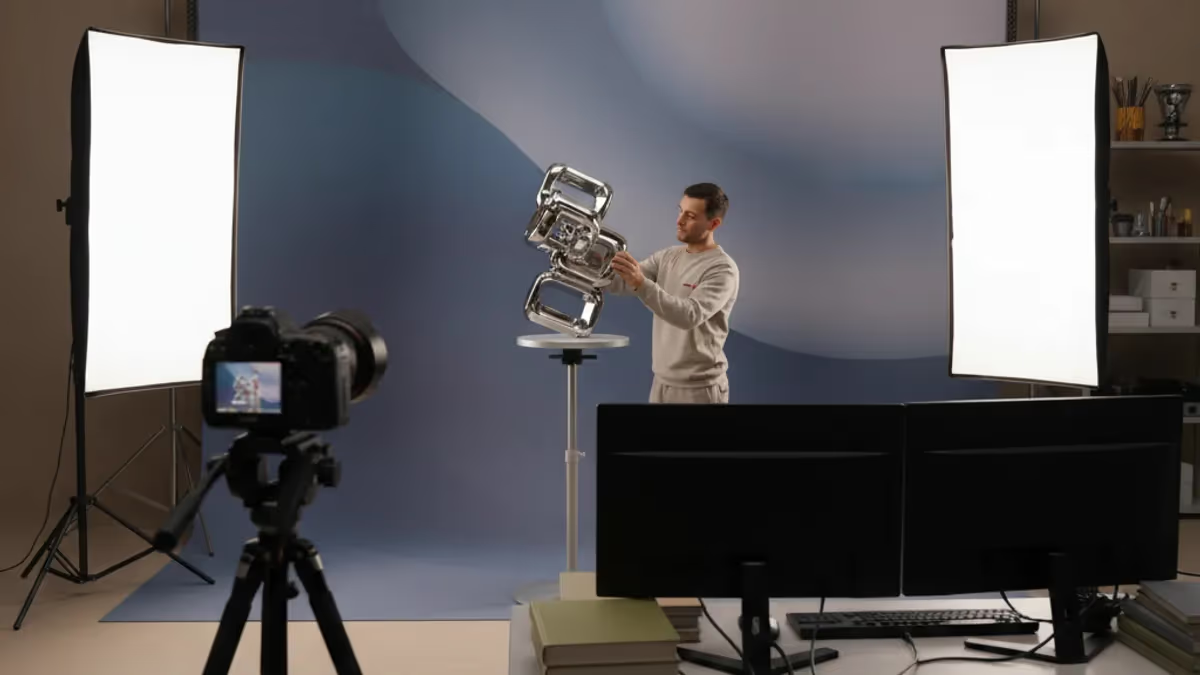
3D product rendering has revolutionized the way businesses showcase their products to potential customers. Gone are the days of static images and limited angles, as 3D rendering allows for a fully immersive and interactive experience. With the use of advanced computer software, companies can now create realistic digital representations of their products, complete with complex details and customizable features. One major advantage of 3D product rendering is its ability to save time and money in the production process. Instead of having to physically manufacture prototypes or prototypes, businesses can create virtual models that can be easily modified or customized according to customer preferences. This not only saves on manufacturing costs but also ensures that any necessary changes or improvements can be made before committing to production.
Furthermore, 3D rendering gives businesses a competitive edge by allowing them to present their products in unique and innovative ways. By using different lighting effects, textures, and backgrounds, companies can create stunning visuals that capture the attention of potential customers. Additionally, 3D rendering enables businesses to showcase their products in various settings or scenarios, helping consumers visualize how they would look or function in real-life situations. 3D product rendering is a powerful tool that offers numerous benefits for businesses across industries. It not only allows for cost savings in manufacturing but also provides an opportunity for creativity and differentiation in marketing strategies. As technology continues to advance, we can expect even more realistic and immersive 3D renderings that will further enhance customer experiences and drive sales growth.
Key Takeaway: 3D Product certification demonstrates expertise in this field. Most candidates spend 4-8 weeks preparing with practice tests and study guides before taking the exam.
- ✓Review the official 3D Product exam content outline
- ✓Take a diagnostic practice test to identify weak areas
- ✓Create a study schedule (4-8 weeks recommended)
- ✓Focus on your weakest domains first
- ✓Complete at least 3 full-length practice exams
- ✓Review all incorrect answers with explanations
- ✓Take a final practice test 1 week before exam day

3D Product: Pros and Cons
- +3D Product credential is recognized by employers and industry professionals
- +Higher earning potential compared to non-credentialed peers
- +Expanded career opportunities and professional advancement
- +Structured learning path builds comprehensive knowledge
- +Professional development that stays current with industry standards
- −Preparation requires significant time and study commitment
- −Associated costs for exams, materials, and renewal fees
- −Continuing education needed to maintain credentials
- −Competition for advanced positions can be challenging
- −Requirements and standards may vary by state or region
Pros and Cons at a Glance
| Pros | Cons |
|---|---|
| Higher earning potential compared to non-credentialed peers | Preparation requires significant time and study commitment |
| Expanded career opportunities and professional advancement | Associated costs for exams, materials, and renewal fees |
| Structured learning path builds comprehensive knowledge | Continuing education needed to maintain credentials |
| Professional development that stays current with industry standards | Competition for advanced positions can be challenging |
Sample 3D Product Practice Questions
Try these questions from our free 3D Product practice tests. The correct answer and an explanation follow each question.
What are the advantages of PETG filament over PLA for functional product prototypes?
- A. PETG has better impact resistance, moisture resistance, and higher temperature tolerance than PLA
- B. PETG has a lower melting point making it easier to print than PLA
- C. PETG produces sharper details and finer surface finish than PLA
- D. PETG is biodegradable while PLA is not
Answer: A. PETG has better impact resistance, moisture resistance, and higher temperature tolerance than PLA
PETG combines PLA's ease of printing with better mechanical properties — higher impact and temperature resistance and food-safe characteristics for functional prototypes.
What is a 'T1 sample' in the injection molding process?
- A. The first parts produced from a new production mold, used to evaluate dimensional accuracy and surface quality
- B. A material test coupon cut from a titanium billet
- C. The first color variant approved in CMF review
- D. A tolerance sample sent to the quality lab
Answer: A. The first parts produced from a new production mold, used to evaluate dimensional accuracy and surface quality
T1 (Tool Trial 1) samples are the first shots from a new injection mold — evaluated against drawings to identify required mold modifications before production approval.
What is the purpose of 'sandblasting' in product finishing?
- A. To create a uniform matte texture and remove surface imperfections by propelling fine abrasive particles at high speed
- B. To polish a surface to a mirror finish using fine compounds
- C. To apply a primer coating before painting
- D. To cut metal parts using high-pressure water and abrasive
Answer: A. To create a uniform matte texture and remove surface imperfections by propelling fine abrasive particles at high speed
Sandblasting (or bead blasting) uses high-pressure abrasive media to clean, texture, or prep surfaces — creating consistent matte or satin finishes on metal and plastic.
What is 'support removal' in 3D printing post-processing?
- A. Physically removing temporary support structures printed alongside the part, using tools or dissolution in solvent
- B. Removing digital support geometry from a CAD model after export
- C. Cleaning excess sinter powder from SLS-printed parts
- D. Stripping the surface coating from a finished part
Answer: A. Physically removing temporary support structures printed alongside the part, using tools or dissolution in solvent
Support removal involves cutting, pulling, or dissolving (in the case of soluble supports) the temporary structures printed to hold up overhanging geometry during printing.
About the Author

Certified Professional Development Expert & Niche Certification Advisor
University of Pennsylvania Graduate School of EducationDr. Alexandra Kim holds a PhD in Professional Studies from the University of Pennsylvania and is a Certified Professional in Learning and Performance (CPLP) and Certified Professional in Talent Development (CPTD). With 17 years of corporate training and professional certification advisory experience, she helps professionals navigate specialized, emerging, and cross-industry certification programs.