

NYPD Practice Test
Updated November 2026Facts verified Nov 1, 2026 against NYC Department of Citywide Administrative Services (DCAS), Bureau of Examinations
NYPD: upcoming dates and official changes
- Jul 1, 2026 – Jun 14, 2027: Applications for NYC Police Officer exams 7311–7322 opened July 1, 2026 and are accepted through June 14, 2027.[1]
- Nov 2, 2026 – Nov 16, 2026: Applications for NYC Police Officer Exam 7315 are accepted November 2–16, 2026.[1]
- Dec 1, 2026 – Dec 5, 2026: NYC Police Officer Exam 7315 is tested December 1–5, 2026.[1]
- Jan 4, 2027 – Jan 9, 2027: NYC Police Officer Exam 7316 is tested January 4–9, 2027 (applications December 1–14, 2026).[1]
- Jul 5, 2027 – Jul 9, 2027: NYC Police Officer Exam 7322, the last in the series, is tested July 5–9, 2027 (applications June 1–14, 2027).[1]
- Candidates must score at least 70% to pass the NYC Police Officer multiple-choice exam.[1]
- The NYC Police Officer exam (Nos. 7311–7322) has a $0.00 application fee; applicants select "No Fee" as the payment method.[1]
- The NYC Police Officer eligible list is usually active for four years.[1]
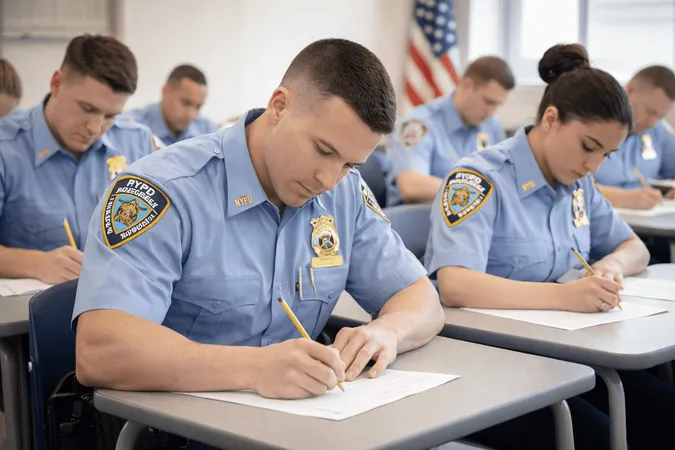
- The NYC Police Officer exam is a multiple-choice test given at a computer terminal, and calculators are not permitted.[1]
- Candidates who pass the NYC Police Officer exam are placed on an eligible list in final score order and notified of their results by email.[1]
- Applications for NYC Police Officer Exam 7315 are accepted November 2–16, 2026.[1]
Numbers in brackets link to the official sources listed under Sources & last verified. Dates that have passed are removed automatically.
NYPD Exam at a Glance
What changed for NYPD in 2026
- Oct 25, 2026: Exam fee changed to $0 application fee (previously $0 application fee (exams 7311–7322)).[1]
- Oct 25, 2026: Delivery changed to Computer-based multiple-choice test; no calculators (previously Computer-based multiple-choice test at DCAS testing centers; no calculators).[1]
- Oct 25, 2026: Registration opens changed to Applications open July 1, 2026 (previously Applications open July 1, 2026 (exam series 7311–7322)).[1]
- Oct 25, 2026: Score release changed to Results by email; passers placed on eligible list (previously Results by email; passers ranked on an eligible list).[1]
Note: The NYPD Police Department requires candidates to have 60 college credits or 2 years of military service before hiring, though you can take the NYPD Exam before meeting these requirements. Scores are valid for 4 years.
NYPD Exam Flashcards
Click to flip and review key concepts
🧠What is Inductive Reasoning?
Inductive reasoning is the ability to combine specific pieces of information to form general rules or conclusions, a key skill for any NYPD Police Officer.
START NYPD PRACTICE TEST🗺️What is Spatial Orientation?
Spatial orientation tests your ability to navigate and determine your location relative to objects or landmarks, crucial for NYPD Recruit patrols.
GET NYPD EXAM PREP👁️What is Visualization?
Visualization is the ability to imagine how something will look after it is moved or rearranged, tested frequently on the NYPD Police Department exam.
REVIEW NYPD QUESTIONS📝What is Written Comprehension?
Written comprehension measures your ability to read and understand information presented in writing, essential for NYPD Police reports.
TRY NYPD MOCK EXAM🗣️What is Written Expression?
Written expression tests your ability to use English words and sentences in writing so others will understand, vital for NYPD Recruit communication.
ACCESS NYPD STUDY GUIDE🧩What is Deductive Reasoning?
Deductive reasoning involves applying general rules to specific problems to produce a logical answer, a core component of the NYPD Exam.
PRACTICE NYPD TEST NOWNYPD Exam Study Guide
This NYPD study guide breaks down critical aspects of the NYPD Police Department selection process. From eligibility to scoring, these sections answer common questions about becoming an NYPD Police Officer.
The NYPD Exam fee may be waived for veterans, unemployment benefit recipients, and those receiving public assistance. Additionally, while recruits buy their initial equipment, a uniform allowance is provided annually to NYPD Police officers after hiring. Practice with the free NYPD practice test on PracticeTestGeeks (7 questions with answer explanations).
Free NYPD Exam Study Tools
Interactive NYPD Exam resources on PracticeTestGeeks, free to start:
- NYPD Exam flashcards — review key terms and concepts card by card
- NYPD Exam study guide — topic-by-topic overview of what the exam covers
- NYPD Exam cheat sheet — one-page printable summary for last-minute review
According to NYC Department of Citywide Administrative Services (DCAS), Bureau of Examinations, “You must achieve a score of at least 70% to pass the test.”[1]
NYPD content outline and where to practise each area
The content areas below are copied from the official NYPD content outline published by NYC Department of Citywide Administrative Services (DCAS), Bureau of Examinations. The right-hand column shows which of our practice sets covers it.
| Official content area | Practice on this site |
|---|---|
| Deductive Reasoning[1] | NYPD Deductive and Inductive Reasoning Practise applying a stated rule to a specific case and stopping at what the facts actually support. |
| Inductive Reasoning[1] | NYPD Deductive and Inductive Reasoning Practise spotting the pattern across several details and choosing the conclusion that fits them all. |
| Information Ordering[1] | NYPD Information Ordering Practise putting steps, reports and events into the correct sequence and checking each link in the chain. |
| Memorization[1] | NYPD Memorization Skills Practise studying faces, details and descriptions briefly, then recalling them without looking back. |
| Problem Sensitivity[1] | NYPD Problem Sensitivity Practise noticing when something is wrong or likely to go wrong before it is stated outright. |
| Spatial Orientation[1] | NYPD Spatial Orientation Practise reading maps and directions and tracking where you are relative to landmarks. |
| Visualization[1] | NYPD Visualization and Matching Practise picturing how a shape or scene looks after it is rotated, moved or combined. |
| Written Comprehension[1] | NYPD Reading Comprehension Practise reading a passage closely and answering only from what the text says. |
| Written Expression[1] | NYPD Written Expression Practise choosing clear, correct and well-organised wording for reports and statements. |
NYPD Practice Test Questions
Prepare for the NYPD Exam exam with our free practice test modules. Each quiz covers key topics to help you pass on your first try.
NYPD Auxiliary Police
NYPD Exam Questions covering Auxiliary Police. Master NYPD Test concepts for certification prep.
NYPD Entry Exam
Free NYPD Practice Test featuring Entry Exam. Improve your NYPD Exam score with mock test prep.
NYPD Deductive and Inductive Reasoning
NYPD Test Prep for Deductive and Inductive Reasoning. Practice NYPD Quiz questions and boost your score.
NYPD Information Ordering
NYPD Questions and Answers on Information Ordering. Free NYPD practice for exam readiness.
NYPD Memorization Skills
NYPD Mock Test covering Memorization Skills. Online NYPD Test practice with instant feedback.
NYPD Information Ordering
Free NYPD Test covering NYPD Information Ordering. Practice and track your NYPD exam readiness.
NYPD Legal Definitions and Police Procedures
NYPD Exam Questions covering NYPD Legal Definitions and Police Procedures. Master NYPD Test concepts for certification prep.
NYPD Mathematical Reasoning
Free NYPD Practice Test featuring NYPD Mathematical Reasoning. Improve your NYPD Exam score with mock test prep.
NYPD Traffic Laws and Enforcement
NYPD Practice Questions for NYPD Traffic Laws and Enforcement. Build confidence for your NYPD certification exam.
NYPD Problem Sensitivity
Free NYPD Test covering Problem Sensitivity. Practice and track your NYPD exam readiness.
NYPD Reading Comprehension
NYPD Exam Questions covering Reading Comprehension. Master NYPD Test concepts for certification prep.
NYPD Situational Judgment
Free NYPD Practice Test featuring Situational Judgment. Improve your NYPD Exam score with mock test prep.
NYPD Spatial Orientation
NYPD Mock Exam on Spatial Orientation. NYPD Study Guide questions to pass on your first try.
Worked examples: how to reason through NYPD questions
These are practice questions written for this site, not questions from the real exam. Each explanation shows why the right answer is right and why the others are wrong.
Example 1
Question: How many hours of training must a new Auxiliary Police recruit complete before being authorized to patrol?
- 24 hours
- 54 hours
- 80 hours
- 120 hours
Answer: B. 54 hours
Explanation:
The correct answer is 54 hours. In this practice question, new Auxiliary Police recruits finish classroom and field training of that length before they are authorized to patrol.
24 hours is wrong because it is too short to cover both classroom and field work. 80 hours and 120 hours are wrong because they overstate the requirement; they look plausible only because longer training sounds more serious.
The general rule: when a question asks for a specific requirement, recall the exact figure rather than picking the one that sounds most thorough. Training hours and similar details vary by program and over time, so confirm current figures with the official source before relying on them.
Example 2
Question: When conducting a traffic stop, where should an officer position their patrol vehicle relative to the stopped vehicle?
- Directly behind the stopped vehicle
- Slightly offset to the left and behind the stopped vehicle
- Alongside the stopped vehicle on the driver's side
- In front of the stopped vehicle
Answer: B. Slightly offset to the left and behind the stopped vehicle
Explanation:
The correct answer is to position the patrol vehicle slightly offset to the left and behind the stopped vehicle. That placement creates a barrier between the officer and moving traffic and gives a safer path for approaching the stopped car.
Directly behind the vehicle is wrong because it leaves no protected space and puts the officer in line with traffic. Alongside the driver's side is wrong because it blocks the lane and leaves the officer exposed. In front of the stopped vehicle is wrong because it cuts off the view of the stopped car and gives the officer no protection from traffic approaching from behind.
The general rule: choose the option that protects the officer and keeps a clear view of the other vehicle.
Example 3
Question: A patrol officer is tasked with memorizing the faces of five individuals on a 'persons of interest' board before going on patrol. The most effective strategy for visualization memorization is to:
- Spend equal time on each face and memorize clothing details
- Focus on the most common facial features shared by all five individuals
- Identify one unique permanent physical feature for each individual and create a mental association
- Memorize each person's name and match it to age estimates
Answer: C. Identify one unique permanent physical feature for each individual and create a mental association
Explanation:
The correct answer is to identify one unique permanent physical feature for each individual and link it to a mental association. A feature that belongs to one person and does not change is what lets you tell that person apart later.
Spending equal time on each face and memorizing clothing is wrong because clothing can change and does not identify anyone. Focusing on features shared by everyone is wrong because shared traits cannot separate one person from another. Memorizing names and age estimates is wrong because the task is about faces, and age estimates are unreliable.
The general rule: for recognition tasks, anchor on distinctive, lasting details, not on shared or changeable ones.
How to use these practice tests
Start by reading the official notice of examination for your exam number so you know the filing period, the test window and the content areas. Then use the blueprint table above to see which of our sets matches each area.
Take one set cold, before reviewing anything, to see where you stand. Write down every question you miss and the reason: you misread it, you did not know the rule, or you ran out of attention. Group the misses by content area and spend most of your time on the weakest areas first.
Work through the reasoning, information ordering and reading sets slowly at first. Check each answer against the explanation, and say the rule in your own words. For memorization, visualization and spatial orientation, practise with a short timer so the skill becomes automatic rather than something you only manage when relaxed.
Near the end, mix areas in one sitting to match the feel of a single computer-based test. Keep the 70% passing score in mind as a target, not a prediction. Our questions are original practice material and do not reproduce the real exam, so use them to build skills and confirm details on the official site.
NYPD Test Day Checklist
- ✓Valid government photo ID
- ✓Admission notice (printed)
- ✓Confirmation number
- ✓No electronic devices
- ✓Arrive 30 mins early
- ✓Comfortable clothing
- ✓Water bottle (clear)
- ✓Positive mindset!
Ready to Join the NYPD?
Start your preparation today with our free NYPD Recruit practice tests. Master the exam, pass the physical, and start your career as one of New York's finest.
The NYPD Police Department is unique in that promotions to Sergeant, Lieutenant, and Captain are based on competitive civil service exams, not just appointments. This allows any NYPD Police Officer to rise through the ranks based on study and performance.
Sources & last verified
- NYC Department of Citywide Administrative Services (DCAS), Bureau of Examinations — passing score, exam fee, validity, delivery (official source). “You must achieve a score of at least 70% to pass the test.” Verified Nov 1, 2026.
How we verify: editorial & fact-checking policy. Report an error: contact us.
NYPD: Pros and Cons
- +NYPD exam preparation strengthens your knowledge across all domains
- +Passing the exam proves competency to employers and clients
- +Study materials and practice tests are widely available
- +Exam-based credentials are portable across states and employers
- +Clear exam objectives help focus your study plan effectively
- −Exam anxiety can affect performance — practice tests help reduce it
- −Registration fees are non-refundable if you miss your test date
- −Limited retake opportunities may apply with waiting periods
- −Exam content updates periodically — use current study materials
- −Testing center availability may require advance scheduling
Pros and Cons at a Glance
| Pros | Cons |
|---|---|
| NYPD exam preparation strengthens your knowledge across all domains | Exam anxiety can affect performance — practice tests help reduce it |
| Passing the exam proves competency to employers and clients | Registration fees are non-refundable if you miss your test date |
| Study materials and practice tests are widely available | Limited retake opportunities may apply with waiting periods |
| Exam-based credentials are portable across states and employers | Exam content updates periodically — use current study materials |
| Clear exam objectives help focus your study plan effectively | Testing center availability may require advance scheduling |
Sample NYPD Exam Practice Questions
Try these questions from our free NYPD Exam practice tests. The correct answer and an explanation follow each question.
A NYPD exam question shows two nearly identical images of a street scene side by side, with the instruction to identify differences. Officers find: a missing trash can in Image B, a changed street sign, and an added pedestrian. How many differences were identified?
- A. One
- B. Two
- C. Three
- D. Four
Answer: C. Three
Three differences were identified: a missing trash can, a changed street sign, and an added pedestrian.
During a NYPD exam visualization section, candidates view a scene for 90 seconds showing a red fire truck parked in front of a school, a crossing guard on the northeast corner, and a group of children on the school steps. After the image is removed, what was on the school steps?
- A. The crossing guard
- B. The fire truck
- C. A group of children
- D. Police officers
Answer: C. A group of children
The scene showed children on the school steps; the crossing guard was on the corner and the fire truck was parked in front.
Under the NYPD use-of-force continuum, verbal commands are classified as which level of force?
- A. Lethal force
- B. Intermediate force
- C. Soft empty-hand control
- D. Officer presence and verbal direction
Answer: D. Officer presence and verbal direction
Verbal commands fall under the lowest tier — officer presence and verbal direction — before any physical force is applied.
The NYPD Patrol Guide serves as:
- A. A set of voluntary best-practice suggestions for officers
- B. The binding rules and procedures governing officer conduct and operations
- C. A training manual used only during the Police Academy
- D. A legislative document enacted by the New York City Council
Answer: B. The binding rules and procedures governing officer conduct and operations
The Patrol Guide contains mandatory procedures that all NYPD officers must follow; violations can result in disciplinary action.
Take the full NYPD Exam practice test
NYPD Questions and Answers
Official Resources
- NYPD Recruitment – the official New York City Police Department recruitment site with eligibility, hiring steps, and candidate information.
- NYC DCAS – Take an Exam – the city's Department of Citywide Administrative Services page for registering and sitting civil-service exams, including the Police Officer exam.
How this page was made: written with AI tools and published by Nathan Beja, founder of Practice Test Geeks, who is responsible for its content. Exam facts are checked against the official sources listed below. Not reviewed by a subject-matter expert. Editorial policy
Sources & references
Exam facts on this page (fees, format, dates, passing scores) are checked against these official sources; the date is our last check. Editorial policy
- nyc.gov — Test delivery, fees, passing score, registration deadline, registration, score release, test dates, score validity, exam information · verified Nov 2026