

Jewelry Design Practice Test
Updated for September 2026Jewelry Design Questions and Answers
- Decide on a degree in fine arts, gemology, or design.
- Look for job postings in trade journals. The simplest ways to stand out to potential employers are to enter contests, display your work, and network.
- Speak with reputable companies, even if they aren’t openly recruiting for positions.
- Your portfolio should demonstrate your technical, physical, and creative talents and thought processes when seeking a job. Include mood boards, prototypes, and sketches.
- Do your homework and stay current on industry news. You may have an advantage over other applicants if you can demonstrate a thorough understanding of a company’s background and business plan.
- Effective communication is essential. Since you will need to collaborate with craftspeople as a designer, practice outlining your ideas and concepts clearly and concisely.
- Look for ideas by browsing the internet and jewelry shops. Before you begin drawing, you will need inspiration when creating jewelry at home. Browse the assortment of jewelry online or at your neighborhood craft fair or craft store. Maybe a pendant or stone may attract your attention. It should be simple to start designing your jewelry as soon as you are inspired. Picture titled Create a Custom Item of Jewelry
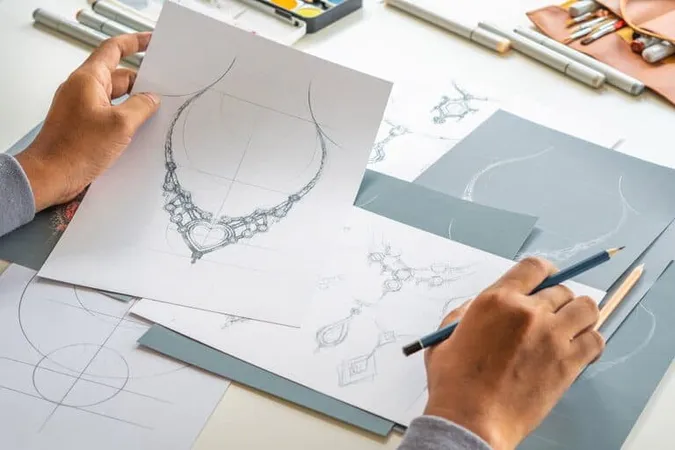
- Start outlining. If you’re unclear where to begin, consider drawing some simple shapes before adding details. Try some aimless drawing for about five minutes if you’re still stuck. This might result in a design that wouldn’t have occurred to you otherwise. You’ll need pencils and blank paper to begin drawing jewelry designs. These are readily available in a nearby craft store or bookstore. Look through the assortment of sketchbooks until you find one that inspires your imagination and makes you want to create. Label each design component with the material you want to use as you sketch your item. Label any objects you are sketching, such as a red plastic bead, on your design. Even though it seems simple to you, you might later forget what you sketched.
- Think of colors. If you like vivid, bright hues, you should include this in your designs. You can use metallic colors in your designs if you favor metallic finishes. You can try new things and make whatever you can think of and what you like most when you design your jewelry. Think about how dark and bright colors contrast. Contrasting colors on the color wheel will stand out. 3-5 hues close to one another on the color wheel will provide harmony. On the color wheel, try matching a color with the two hues next to its opposite.
- Consider forms. Consider the shape you want to draw while you sketch. You may want to use rectangles or zigzags in your design. Maybe you’re drawn to spheres or circles and like to work with them. Think about having the beads or ornaments fit the shape of the entire piece. For instance, you may use round beads to create a bracelet. Another option is to dangle a large, narrow bead straight from a short chain. This will form a pointy, triangular-shaped pendant. Think about space. Consider hoop earrings: the void inside the hoop draws attention to the wearer’s jawline. Consider the things your jewelry will frame.
- Keep wearability in mind. It’s simple to get carried away with your design and produce something that’s either too hefty or too angular to be comfortable. Consider your jewelry’s weight and the surface it will hang on. For instance, wearing heavy earrings dangling from your earlobes will hurt more than wearing a heavy necklace draped around your shoulders. Similar to how jagged metal earrings that hang away from your face are unlikely to damage you, a spikey necklace may nick your flesh.
- Look over supplies for ideas. Gather jewelry-making materials, such as beads, chains, clasps, string, etc., at a local craft store. The resources at hand may inspire you. Having access to these resources may inspire you as you draft your thoughts.
- Begin with a basic idea
- A quick sketch is produced
- You use CAD software to construct your design
- The jewelry is modeled in wax or resin
- Your unique item is constructed and hand-finished
- Worthy: Best Overall
- CashForGoldUSA
- WP Diamonds
- Mondiamo
- Diamond Buyers International
- The Real Real
- The Diamond Valet
- Sotheby’s
- Christie’s
- Etsy
- Ruby Lane
- Visit the department stores and check out the available brands. It’s important to remember that certain “brands” are private labels (made by the department store), while others are not. Knowing what brand you might like to design for and being aware of the competition should be your goals.
- Create a portfolio and resume. Your training, expertise, and ownership of your line should all be listed in your CV. Any assortment of items that can creatively and effectively relate to your thoughts and abilities can be included in your portfolio. While not always necessary, drawing skills are vital. The objective is to demonstrate your ability to take an idea and make it into a functional product.
- Avoid piling a desk in front of you with hundreds of tangled product parts. Find a technique to cut down to your greatest pieces and a neat, straightforward manner to display them.
- Offer to carry out a test project. To give you both a sense of what you can offer them and whether you enjoy working with the organization, you might begin with a test-drive project under their guidance. While most freelancers bill by the hour, others do so as well.
- Ask the appropriate questions before accepting a job. Request any visual details the client is willing to offer. Ask them how many designs and in what price range they are interested. If you are a new designer, see if they have time to show you some of their best-selling looks so you can be sure to create some creative variations of them. Ask if they have time to demonstrate how the other designers submit their work.
- Submit a strong selection of work. Don’t produce variations of the same style. Make sure to perform chandeliers, buttons, drops, and hoops. Make chokers, chains, pendants, torsades, draped necks, and beads. Don’t forget to wear charm bracelets, flex bracelets, stretch bracelets, and bangles.
- Initially bill for fewer hours. I was a little slower when I started freelancing, so I occasionally charged for fewer hours to give the impression that I completed much more work in a shorter time. Work locally. If possible, working on-site is a terrific method to network with other designers and pick their brains about the business.
- Make the appropriate introductions to begin going. You can call Information to receive the receptionist’s contact information and the phone numbers of the businesses you’re interested in. the Design Director and that you are a freelance designer who would like to chat with them.
- Receive an Associate or Bachelor’s Degree. The most crucial thing for prospective jewelry designers to accomplish is to pursue a jewelry design school. You can pursue a degree in jewelry design, gemology, accessory design, or any other area pertinent to the jewelry industry.
- Acquire some fundamental jewelry design abilities. You can achieve this by enrolling in specific professional classes while earning your degree, attending online courses and workshops, or both.
- Developing your sales abilities is one of the crucial industry talents and experiences you need to become a great jewelry designer because you’ll need to be able to sell the jewelry you develop or the jewelry produced by the firm you’ll be working for. You also require the best production abilities, such as gem setting, jewelry manufacture, prototype testing, wax model carving, and jewelry finishing. Additionally, you must expand your knowledge of managing a jewelry store and caring for metals.
- Build a resume portfolio. You must build a portfolio to work as a jewelry designer for any business worth its salt, let alone Tiffany. You should start building your portfolio as soon as possible because every employer will ask for it together with the CV. It is advised that you begin building your portfolio while you are still in school, while you are interning, and also when you are working your first job.
- Go on studying Jewelry design has some significant specialization areas that frequently necessitate additional education. These include professions like metallurgy, gemology, and jewelry assessment.
- Develop a business network. The greatest mentorship will help you advance your career, and the correct networks will educate you more about the trends in the jewelry industry.
- Focus on soft skills. Along with honing your creativity, you should also develop other talents like attention to detail, problem-solving, outstanding communication, and technological know-how.
- Creating handmade jewelry with various metal forms. A jeweler should concentrate more on the modification process than the finished item. Their use of shape and texture emphasizes repetition and change. Try to change one form into several different formations to make lovely jewelry.
- The use of color and stone in design using a prefabricated finding causes some jewelers anxiety. Turning the piece of jewelry over reveals a machine-cut cabochon. Additionally, jewelers should experiment with stone or color as a design medium to produce signature pieces of outstanding handmade jewelry.
- Utilize bold colors bright colors have a lot of intensity, which makes it simple for them to blend in with any background. For the creation of stunning, handcrafted jewelry, deep hues are quite helpful. A dominant color gives a bright palette structure and balance. Therefore pick a dominant color for the ideal jewelry design.
- The use of mixed-media objects like a domino Polymer clay, resin, or concrete can be used to prepare domino pieces for inlay. To make these earrings, combine some tile grout. Tile grout has a limited palette of colors but is light, smooth, and has a beautiful matte finish. It doesn’t have lumps or pores and combines with colors wonderfully.
- Select the type of jewelry you prefer. When creating jewelry, you can’t expect to become an expert in every style at once. Decide on your favorite type of jewelry first, then proceed. Then, switch to the second jewelry-designing form after learning and perfecting it.
- Learn a few fundamentals. There are a few abilities that you must acquire if you want to design jewelry, regardless of whether you want to start with beads, clay metal, or another type of jewelry.
- Purchase top-notch crafting tools. Once you have the right tools, making jewelry becomes relatively affordable.
- Become familiar with the jargon. Using the right terminology when describing your materials or ideas while designing jewelry is crucial to avoid wasting time, money, and frustration on product returns and exchanges due to misunderstandings. The ideal industry jargon will go a long way in helping you create your jewelry design company, improve communication, and attempt to comprehend the wants of your clientele.
- Have some supplies on hand. Make sure you have some tools and materials for designing and manufacturing jewelry. Take them and study them. You might go to a nearby craft shop or prefer online retailers. But inspect, touch, and choose your favorites when you shop.
- Maintain a clean workspace. Nothing irritates a jewelry designer more than materials lying around. The time that could be spent generating is lost when you can’t discover what you need.
- Select a room, a table, a desk, a drawer, etc., to organize and categorize your resources. Use a cheap jewelry manufacturing storage unit to organize your jewelry design craft.
- Use the internet to find inspiration. The internet, accessory shops, or one of your favorite clothing stores are all great places to find inspiration. You might also check through the jewelry design archives of select bloggers whose writing you appreciate.
- Take jewelry design classes by enrolling in one of the many offline and online courses available for jewelry design, let a professional lead you. You’ll discover all there is to know about jewelry design. Additionally, many free jewelry design courses are available that will inspire you to get started and help you with many of the problems you run into when making lovely jewelry.
- Jewelry CAD Dream
- Adobe Illustrator
- MatrixGold
- 3Design
- RhinoGold 6
- WizeGem
- LibreCAD
- SketchUp
- AutoCAD
- TinkerCAD
- Use old brooches to embellish hats, headbands, or jackets.
- Glue old earrings to a necklace for a new look.
- Turn worn-out necklaces into chokers or bracelets.
- Add sparkle to plain stud earrings by gluing them on rhinestones or other jewels.
- Take apart old watches and use the parts to create unique new jewelry pieces.
- SelfCAD
- JewelryCAD dream
- Adobe illustrator
- AutoCAD
- Sketchup
- Rhinojewel
- Matrix Gold
- WizeGem
- Blender
- ZBrush
- Ethereal Jewelry
- Harper j. Vintage Design
- Old Soul Vintage Jewelry
- The Lux Looks
- sororité.
- Tiffany & Co.
- Harry Winston
- Cartier
- Chopard
- Van Cleef & Arpels
- Graff
- David Yurman
- Buccellati
- Bvlgari
- Boucheron
Jewelry Design Practice Test Questions
Prepare for the Jewelry Design exam with our free practice test modules. Each quiz covers key topics to help you pass on your first try.
Jewelry Design MCQ
Jewelry Design Exam Questions covering MCQ. Master Jewelry Design Test concepts for certification prep.
Jewelry Design
Free Jewelry Design Practice Test featuring Jewelry Design. Improve your Jewelry Design Exam score with mock test prep.
Jewelry Design Jewelry Trivia
Jewelry Design Mock Exam on Jewelry Trivia. Jewelry Design Study Guide questions to pass on your first try.
Jewelry Design Gemstones and Precious Stones
Jewelry Design Test Prep for Gemstones and Precious Stones. Practice Jewelry Design Quiz questions and boost your score.
Jewelry Design Jewelry
Jewelry Design Questions and Answers on Jewelry. Free Jewelry Design practice for exam readiness.
Jewelry Design Jewelry Business and Profes...
Jewelry Design Mock Test covering Jewelry Business and Professional Practices. Online Jewelry Design Test practice with instant feedback.
Jewelry Design
Free Jewelry Design Quiz on Jewelry Design. Jewelry Design Exam prep questions with detailed explanations.
Jewelry Design MCQ
Jewelry Design Practice Questions for Jewelry Design MCQ. Build confidence for your Jewelry Design certification exam.
Jewelry Design Jewelry Finishing and Surfa...
Jewelry Design Test Online for Jewelry Finishing and Surface Treatments. Free practice with instant results and feedback.
Jewelry Design Jewelry History and Periods
Jewelry Design Study Material on Jewelry History and Periods. Prepare effectively with real exam-style questions.
Pro Tip: Focus your Jewelry Design study time on areas where you score lowest. Most exam questions test application of knowledge, not memorization.
- ✓Review the official Jewelry Design exam content outline
- ✓Take a diagnostic practice test to identify weak areas
- ✓Create a study schedule (4-8 weeks recommended)
- ✓Focus on your weakest domains first
- ✓Complete at least 3 full-length practice exams
- ✓Review all incorrect answers with detailed explanations
- ✓Take a final practice test 1 week before exam day

Jewelry Design Templates
Jewelry Design: Pros and Cons
- +Jewelry Design credential is recognized by employers and industry professionals
- +Higher earning potential compared to non-credentialed peers
- +Expanded career opportunities and professional advancement
- +Structured learning path builds comprehensive knowledge
- +Professional development that stays current with industry standards
- −Preparation requires significant time and study commitment
- −Associated costs for exams, materials, and renewal fees
- −Continuing education needed to maintain credentials
- −Competition for advanced positions can be challenging
- −Requirements and standards may vary by state or region
Jewelry Design Questions and Answers
About the Author

Certified Professional Development Expert & Niche Certification Advisor
University of Pennsylvania Graduate School of EducationDr. Alexandra Kim holds a PhD in Professional Studies from the University of Pennsylvania and is a Certified Professional in Learning and Performance (CPLP) and Certified Professional in Talent Development (CPTD). With 17 years of corporate training and professional certification advisory experience, she helps professionals navigate specialized, emerging, and cross-industry certification programs.