

B1 Preliminary Practice Test
Updated October 2026Facts verified Oct 25, 2026 against Cambridge University Press & Assessment
- The B1 Preliminary Listening paper has 4 parts and 25 questions and makes up 25% of the total marks.[1]
- The B1 Preliminary Reading paper has 6 parts and 32 questions and makes up 25% of the total marks.[1]
- The B1 Preliminary Listening paper takes 30 minutes, including 6 minutes' transfer time.[1]
- The B1 Preliminary Reading paper takes 45 minutes.[1]
- A Cambridge English B1 Preliminary certificate does not expire, though recognising organisations choose how long to accept results.[2]
- B1 Preliminary is available as a digital or paper-based exam, and both are the same qualification.[3]
- B1 Preliminary digital exam results are available 5–10 working days after the exam session.[2]
- B1 Preliminary paper-based exam results are normally available 4–6 weeks after the exam session.[2]
Numbers in brackets link to the official sources listed under Sources & last verified. Dates that have passed are removed automatically.
B1 Exam at a Glance
| Item | Detail | Source · Verified |
|---|---|---|
| Number of questions (listening) | 25 questions, 4 parts[1] | Cambridge University Press & Assessment · Oct 24, 2026 |
| Number of questions (reading) | 32 questions, 6 parts[1] | Cambridge University Press & Assessment · Oct 24, 2026 |
| Number of questions (writing) | 2 questions, 2 parts[1] | Cambridge University Press & Assessment · Oct 24, 2026 |
| Time limit (listening) | 30 minutes including 6 minutes' transfer time[1] | Cambridge University Press & Assessment · Oct 24, 2026 |
| Time limit (reading) | 45 minutes[1] | Cambridge University Press & Assessment · Oct 24, 2026 |
| Time limit (speaking) | 10–12 minutes per pair[1] | Cambridge University Press & Assessment · Oct 24, 2026 |
| Time limit (writing) | 45 minutes[1] | Cambridge University Press & Assessment · Oct 24, 2026 |
| Validity | Certificate does not expire[2] | Cambridge University Press & Assessment · Oct 25, 2026 |
| Delivery | Digital or paper-based[3] | Cambridge University Press & Assessment · Oct 25, 2026 |
| Score release (digital) | 5–10 working days after the session[2] | Cambridge University Press & Assessment · Oct 25, 2026 |
| Score release (paper-based) | 4–6 weeks after the session[2] | Cambridge University Press & Assessment · Oct 25, 2026 |
B1 Preliminary has 4 papers lasting about 2 hours 20 minutes, and you pass at Level B1 with a Cambridge English Scale score of 140 or higher. The B1 Preliminary test is widely recognized by employers and educational institutions as proof of intermediate English proficiency. Achieving a passing score demonstrates your ability to communicate effectively in most everyday situations, write simple connected text, and understand spoken language on familiar matters. The official Cambridge English B1 Preliminary exam format lists 32 Reading questions, 2 Writing tasks, 25 Listening questions and a 4-part Speaking test. Try our KET A2 practice test. Practice with the free B1 Preliminary practice test on PracticeTestGeeks (350+ questions with answer explanations).
Candidates preparing for cefr can build exam confidence with our CEFR English level test 2026, which covers all key topics and question formats used in the real assessment.
Free B1 Preliminary Study Tools
Interactive B1 Preliminary resources on PracticeTestGeeks, free to start:
- B1 Preliminary Practice Test 1 — 16 questions with instant scoring and answer explanations
- B1 Preliminary flashcards — review key terms and concepts card by card
- B1 Preliminary study guide — topic-by-topic overview of what the exam covers
- B1 Preliminary cheat sheet — one-page printable summary for last-minute review
According to Cambridge University Press & Assessment, “10–12 minutes per pair of candidates; 15–17 minutes per group of three.”[1]
B1 Practice Test Questions
Prepare for the B1 - Preliminary exam with our free practice test modules. Each quiz covers key topics to help you pass on your first try.
B1 Preliminary Speaking Skills
Free B1 Practice Test featuring B1 Preliminary Speaking Skills. Improve your B1 Exam score with mock test prep.
B1 Preliminary Use of English
B1 Mock Exam on B1 Preliminary Use of English. B1 Study Guide questions to pass on your first try.
B1 Grammar and Vocabulary
Free B1 Quiz on Grammar and Vocabulary. B1 Exam prep questions with detailed explanations.
B1 Listening and Speaking
B1 Practice Questions for Listening and Speaking. Build confidence for your B1 certification exam.
B1 Phrasal Verbs and Prepositions
B1 Study Material on Phrasal Verbs and Prepositions. Prepare effectively with real exam-style questions.
B1 Preliminary Listening Comprehension
B1 Exam Questions covering Preliminary Listening Comprehension. Master B1 Test concepts for certification prep.
B1 Preliminary Practice Test
Free B1 Practice Test featuring Preliminary Practice Test. Improve your B1 Exam score with mock test prep.
B1 Preliminary Vocabulary & Spelling
B1 Mock Exam on Preliminary Vocabulary & Spelling. B1 Study Guide questions to pass on your first try.
B1 Preliminary Writing Skills
B1 Test Prep for Preliminary Writing Skills. Practice B1 Quiz questions and boost your score.
B1 Reading Skills
B1 Mock Test covering Reading Skills. Online B1 Test practice with instant feedback.
B1 Preliminary Basic
B1 Study Material on Preliminary Basic. Prepare effectively with real exam-style questions.
B1 Preliminary for Schools Reading
Free B1 Test covering Preliminary for Schools Reading. Practice and track your B1 exam readiness.
B1 Preliminary Grammar
B1 Exam Questions covering Preliminary Grammar. Master B1 Test concepts for certification prep.
Worked examples: how to reason through B1 questions
These are practice questions written for this site, not questions from the real exam. Each explanation shows why the right answer is right and why the others are wrong.
Example 1
Question: In collaborative speaking tasks, what is most important?
- Speaking more than your partner
- Interacting with your partner — asking questions, responding to ideas, and reaching conclusions together
- Using the most advanced vocabulary
- Finishing as quickly as possible
Answer: B. Interacting with your partner — asking questions, responding to ideas, and reaching conclusions together
Explanation:
The correct answer is B. The collaborative task is about working with your partner, not winning the conversation. Asking for your partner's opinion, responding to what they say, agreeing or disagreeing politely and moving toward a shared decision all show real interaction.
Speaking more than your partner is wrong because it leaves them no space and breaks the turn-taking. Using the most advanced vocabulary is wrong because clear, natural language that fits the conversation matters more than difficult words. Finishing as quickly as possible is wrong because a rushed task gives you little chance to show what you can do.
Rule to remember: in a pair task, listen, react and build on what your partner says.
Example 2
Question: Which of these statements is factually incorrect?
- The boys slept heavily.
- We worked hardly.
- They ran quickly.
Answer: B. We worked hardly.
Explanation:
The incorrect statement is B, "We worked hardly." The word "hardly" is an adverb meaning scarcely or barely, so the sentence says you hardly worked at all. If you mean you worked with great effort, the adverb you need is "hard": "We worked hard."
A is fine because "heavily" is a normal adverb that describes how the boys slept. C is fine because "quickly" correctly describes how they ran.
Rule to remember: some adverbs have two forms with different meanings. "Hard" means with effort, while "hardly" means almost not at all. Do not assume that adding -ly gives the adverb you want. Check the meaning of the sentence you have written, not just its grammar.
Example 3
Question: A text message says: 'Can't make football practice today — feeling ill. See you tomorrow.' Why is the person not coming?
- They feel ill
- They are too busy
- They moved away
- They quit the team
Answer: A. They feel ill
Explanation:
The correct answer is A. The message says "feeling ill", and that is the stated reason the person cannot come to football practice. The question asks only why they are absent, so the answer comes straight from the text.
B is wrong because nothing in the message mentions being busy. C is wrong because the writer says "See you tomorrow", so they have not moved away. D is wrong because they expect to be back, which does not fit quitting the team.
Rule to remember: in short-message reading tasks, find the exact words that answer the question and reject any option that adds information the text does not give. Answers rest on what is written, not on what might be true.
How to use these practice tests
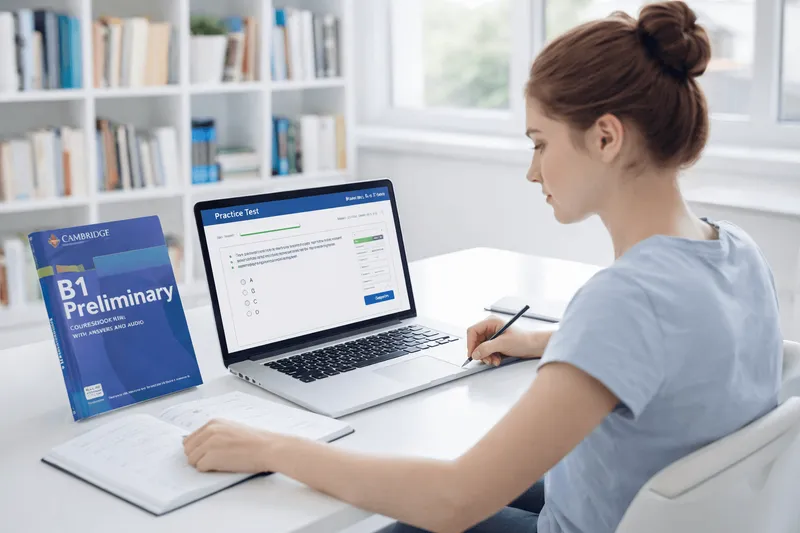
Start with the official format page so you know the shape of each paper and how long it runs. Then take the B1 Preliminary Practice Test without a timer and note which skills cost you the most marks.
Use that result to choose your focus. For weak reading, work through B1 Preliminary Reading and B1 Reading Skills. For listening, use B1 Preliminary Listening Comprehension. For writing, use B1 Preliminary Writing Skills, then reread your answers and fix errors. For language accuracy, try B1 Preliminary Grammar, B1 Phrasal Verbs and Prepositions and B1 Preliminary Vocabulary & Spelling.
Practise speaking aloud with a partner using B1 Preliminary Speaking Skills, since the real task is done in a pair. Keep a list of every question you miss and why. Near test day, repeat the full practice test under timed conditions and compare it with your first attempt.
B1 Preliminary Flashcards
Click to reveal the answer and prepare for your B1 Preliminary exam.
⏱️How long is the Reading paper?
The Reading paper lasts for 45 minutes and contains 6 parts.
START B1 PRELIMINARY TEST📝How many parts in Writing?
The Writing paper has 2 parts: an email and an article or story.
🔊What is the Listening format?
Listening takes about 30 minutes and includes 4 parts with 25 questions.
REVIEW B1 PRELIMINARY QUESTIONS🗣️Who attends the Speaking test?
Two candidates and two examiners are present during the Speaking test.
TRY B1 PRELIMINARY MOCK EXAM📊What is a passing score?
A score of 140-159 is required to pass the B1 Preliminary exam.
ACCESS B1 PRELIMINARY STUDY GUIDE🔄Does the B1 certificate expire?
No, the Cambridge English B1 Preliminary certificate is valid for life.
PRACTICE B1 PRELIMINARY TEST NOWB1 Preliminary Exam Study Guide
Our comprehensive study guide answers common questions about the B1 Preliminary test format, registration, and scoring. Use this information to plan your preparation effectively.
For the B1 Preliminary speaking test, practice describing photos for one minute without stopping. Focus on organizing your description: start with the general idea, then describe details (foreground, background), and speculate about what is happening.
B1 Preliminary Score Interpretation
Understanding your Cambridge English Scale score is essential for knowing your CEFR level.
| Score Range | Grade | CEFR Level | Outcome |
|---|---|---|---|
| 🥇 160 - 170 | Grade A | Level B2 | Distinction (Above Level) |
| 🥈 153 - 159 | Grade B | Level B1 | Merit (Pass) |
| 🥉 140 - 152 | Grade C | Level B1 | Pass |
| 📉 120 - 139 | Level A2 | Level A2 | A2 Certificate |
| ❌ 102 - 119 | Fail | Below A2 | No Certificate |
The B1 Preliminary exam uses the Cambridge English Scale. A score of 140 indicates you have met the B1 requirement. Scoring 160 or above demonstrates ability at Level B2.
The B1 Preliminary qualification is valid for life, making it a cost-effective investment for your education and career. Unlike other exams that expire after two years, you only pay once.

B1 Preliminary Test Day Checklist
- ✓Valid Photo ID (Passport/ID Card)
- ✓Confirmation of Entry document
- ✓Pencils (B or HB) and eraser
- ✓Blue or black pen (for Writing)
- ✓Water in clear plastic bottle
- ✓Arrive 30 minutes early
- ✓No electronic devices
- ✓Check venue location beforehand
Pass Your B1 Preliminary Exam
Get ready for exam day with our complete collection of practice tests, study guides, and flashcards. Start practicing now to achieve your best score.
B1: Pros and Cons
- +B1 exam preparation strengthens your knowledge across all domains
- +Passing the exam proves competency to employers and clients
- +Study materials and practice tests are widely available
- +Exam-based credentials are portable across states and employers
- +Clear exam objectives help focus your study plan effectively
- −Exam anxiety can affect performance — practice tests help reduce it
- −Registration fees are non-refundable if you miss your test date
- −Limited retake opportunities may apply with waiting periods
- −Exam content updates periodically — use current study materials
- −Testing center availability may require advance scheduling
Sample B1 Preliminary Practice Questions
Try these questions from our free B1 Preliminary practice tests. The correct answer and an explanation follow each question.
How long is the B1 Preliminary Speaking test for a pair of candidates?
- A. 5 minutes
- B. 10–12 minutes
- C. 15–17 minutes
- D. 20 minutes
Answer: C. 15–17 minutes
The B1 Preliminary Speaking test lasts approximately 10–12 minutes for a pair of candidates.
In the B1 Preliminary speaking test, what should you do if you don't understand the examiner's question?
- A. Politely ask them to repeat or clarify it
- B. Stay silent and wait
- C. Guess the answer
- D. Say 'I don't know' and stop
Answer: A. Politely ask them to repeat or clarify it
It is perfectly acceptable to politely ask the examiner to repeat or clarify a question.
What is the speaking test structure in the B1 Preliminary exam?
- A. Conversation with examiner, picture description and discussion, solution discussion, likes and dislikes discussion
- B. Monologue on a given topic, describing past events, debating pros and cons
- C. Group discussion, summary presentation, job interview role-play
- D. Reading aloud, describing personal experiences, answering hypothetical questions
Answer: A. Conversation with examiner, picture description and discussion, solution discussion, likes and dislikes discussion
The B1 Preliminary Speaking test is divided into four parts: a general conversation with the examiner, a collaborative task involving picture description and discussion, a problem-solving or solution discussion, and a final section discussing likes, dislikes, and personal experiences. This structure allows for a comprehensive assessment of interactive and descriptive speaking skills.
What should you avoid doing during the B1 Preliminary speaking test?
- A. Reading from a prepared script
- B. Using linking words
- C. Making eye contact with your partner
- D. Asking your partner's opinion
Answer: A. Reading from a prepared script
Reading a memorized script sounds unnatural and does not demonstrate real communicative ability.
Take the full B1 Preliminary practice test
If you want more targeted practice, the b1 preliminary test pdf page covers the same material with additional questions and explanations.
B1 Questions and Answers
Official Resources
- Cambridge English – B1 Preliminary is the exam board's official page for the qualification, covering the exam format, dates, and what each CEFR B1 level means.
- Cambridge English Qualifications lists every official Cambridge exam so you can confirm B1 Preliminary sits between A2 Key and B2 First on the CEFR scale.
Sources & last verified
- Cambridge University Press & Assessment — number of questions, time limit (official source). “4 parts / 25 questions” Verified Oct 24, 2026.
- Cambridge University Press & Assessment — validity, score release (official source). “Your Cambridge English certificate does not expire.” Verified Oct 25, 2026 · source checked Oct 25, 2026.
- Cambridge University Press & Assessment — delivery (official source). “digital or paper-based” Verified Oct 25, 2026 · source checked Oct 25, 2026.
How we verify: editorial & fact-checking policy. Report an error: contact us.
How this page was made: written with AI tools and published by Nathan Beja, founder of Practice Test Geeks, who is responsible for its content. Exam facts are checked against the official sources listed below. Not reviewed by a subject-matter expert. Editorial policy
Sources & references
Exam facts on this page (fees, format, dates, passing scores) are checked against these official sources; the date is our last check. Editorial policy
- cambridgeenglish.org — Score release, score validity, test delivery, exam format, time limit · verified Oct 2026